

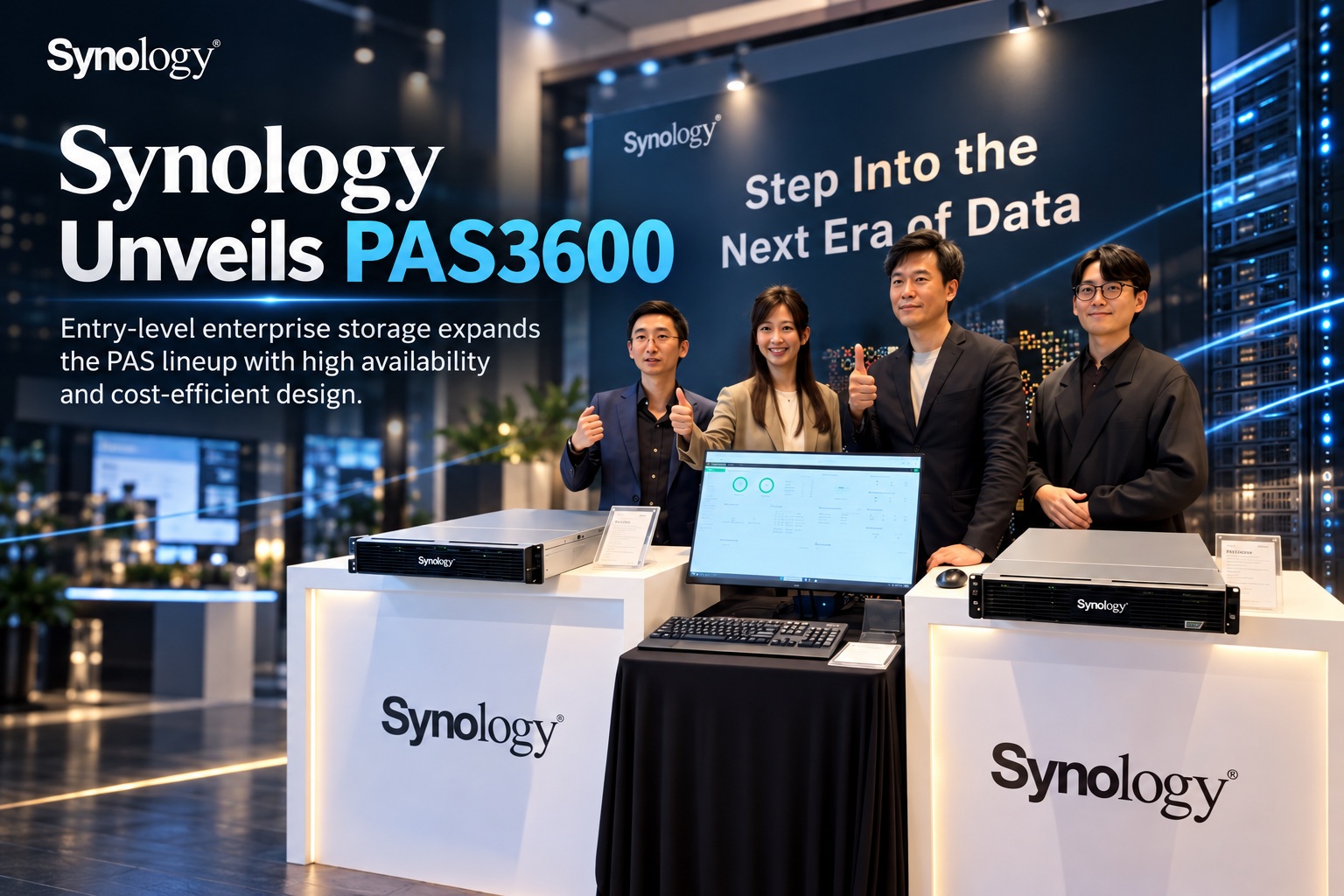
Synology has expanded its enterprise storage portfolio with the introduction of the PAS3600, a new entry-level model aimed primarily at small and medium-sized businesses that need enterprise-grade availability without stepping up to the significantly more performance-focused PAS7700.
The Taiwanese data solutions company unveiled the new system during its Annual Press Event 2026. While the PAS3600 retains several of the architectural features found in Synology's flagship PAS storage platform, it uses a more cost-efficient SATA-based design intended for general-purpose business workloads rather than the end-to-end NVMe performance offered by the PAS7700.
PAS3600 Brings Active-Active Architecture To A Lower Tier
One of the PAS3600's most important features is its active-active dual-controller architecture. Both controllers are designed to operate simultaneously, helping maintain storage availability if one controller encounters a problem.
This architecture is particularly valuable for businesses where storage downtime can quickly affect applications, virtual machines and employee access to important data. Instead of relying on a single controller and waiting for failover during a hardware problem, the dual-controller configuration provides greater redundancy as part of the system's standard design.
Synology is effectively bringing one of the key enterprise characteristics of the PAS7700 into a more accessible platform.
SATA Keeps Costs Lower Than The PAS7700
The biggest hardware difference between the PAS3600 and PAS7700 is the underlying storage interface. Synology's higher-end PAS7700 uses an end-to-end NVMe architecture designed for extremely demanding workloads, while the PAS3600 is built around SATA storage.
That naturally limits peak performance compared with the flagship system, but it also helps reduce the overall cost of deployment. For many organisations, extreme NVMe performance is unnecessary when the workload primarily involves file services, business applications, general virtualisation or other everyday enterprise storage requirements.
The PAS3600 therefore occupies a practical middle ground between traditional business NAS products and Synology's highest-performance enterprise storage systems.
12-Bay 2U Chassis With Expansion Support
The PAS3600 is housed inside a 12-bay 2U chassis, giving organisations a reasonable amount of storage density without requiring excessive rack space. Businesses that need additional capacity can connect a PAX212 expansion unit, increasing the system to a maximum of 24 drives.
This makes the platform more flexible for organisations expecting their storage requirements to grow over time. A company can begin with the base configuration and expand later rather than purchasing the maximum storage capacity immediately.
That scalability could make the PAS3600 particularly attractive to smaller enterprises that want a platform capable of growing alongside their operations.
Each Controller Supports Up To 256GB Of Memory
Synology has also provided substantial memory capacity for the new storage system. Each controller can be configured with up to 256GB of memory, providing enough headroom for demanding storage services and larger workloads.
Optional networking upgrades are also available, including 10GbE and 25GbE network interface cards. Organisations using Fibre Channel infrastructure can instead configure the system with 16G or 32G FC connectivity.
These options allow the PAS3600 to be adapted according to the existing data-centre environment rather than forcing every customer into the same networking configuration.
DSM Enterprise Keeps The Interface Familiar
On the software side, the PAS3600 runs DSM Enterprise, Synology's enterprise-focused operating environment. Importantly, the interface shares many similarities with the familiar DiskStation Manager software already used across the company's other storage products.
That familiarity is intentional. Businesses already using Synology systems should not need to completely relearn how to administer storage simply because they are moving to the PAS product family.
Reducing the learning curve can make enterprise deployment considerably easier, particularly for smaller IT teams that may already be managing several different infrastructure platforms.
Synology Has Yet To Confirm Malaysian Availability
Although the PAS3600 has now been officially revealed, Synology has not announced when the system will become available in Malaysia or how much it will cost locally.
Pricing will be particularly important because the product is being positioned as the entry-level member of the PAS family. The appeal of using SATA instead of end-to-end NVMe largely comes from creating a more cost-effective enterprise storage platform.
If positioned appropriately, the PAS3600 could provide Malaysian SMEs with an interesting path towards redundant enterprise storage without requiring investment in the significantly higher-performance PAS7700.
DP7400 Targets Dedicated Enterprise Backup
Synology also used the event to showcase the DP7400, another enterprise appliance but one designed specifically around backup rather than primary storage.
The DP7400 is part of the company's DP series and can monitor as many as 2,500 servers. It provides 140TB of raw storage capacity, making it suitable for organisations that need a centralised platform for protecting large numbers of workloads.
Connectivity includes two 10GbE LAN ports alongside a dedicated 1GbE management port, allowing backup traffic and administrative access to be handled separately.
ActiveProtect Manager Handles Physical, Virtual And SaaS Workloads
The DP7400 runs ActiveProtect Manager, giving organisations one platform for managing protection across different types of infrastructure. This includes physical systems, virtual environments and supported SaaS workloads.
That breadth is increasingly important because enterprise data no longer sits entirely inside traditional servers. A business may have on-premises infrastructure, virtual machines and cloud applications all operating simultaneously.
Using one backup management platform across those environments can simplify administration and provide IT teams with a clearer picture of whether critical workloads are actually protected.
Ransomware Protection Is Built Into The Backup Platform
Synology has also included security capabilities such as ransomware protection within the DP7400's backup environment. This has become increasingly important because attackers frequently target backups after compromising production systems.
A backup platform is only useful during a ransomware incident if the recovery data itself remains intact. Organisations therefore need mechanisms that prevent attackers from simply encrypting or deleting the backups alongside the original information.
Dedicated backup appliances such as the DP7400 are increasingly being designed around this assumption rather than treating cybersecurity as a completely separate concern.
SPU7200D Targets High-Performance NVMe Deployments
Synology also highlighted its SPU7200D series, a family of high-performance dual-port SSDs designed primarily for the company's higher-end PAS systems.
Unlike the SATA-focused PAS3600, these drives are intended to support end-to-end NVMe environments such as the PAS7700. Synology says the SSDs can deliver up to 140,000 4K write IOPS, with the design optimised specifically for low-latency enterprise workloads.
That makes them significantly more relevant to databases, transactional workloads and other environments where storage latency and sustained performance are critical.
Dual-Port SSDs Improve Enterprise Availability
The dual-port design is important in enterprise storage because it provides more than one path to the drive. If one controller or connection becomes unavailable, the second path can continue providing access.
This complements the active-active architecture used by the PAS platform. High availability depends not only on redundant controllers but also on ensuring storage devices themselves remain accessible through multiple paths.
Consumer SSDs rarely require this capability, but it becomes significantly more important in environments where downtime carries a direct business cost.
Built-In Security Supports Faster Data Sanitisation
The SPU7200D SSDs also support TCG Opal self-encrypting drive functionality, giving organisations hardware-level options for protecting stored information.
The drives support crypto erase and PSID-based processes for quickly and securely sanitising data. Rather than overwriting every block on a large SSD manually, cryptographic erasure can effectively destroy access to encrypted information by removing the keys required to decrypt it.
This can be particularly useful when drives are being retired, reassigned or replaced within environments that handle sensitive information.
Synology Is Building A Broader Enterprise Portfolio
Taken together, the announcements show Synology expanding well beyond the traditional NAS market it is best known for. The PAS3600 and PAS7700 address different tiers of primary enterprise storage, while the DP7400 concentrates on dedicated backup and the SPU7200D provides high-performance SSD technology for NVMe deployments.
This broader portfolio gives organisations more opportunities to build storage and data-protection infrastructure using products from the same ecosystem. That could simplify management for existing Synology customers that want to move into more demanding enterprise environments without completely changing vendors.
The challenge will be demonstrating that the platform can meet the availability, support and performance expectations enterprises already receive from established data-centre storage vendors.
PAS3600 Could Appeal Strongly To SMEs
The PAS3600 may ultimately be one of the more interesting products for smaller businesses because it avoids chasing specifications that many organisations simply do not need. End-to-end NVMe is impressive, but it can also be unnecessarily expensive for workloads that are perfectly comfortable on SATA storage.
By retaining active-active controllers, large memory capacity and enterprise connectivity options while using more affordable drives, Synology can target businesses that value reliability more than benchmark-leading performance.
That combination could make the PAS3600 particularly suitable for organisations wanting to move beyond conventional NAS storage without immediately entering the highest enterprise price category.
Final Thoughts
Synology's new PAS3600 fills an important gap in the company's enterprise storage lineup. It retains the active-active dual-controller architecture of the PAS7700 but replaces the flagship model's end-to-end NVMe design with a more affordable SATA-based configuration better suited to everyday enterprise workloads.
With a 12-bay 2U chassis, expansion to 24 drives, up to 256GB of memory per controller and optional 25GbE or 32G Fibre Channel connectivity, the PAS3600 still provides plenty of room for businesses to scale. DSM Enterprise should also make the transition relatively straightforward for organisations already familiar with Synology's software.
The accompanying DP7400 and SPU7200D announcements further show how aggressively Synology is expanding its enterprise ambitions, covering dedicated backup, ransomware protection and high-performance NVMe storage alongside general-purpose infrastructure.
For Malaysian businesses, the remaining questions are pricing and availability. If Synology can position the PAS3600 significantly below the PAS7700 while preserving its high-availability advantages, it could become a compelling enterprise storage option for SMEs that need resilience without paying for performance they may never actually use.











Comments 0