

Google Translate has been around for so long that many of us probably take it for granted now. Whether it is used for travelling, reading foreign-language websites, checking menu items, translating messages, or simply trying to understand a phrase in another language, it has become one of those everyday tools that quietly sits in the background of modern internet life.
This year marks a major milestone for the service. Google Translate officially launched on 28 April 2006, which means the platform has now reached its 20th anniversary. To celebrate that milestone, Google is introducing a new AI-powered feature that focuses on something translation apps have not always handled well: helping users pronounce words correctly.
The new feature is called pronunciation practice, and it is being rolled out to the Google Translate app on Android.
More Than Just Translating Words
For years, Google Translate has mainly been seen as a tool for converting text from one language to another. Over time, it became more capable, supporting voice input, camera translation, offline translation, conversation mode, and improved contextual understanding.
But learning a language is not only about knowing what a word means. Pronunciation matters too. You may know the correct word, but if you cannot say it clearly enough, the other person may still struggle to understand you.
That is where pronunciation practice comes in. Instead of only showing users the translated word or phrase, Google Translate now wants to help users say it properly. This makes the app feel less like a simple translation tool and more like a lightweight language-learning assistant.
How The Pronunciation Practice Feature Works
According to Google, pronunciation practice builds on previous Translate app features such as "ask" and "understand". Like those tools, the new feature uses AI to process user input and provide more helpful feedback.
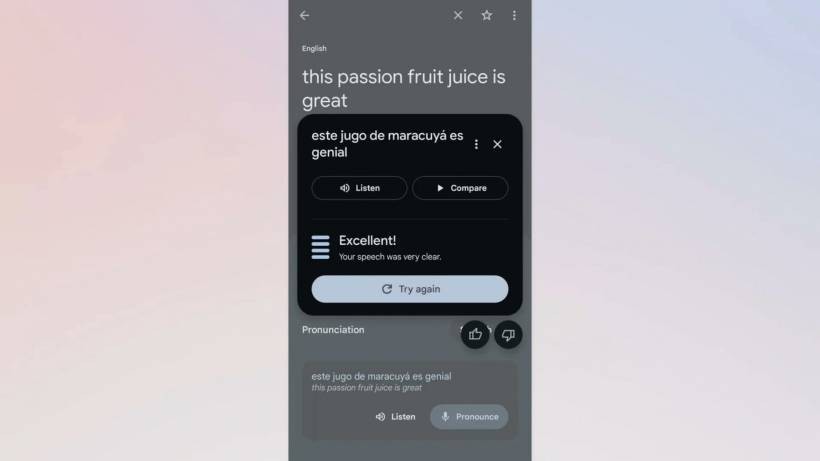
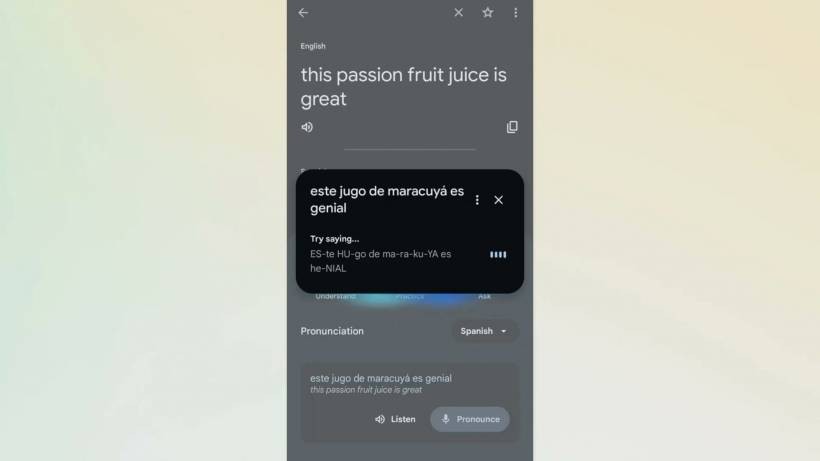
The process appears to be simple. When viewing a translation, users can tap a "practice" button. From there, the app provides two options: listen and pronounce.
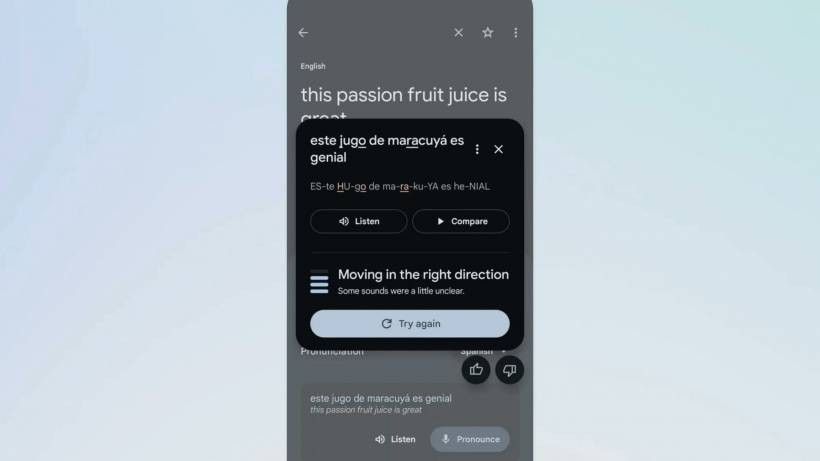
The listen option allows users to hear how the word or phrase should sound. The pronounce option is where the new practice feature becomes more useful. Once selected, the app shows the phonetic spelling of the word or phrase, giving users a clearer guide on how to produce the correct sounds.
After that, the user speaks into the app. Google Translate then listens, analyses the pronunciation, and gives feedback based on what it hears.
AI Feedback Could Make Practice More Practical
The most useful part of this feature is not just that it listens to your voice. It is the feedback that comes after.
Based on Google's demonstration, the tool can identify pronunciation mistakes and highlight areas where the user can improve. This is important because many language learners struggle to know what exactly they are getting wrong.
For example, someone may repeat a foreign word several times and still feel unsure whether the issue is the vowel sound, the stress, the rhythm, or the ending sound. A tool that can point out the problem more directly could make self-practice less frustrating.
There is also a "try again" option, allowing users to repeat the exercise until they are more comfortable. This makes sense because pronunciation usually improves through repetition. Having instant feedback inside a translation app could make that process more convenient, especially for casual learners.
Useful For Travellers And Everyday Learners
This feature could be especially helpful for people who are not formally studying a language but still need to say certain words correctly.
For travellers, it may help with basic phrases used in restaurants, transport, hotels, shops, or asking for directions. For students, it may support vocabulary practice. For workers dealing with international colleagues or customers, it could help with more confident communication.
It also lowers the barrier for users who feel shy about speaking in another language. Practicing with an app first can be less intimidating than trying to say the word directly to another person and hoping it comes out right.
Of course, this does not replace proper language learning, real conversations, or guidance from a teacher. But as a built-in tool inside Google Translate, it could be a practical improvement for everyday use.
The Rollout Is Still Very Limited
The catch is that not everyone can use the feature yet.
For now, Google is only rolling out pronunciation practice in two regions: the United States and India. The feature is also limited to Android at the moment, based on Google's announcement.
Language support is also narrow for now. Pronunciation practice currently supports only three languages: English, Spanish, and Hindi.
That selection is not random. Google says English to Spanish is the most common translation pair, while English to Hindi is also widely used. So, it makes sense that Google is starting with languages that have strong demand and large user bases.
Malaysians May Need To Wait Longer
For users in Malaysia and other regions, the feature may not appear immediately in the Google Translate app. At the moment, Google has not announced a wider rollout schedule, so it is unclear when pronunciation practice will become available globally.
This is a bit disappointing, especially because Google Translate is widely used in multilingual countries. In Malaysia, for example, many people move between English, Malay, Mandarin, Tamil, and other languages depending on context. A pronunciation practice feature could be useful for students, travellers, workers, and anyone trying to communicate more clearly across languages.
Still, limited rollouts are common with AI-powered features. Google may be testing accuracy, feedback quality, regional usage, and technical performance before expanding it further.
Final Thoughts
Google Translate's new pronunciation practice tool is a natural next step for the app. Translation alone helps users understand words, but pronunciation support helps them actually use those words more confidently in real conversations.
By using AI to listen, analyse, and provide feedback, Google Translate could become more useful for casual language learners and travellers who want quick, practical speaking guidance. The ability to listen, pronounce, receive corrections, and try again makes the feature feel simple but potentially powerful.
The only downside is availability. With the feature currently limited to Android users in the US and India, and only supporting English, Spanish, and Hindi, many users around the world will have to wait. Hopefully, Google expands the tool to more regions and languages in the future, because pronunciation is one area where translation apps can genuinely make everyday communication easier.











Comments 0