

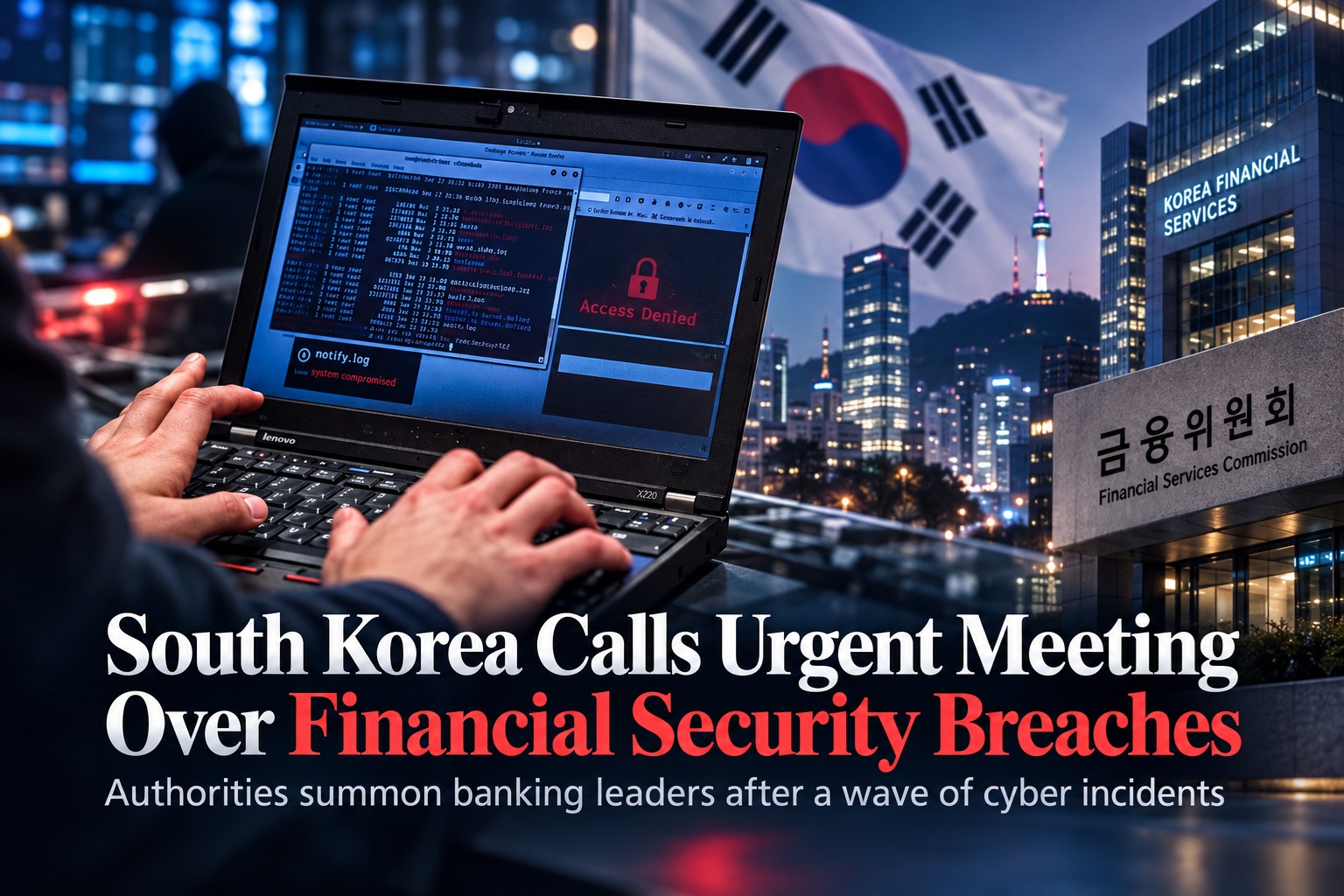
South Korean financial authorities have called an urgent meeting with senior leaders across the country's financial sector following a series of recent cybersecurity and data breach incidents. According to reports, heads of financial industry associations and chief executives from financial institutions, including organisations directly affected by security incidents, were summoned for discussions on 4 October. The move reflects growing concern over the resilience of South Korea's financial infrastructure as cyberattacks become more frequent and potentially more disruptive.
The meeting follows another emergency session held by the country's financial regulator with banks and other financial institutions a day earlier. That discussion was prompted by a series of data breaches, including a cyberattack involving Hana Bank. Authorities are now widening the conversation to include senior decision-makers across the industry rather than treating the incidents as isolated problems affecting individual organisations.
Financial Authorities Escalate Their Response
The decision to convene industry association leaders and company CEOs suggests that regulators want cybersecurity concerns addressed at the highest organisational level. Security incidents within financial institutions are no longer simply technical matters handled by internal IT departments. They can affect customer information, financial transactions, service availability and confidence in the wider banking and payment ecosystem.
Bringing executives directly into the discussion also places greater responsibility on company leadership to understand cyber risks and ensure appropriate controls are in place. In heavily regulated sectors such as finance, cybersecurity increasingly forms part of operational governance rather than being treated only as an infrastructure issue. Senior management therefore plays an important role in ensuring security investment, incident response and business continuity receive sufficient attention.
Recent Breaches Put Financial Sector Security Under Scrutiny
The emergency meetings come amid several reported security breaches affecting South Korean financial organisations. One of the incidents involved Hana Bank, which was reportedly targeted in a cyberattack. While the brief report did not provide detailed information about the nature or impact of that incident, its inclusion among the cases prompting regulatory action shows that authorities are taking the wider pattern seriously.
Multiple breaches occurring within a relatively short period can raise questions about whether organisations are facing similar weaknesses or attack methods. Regulators may therefore be interested not only in how individual companies responded, but also whether broader lessons can be shared across the industry. A coordinated response can help prevent the same weaknesses from being exploited repeatedly at different institutions.
Why Cybersecurity Is Particularly Important For Financial Institutions
Financial organisations are attractive targets because they hold highly valuable information and operate systems that customers depend on every day. Banks and other financial service providers manage personal information, account data, transaction records and access to payment infrastructure. Even when attackers cannot directly steal money, compromising these systems can create opportunities for fraud, identity theft or further intrusion.
Service disruption can be equally damaging. Customers increasingly rely on mobile banking, online transactions and digital payment platforms, meaning a successful attack can affect large numbers of people within a short period. This makes resilience and rapid recovery just as important as preventing an intrusion in the first place.
Data Breaches Can Have Long-Term Consequences
A data breach does not necessarily end once the initial intrusion has been contained. Personal or financial information obtained by attackers may continue circulating or be used in later fraud and phishing campaigns. Criminals can combine information from multiple breaches to create more convincing impersonation attempts against customers.
For financial institutions, this means incident response must include more than simply restoring affected systems. Organisations also need to understand what information may have been accessed, how the breach occurred and whether customers need additional protection. Clear communication can become particularly important when affected individuals need to monitor accounts or change credentials.
Authorities May Focus On Incident Response And Preparedness
Although full details of the 4 October meeting agenda were not provided, the recent incidents are likely to place attention on how financial organisations detect, contain and recover from cyberattacks. An effective response requires technical controls, clear internal escalation procedures and coordination between security teams, management and regulators. The speed at which an organisation identifies an intrusion can significantly influence its eventual impact.
Authorities may also want greater consistency across the sector when reporting incidents. Prompt reporting makes it easier for regulators to understand whether separate attacks may be connected and to warn other organisations about emerging threats. Sharing indicators of compromise and attack techniques can also help institutions strengthen their defences before similar attacks reach them.
Third-Party And Supply Chain Risks Are Another Concern
Modern financial services depend heavily on interconnected technology environments. Banks and other institutions commonly rely on cloud platforms, payment processors, software vendors, telecommunications providers and other third parties. A weakness outside the institution itself can therefore sometimes become an entry point into sensitive systems.
This makes cybersecurity a shared responsibility across the wider financial ecosystem. Strong internal controls may not be sufficient if important suppliers or connected services have weaker protection. Industry-wide meetings can provide an opportunity to discuss how organisations assess vendors, manage access and respond when a security incident originates through an external partner.
Customers Also Have A Role In Reducing Risk
While financial institutions carry primary responsibility for securing their systems, customers can also reduce their exposure to attacks that follow major breaches. Criminals frequently exploit public awareness of security incidents by sending fake security alerts, password-reset messages or fraudulent calls claiming to be from banks. These secondary scams can sometimes be more visible to customers than the original cyberattack.
Customers should therefore be cautious with unexpected messages requesting login credentials, one-time passwords or payment information. Banking applications and official websites should be accessed directly rather than through unfamiliar links received through email or messaging platforms. Security incidents often create confusion, and attackers may deliberately take advantage of that uncertainty.
Cybersecurity Is Becoming A Board-Level Issue
The involvement of CEOs in the upcoming meeting reflects a wider change in how organisations view cyber risk. A serious breach can have regulatory, financial and reputational consequences that extend far beyond the technology department. Executives therefore need to understand whether their organisations are adequately prepared for incidents and whether recovery plans have been properly tested.
For financial companies, this includes ensuring critical services can continue even during a cyberattack. Business continuity, backup systems, employee training and crisis communication all form part of effective cyber resilience. Regulators increasingly expect organisations to demonstrate that they can both prevent attacks and maintain operations when prevention fails.
Final Thoughts
South Korea's decision to urgently bring financial industry leaders together shows that the recent series of breaches is being treated as a broader sector-wide concern. With another emergency meeting already held between the regulator, banks and other institutions following incidents including the Hana Bank cyberattack, authorities appear focused on ensuring that weaknesses are addressed before further attacks occur.
The financial sector remains one of the most attractive targets for cybercriminals because of the valuable information and essential services it controls. As banking and payments become increasingly digital, cybersecurity is becoming inseparable from financial stability and customer trust. The challenge for South Korean institutions will be to turn the lessons from recent incidents into stronger prevention, faster detection and more resilient recovery across the entire industry.











Comments 0