

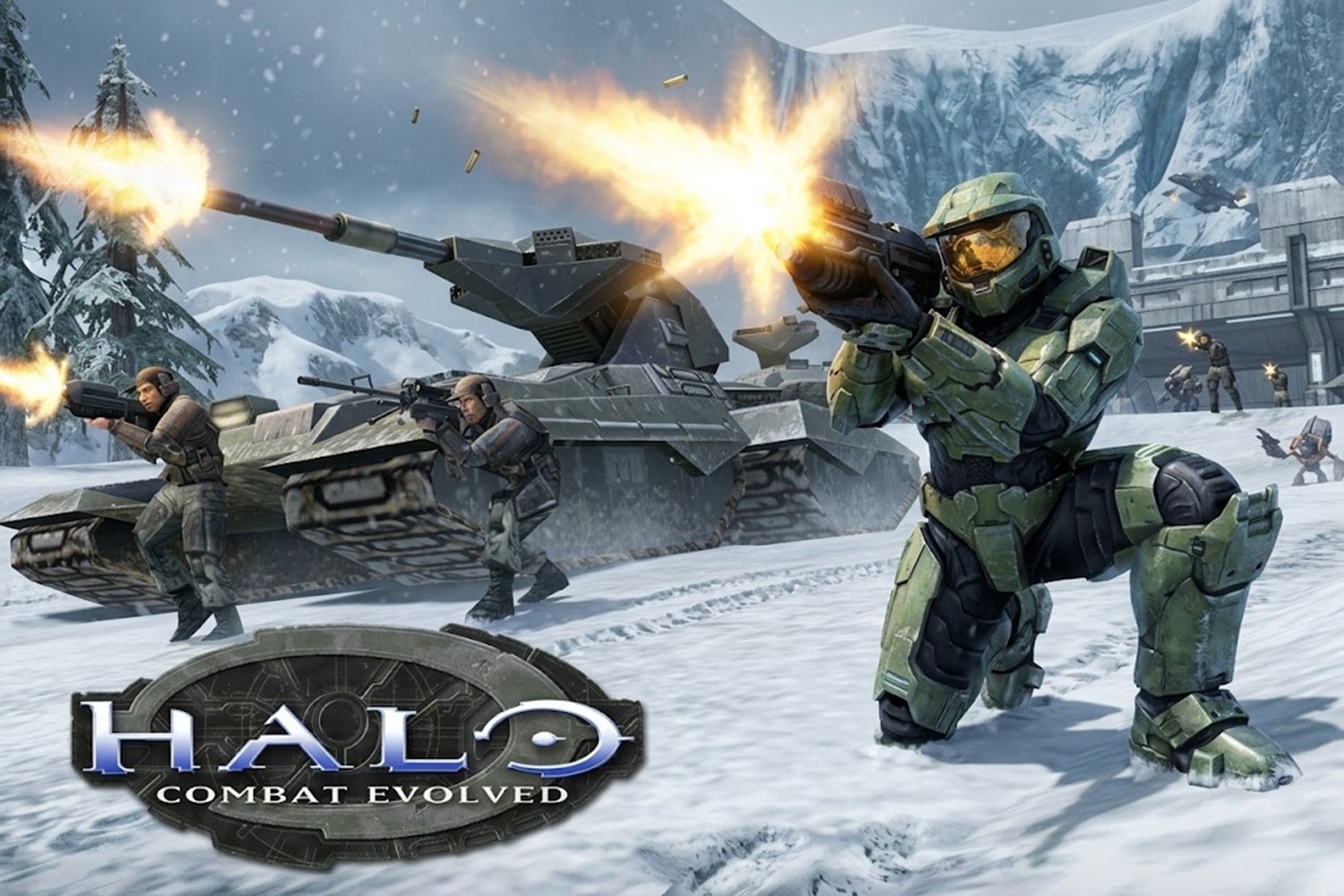
Halo: Combat Evolved is one of the defining first-person shooters of the early 2000s, combining cinematic science-fiction storytelling, intelligent enemy encounters, large outdoor battlefields, vehicle combat, and a weapon sandbox that encourages constant experimentation. Released in 2001, the game introduced players to Master Chief, Cortana, the Covenant, the UNSC, and the mysterious ring-shaped installation known simply as Halo. Rather than relying entirely on narrow corridors and scripted shooting galleries, Halo frequently opens into enormous spaces where players can approach battles from different directions, commandeer vehicles, fight alongside Marines, or improvise with whatever weapons happen to be available. Its influence can still be felt throughout modern first-person shooters.
The campaign begins aboard the UNSC Pillar of Autumn as humanity's war against the Covenant reaches another desperate confrontation. Master Chief is awakened from cryogenic sleep and quickly thrown into battle as Covenant forces board the ship, forcing survivors to evacuate toward an enormous artificial ringworld nearby. What initially appears to be a possible refuge soon reveals ancient structures, hidden technology, and secrets far more dangerous than either side understands. As the story develops, the discovery of the Flood transforms the conflict from a military struggle into a fight for survival with consequences extending far beyond the Halo installation itself.
Now playable online through Lemon Web Games, Halo: Combat Evolved brings Master Chief's legendary campaign directly into the web browser, allowing players to experience its mixture of gunplay, grenades, melee combat, vehicles, exploration, and large-scale science-fiction battles without depending on the original gaming hardware. Players can fight through the Pillar of Autumn, explore the massive Halo ring, battle Covenant forces, drive iconic vehicles, rescue Marines, and eventually confront the horrifying Flood. The browser-playable version provides an accessible way to revisit one of gaming's most influential shooters while preserving the campaign structure and memorable combat encounters that made the original so important. Whether returning after many years or discovering Halo for the first time, the adventure remains remarkably engaging.
Master Chief Becomes Humanity's Most Important Soldier
Master Chief, formally known as John-117, is introduced as a heavily augmented Spartan super-soldier created for missions ordinary troops could never survive. His green Mjolnir armor, reflective visor, enormous physical strength, and calm personality immediately establish him as something very different from the Marines fighting alongside him. Yet the game avoids turning him into an endlessly talkative action hero. Master Chief usually speaks only when necessary, allowing players to project themselves into the role while still giving the character a recognizable personality.
The Spartan's strength is reflected directly through gameplay. Master Chief can carry heavy weapons, absorb significant punishment through his energy shielding, flip overturned vehicles, and engage Covenant soldiers at close range without feeling fragile. At the same time, careless play can still lead to a quick death, particularly against stronger Elites or concentrated enemy fire. The balance makes the player feel powerful without removing danger.
Master Chief's relationship with Cortana provides much of the campaign's personality. She serves as an artificial intelligence companion who communicates through the armor, analyzes technology, provides mission information, and frequently understands situations before everyone else does. Her intelligence complements Master Chief's direct approach, creating a partnership that becomes central to the story. Many of the most important discoveries about Halo come through their conversations.
Cortana Is More Than a Mission Guide
Cortana could easily have functioned as a simple voice explaining objectives, but Halo gives her a much larger role. She interprets Covenant communications, interfaces with alien systems, analyzes Forerunner technology, and gradually pieces together the actual purpose of the Halo installation. Her curiosity often pushes the story forward. Players frequently understand the importance of an environment through what Cortana notices.
Her personality also provides contrast with Master Chief. Cortana is more expressive, sarcastic, and conversational, while Chief remains restrained and focused. This dynamic gives story scenes energy without requiring lengthy cinematic interruptions. Their relationship develops naturally as they survive increasingly dangerous situations together.
Cortana's role becomes especially important once the true nature of Halo begins to emerge. Information contained within the ring's systems reveals that the installation was never created as an ordinary weapon or fortress. Her understanding of that information eventually changes the campaign's entire objective. The player realizes that simply defeating the Covenant is no longer enough.
The Covenant Provide Intelligent and Varied Enemies
The Covenant are far more interesting than an army of identical soldiers. Their forces combine several alien species with different weapons, behaviors, strengths, and tactical roles. Grunts are small infantry units that can attack in groups but often panic when their leadership falls. Jackals use energy shields to block incoming fire, forcing players to target exposed areas or use explosives.
Elites provide the Covenant's strongest common infantry presence. Their rechargeable energy shields allow them to survive far more punishment than ordinary enemies, while their speed and aggressive movement make them dangerous at almost any distance. Some use plasma rifles, others carry Needlers or energy swords, and higher-ranking versions can withstand considerable damage. Fighting an Elite often becomes a small tactical duel within a larger encounter.
Hunters represent an entirely different threat. These enormous armored soldiers carry powerful fuel-rod weapons and can absorb tremendous punishment from the front. Their armor has vulnerable sections that reward careful positioning and accurate fire. Encountering a pair of Hunters can completely change the pace of a battle.
This enemy variety is one reason Halo's encounters remain enjoyable after repeated playthroughs. A group containing Grunts, Jackals, and Elites behaves differently from one dominated by Hunters or cloaked enemies. Players constantly need to prioritize threats and choose weapons accordingly. The Covenant feels like a functioning military force rather than a collection of interchangeable targets.
The Two-Weapon Limit Changes How Players Think
One of Halo's most influential mechanics is its restriction allowing Master Chief to carry only two firearms at a time. Earlier shooters often allowed protagonists to carry enormous arsenals simultaneously, giving players instant access to every weapon collected during the campaign. Halo forces a different decision: which two weapons are most useful right now? That simple restriction changes the entire rhythm of combat.
Players constantly encounter dropped Covenant weapons and UNSC equipment during battles. Picking up something new usually means abandoning another weapon, creating small strategic decisions throughout every mission. A sniper rifle may be excellent for long-range combat but less useful once the player enters a confined structure. A shotgun becomes extremely valuable against the Flood but may provide little help against distant Covenant positions.
The system also encourages experimentation. Players cannot simply find one favorite weapon and ignore everything else indefinitely because ammunition may eventually run out. Battlefield conditions frequently force another choice. This makes the weapon sandbox feel dynamic rather than static.
UNSC Weapons Provide Familiar Firepower
Human weapons offer a relatively conventional foundation for the combat system. The assault rifle provides rapid automatic fire and works particularly well against groups of weaker enemies at close range. The pistol, despite its simple appearance, can be surprisingly powerful in the hands of an accurate player. Its zoom capability and precision make it useful across many different encounters.
The shotgun delivers devastating close-range damage and becomes especially valuable later in the campaign. Its limited range means players need to approach threats carefully, but few ordinary enemies can withstand a well-placed blast. Against the Flood, it becomes one of the most useful tools available. The weapon perfectly complements the chaotic nature of those encounters.
The sniper rifle dominates long-distance engagements. Its powerful scope and high damage allow skilled players to eliminate dangerous Covenant targets before approaching a position. Ammunition is limited enough that every shot matters. Missing repeatedly can leave the player without one of the strongest tactical advantages in the game.
Rocket launchers provide the opposite style of precision. Their explosive power can destroy groups of enemies and vehicles quickly, but careless use at close range can be disastrous. Carrying one usually means sacrificing a more flexible weapon. This reinforces the constant decision-making created by the two-weapon system.
Covenant Weapons Behave Very Differently
Alien weapons introduce mechanics that distinguish them immediately from UNSC equipment. Plasma pistols and plasma rifles use rechargeable energy rather than conventional ammunition magazines. Once their power supply is depleted, the weapon must be discarded rather than reloaded. This encourages players to treat Covenant equipment differently.
The plasma pistol becomes particularly useful because its charged shot can rapidly remove enemy energy shields. A common tactic is to strip an Elite's shield with plasma before switching to a ballistic weapon for the finishing shot. This creates weapon combinations that reward understanding rather than raw firepower. The system encourages players to think about how shields and health interact.
The Needler is perhaps the most visually distinctive Covenant weapon. Its crystalline projectiles track enemies and embed themselves before detonating if enough needles accumulate in one target. Watching a successful burst trigger a large explosion remains extremely satisfying. The weapon works differently enough from ordinary firearms to feel genuinely alien.
Other Covenant weapons reinforce the same design philosophy. Instead of simply giving alien guns different appearances, Halo often gives them distinct behaviors and tactical purposes. Players need to understand those differences to use the battlefield effectively. This makes collecting enemy weapons much more interesting.
Energy Shields Redefine Health Management
Master Chief's rechargeable energy shield fundamentally changes the pacing of combat. The shield absorbs damage before the player's underlying health is affected and begins recharging automatically after several seconds without taking another hit. This encourages players to move in and out of danger rather than permanently losing resources after every mistake. Retreating briefly can transform a nearly defeated Chief back into a combat-ready soldier.
The mechanic creates a natural rhythm within firefights. Players can push aggressively until the shield warning begins, find cover, wait for the recharge, and re-enter the battle from another angle. Remaining exposed after the shield collapses is extremely dangerous because underlying health is limited. Knowing when to disengage becomes an important survival skill.
Enemies such as Elites use similar shields, making the mechanic part of the world rather than something unique to the player. Watching an Elite retreat after losing its protection creates another tactical opportunity. Players can pressure the enemy before its shield returns or reposition while both sides recover. This symmetry makes encounters more interesting.
Grenades Become Part of Every Firefight
Grenades are available alongside firearms rather than occupying a weapon slot. Players can therefore throw explosives without abandoning the gun currently being used, making grenades a constant part of combat. Fragmentation grenades behave in relatively familiar ways, bouncing across environments before exploding. They are especially useful against groups or enemies hiding behind cover.
Plasma grenades provide a more distinctive option. These Covenant explosives can stick directly to enemies or vehicles, creating some of Halo's most memorable combat moments. Successfully attaching one to an Elite creates immediate panic as the doomed enemy attempts to move away before the explosion. A well-placed throw can eliminate even dangerous opponents efficiently.
Grenades also interact with the environment in unpredictable ways. Explosions can send weapons, bodies, and vehicles flying, occasionally creating chain reactions. Players learn to recognize areas where a single grenade can cause disproportionate destruction. The physics make every throw slightly more dynamic.
Melee Combat Rewards Aggressive Positioning
Master Chief can strike enemies directly with whatever weapon he is holding, providing a powerful close-range option that consumes no ammunition. Melee attacks are especially effective against weaker enemies or opponents whose shields have already been removed. They also allow players to finish encounters quickly without wasting valuable ammunition. Timing remains important because approaching a dangerous enemy exposes the player to additional risk.
Attacking from behind can deliver devastating damage against many enemies. This makes stealthy positioning useful even though Halo is not primarily a stealth game. A carefully planned approach can remove a powerful target before the larger firefight begins. The mechanic rewards awareness of enemy orientation.
Melee also contributes to Halo's physical feel. Master Chief does not simply float around firing weapons; he interacts directly with the battlefield. Punching a Grunt away or striking an Elite at close range makes combat feel immediate. Combined with grenades and gunfire, it creates a flexible three-part combat system.
Large Outdoor Levels Make Halo Feel Different
One of Halo's most important achievements is its ability to move naturally between tight interior corridors and enormous outdoor environments. After escaping the Pillar of Autumn, players arrive on the surface of Halo and suddenly encounter broad valleys, cliffs, rivers, alien structures, and open skies. The transition is dramatic. The world immediately feels much larger than a conventional shooter level.
These outdoor spaces create tactical freedom. Players can attack enemy positions from different directions, use vehicles, fight at long range, or approach through terrain that provides additional cover. Encounters feel less like scripted rooms and more like battlefields. The player often decides how quickly or cautiously to proceed.
The artificial ringworld itself becomes one of the campaign's most memorable characters. Looking upward reveals the surface of Halo curving into the sky and continuing across the horizon. This visual constantly reminds players that they are standing on something enormous and unnatural. The environment creates a sense of mystery before the story explains anything about its origins.
The Warthog Defines Halo's Vehicle Combat
The Warthog is perhaps the most recognizable vehicle in Halo. This military jeep combines fast movement with a rear-mounted machine gun, allowing one character to drive while another operates the weapon. During the campaign, Marines can climb aboard and provide fire while Master Chief handles the driving. This creates large-scale encounters that feel very different from ordinary infantry combat.
The vehicle's physics are intentionally responsive rather than strictly realistic. Players can launch from hills, skid around corners, flip the Warthog, and recover from situations that would destroy an ordinary vehicle. This makes driving energetic and occasionally chaotic. Learning how the vehicle handles becomes a skill of its own.
The Warthog also turns level traversal into gameplay rather than simply transportation. Open environments contain enemy patrols, Covenant positions, ramps, and natural obstacles that make the journey itself interesting. A long drive can include several firefights and improvised stunts. The vehicle becomes part of the combat sandbox.
The Ghost Provides Fast Covenant Mobility
The Ghost offers a completely different driving experience. This small Covenant hovercraft moves quickly across open terrain and comes equipped with plasma weapons. Its low profile and responsive steering make it useful for rapidly attacking infantry positions. Players can steal Ghosts from Covenant forces and turn their own equipment against them.
Because the Ghost floats above the ground, its movement feels smoother than the Warthog across uneven terrain. It can strafe while firing, making it particularly effective when circling enemy positions. The vehicle sacrifices durability for agility. Staying mobile becomes essential.
Stealing enemy vehicles also reinforces the improvisational nature of Halo's combat. Players do not need to rely exclusively on equipment placed specifically for them. If an enemy arrives with something useful, it can often become the player's advantage moments later. The battlefield constantly provides new possibilities.
The Scorpion Tank Delivers Heavy Firepower
The Scorpion provides the opposite experience from the Ghost. It is slow, heavily armored, and equipped with an extremely powerful main cannon capable of destroying vehicles and groups of enemies from long range. Taking control of one immediately changes the balance of an outdoor battle. Enemies that previously required careful positioning can suddenly be eliminated with one well-placed shell.
The tank still needs protection from certain threats, particularly enemies attacking from awkward angles or powerful Covenant vehicles. Its size and relatively slow movement make navigation more deliberate. Players cannot simply drive anywhere without considering terrain. This prevents the vehicle from removing all challenge.
Marines can also ride alongside the tank, creating another sense of combined-arms warfare. The player is no longer fighting alone but moving with surviving UNSC forces through hostile territory. These moments make the campaign feel like part of a larger war. Vehicle encounters contribute enormously to Halo's scale.
The Banshee Takes Combat into the Air
The Banshee introduces aerial vehicle combat, giving players the ability to fly above terrain and attack enemies from the sky. Its plasma weapons provide useful offensive capability, while flight allows access to positions impossible to reach from the ground. Taking control of a Banshee can completely transform how a familiar battlefield is approached. The world suddenly becomes much more vertical.
Flying is relatively accessible, fitting the game's broader arcade-oriented vehicle design. Players do not need to manage complicated aircraft systems before becoming effective. Instead, the challenge comes from avoiding incoming fire while lining up attacks. The vehicle feels immediately useful.
Aerial movement also emphasizes the scale of Halo's environments. Areas that seemed enormous while travelling on foot can be crossed much more quickly from above. Mountains, structures, and valleys become part of one connected space. The Banshee reinforces the impression that Halo is a genuine place rather than a sequence of disconnected levels.
Marines Make Battles Feel Larger
UNSC Marines frequently fight alongside Master Chief during the campaign. They are not merely decorative background characters; they shoot enemies, throw grenades, board vehicles, and react to the surrounding battle. Their presence makes encounters feel like military operations rather than one-person missions. Master Chief may be exceptional, but humanity's forces are still fighting around him.
Marines also provide personality through combat dialogue. They react to Chief's arrival, comment on dangerous situations, and celebrate successful engagements. Hearing surviving soldiers cheer after a difficult battle adds atmosphere. Their responses help make Master Chief's reputation feel real within the world.
Keeping Marines alive can sometimes provide practical advantages as well. A surviving soldier operating the Warthog turret can eliminate enemies while the player focuses on driving. Groups of Marines can help distract Covenant forces during larger firefights. Protecting them becomes worthwhile even when the mission does not explicitly require it.
The Silent Cartographer Demonstrates Halo's Open Combat Design
The Silent Cartographer is one of the campaign's most memorable missions because it showcases many of Halo's strengths at once. Master Chief arrives on a tropical island alongside Marines before beginning a search for a facility containing important information about the ring. The environment provides beaches, interior structures, vehicles, enemy positions, and multiple routes. Players can approach several sections with considerable freedom.
The opening beach assault immediately combines infantry combat with vehicles and allied forces. Covenant defenders occupy several positions, forcing players to decide which threats should be addressed first. Once the initial area is cleared, the island becomes something to explore rather than simply a corridor to follow. The mission gives the player room to breathe.
Later portions move underground into Forerunner structures, creating a dramatic contrast with the bright exterior. The player transitions from broad outdoor combat into mysterious alien architecture. This mixture became one of Halo's defining level-design patterns. The Silent Cartographer remains a strong example of why the campaign became so memorable.
Forerunner Architecture Creates Mystery
The ancient structures scattered across Halo look completely different from both human and Covenant technology. Massive metallic corridors, geometric architecture, enormous chambers, and unexplained machinery create the impression of a civilization far beyond anything currently occupying the ring. The game initially provides very little explanation. Players are encouraged to wonder who built these places and why.
The scale of Forerunner structures is especially important. Doorways and rooms frequently feel much larger than necessary for ordinary human use. This creates a sense that the installation was designed according to priorities the player does not yet understand. Even empty spaces can feel intimidating.
Cortana gradually reveals pieces of information, but the campaign wisely preserves mystery for a long time. The player spends hours exploring Forerunner technology before understanding its true purpose. This slow discovery strengthens the eventual revelation. Halo's science-fiction atmosphere depends heavily on what remains unexplained.
The Flood Completely Changes the Campaign
The arrival of the Flood marks one of the most dramatic shifts in Halo: Combat Evolved. Up to that point, players understand the basic conflict as humanity fighting the Covenant while both sides explore an ancient ringworld. The Flood introduces a biological threat capable of infecting living creatures and turning them into aggressive combat forms. Suddenly, the Covenant is no longer the only enemy.
The first encounters are deliberately unsettling. Environmental clues suggest that something terrible happened before the player fully understands what is responsible. Abandoned equipment, frightened Covenant forces, and unusual recordings gradually build tension. When the Flood finally attacks in force, the pace changes dramatically.
Combat against the Flood requires different tactics. They often attack in large numbers and close distance aggressively, making weapons such as the shotgun particularly valuable. Enemies that appear defeated may sometimes continue fighting. The predictable military structure of Covenant encounters gives way to chaos.
This change is one of the main reasons Halo's campaign remains so memorable. The player has already become comfortable fighting Covenant forces when the game introduces an enemy operating according to completely different rules. What seemed like a conventional military science-fiction story suddenly becomes something closer to survival horror. The entire purpose of the mission changes.
343 Guilty Spark Reveals Halo's True Purpose
The artificial intelligence known as 343 Guilty Spark introduces another major turning point. Initially, the floating monitor appears helpful and knowledgeable about the installation. It refers to Master Chief in strange ways and assumes he understands procedures that remain completely unfamiliar to both Chief and the player. The character immediately raises new questions about Halo's history.
Guilty Spark explains that the Flood has escaped containment and that the ring's systems must be activated. What initially sounds like a solution gradually reveals something far more terrifying. Halo was not built simply to destroy the Flood directly. Its purpose involves eliminating the conditions that allow the parasite to spread.
Cortana ultimately recognizes the implications before Master Chief activates the installation. This creates one of the campaign's most important moments. The objective suddenly shifts from using Halo to preventing anyone from firing it. Humanity and the Covenant are no longer the only sides of the conflict.
Multiple Enemy Factions Create Chaotic Battles
Once the Flood enters the campaign, players can encounter situations where Covenant and Flood forces are already fighting each other. This creates opportunities to observe, wait, or intervene strategically. Instead of immediately attacking everything, the player can allow both groups to weaken one another first. These three-way battles make environments feel dynamic.
Sentinels controlled by Forerunner systems introduce another faction. Their energy weapons are effective against the Flood but can eventually become hostile to Master Chief as objectives change. Encounters can therefore contain several groups with different priorities. Understanding who is currently fighting whom becomes important.
These battles showcase Halo's combat sandbox at its best. The same encounter can unfold differently depending on where the player moves and which faction receives attention first. Explosions, dropped weapons, vehicles, and grenades create further unpredictability. The world appears to operate beyond the player's immediate actions.
The Library Pushes Survival to the Limit
The Library is one of the campaign's most intense and controversial missions. Master Chief follows 343 Guilty Spark through an enormous Forerunner facility while waves of Flood continually attack. The level places heavy emphasis on endurance and close-range combat rather than the broad exploration found in earlier missions. Players need to manage ammunition carefully while staying mobile.
The shotgun becomes particularly valuable here because many Flood forms attempt to close the distance rapidly. Automatic weapons can help control groups, while grenades provide temporary relief when enemies become overwhelming. Weapon availability constantly influences survival. The two-weapon limitation feels especially important.
The repeated architecture and sustained enemy pressure make the mission intentionally exhausting. Some players appreciate the relentless survival challenge, while others remember it as one of the campaign's most frustrating sections. Regardless of opinion, The Library reinforces how dramatically the Flood changes Halo's tone. The player is far removed from the open beaches and valleys of earlier missions.
Returning to Familiar Locations Changes Their Meaning
Later missions revisit environments encountered earlier in the campaign, but circumstances have changed dramatically. Covenant positions may now be overwhelmed by the Flood, familiar corridors contain different enemies, and locations that once felt mysterious become associated with Halo's terrifying purpose. This reuse of space reinforces the sense that the world has changed because of events the player helped trigger. Familiarity becomes unsettling.
Revisiting earlier environments also allows players to apply new knowledge. A location that once seemed like a simple alien structure now has additional meaning after learning about the Forerunners and Flood containment. The architecture has not changed, but the player's understanding has. This gives returning areas stronger narrative context.
Combat changes as well. Instead of fighting one organized enemy faction, players may encounter Covenant, Flood, and Sentinels simultaneously. The same physical space produces completely different tactical situations. The later campaign becomes increasingly chaotic.
The Final Escape Is Pure Halo
The campaign ends with one of its most memorable sequences: a desperate Warthog escape through the collapsing Pillar of Autumn. Rather than finishing with a conventional boss fight, the game asks players to drive through exploding corridors and collapsing structures while racing against time. The sequence brings one of Halo's most recognizable vehicles back into focus. Driving skill becomes just as important as gunplay.
The route includes jumps, narrow passages, dangerous gaps, and enormous explosions occurring around the vehicle. Crashes cost valuable seconds, while maintaining momentum becomes essential. The chaotic vehicle physics make every attempt slightly unpredictable. Successful navigation produces an enormous sense of relief.
This finale works because it reflects the variety that defined the entire campaign. Halo was never simply about shooting enemies in corridors. Vehicles, large environments, physics, and improvisation were present from the beginning. Ending with a frantic driving sequence feels completely appropriate.
The Soundtrack Gives Halo Its Epic Identity
Martin O'Donnell and Michael Salvatori's soundtrack is one of the most recognizable aspects of Halo. The famous opening chant immediately creates a sense of ancient mystery before the player understands anything about the ringworld. Orchestral themes, percussion, electronic elements, and ambient compositions change according to the environment and intensity of the action. Music frequently elevates ordinary gameplay into something cinematic.
The soundtrack knows when not to dominate as well. Quiet exploration may feature subtle ambience rather than constant dramatic music. This allows Forerunner structures and outdoor landscapes to develop their own atmosphere. When a major theme eventually begins, the contrast makes it more powerful.
Combat music frequently reacts to encounters, increasing intensity during dangerous situations. This creates the impression of a dynamic score accompanying the player's actions. Several tracks became inseparable from the identity of the series. Even players who have not experienced the original game often recognize its musical themes.
Artificial Intelligence Makes Battles Feel Reactive
Halo's enemies gained considerable attention because of the way they respond during combat. Elites move between cover, Grunts panic when their leaders fall, and different units react to grenades or player positioning. These behaviors make opponents feel less like stationary targets. The player is constantly responding to enemies that appear capable of reacting in return.
Difficulty settings further change these encounters. On higher difficulties, enemies become more accurate, aggressive, and dangerous rather than simply absorbing vastly larger amounts of damage. Legendary difficulty in particular turns familiar battles into demanding tactical challenges. Players need to understand weapons and enemy behaviors thoroughly.
Friendly AI also contributes to the battle atmosphere. Marines follow the player, operate vehicle weapons, and engage enemies independently. Their effectiveness varies, but their presence creates the sense of fighting alongside an army. Large encounters feel much more alive.
Halo Rewards Improvisation
Perhaps the greatest strength of Combat Evolved is how often players need to improvise. Ammunition runs out, favorite weapons disappear, vehicles become damaged, Marines are lost, and enemy reinforcements arrive unexpectedly. The battlefield continually forces players to reconsider their plan. Success comes from using whatever remains available.
A player might begin an encounter with a sniper rifle before switching to a Covenant plasma weapon after exhausting ammunition. A nearby Ghost could then provide an opportunity to attack another position from a completely different direction. Grenades scattered around the battlefield might become the solution to a Hunter pair. These changes happen naturally.
This improvisational quality gives encounters replay value. Even when the level layout is familiar, weapon drops and combat decisions can create another experience. The game provides systems rather than one scripted solution. That design philosophy became one of Halo's most important legacies.
Why Halo: Combat Evolved Changed First-Person Shooters
Halo influenced first-person shooter design in several major ways. Rechargeable shields changed how players managed damage, the two-weapon limit forced constant loadout decisions, and integrated grenades and melee attacks created a more flexible combat loop. Vehicles worked naturally within the same first-person world rather than feeling like unrelated mini-games. These systems would become familiar throughout the genre.
The game also demonstrated how well first-person shooters could work with console controls. Its aiming and movement systems helped establish conventions that countless later games would refine. This expanded the audience for a genre previously associated heavily with PC gaming. Halo became proof that a console shooter could offer both accessibility and tactical depth.
Its approach to level scale was equally important. Huge outdoor battlefields could exist alongside tightly designed interiors without feeling like separate games. Players moved naturally between infantry combat and vehicles. The campaign felt much broader than many shooters of its era.
Playing Halo: Combat Evolved Online Today
Through Lemon Web Games, Halo: Combat Evolved can now be played directly in your web browser with no downloads or setup required. Features of the web-based version include:
Playing Halo: Combat Evolved through a browser provides a convenient way to revisit one of gaming's most influential first-person shooter campaigns. The controls and visual presentation naturally reflect the era in which it was created, but the central combat sandbox remains remarkably effective. Weapons have clear strengths and weaknesses, enemies react differently depending on their role, and vehicles dramatically alter how outdoor battles unfold. Few encounters require exactly one solution.
For returning players, the campaign offers familiar missions such as The Silent Cartographer, Assault on the Control Room, and the desperate final escape from the Pillar of Autumn. Newcomers can experience these sequences without decades of nostalgia and still see why they became so influential. The shift from Covenant warfare to Flood survival remains especially effective. Halo's greatest ideas continue to communicate themselves clearly through gameplay.
Who Should Play Halo: Combat Evolved
Halo: Combat Evolved is particularly suitable for players who enjoy shooters where combat encounters can be approached in several different ways. Weapons, grenades, melee attacks, vehicles, environmental positioning, and enemy behavior constantly create tactical opportunities. Players who experiment rather than relying on one favorite weapon will generally find the combat more rewarding. The sandbox encourages adaptation.
It is equally valuable for anyone interested in the history of the first-person shooter genre. Many systems now considered normal were unusual or especially influential when Halo appeared. Playing the original campaign makes that influence easy to understand. The game remains enjoyable beyond its historical importance because those systems still work together extremely well.
Play Halo: Combat Evolved Online Now
Halo: Combat Evolved offers a campaign where almost every major element became iconic: Master Chief, Cortana, the Covenant, the Flood, the Halo ring, the Warthog, plasma grenades, rechargeable shields, and the unforgettable soundtrack. The adventure begins as a desperate military evacuation before expanding into exploration of an ancient alien structure and eventually transforming into a battle to prevent catastrophic destruction. Gunplay, vehicles, enemy AI, and open environments continually reinforce one another. The result is a shooter that feels much larger than a simple sequence of firefights.
Through Lemon Web Games, players can return to the Halo installation directly through a modern browser and experience the campaign's mixture of action, exploration, and science-fiction mystery. Returning fans can revisit legendary missions and experiment with weapons they already know, while newcomers can discover why Master Chief's first adventure became such an important moment in gaming history. The visuals may belong to an earlier generation, but the fundamental combat design remains immediately understandable. Few classic shooters demonstrate their influence quite so clearly.
Final Thoughts
Halo: Combat Evolved remains extraordinary because so many of its systems support one another naturally. Rechargeable shields encourage aggressive movement followed by tactical retreats, the two-weapon limitation forces players to adapt, grenades and melee attacks complement firearms, and vehicle combat expands the same battlefield rather than existing as a separate mode. Enemy behavior then gives those systems something meaningful to react against. Fighting the Covenant feels tactical, while fighting the Flood creates a completely different type of pressure.
The campaign's story and environments are equally important. Halo begins as a mysterious artificial world whose purpose is unclear, gradually revealing Forerunner technology, the Flood, and the devastating reason the ring was created. The shift changes both the narrative and the gameplay, transforming a military science-fiction adventure into something much darker. Master Chief and Cortana remain at the center throughout, providing the partnership that carries the story from the Pillar of Autumn to the final escape.
More than two decades after its original release, Halo: Combat Evolved remains one of the clearest examples of a game influencing an entire genre while still being enjoyable on its own terms. Its vehicles, weapons, enemies, soundtrack, environments, and combat systems created a foundation that would shape the Halo series and countless shooters that followed. Through Lemon Web Games, players can once again step into Master Chief's armor, land on the mysterious ringworld, battle the Covenant, confront the Flood, and experience a legendary science-fiction campaign directly in their browser.











Comments 0