

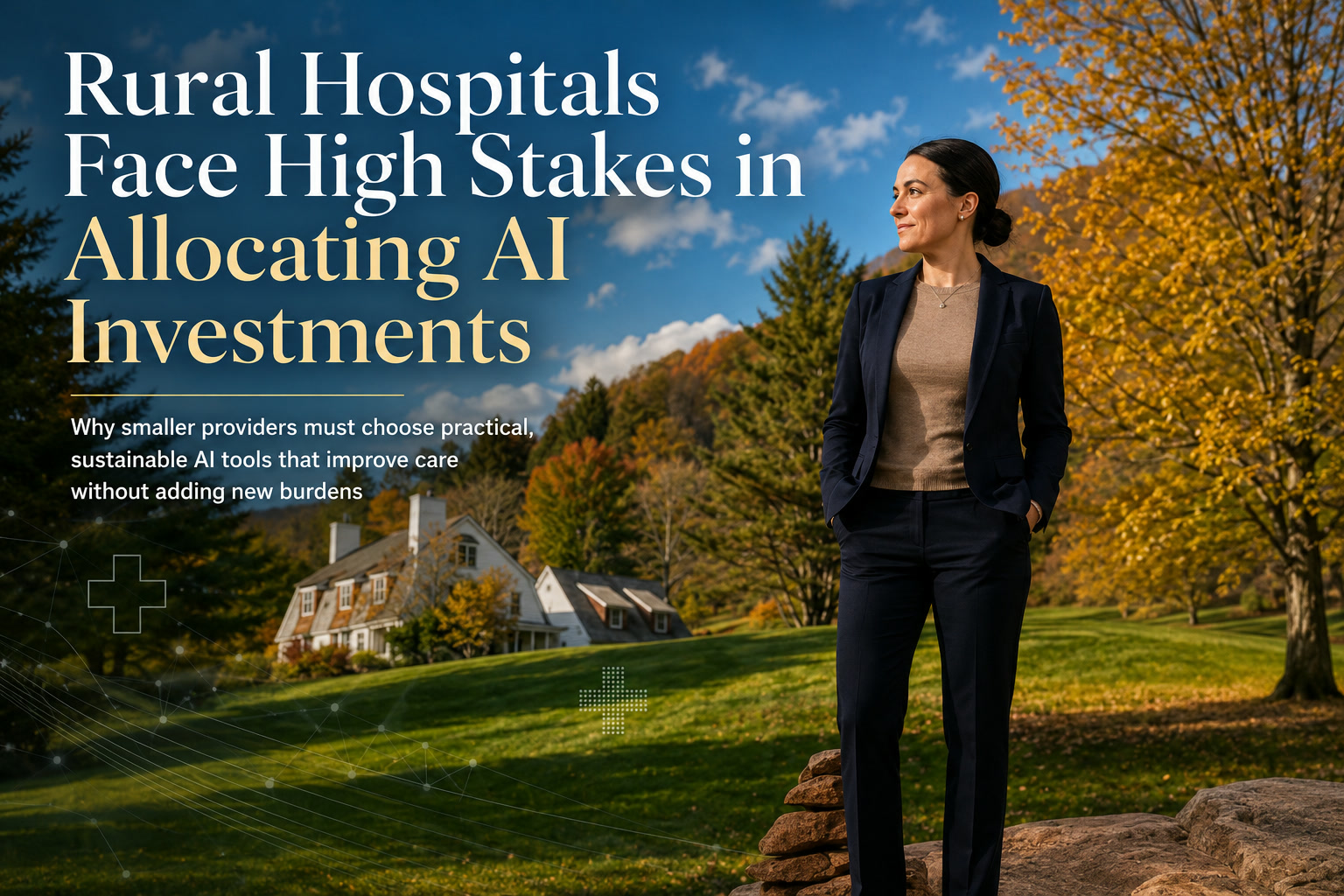
Artificial intelligence has the potential to help rural hospitals overcome some of their biggest challenges. It can reduce administrative workload, support overstretched clinicians, improve revenue collection and extend access to services that small hospitals may struggle to provide locally.
The problem is that many rural providers are also the least equipped to make large technology investments.
Compared with major health systems, smaller hospitals often operate with tighter budgets, limited IT teams, weaker infrastructure and fewer specialists capable of managing complex AI systems. That creates a difficult situation: the organisations that could benefit most from AI may also face the greatest risk of investing in the wrong tools.
For rural healthcare leaders, the key may therefore be careful prioritisation rather than trying to adopt everything at once.
Start With the Problem, Not the AI
Julia Clark, managing director at research and consulting firm BRG, argues that rural hospitals should begin by identifying a clear operational or clinical problem before deciding whether AI is the answer.
That distinction matters.
It can be tempting to start with a new AI platform and then search for somewhere to use it. For financially constrained hospitals, however, every investment needs to solve a measurable problem.
Leaders should ask whether the technology can meaningfully improve areas such as productivity, cost, turnaround time, staff satisfaction or quality of care.
If the benefit cannot be clearly defined and measured, the project may not belong at the front of the investment queue.
This is particularly important because many rural hospitals are already operating under serious financial pressure, with some facing continued losses and potential closure.
Large health systems may be able to absorb the cost of unsuccessful technology experiments.
Small hospitals often cannot.
Back-Office Automation May Offer the Fastest Return
For many rural providers, some of the strongest early AI opportunities may sit outside direct patient care.
Revenue cycle management is one example.
AI can potentially assist with:
These functions may offer relatively clear financial returns because improvements can be measured through faster reimbursement, fewer denied claims and reduced manual workload.
They also carry less direct patient-safety risk than AI systems making clinical recommendations.
For rural hospitals struggling with cash flow, even modest improvements in revenue-cycle efficiency can have a meaningful impact.
That makes administrative AI a more practical starting point than jumping immediately into advanced clinical decision support.
Ambient AI Documentation Could Also Be a Good Early Investment
Ambient documentation is another area Clark identifies as particularly promising.
AI scribes can listen to clinical conversations and produce draft notes for review inside existing electronic health record workflows.
For physicians and nurses, that can reduce the amount of time spent typing documentation after patient encounters.
This is especially relevant in rural areas, where recruiting and retaining clinicians is already difficult.
If AI can remove some repetitive administrative work, clinicians may be able to spend more time with patients and less time completing notes after hours.
The technology also tends to fit more naturally into workflows hospitals already have, making it easier to introduce than systems requiring entirely new infrastructure or specialist teams.
For smaller organisations, AI that quietly improves an existing workflow may deliver more value than an impressive standalone platform that nobody has time to manage.
Some Clinical AI Investments Should Probably Wait
Not every AI application is equally suitable for a rural hospital.
Clark suggests that more complex technologies may need to wait until organisations have stronger governance, infrastructure and technical support.
These include advanced clinical decision-support systems, predictive models requiring large validated datasets and tools that demand specialised staff to maintain.
The reason is not that these technologies lack potential.
The problem is risk.
A billing automation tool that produces an incorrect suggestion can be reviewed before submission.
A clinical decision-support system producing an incorrect recommendation could potentially affect patient care.
That means higher-risk AI requires stronger validation, monitoring and oversight.
Small hospitals need to be realistic about whether they can provide those safeguards before deploying the technology.
Existing Workflows Matter More Than Exciting Features
One of the most important questions rural hospitals should ask is whether an AI tool fits into the systems employees already use.
A tool may look impressive during a demonstration but create additional work once deployed.
If clinicians have to open another application, duplicate data, remember another password and manually transfer information back into the EHR, adoption will probably suffer.
Successful AI should ideally remove friction rather than create another layer of it.
Clark recommends evaluating whether the technology solves a clearly identified problem, integrates with existing workflows and comes from a vendor capable of supporting the product over the long term.
Hospitals also need to consider whether they can realistically govern and maintain the system after implementation.
Buying AI is only the beginning.
Someone still needs to manage it.
Infrastructure Remains a Basic Barrier
Before discussing advanced AI, some rural hospitals are still dealing with a more fundamental challenge: connectivity.
Reliable broadband is essential not only for AI but also for EHR access, telehealth, medical image transfers, cloud applications and remote patient monitoring.
Where connectivity remains weak, sophisticated AI services may simply be impractical.
Hospitals may need to concentrate bandwidth-intensive services in locations with better connectivity while continuing to pursue available broadband funding.
Cybersecurity must also improve alongside digital adoption.
Every additional connected system increases dependence on technology and creates another potential point of failure.
AI therefore cannot be separated from broader investments in network resilience, cloud infrastructure and cybersecurity.
Without those foundations, hospitals risk building new capabilities on infrastructure that cannot reliably support them.
The Rural IT Workforce Is Often Very Small
Technology staffing creates another challenge.
Large academic hospitals may have dedicated data scientists, AI engineers, cybersecurity specialists and informatics teams.
A rural hospital may have only a handful of people responsible for virtually everything involving technology.
That makes building and maintaining AI systems internally unrealistic for many organisations.
Instead, rural providers are increasingly likely to depend on vendors, shared services and consortium-based approaches.
Partnerships with larger academic medical centres may also become important.
Through hub-and-spoke arrangements, rural hospitals can gain access to expertise, infrastructure and specialised services they could never justify building independently.
The same model already works in areas such as tele-radiology and tele-critical care.
AI could extend that approach further.
Grants Can Start an AI Project, But They Cannot Sustain It Forever
Government programmes and grants can help rural hospitals fund initial AI pilots and infrastructure improvements.
The danger is building a programme around temporary money.
A hospital may receive funding to implement a technology for two years, only to discover that it cannot afford licensing, cloud infrastructure or support once the grant ends.
Clark argues that hospitals should define the long-term funding model before launching the pilot.
That means identifying where ongoing costs will eventually be covered.
Possible sources could include reimbursement, operational savings, additional revenue or measurable cost avoidance.
If none of those can sustain the system after the grant ends, the organisation may simply be delaying an expensive problem.
A successful pilot that cannot be maintained is not necessarily a successful investment.
Rural Data May Not Look Like Urban Data
Another issue is the data behind the AI itself.
Many healthcare AI models are trained and validated using information from large urban or academic health systems.
Rural populations may be very different.
They may have different disease patterns, access barriers, demographics and healthcare utilisation.
Datasets at individual rural hospitals are also often smaller and more fragmented.
That raises an important question:
Does an AI system that performs well at a major academic hospital perform equally well in a small rural facility?
The answer should not automatically be assumed to be yes.
Clark recommends that rural providers look for evidence that models have been validated on populations similar to their own.
Multi-site partnerships and shared datasets could also help rural organisations build stronger data foundations while reducing the burden on individual hospitals.
Governance Is Still Necessary Even for Small Hospitals
A small organisation does not get to skip AI governance simply because it has fewer employees.
Hospitals still need processes for evaluating safety, privacy, cybersecurity, ethics and operational impact.
Those governance structures may be simpler than those at a national health system, but they still need to exist.
Someone should be responsible for deciding which AI tools can be introduced, what data they can access, how their performance will be monitored and what happens if something goes wrong.
For rural hospitals, community trust also matters greatly.
These organisations are often deeply connected to the towns they serve and may also be major local employers.
Transparency about how AI is being used can therefore be particularly important.
Patients may be more comfortable with technology when they understand what it does, what it does not do and where human decision-making remains involved.
AI Could Either Widen or Narrow the Rural Healthcare Gap
The bigger question is what happens over the next several years.
There are two very different possibilities.
In one scenario, large health systems continue investing heavily in AI while rural hospitals fall further behind because they lack money, infrastructure and technical expertise.
If new healthcare AI is mainly designed around large urban institutions, the gap could become even wider.
But there is another possibility.
AI could become an equaliser.
Revenue-cycle automation could strengthen hospital finances.
Ambient documentation could reduce clinician burnout.
Remote monitoring could allow small teams to manage more patients.
Virtual behavioural health could bring specialists into communities where none are locally available.
Tele-critical care could allow rural clinicians to access specialist support without transferring every complex patient to a distant hospital.
In that version of the future, AI does not replace rural healthcare workers.
It helps a small workforce reach further.
The Best AI Investment May Be the Least Exciting One
For rural hospitals, success may depend on resisting the pressure to pursue the most impressive technology.
The best investment may be something much less glamorous.
It may be an AI tool that reduces denied claims.
It may be an ambient scribe that saves clinicians 30 minutes each day.
It may be software that helps identify appointment gaps or automate repetitive administrative work.
Those tools may not generate dramatic headlines.
But they may solve real problems quickly and sustainably.
That is far more valuable than deploying advanced AI simply because every other health system appears to be doing it.
Final Thoughts
Rural hospitals have plenty to gain from artificial intelligence, but they also have much less room for expensive mistakes.
The right strategy is therefore unlikely to involve massive AI transformation programmes copied from large academic medical centres.
Instead, rural providers need targeted investments tied to immediate problems, existing workflows and measurable returns.
Revenue-cycle automation and ambient documentation may offer sensible starting points, while higher-risk clinical AI may require stronger infrastructure and governance before it becomes practical.
Funding, broadband, cybersecurity, workforce expertise and long-term sustainability all need to be considered alongside the technology itself.
If those foundations are ignored, AI could become yet another expensive digital burden.
But if investments are carefully selected and designed around the realities of rural care, AI could help small hospitals do something they have always needed to do: make limited resources stretch much further without compromising the communities that depend on them.











Comments 0