

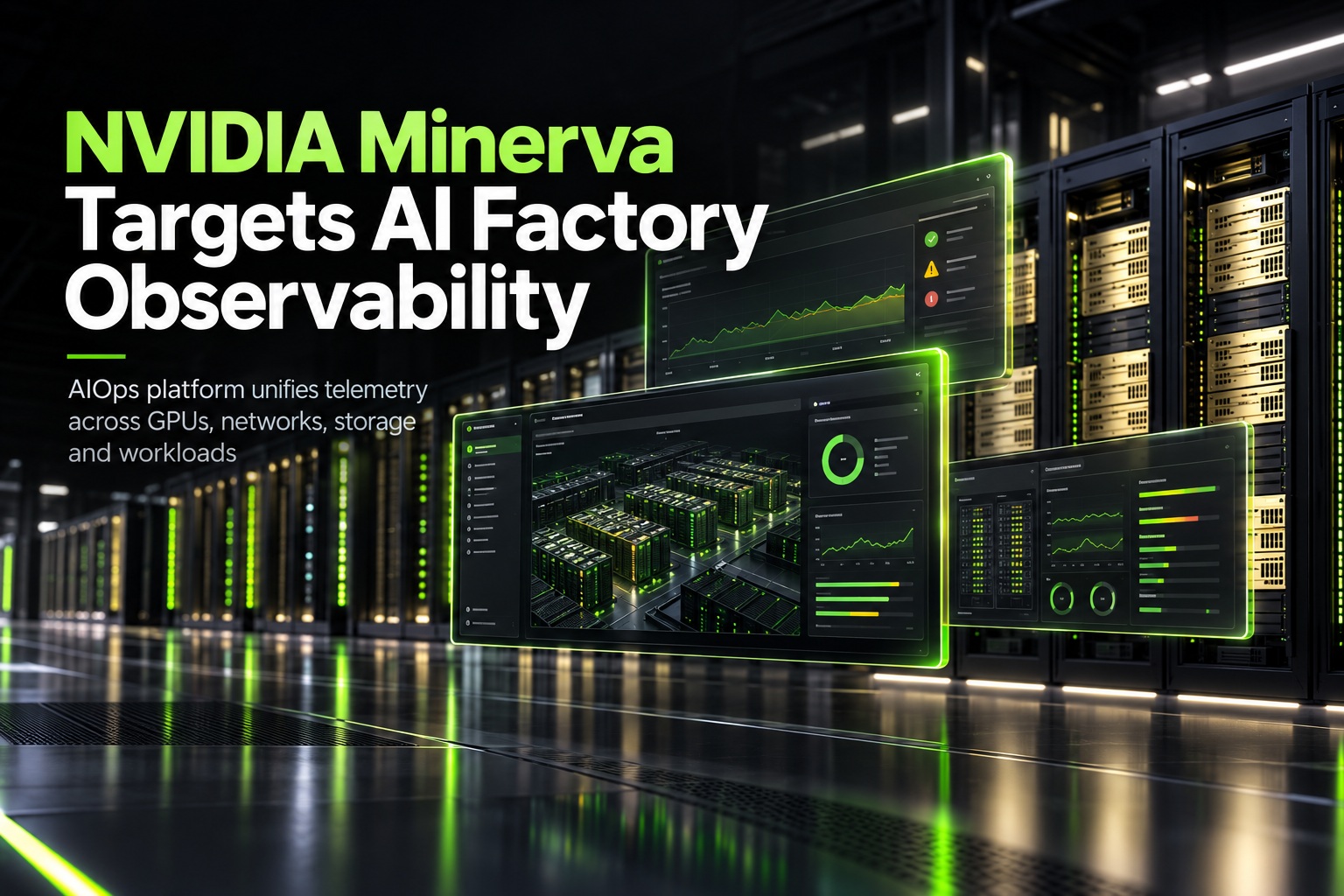
NVIDIA has introduced Minerva, a new AIOps platform designed to improve the reliability and productivity of large-scale AI factories. The platform brings infrastructure and workload telemetry together into a single operational view, helping teams identify the source of performance problems before they significantly affect AI training or inference workloads.
The system is aimed particularly at organisations operating extremely large GPU clusters, where even one poorly performing component can have a noticeable impact on an entire job. NVIDIA says Minerva can correlate information from GPUs, networking infrastructure, storage systems and job schedulers, allowing operators to understand how individual hardware components affect the workloads running across the environment.
AI Factories Need A Different Kind Of Monitoring
Traditional data centre monitoring often separates infrastructure into different operational areas. Network engineers may work from one dashboard, compute teams from another, while storage administrators and site reliability engineers rely on their own tools and metrics.
That approach becomes increasingly difficult in large AI environments because all of these systems are tightly connected. A slow storage device can affect GPU utilisation, a network problem can reduce training throughput and one overheating GPU may cause an entire distributed job to perform below expectations.
Minerva attempts to remove those operational silos by bringing the different signals together. Instead of viewing every infrastructure layer independently, teams can examine the relationship between the physical infrastructure and the AI workloads depending on it.
Telemetry From GPUs, Networks And Storage Comes Together
Minerva collects operational information from several critical parts of an AI factory. This includes telemetry generated by GPUs, the high-speed network fabric connecting them and the storage systems feeding data into AI workloads.
Job schedulers are also included because they determine where workloads are placed across the cluster. By understanding which job is running on which hardware, the platform can correlate application behaviour directly with infrastructure conditions.
This becomes particularly important when an AI factory contains tens or hundreds of thousands of GPUs. At that scale, simply identifying which component is responsible for degraded performance can become extremely difficult without a unified operational view.
A Dynamic Knowledge Graph Maps Jobs To Hardware
One of Minerva's core capabilities is the creation of a dynamic knowledge graph that maps physical infrastructure against the workloads using it. This allows operators to trace an application problem through the underlying hardware rather than treating the job and infrastructure as separate systems.
For example, if a training workload suddenly slows down, Minerva could help determine whether the problem originates from a GPU, storage device, network connection or another infrastructure component associated with that particular job.
This relationship mapping could significantly reduce troubleshooting time in environments where manually following infrastructure dependencies would otherwise be extremely complicated.
Idle GPUs Represent Expensive Lost Capacity
The financial argument behind Minerva is relatively straightforward. High-end GPUs are expensive, and organisations operating large AI clusters want those accelerators performing useful work as consistently as possible.
When a training job stalls because one GPU is overheating, a storage device cannot deliver data quickly enough or a network path becomes unreliable, expensive compute capacity can sit underutilised. The impact may extend far beyond the individual component because distributed AI workloads depend on many systems operating together.
If one part of the cluster becomes a bottleneck, overall goodput can fall, reducing the amount of productive work the AI factory completes despite the hardware technically remaining online.
Goodput Matters More Than Simply Keeping GPUs Online
Traditional infrastructure monitoring frequently focuses on uptime. A server or GPU is considered healthy if it remains available and responds to monitoring checks.
For AI infrastructure, availability alone does not necessarily mean productivity. A GPU can technically remain online while delivering substantially less useful work because another part of the environment is slowing the job down.
This is why NVIDIA emphasises goodput rather than simple uptime. The objective is not merely keeping GPUs switched on; it is maximising the amount of productive AI computation completed during the time those GPUs are operating.
In an AI factory containing thousands of expensive accelerators, even relatively small improvements in utilisation can represent significant value.
Minerva Processes Billions Of Data Points Every Hour
According to NVIDIA, Minerva can analyse billions of telemetry data points per hour. The platform applies both supervised and unsupervised machine learning techniques to identify patterns across the infrastructure.
The models learn what normal behaviour looks like for a particular cluster topology. Once that baseline has been established, Minerva can identify unusual behaviour that may indicate a developing problem.
The use of unsupervised learning is particularly useful because not every infrastructure failure will resemble something the platform has already encountered. New combinations of symptoms can appear as hardware, workloads and network configurations change.
The Platform Can Detect Previously Unseen Anomalies
Traditional monitoring relies heavily on predefined thresholds. A temperature reaches a particular level, latency exceeds a specific number or a network error counter crosses a configured limit.
That approach works well when operators already know what constitutes abnormal behaviour. The problem is that emerging failures do not always exceed obvious thresholds immediately.
Minerva is designed to identify unusual relationships across telemetry even when no specific rule has been configured for that condition. This could help operations teams detect subtle signs of degradation earlier and intervene before the issue becomes a significant production incident.
Predictive Failure Detection Could Reduce Interruptions
NVIDIA also says Minerva can identify failures that are still developing. Instead of waiting until hardware completely stops working, operators may receive warning that a component is behaving differently from similar devices and appears likely to fail.
That creates an opportunity for proactive maintenance. A questionable component could potentially be removed or replaced during a planned maintenance window rather than unexpectedly failing in the middle of a large training run.
For long-running AI workloads, avoiding unplanned interruptions can be extremely valuable because recovering from a failed training job may consume significant time and additional GPU resources.
Alert Storms Are Another Major Problem
Large infrastructure environments can generate enormous numbers of alerts from what is ultimately one underlying problem. A marginal cable, for example, might create network errors that trigger warnings across switches, GPUs, applications and monitoring systems simultaneously.
Without correlation, engineers may be presented with dozens or hundreds of separate alerts describing symptoms rather than the actual cause. Teams then spend time investigating each warning while trying to determine whether they are related.
Minerva attempts to collapse this alert storm into a smaller number of focused incidents. The platform analyses relationships between events and provides a likely root cause rather than simply forwarding every individual alert.
One Problem Should Become One Incident
This correlation could fundamentally change how operations teams respond to large infrastructure problems. Instead of engineers starting with hundreds of warning messages, they receive a consolidated incident showing the most likely source and which workloads are being affected.
That helps shift operational work away from manually sorting alerts and towards actually fixing the underlying issue.
In extremely large AI factories, this difference becomes significant because the volume of telemetry can easily exceed what human teams can realistically interpret on their own.
AI is therefore being used not simply to generate additional monitoring information but to reduce the amount operators need to process manually.
Minerva Includes A Native AI Assistant
NVIDIA has also integrated a conversational AI assistant directly into Minerva. Operators can interact with the platform using natural-language questions rather than relying entirely on dashboards and query interfaces.
An engineer could ask about the health of a particular cluster, investigate why a job is underperforming or request information about recent anomalies. The assistant uses live telemetry as its context when responding.
This grounding is important because the objective is not for the assistant to generate generic infrastructure advice. It needs to reason about what is actually happening inside the organisation's environment at that moment.
Operators Can Ask Questions About Live Cluster Health
A natural-language interface could make troubleshooting considerably faster when dealing with complicated environments. Engineers may be able to ask questions such as which GPUs are degrading a particular workload or whether storage performance changed before an incident occurred.
Instead of manually navigating several dashboards and correlating timestamps, the AI assistant can potentially perform much of that analysis automatically.
The operator still needs to understand the infrastructure and evaluate the recommendation, but the time required to gather evidence could be significantly reduced.
This is where AI-powered operations become more useful than traditional monitoring alone.
Minerva Can Recommend Remediation
The platform does not stop at identifying problems. Once Minerva determines the likely cause of an incident, it can also recommend potential remediation actions.
A human operator can review the recommendation and decide whether to implement it manually. This preserves traditional approval processes for organisations that are not comfortable allowing AI to make infrastructure changes automatically.
However, NVIDIA is also positioning Minerva for environments that want to move towards increasingly autonomous operations.
Agentic Remediation Can Automate Approved Actions
Where appropriate, Minerva can pass remediation actions through infrastructure APIs and external automation systems. This introduces an agentic element where the system not only identifies a problem but can potentially participate directly in resolving it.
For example, an unhealthy component might be removed from a workload pool, a job could be rescheduled or an infrastructure workflow could be triggered automatically. The exact capabilities will depend on the APIs and systems connected to Minerva.
Organisations can therefore choose how much control remains with human operators and how much is delegated to automation.
Third-Party AI Agents Can Also Connect
NVIDIA says Minerva can integrate with third-party agentic AI platforms as well. This means organisations do not necessarily need to use its native assistant as the only interface for operational automation.
A company may already have AI agents handling infrastructure management, ticketing or incident response. Minerva can provide those systems with richer telemetry and infrastructure context.
This interoperability could become increasingly important as enterprises build broader AI-driven operations platforms rather than relying on one vendor for every component.
AI Factory Yield Is NVIDIA's Main Metric
NVIDIA describes the overall objective in terms of AI factory yield. Rather than focusing simply on how many GPUs an organisation owns, the more meaningful question is how effectively those GPUs are converted into productive AI output.
Two organisations could operate identical GPU fleets but achieve very different results if one experiences frequent interruptions, poor scheduling or infrastructure bottlenecks.
Minerva is intended to improve that yield by increasing useful GPU hours, reducing interruptions and improving goodput across the cluster.
For companies spending billions on AI infrastructure, relatively small efficiency gains can translate into substantial financial savings.
Fewer Interruptions Mean More Productive GPU Hours
Large training workloads can run for extended periods, making reliability extremely important. Every interruption potentially reduces productive GPU time and can require jobs to restart from checkpoints.
Preventing failures before they occur allows more compute capacity to remain focused on actual workloads rather than recovery and troubleshooting.
Minerva's predictive capabilities are therefore as important as its ability to diagnose failures after they happen. The ideal outcome is avoiding the incident entirely rather than simply resolving it faster.
That shifts infrastructure management from reactive troubleshooting towards proactive maintenance.
Faster Repair Still Matters When Failures Occur
No monitoring platform can completely eliminate hardware failures. GPUs, drives, cables and switches will eventually fail regardless of how sophisticated the software becomes.
The second objective is therefore shortening the time required to identify and correct those failures. Automated correlation can reduce the period engineers spend determining which component actually caused the incident.
If Minerva can consistently identify the root cause faster than traditional monitoring systems, the affected workload can return to productive operation sooner.
The value of those saved minutes or hours increases dramatically as the size and cost of the cluster grows.
IREN Is Already Using Minerva
IREN has been identified as one of the early organisations deploying NVIDIA Minerva. The company operates large AI infrastructure environments and is using the platform to improve visibility across its growing GPU fleet.
IREN CTO Denis Skrinnikoff said the company's primary objective as it expands its AI factories is maximising GPU productivity for customers. Having one operational view across networking, GPUs and workloads allows the team to concentrate more heavily on proactive maintenance rather than spending as much time troubleshooting individual incidents.
The company believes this visibility will also strengthen the operational model used for future infrastructure expansion.
AI Infrastructure Is Becoming Too Large For Traditional Monitoring
The introduction of platforms such as Minerva reflects how dramatically data centre operations are changing. Traditional monitoring tools were designed for environments where administrators might manage hundreds or thousands of servers.
AI factories can operate on a completely different scale, with enormous GPU clusters connected through highly specialised networking and storage infrastructure.
Distributed training also means components cannot be viewed independently. One degraded device can potentially affect many other systems because the entire workload depends on them operating together.
That complexity creates a strong argument for AI-assisted operational management.
GPU Density Makes Small Problems Expensive
When an AI factory contains hundreds of thousands of GPUs, even a tiny percentage of degraded devices can represent significant lost capacity. A problem affecting 0.1% of a 100,000-GPU environment still involves 100 accelerators.
That would already represent an enormous amount of expensive hardware operating below its intended productivity.
The challenge is therefore not only identifying major failures but recognising small inefficiencies that become significant when multiplied across massive infrastructure.
This is where large-scale telemetry analysis becomes particularly valuable.
Storage Can Become The Hidden Bottleneck
AI infrastructure discussions tend to focus heavily on GPUs, but storage performance can have an equally important impact. Training systems need enormous amounts of data supplied continuously to accelerators.
If an NVMe drive or storage layer loses throughput under load, GPUs may spend more time waiting for information rather than performing calculations.
From a traditional monitoring perspective, every GPU may appear healthy. From a productivity perspective, however, the entire job may be underperforming.
Correlating storage telemetry with GPU workloads allows Minerva to identify this kind of relationship.
Networking Is Equally Critical
The network fabric connecting GPUs is another essential component. Large AI models are often distributed across many accelerators that continuously exchange enormous amounts of information.
Even relatively minor network degradation can therefore reduce the performance of the entire training job. A failing cable or congested path may produce symptoms that appear elsewhere across the cluster.
By ingesting network telemetry alongside GPU and workload information, Minerva can potentially determine whether a performance problem originates from compute or connectivity.
That eliminates some of the organisational boundaries that traditionally separate networking and compute teams.
Scheduling Data Provides Another Layer Of Context
Job schedulers determine where AI workloads run across the infrastructure. Without that information, monitoring software may know that a GPU is behaving unusually but not understand which training job depends on it.
Minerva incorporates scheduler telemetry so that infrastructure conditions can be associated directly with workloads.
This allows teams to prioritise incidents according to their operational impact. A degraded GPU sitting idle may require maintenance, but one currently slowing an expensive production training job deserves much more immediate attention.
Context transforms a hardware alert into a business-relevant incident.
AI Operations Still Need Human Oversight
The addition of agentic remediation does not mean organisations should immediately hand complete control of their infrastructure to an autonomous system. Large AI factories represent extremely expensive environments where incorrect automated actions could create significant disruption.
Human approval will likely remain important for complex or high-impact changes. The more practical initial approach may involve letting Minerva investigate problems, gather evidence and recommend solutions while engineers make the final decision.
As organisations gain confidence in specific workflows, repetitive low-risk actions can gradually be automated.
This allows autonomy to increase without removing operational accountability.
The Real Value Will Need To Be Proven
NVIDIA's claims around improved AI factory yield, longer intervals between failures, faster repair and reduced alert volumes are compelling, but the real-world benefits will depend on deployment experience.
IREN's adoption provides an early example, although broader independent measurements will be needed to determine how much Minerva improves GPU utilisation and operational efficiency across different environments.
AI operations platforms often sound impressive in demonstrations. The true test is whether they consistently identify problems faster and more accurately than experienced infrastructure teams working with existing monitoring tools.
For organisations spending enormous amounts on GPU infrastructure, even modest gains may still justify the investment.
Final Thoughts
NVIDIA Minerva reflects the next stage in managing increasingly massive AI infrastructure. Instead of monitoring GPUs, networking, storage and workloads through separate systems, the platform brings those signals together and builds a dynamic operational model of the entire AI factory.
By analysing billions of telemetry points every hour, Minerva can identify anomalies, predict developing failures and collapse large alert storms into focused incidents with likely root causes. Its built-in AI assistant allows operators to investigate cluster health through natural-language conversations, while agentic capabilities can eventually pass approved remediation actions directly into infrastructure automation.
The biggest idea behind Minerva is that owning enormous numbers of GPUs is not enough. What matters is how much useful AI work those GPUs actually complete.
As AI factories grow towards hundreds of thousands of accelerators, individual hardware problems become increasingly difficult for human teams to identify manually. A single degraded GPU, storage device or network connection can quietly reduce the performance of an entire training workload.
If Minerva can reliably find those problems before they consume large amounts of expensive GPU time, NVIDIA may have found another important role for AI inside the AI industry itself: using artificial intelligence to keep the machines building artificial intelligence running efficiently.











Comments 0