

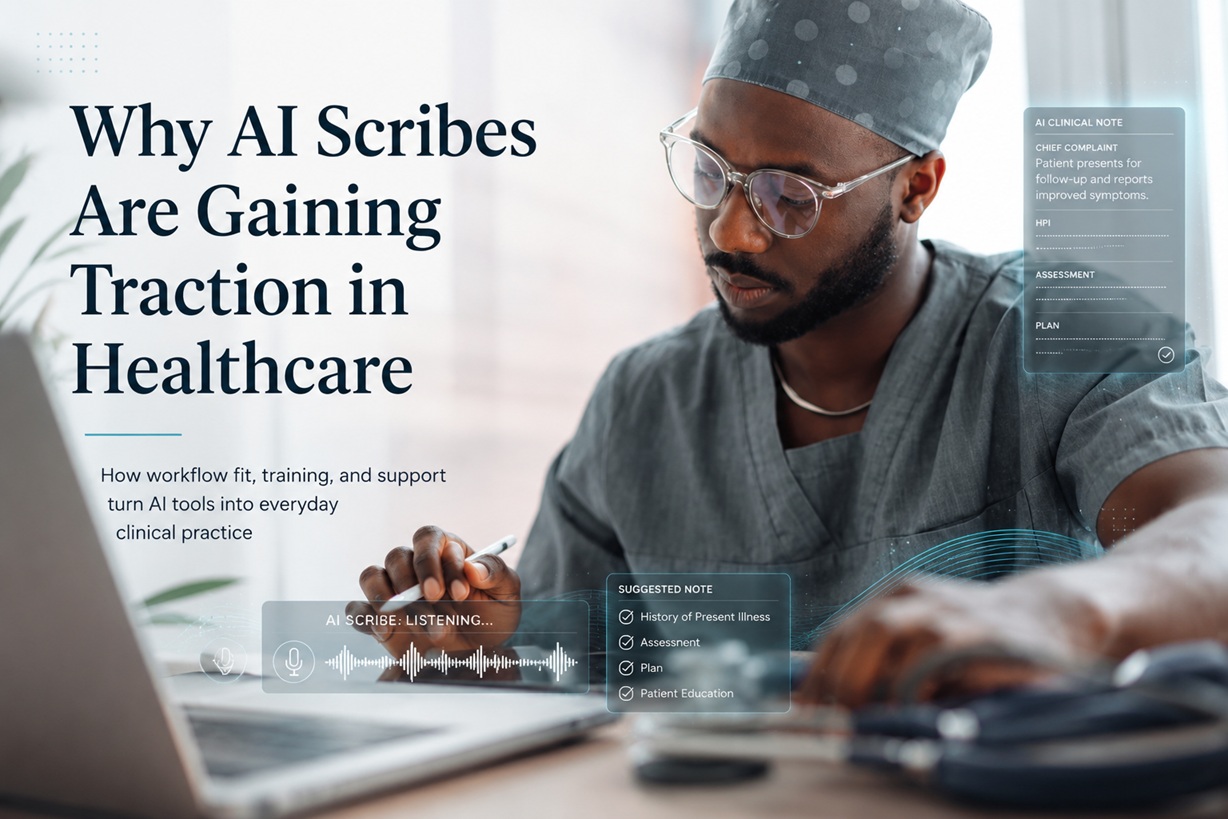
Healthcare organisations are increasingly turning to artificial intelligence to reduce administrative workload, improve clinician experience and help address persistent staffing pressures. Among the most promising tools are ambient AI scribes, which listen to patient-clinician conversations and automatically generate draft clinical documentation. The technology can potentially return valuable time to doctors and reduce one of the most commonly cited contributors to burnout: documentation.
But simply giving clinicians access to an AI scribe does not guarantee they will actually use it.
Cleveland Clinic's experience suggests that successful adoption depends just as much on workflow integration, training, governance and responsive support as it does on the AI technology itself.
Healthcare Staffing Pressures Aren't Going Away
The pressure to find new ways of supporting clinicians remains significant.
A workforce analysis from AMN Healthcare projects that the United States could face a physician shortage of up to 86,000 doctors by 2036, with primary care and specialist positions among the areas most affected.
Nursing pressures have eased from their pandemic-era peak, but staffing challenges remain, particularly in rural areas.
Against this background, healthcare organisations are looking at AI not simply as a technology upgrade, but as another tool for workforce optimisation.
Predictive analytics may help identify workload and burnout risks, while administrative automation can reduce repetitive tasks. Ambient documentation tools are particularly attractive because they address work clinicians encounter during almost every patient consultation.
Instead of spending additional time typing notes after an encounter, an AI scribe can generate a draft from the conversation for the clinician to review.
Getting Clinicians to Actually Use AI Is the Hard Part
The benefits sound straightforward, but adoption is not automatic.
Healthcare professionals may be sceptical of AI-generated documentation, particularly if they are concerned about accuracy, reliability or how much editing will be required afterwards.
Clinical workflows also vary substantially.
A physician who already relies heavily on copy-forward documentation may interact with the EHR very differently from a colleague who writes detailed notes from scratch. Specialties also have different documentation requirements, terminology and preferred formatting.
Other barriers identified by Cleveland Clinic researchers include:
Those factors help explain why measuring whether someone has ever tried an AI tool is not enough.
Cleveland Clinic instead focused heavily on encounter-level utilization—whether clinicians actually used the AI scribe during eligible patient encounters.
That is a much tougher measure of meaningful adoption.
Cleveland Clinic Took an Enterprise-Wide Approach
Cleveland Clinic partnered with Ambience Healthcare to deploy its ambient AI documentation technology across the health system.
The scale was considerable.
Cleveland Clinic operates 23 hospitals, 276 outpatient locations and employs approximately 80,000 caregivers.
Within just four months, the rollout reached around 4,000 ambulatory clinicians.
After 12 months, more than 4,800 clinicians had used the AI scribe across over 3.5 million encounters.
That level of utilisation did not happen simply by switching the software on.
The health system created a structured governance model designed specifically around deployment, clinician engagement and ongoing improvement.
Governance Helped Keep the Rollout Organised
A dedicated Project Operating Council managed day-to-day implementation.
Rather than leaving deployment entirely to IT, the programme involved cross-functional teams responsible for areas such as technical access, clinician training, user feedback and utilisation monitoring.
Different subgroups handled specific tasks.
IT developers addressed access problems. Trainers worked directly with clinicians. Product teams reviewed feedback and prioritised improvements. Leadership teams monitored adoption and identified departments needing additional support.
This multidisciplinary structure meant problems could be dealt with quickly rather than waiting for them to move through several layers of administration.
That speed became especially important during the early stages of adoption.
Fast Support Made a Significant Difference
One of the standout elements of Cleveland Clinic's rollout was the amount of support available to clinicians.
During implementation, more than 900 support enquiries were handled with an average response time of around two minutes.
Clinicians commonly requested help with issues such as custom physical examination templates, multi-clinician workflows, corrections to draft notes, content updates and access to organisational AI policies.
Ambience Healthcare also provided live virtual training sessions three times each day and maintained a 24/7 mobile chat service staffed by human support personnel.
That approach removed a common obstacle to technology adoption.
When clinicians encountered a problem, they did not have to submit a ticket and wait until the following day. They could ask for help while the issue was still happening.
For busy healthcare professionals, that difference can determine whether they continue using a tool or simply return to their old workflow.
Training Had to Adapt to Clinical Reality
Cleveland Clinic also learned that one training format would not work for every department.
Some specialties simply could not attend scheduled training because their clinical workloads were too demanding.
Feedback from clinicians and the vendor support team therefore led to changes in the programme.
The health system expanded in-person sessions, allocated additional time during departmental meetings and increased asynchronous training options so clinicians could learn when their schedules allowed.
Dedicated office hours provided another opportunity for users to receive practical help.
The lesson was simple: training needs to fit around clinical work, not the other way around.
Clinician Feedback Shaped the Product
The rollout also included a provider advisory group responsible for collecting specialty-specific feedback.
This was important because documentation needs differ considerably between specialties.
A note structure that works perfectly for primary care may not suit cardiology, orthopaedics or another specialty.
Clinicians therefore provided feedback on formatting, content, settings and features, which could then be used to improve the product.
This continuous feedback loop helped make the AI scribe feel less like a generic technology being imposed on clinicians and more like a tool being adapted around their actual needs.
That likely contributed significantly to sustained utilisation.
Department Leaders Were Given Visibility Into Adoption
Leadership involvement was another important factor.
Cleveland Clinic provided department chairs with dashboards showing progress around training and onboarding.
Instead of relying on occasional reports, leaders could see where their teams were succeeding and where additional support might be needed.
The implementation team also provided reusable outreach messages that department chairs could send to their clinicians.
That reduced the administrative burden on leaders while still giving them a role in encouraging adoption.
In a large healthcare organisation, this type of local leadership can matter enormously.
Clinicians may be more willing to engage with a new workflow when their own department understands and supports the change.
AI Scribes Could Help With Clinician Retention
The programme appears to have produced more than high usage numbers.
According to Cleveland Clinic researchers, around 60% of users agreed or strongly agreed that the ambient AI tool increased their likelihood of remaining in clinical practice.
That is particularly notable given the wider concern around clinician burnout.
Documentation is obviously not the only reason healthcare professionals leave medicine, and AI scribes cannot solve workforce shortages by themselves.
But reducing repetitive administrative work can still improve the daily experience of practising medicine.
If clinicians spend less time completing notes outside normal working hours, they may have more time for patients, colleagues and their own lives.
At scale, even relatively small improvements in retention can have meaningful workforce effects.
The Technology Alone Wasn't the Reason for Success
Perhaps the biggest lesson from Cleveland Clinic is that high AI utilisation was not simply the result of choosing a capable AI model.
The researchers attributed the outcome to deliberate organisational decisions throughout the rollout.
The system combined:
All of these factors worked together.
Without them, even an excellent AI scribe could have struggled to move beyond small groups of enthusiastic early adopters.
Healthcare AI Needs to Fit Into the Workflow
This lesson applies far beyond ambient documentation.
Healthcare technology often fails when it creates another task for clinicians.
If an AI system requires users to leave the EHR, open another application, remember another password and manually copy information back into the clinical system, adoption will naturally suffer.
The technology needs to disappear into the workflow as much as possible.
That means success should not simply be measured by how accurate the AI is.
Healthcare organisations also need to ask:
Those operational questions may ultimately determine whether an AI project generates measurable value.
Final Thoughts
Cleveland Clinic's AI scribe rollout demonstrates that successful healthcare AI adoption is as much an organisational challenge as a technical one.
The health system managed to bring ambient documentation to thousands of clinicians and millions of patient encounters because it invested heavily in governance, training, support and continuous feedback, rather than simply deploying the software and expecting clinicians to adapt.
That distinction is important as more hospitals begin experimenting with AI.
The goal should not merely be to say that clinicians have access to an AI tool.
The real measure is whether they continue using it during everyday clinical work—and whether that usage genuinely improves their experience.
Cleveland Clinic's experience suggests that when AI is properly integrated and clinicians receive the support they need, ambient documentation can move from an interesting experiment to a tool that becomes part of routine care.











Comments 0