

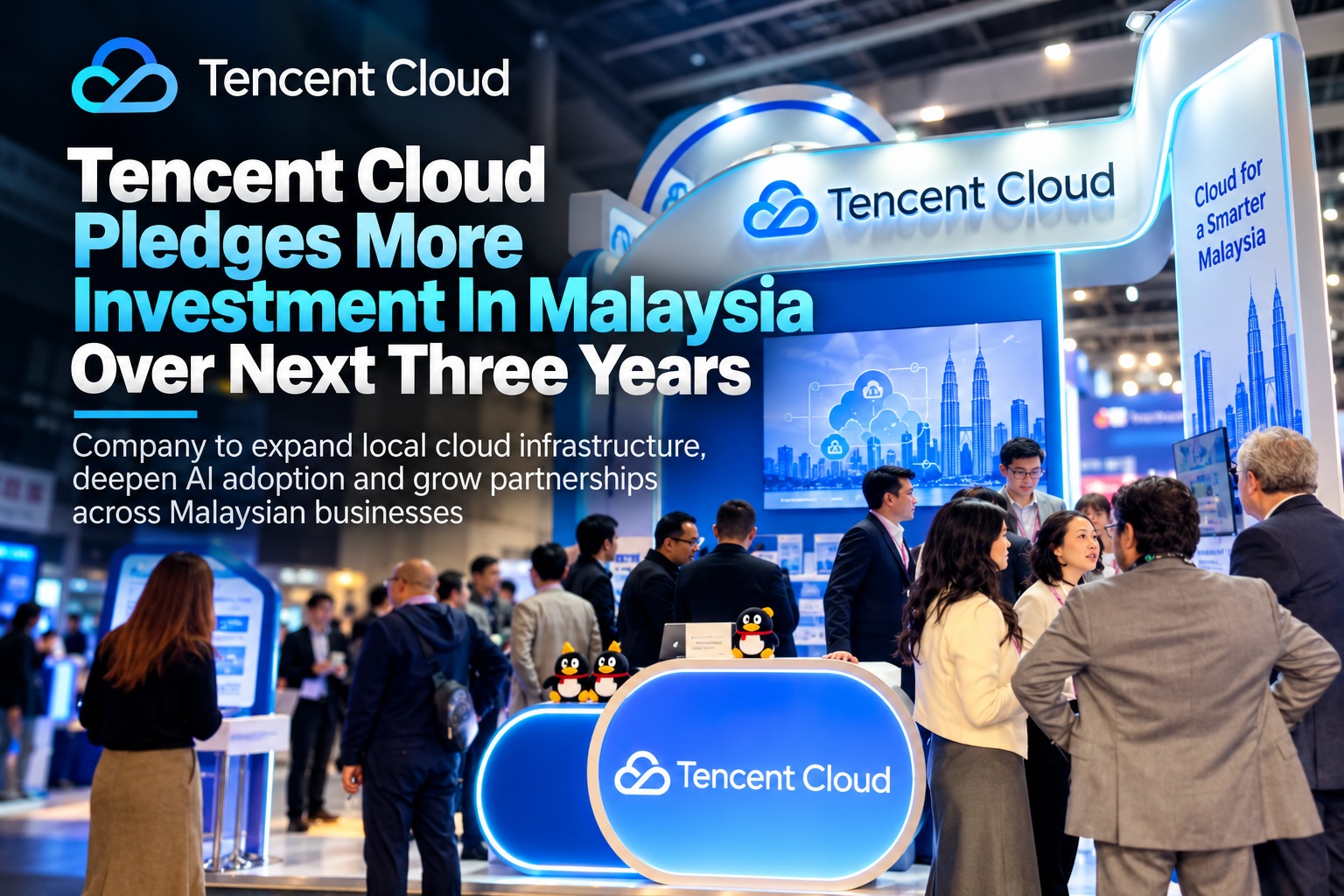
Tencent Cloud has confirmed that it plans to continue investing in Malaysia over the next three years as it expands its local cloud and artificial intelligence presence. The company has not disclosed the value of the planned investment, but said it will build on the infrastructure and partnerships already established in the country.
Nucky Fang, general manager for Tencent Cloud International and Tencent Cloud Malaysia, said the company expects more Tencent applications and services to emerge in the local market as demand continues to grow. Speaking during a media interview at the Global Digital Ecosystem Summit in Shenzhen, China, he said the expansion will target a broader range of industries rather than focusing only on Tencent Cloud's traditional customer base.
Demand Is Growing Across Malaysian Businesses
Tencent Cloud says it is seeing demand from a wide variety of Malaysian organisations. These include small and medium-sized enterprises, startups, banks, payment providers, e-wallet operators and large corporations.
The company is also looking beyond its existing customer segments to identify opportunities in industries where cloud infrastructure, AI and digital services can support business operations. Rather than positioning itself purely as a technology vendor, Tencent Cloud wants to work more closely with customers to determine how its services can be integrated into specific workflows.
This approach reflects the broader shift taking place across the cloud industry, where providers increasingly compete on industry solutions and AI capabilities rather than basic infrastructure alone.
Malaysia Cloud Region Forms The Foundation For Expansion
Tencent Cloud established its first cloud region in Malaysia in August this year, marking a major step in its local expansion. The infrastructure is based in Johor and is designed to support up to three availability zones.
Two of those zones were operational when the region launched, while the third remained under development. The Malaysian region forms part of Tencent Cloud International's wider global infrastructure, which spans 66 availability zones across 23 regions.
Having a local region gives Malaysian organisations access to cloud resources hosted closer to home, which can improve latency and support requirements involving local data processing and digital services.
Johor Infrastructure Supports AI And Data-Intensive Workloads
The new cloud infrastructure is intended to support more than conventional hosting and storage. Tencent Cloud is positioning the Malaysian region to handle AI workloads, data-intensive applications and other digital services that require scalable computing resources.
As businesses adopt more AI-powered tools, demand for local compute capacity is expected to increase. AI agents, content-generation platforms and enterprise analytics all require significant processing and storage resources, particularly when organisations want to keep workloads close to their users.
The Johor region gives Tencent Cloud a local foundation from which to expand those services.
Tencent Cloud Is Working With Boost And Genting Plantations
Tencent Cloud has also announced partnerships with several Malaysian organisations as part of its expansion strategy. These include collaborations with Boost and Genting Plantations Group to explore the use of AI agent technologies within their operations.
The partnerships are intended to identify practical ways AI agents can support business processes rather than simply deploying technology for the sake of experimentation. This could include automating selected workflows, assisting employees or improving operational efficiency.
The exact applications will depend on each organisation's needs, but the projects illustrate how Tencent Cloud is trying to move AI from concept into real business environments.
Universiti Teknologi Malaysia Partnership Focuses On AI Talent
Beyond commercial projects, Tencent Cloud is also working with Universiti Teknologi Malaysia on digital and AI skills development.
The collaboration aims to train more than 1,000 digital and AI talents over the coming years. Building local expertise is important because infrastructure investment alone is not enough to support a growing digital economy.
Companies adopting AI and cloud technologies also need engineers, developers, data professionals and other specialists capable of implementing and managing those systems effectively.
AI-Generated Content Is Attracting Interest From Malaysian SMEs
Tencent Cloud is also seeing local interest in its AI-generated content tools. These platforms can produce images and videos, making them useful for businesses that need creative material without relying entirely on traditional production processes.
According to Fang, Malaysian SMEs are already experimenting with these tools. Companies and production studios have used them for projects such as dramas, trailers and advertisements.
For smaller businesses, AI-generated content can reduce the time and cost involved in creating certain types of visual material. However, the technology still needs to be integrated carefully into existing creative and production workflows.
Malaysia Is Still Exploring Practical AI Use Cases
Despite the growing interest, Tencent Cloud does not believe AI adoption has reached full maturity in Malaysia. Fang said both Malaysia and other markets, including China, remain in an exploratory phase when it comes to identifying the most effective business applications for AI.
Many organisations are interested in the technology but are still trying to determine where it can create measurable value. Simply introducing an AI tool does not automatically improve productivity or reduce costs.
The challenge is finding use cases that fit naturally into existing business processes and deliver clear operational benefits.
The Focus Is Shifting From AI Experimentation To Integration
Tencent Cloud is increasingly working with customers to move beyond basic experimentation. Instead of providing technology and leaving businesses to determine how to use it, the company is taking a more collaborative approach.
This means understanding the customer's existing workflows first and then identifying where AI or cloud services could improve efficiency. The objective is to make the technology part of the operating model rather than an isolated pilot project.
That shift is important because many businesses have already completed the early stage of testing AI tools. The next question is how to make them useful at scale.
Local Partnerships Are Becoming More Important
Fang said Tencent Cloud is placing greater emphasis on working with local partners. These partnerships can help the company understand industry-specific requirements and adapt its technology to the Malaysian market.
Local businesses may have very different operational needs from companies in China or other regions. Regulations, customer behaviour, infrastructure and business practices can all influence how cloud and AI solutions need to be deployed.
By working more closely with Malaysian organisations, Tencent Cloud can tailor its services rather than applying a one-size-fits-all approach.
Tencent Cloud Wants To Move Beyond Being Just A Service Provider
The company's broader ambition is to become more involved in customers' business development rather than acting only as an infrastructure provider.
Traditional cloud providers generally focused on delivering computing, storage and networking resources. AI is changing that relationship because customers increasingly expect vendors to help identify use cases and solve specific business problems.
Tencent Cloud is therefore positioning itself as a technology partner that contributes directly to operational improvement and business growth.
That approach could become increasingly important as cloud services become more commoditised and providers look for new ways to differentiate themselves.
Malaysia Is Becoming More Important In Tencent Cloud's Regional Strategy
The decision to continue investing over the next three years suggests that Malaysia is becoming a more important market within Tencent Cloud's regional expansion plans.
The country already has growing demand for data centres, cloud services and AI infrastructure, driven by both local companies and multinational technology firms. Johor in particular has become a major location for digital infrastructure development.
Tencent Cloud's local region gives the company a stronger position to compete for Malaysian enterprise customers while also supporting businesses expanding across Southeast Asia.
Local Cloud Infrastructure Can Improve Performance
Having cloud infrastructure physically located within Malaysia can offer several practical benefits. Applications can communicate with nearby servers more quickly, reducing latency and improving responsiveness.
This can matter for services involving financial transactions, AI inference, gaming, real-time communications and other workloads where delays affect the user experience.
Local infrastructure may also make it easier for organisations to address internal policies or regulatory requirements concerning where certain data is processed or stored.
Financial Services Are An Important Customer Segment
Banks, payment providers and e-wallet operators are among the Malaysian businesses showing interest in Tencent Cloud.
Financial services increasingly depend on scalable infrastructure capable of processing large transaction volumes while maintaining strong security and availability. AI is also being explored for areas such as customer service, fraud detection, analytics and operational automation.
For cloud providers, financial institutions represent attractive but demanding customers because reliability, compliance and security expectations are extremely high.
SMEs Could Benefit From Lower Barriers To AI Adoption
Smaller businesses may be one of the biggest beneficiaries of cloud-based AI because they often lack the resources to build advanced infrastructure themselves.
Instead of purchasing expensive hardware or hiring large internal AI teams, SMEs can access tools through cloud platforms and pay according to usage.
This lowers the barrier to experimenting with technologies that previously would have been available mainly to large enterprises.
Tencent Cloud's growing focus on SMEs therefore reflects a broader trend towards making AI capabilities accessible through managed services.
Creative Industries Are Already Experimenting
The use of AI-generated content by Malaysian production studios shows that adoption is not limited to traditional enterprise IT.
Creative businesses can use AI tools to produce early concepts, promotional visuals, trailers or other supporting content more quickly. These tools can complement conventional production rather than necessarily replacing it.
The most valuable use cases may be those where AI reduces repetitive work while human creators continue making the main creative decisions.
AI Agents Could Become The Next Major Area Of Growth
Tencent Cloud's partnerships involving AI agents suggest that autonomous or semi-autonomous systems are likely to become an increasingly important part of its Malaysian strategy.
AI agents can potentially perform multi-step tasks, interact with enterprise systems and assist employees with routine processes. This moves beyond simple chatbots or content generation towards systems capable of taking actions within defined workflows.
However, businesses will need appropriate governance and access controls before giving agents significant operational authority.
Talent Development Will Determine How Fast Adoption Grows
The partnership with Universiti Teknologi Malaysia also highlights one of the biggest challenges facing AI adoption: finding enough skilled people.
Cloud infrastructure can be deployed relatively quickly, but developing experienced engineers and AI professionals takes time. Organisations need people who understand not only the technology itself but also cybersecurity, data governance and how to integrate new systems into existing operations.
Training more than 1,000 local talents could therefore support both Tencent Cloud's growth and Malaysia's wider digital economy.
More Investment Does Not Necessarily Mean Only More Data Centres
Tencent Cloud has not provided a specific breakdown of what the next three years of investment will involve. The company already has local cloud infrastructure, so future spending could cover additional capacity, partnerships, AI platforms, talent development or other services.
More Tencent applications may also be introduced locally as the ecosystem expands.
This means the investment should probably be viewed as a broader long-term commitment to Malaysia rather than simply another physical data centre announcement.
The Investment Amount Remains Undisclosed
One important detail is that Tencent Cloud has not revealed the value of its planned investment.
That makes it difficult to compare the commitment directly with announcements from other global technology companies investing billions of ringgit into Malaysian cloud and data centre infrastructure.
However, the three-year timeline indicates that Tencent Cloud intends to maintain a sustained local expansion rather than treating the Malaysian region as a one-off project.
More detailed investment figures could emerge as individual projects are announced.
Final Thoughts
Tencent Cloud's commitment to continue investing in Malaysia over the next three years reflects the country's growing importance as a regional cloud and AI market. The company already operates a local cloud region in Johor, with two availability zones active and a third under development, giving it the infrastructure needed to support more Malaysian workloads locally.
The expansion goes beyond cloud infrastructure. Tencent Cloud is working with Boost and Genting Plantations on AI agent use cases, collaborating with Universiti Teknologi Malaysia to develop more than 1,000 digital and AI talents, and providing AI-generated content tools to Malaysian SMEs and production studios.
At the same time, Tencent Cloud acknowledges that AI adoption remains in an exploratory stage. Many businesses are interested in the technology but are still determining where it delivers meaningful operational value.
That is why the company increasingly sees its role as more than simply selling cloud services. It wants to work alongside Malaysian businesses to identify problems, integrate AI into existing workflows and contribute directly to business development.
The exact amount Tencent Cloud intends to invest remains unknown, but its direction is clear: Malaysia is becoming a longer-term strategic market for its cloud, AI and digital technology ambitions.











Comments 0