

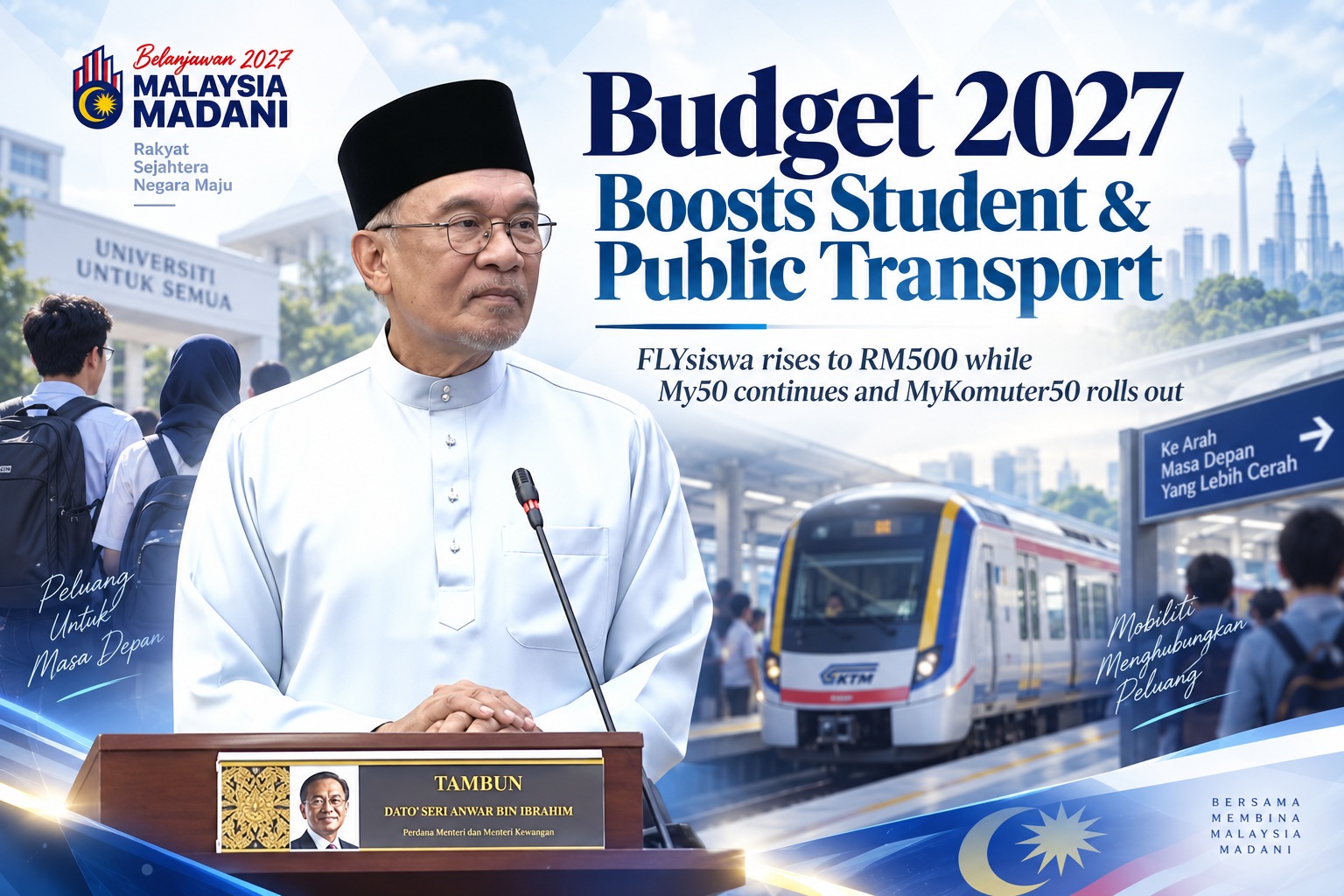
The Malaysian government has announced several public transport-related measures under Budget 2027, including a higher FLYsiswa subsidy for students travelling between Peninsular Malaysia and East Malaysia, the continuation of the My50 unlimited travel pass and the introduction of a new MyKomuter50 programme for KTM users. Prime Minister Datuk Seri Anwar Ibrahim, who is also Finance Minister, announced the initiatives as part of efforts to reduce transport costs for students, daily commuters and other eligible groups. The government is also allocating billions of ringgit towards improving rail reliability and acquiring additional trains.
The measures cover both short-term assistance for passengers and longer-term investment in Malaysia's public transport infrastructure. Students travelling long distances will receive more financial support for airfares, while regular rail and bus passengers will continue benefiting from subsidised monthly passes. KTM Komuter passengers, meanwhile, are set to receive their own equivalent of the existing My50 programme.
FLYsiswa Subsidy Increased To RM500 Per Student
One of the biggest changes under Budget 2027 involves the FLYsiswa programme, which provides flight subsidies to eligible students travelling between Peninsular Malaysia, Sabah and Sarawak. The subsidy had previously been increased to RM400 and will rise again to RM500 per student next year. The programme is intended to reduce the financial burden faced by students who need to travel significant distances between their place of study and home.
Anwar said the increased subsidy is expected to benefit more than 60,000 students studying at public higher education institutions. This includes students from public universities, polytechnics and community colleges. For students who regularly need to travel between East and West Malaysia, the additional RM100 could help offset some of the cost of increasingly expensive domestic airfares.
My50 Unlimited Travel Pass Will Continue
The government has also confirmed that the My50 pass will continue under Budget 2027. The programme allows users to travel on participating Prasarana rail and bus services using a monthly unlimited travel pass. Anwar said approximately 300,000 commuters are expected to benefit from its continuation.
My50 was introduced in 2022 as the successor to the My30 programme. Earlier versions of similar travel passes included an older My50 option focused on bus services and the My100 pass, which provided unlimited access to selected rail services. The current My50 structure brought those benefits together into a more affordable monthly public transport option.
MyKomuter50 Will Bring Similar Benefits To KTM Users
Budget 2027 will also introduce MyKomuter50, extending the monthly-pass concept to KTM Komuter passengers. As the name suggests, the programme is effectively intended to serve as the KTM equivalent of My50. The government expects approximately 40,000 KTM users to benefit once the programme is introduced.
According to Anwar, MyKomuter50 could help commuters save as much as RM160 per month. For passengers who regularly rely on KTM Komuter for work or education, those savings could make a noticeable difference to monthly transport expenses. The programme also brings KTM users closer to the subsidised travel benefits already available to commuters using Prasarana services.
Free Public Transport Passes For Selected Groups
The government is also continuing targeted support for groups that may face greater difficulty covering public transport costs. Anwar announced that free passes will be provided to around 360,000 eligible users, including schoolchildren, children below six years old and members of the OKU community. These measures are intended to make public transport more accessible while reducing transport expenses for families and persons with disabilities.
Providing free or heavily subsidised travel can also encourage greater use of buses and trains, particularly among younger passengers who may become regular public transport users later in life. For households with several children travelling regularly, even relatively small daily fares can accumulate into a significant monthly expense. The free-pass programme therefore provides direct financial relief alongside wider mobility benefits.
Prasarana To Invest More Than RM3.4 Billion In Rail Recovery
Budget 2027 also addresses concerns surrounding rail reliability. Prasarana is expected to invest more than RM3.4 billion in what the government describes as a comprehensive recovery programme for its rail services. The investment is intended to improve existing infrastructure and help address recurring service disruptions.
Frequent train breakdowns and other operational problems can undermine confidence in public transportation even when fares remain affordable. Improving reliability is therefore just as important as introducing subsidised passes. A commuter who cannot depend on trains arriving or operating consistently may still choose private transportation despite lower public transport costs.
42 New Train Sets For ETS And KTM Komuter
The government will also acquire 42 new train sets for ETS and KTM Komuter services. The additional trains are intended to form part of a longer-term solution to capacity and reliability challenges across the national rail network. Replacing or supplementing ageing rolling stock can reduce maintenance pressure while increasing the number of trains available during busy periods.
For KTM users, the investment complements the upcoming MyKomuter50 programme. Lower fares can encourage more passengers to use public transport, but increased ridership also requires sufficient train capacity and reliable services. Expanding the fleet is therefore important if the government wants subsidised travel programmes to translate into sustainable increases in public transport usage.
Making Public Transport More Affordable And Reliable
Taken together, the Budget 2027 announcements address two of the biggest factors affecting public transport adoption: affordability and reliability. FLYsiswa, My50, MyKomuter50 and free travel passes reduce the cost of moving around, while infrastructure investment and new trains are intended to improve the quality of the services passengers depend on.
The combination is particularly important because cheaper public transportation alone cannot solve operational problems. Likewise, better trains and stations will not necessarily increase ridership if regular commuting remains too expensive for some households. The government appears to be approaching both sides of the equation through passenger subsidies and infrastructure spending.
Final Thoughts
Budget 2027 introduces several meaningful transport benefits for Malaysians, led by the increase of the FLYsiswa subsidy to RM500 per student and the introduction of MyKomuter50 for KTM users. The continuation of My50 and free travel passes for selected groups further expands support for commuters, students, schoolchildren and the OKU community.
At the same time, Prasarana's planned investment of more than RM3.4 billion and the acquisition of 42 new ETS and KTM Komuter train sets show that the government is also addressing longer-term reliability issues. If these investments translate into fewer disruptions and more dependable services, the combination of lower travel costs and improved infrastructure could make public transportation a more attractive option for many Malaysians.











Comments 0