

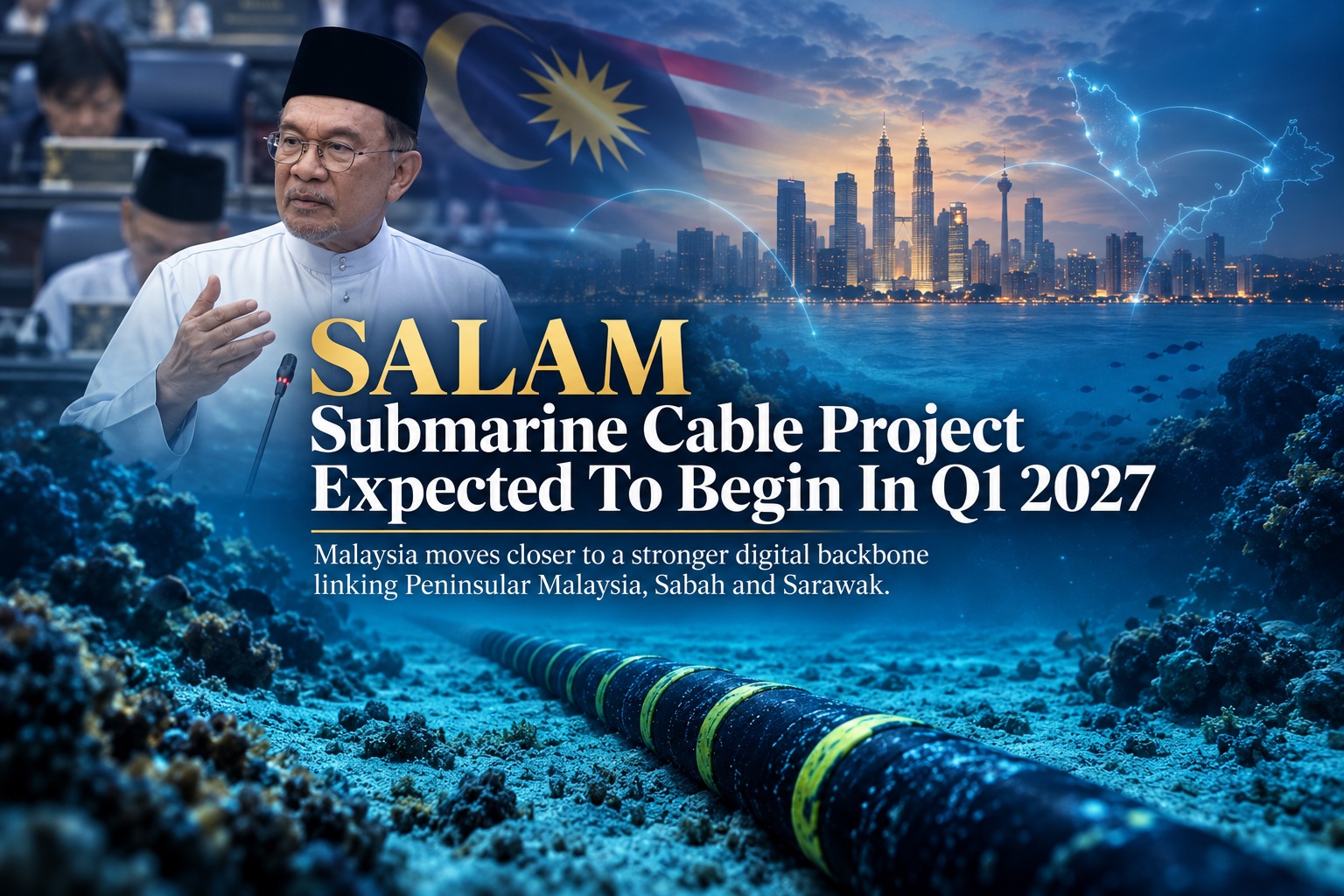
Malaysia's planned Madani Submarine Cable, better known as the SALAM project, is expected to begin development in the first quarter of 2027, with completion targeted for the fourth quarter of 2029. The project is designed to strengthen communications connectivity between Peninsular Malaysia, Sabah and Sarawak through a new high-capacity domestic submarine cable system.
SALAM was first announced by Prime Minister Datuk Seri Anwar Ibrahim during the tabling of Budget 2026 on 10 October 2025. A year later, the project is moving closer towards implementation, with the Malaysian Communications and Multimedia Commission currently evaluating submissions received following the publication of its invitation document.
A New Domestic Submarine Cable For Malaysia
The SALAM project is intended to provide Malaysia with a more resilient communications backbone linking the peninsula with Sabah and Sarawak. Rather than relying entirely on existing cable infrastructure, the government wants to establish a new high-capacity submarine network with multiple routes and backup capabilities.
This additional redundancy is particularly important for communications infrastructure. If one route experiences a failure, damage or service disruption, traffic can potentially be redirected through another path instead of leaving affected regions dependent on a single connection.
For a country separated geographically by the South China Sea, strengthening submarine connectivity between Peninsular Malaysia and East Malaysia is especially important for long-term digital resilience.
Construction Targeted To Start In Early 2027
According to a written parliamentary reply, development of the SALAM cable is expected to begin during the first quarter of 2027.
The target completion date is currently set for the fourth quarter of 2029, meaning the project is expected to take almost three years from the start of implementation to completion.
The Malaysian Communications and Multimedia Commission, or MCMC, is currently assessing submissions received after the project's invitation document was issued. This indicates that the initiative is still within the evaluation and procurement stages before physical deployment begins.
Why Malaysia Needs More Submarine Cable Resilience
Submarine cables carry enormous amounts of internet and telecommunications traffic between regions. While they are generally reliable, failures can occur because of cable damage, natural events, equipment problems or other disruptions.
A domestic system with diverse network routes gives network operators more options when something goes wrong.
The SALAM project is specifically being designed with high capacity, network diversity and backup capabilities. The goal is not simply to increase bandwidth, but also to make the country's communications infrastructure more resilient.
That distinction matters because connectivity is increasingly critical to government services, businesses, cloud platforms, healthcare systems and everyday communications.
Sabah And Sarawak Stand To Benefit Significantly
East Malaysia remains one of the most important parts of the SALAM project because geographical distance makes terrestrial connectivity with Peninsular Malaysia impossible.
Sabah and Sarawak already depend heavily on submarine and other long-distance telecommunications infrastructure. Adding another domestic cable system could improve both capacity and redundancy for services travelling between the regions.
The project also comes as the government continues expanding terrestrial and wireless connectivity through the next phase of the National Digital Network Plan, better known as Jendela.
Taken together, SALAM and Jendela address different parts of the same challenge: improving Malaysia's digital infrastructure from the national backbone down to individual communities.
Jendela Phase 2 Is Also Moving Forward
Alongside the SALAM update, the Communications Ministry provided new information regarding Jendela Phase 2, or Jendela 2.
MCMC is preparing to begin the rollout of Group 1 next month, covering a total of 1,000 sites nationwide. Of those, 352 sites are located in Sabah, making the state a major focus of the first rollout group.
The planned deployment will use different technologies depending on the needs and conditions of each area. These can include public 4G mobile services, combined 4G and 5G coverage, or satellite broadband.
This flexible approach recognises that one connectivity solution does not necessarily work equally well everywhere.
Different Areas May Use Different Connectivity Technologies
Malaysia's geography makes nationwide coverage particularly challenging.
Urban and suburban areas may be relatively straightforward to serve using conventional mobile towers and fibre connectivity. Remote communities, mountainous regions and locations separated by difficult terrain can require very different solutions.
For some Jendela 2 sites, conventional 4G coverage may be sufficient. Others may benefit from a combination of 4G and 5G, while especially remote locations could be better served through satellite broadband.
Allowing MCMC to select the most appropriate technology for each area should help avoid forcing a single deployment method onto locations where it may not be practical.
Kinabatangan Receives The Largest Number Of Sabah Sites
Of the 352 Jendela 2 Group 1 sites planned for Sabah, Kinabatangan will receive the largest allocation with 106 sites.
The distribution across Sabah is as follows:
• Kinabatangan – 106 sites
• Pensiangan – 55 sites
• Kota Marudu – 36 sites
• Kalabakan – 29 sites
• Kudat – 26 sites
• Tuaran – 23 sites
• Penampang – 15 sites
• Ranau – 15 sites
• Sipitang – 13 sites
• Kimanis – 12 sites
• Sepanggar – 6 sites
• Papar – 5 sites
• Batu Sapi – 4 sites
• Beaufort – 3 sites
• Tawau – 3 sites
• Putatan – 1 site
The large number of planned sites in areas such as Kinabatangan and Pensiangan reflects the ongoing challenge of expanding reliable internet coverage across Sabah's more geographically dispersed communities.
More Sabah Locations Could Be Added Later
The current site allocation is not necessarily the final extent of Jendela 2 deployment in Sabah.
The Communications Ministry said the government, through MCMC, will continue assessing current connectivity requirements and may consider expanding implementation into other areas of the state.
Future expansion will depend on priorities and the availability of funding.
Putatan was specifically mentioned as one of the areas that could receive further consideration, despite having only one site included within the current Group 1 rollout.
SALAM And Jendela Solve Different Problems
Although SALAM and Jendela are being discussed together, they operate at very different levels of Malaysia's communications infrastructure.
SALAM focuses on the national backbone. Its submarine cables will help carry large volumes of traffic between Peninsular Malaysia, Sabah and Sarawak.
Jendela, meanwhile, is more focused on bringing usable connectivity closer to individual communities and users through mobile coverage and broadband access.
You can think of SALAM as strengthening the major highways carrying Malaysia's digital traffic, while Jendela builds the roads that ultimately connect homes, businesses and communities to those highways.
Both are necessary if connectivity improvements are to reach users consistently.
Better Backbone Capacity Supports Future 5G Growth
The timing of SALAM is also important as Malaysia continues expanding 5G and other high-bandwidth digital services.
Wireless networks still depend heavily on fixed infrastructure behind the scenes. Mobile towers and 5G base stations need high-capacity connections back into national and international networks.
As more Malaysians use cloud services, streaming, AI applications, remote work and high-bandwidth mobile applications, the amount of data travelling through the country's telecommunications infrastructure continues increasing.
Additional submarine capacity between East and West Malaysia could therefore become increasingly important even if ordinary users never interact directly with the cable itself.
Redundancy Is Just As Important As Speed
Connectivity discussions often focus on headline speeds, but resilience can be equally important.
A very fast connection is not particularly useful if one infrastructure failure can interrupt services across a large region.
By incorporating diverse cable routes and backup capabilities, SALAM is intended to reduce the impact of individual failures. This could help telecommunications operators maintain services even when maintenance, accidents or other incidents affect part of the network.
For businesses and public services increasingly dependent on digital connectivity, that reliability can be just as valuable as additional bandwidth.
A Long-Term Infrastructure Investment
The expected Q4 2029 completion date shows that SALAM is a long-term infrastructure project rather than something users will notice immediately.
Submarine cables require significant planning, route assessments, equipment procurement, cable manufacturing, installation and testing before commercial traffic can begin flowing across them.
Once operational, however, this type of infrastructure can remain useful for many years.
That makes the design decisions being taken now important not only for current connectivity requirements but also for future demand across Sabah, Sarawak and Peninsular Malaysia.
Final Thoughts
The SALAM submarine cable project is now expected to begin implementation in Q1 2027 and reach completion by Q4 2029, giving Malaysia a new high-capacity domestic communications link between Peninsular Malaysia, Sabah and Sarawak. With multiple network routes and backup capabilities planned, the project is as much about improving resilience as it is about adding additional capacity.
At the same time, Jendela 2 is preparing to expand connectivity much closer to individual communities, with 1,000 Group 1 sites nationwide and 352 located in Sabah. The use of 4G, combined 4G and 5G, or satellite broadband depending on local conditions should give MCMC greater flexibility when addressing difficult-to-reach areas.
Together, SALAM and Jendela 2 represent two complementary parts of Malaysia's longer-term digital infrastructure strategy: strengthening the backbone that connects the country while continuing to expand reliable internet access to communities that still need better coverage.











Comments 0