

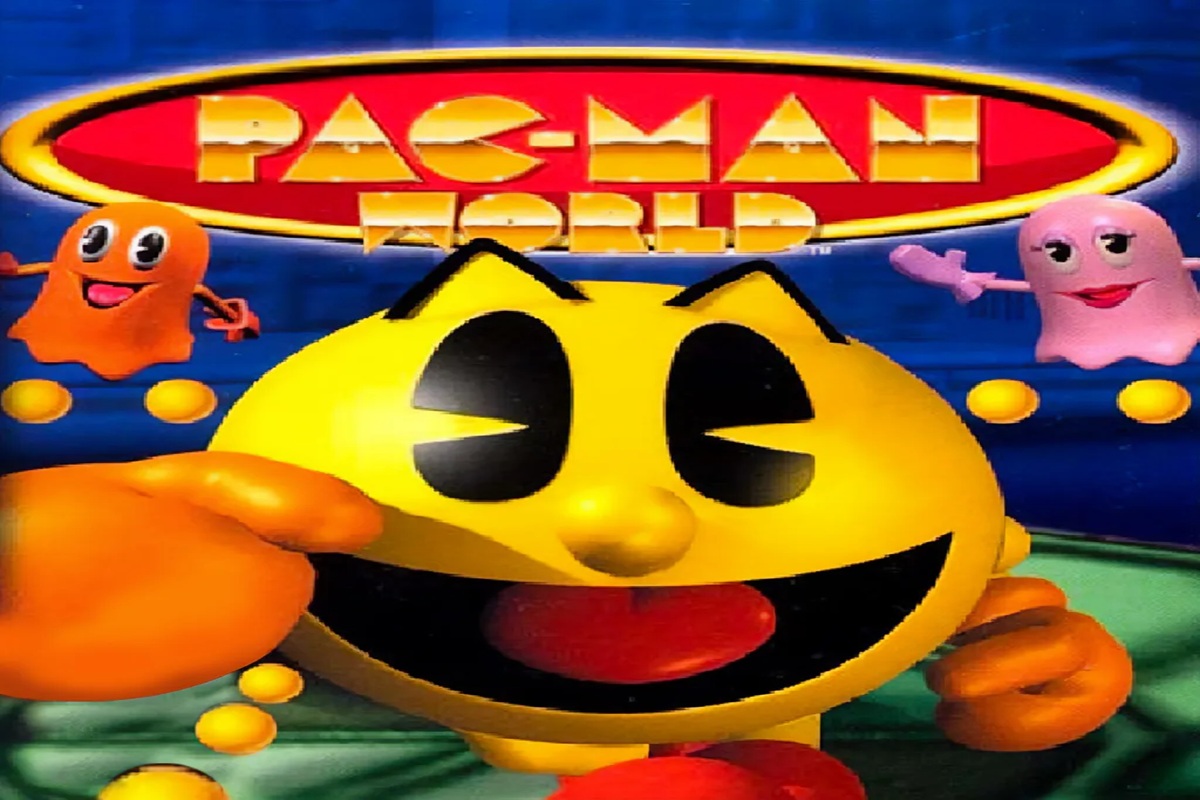
Pac-Man World takes one of gaming's most recognizable arcade characters and places him inside a much broader platforming adventure filled with exploration, environmental puzzles, enemies, collectibles, and familiar Pac-Man mechanics. Rather than spending the entire game inside traditional mazes, players guide Pac-Man across beaches, underground areas, futuristic environments, and other imaginative locations while searching for his kidnapped family and friends. The Game Boy Advance version adapts the original Pac-Man World concept into a more compact handheld experience while preserving its most important movement abilities and puzzle mechanics. It is a very different style of Pac-Man game, but the constant presence of Pac-Dots, ghosts, fruit, and Power Pellets keeps the adventure connected to the arcade classic.
The game begins with Pac-Man discovering that the mysterious Toc-Man has captured his loved ones and taken them away to Ghost Island. Pac-Man must travel through dangerous environments, overcome enemies, activate switches, locate important items, and gradually work his way toward Toc-Man's hideout. Along the way, familiar arcade ideas are reinterpreted for platforming, with fruit becoming useful for opening special doors and Pac-Dots serving both as collectibles and offensive projectiles. These systems give Pac-Man World an identity that sits comfortably between traditional mascot platforming and classic Pac-Man gameplay.
Now playable online through Lemon Web Games, Pac-Man World brings this colorful platforming adventure directly into modern web browsers without requiring the original handheld console. Players can explore the different stages, master Pac-Man's Butt-Bounce and Rev Roll, search for collectibles, defeat ghosts, and continue the journey toward Toc-Man. The browser-based version makes it easy to revisit a distinctive period in Pac-Man's history when the character was being adapted into larger adventure games rather than remaining entirely inside arcade mazes. Whether you played the handheld version years ago or are discovering it for the first time, its combination of familiar Pac-Man ideas and platforming mechanics remains entertaining.
Taking Pac-Man Beyond His Traditional Mazes
Pac-Man began as one of the purest arcade games ever created, with players navigating compact mazes while eating pellets and avoiding four persistent ghosts. Pac-Man World takes that instantly recognizable formula and asks what Pac-Man might do inside a larger platforming environment. Instead of simply turning corners inside a maze, he now jumps between platforms, attacks enemies, breaks containers, activates switches, and navigates obstacles. This dramatically changes the pace while still keeping several familiar elements at the center of the experience.
The transition works because Pac-Man's original mechanics are not completely abandoned. Pac-Dots remain important, Power Pellets still reverse the relationship between Pac-Man and the ghosts, and fruit continues to appear throughout the adventure. The difference is that these familiar objects now serve new purposes within larger stages. This gives longtime players recognizable references without simply reproducing the original arcade game.
The result is a platformer that feels unusual compared with mascot games built around more conventional heroes. Pac-Man does not rely on punches, swords, or firearms as his primary tools. His movement abilities are based around bouncing, rolling, jumping, and throwing the same pellets he once simply consumed. That playful interpretation is one of the reasons Pac-Man World has maintained its own identity within the larger franchise.
A Portable Interpretation of the Original Adventure
The Game Boy Advance edition is not a complete one-to-one recreation of the original home-console release. The handheld hardware required the adventure to be redesigned and condensed, resulting in a more focused selection of stages and mechanics. Some environments and features from the larger version were simplified or removed, while the remaining stages were adapted to work within the capabilities of a portable system. This makes the GBA release better understood as its own interpretation of Pac-Man World rather than merely a smaller visual copy.
The camera perspective and stage design also give the handheld version a distinctive feel. Environments create the impression of three-dimensional depth even though the game is running on much more limited hardware. Pac-Man can move around platforms, navigate elevated areas, and interact with objects positioned at different depths within the scene. This gives the stages more spatial complexity than a straightforward left-to-right platformer.
The portable structure makes the adventure relatively easy to approach in shorter sessions. Individual areas provide clear objectives, collectibles, environmental challenges, and opportunities to experiment with Pac-Man's abilities. While the handheld adaptation is more streamlined than the original version, the main platforming identity remains intact. Players still need to understand how Pac-Man's movement and special actions interact with the environment.
Toc-Man and the Rescue Mission
The story begins when Toc-Man and his forces disrupt Pac-Man's celebration and capture members of his family and group of friends. Pac-Man returns to discover what has happened and sets out to rescue them, eventually travelling across Ghost Island in pursuit of the mysterious villain. The premise is deliberately simple, giving players an immediate reason to move from one stage to the next. Pac-Man's journey becomes less about chasing a high score and more about completing a traditional adventure.
Toc-Man is designed as a twisted imitation of Pac-Man, creating a villain who directly reflects the hero rather than simply being another member of the familiar ghost gang. His appearance and role give the game a central antagonist capable of supporting a longer storyline. Instead of Blinky, Pinky, Inky, and Clyde functioning as the primary threat, the ghosts become part of Toc-Man's larger scheme. This allows Pac-Man World to expand its story beyond the structure of the original arcade game.
The rescue theme also encourages exploration. Progress is not simply about reaching the end of a stage as quickly as possible, because Pac-Man frequently needs to search environments for keys, fruit, switches, and other important objects. The game therefore rewards players who pay attention to their surroundings. This more deliberate structure helps distinguish the adventure from Pac-Man's traditional maze-based gameplay.
Mastering the Butt-Bounce
One of Pac-Man's most useful new abilities is the Butt-Bounce, which is performed while jumping. Pac-Man slams downward onto whatever is beneath him, allowing him to defeat certain enemies, smash objects, and interact with environmental mechanisms. It also gives him additional vertical movement because repeated bouncing can help him reach areas that would otherwise be too high. The move quickly becomes one of the most frequently used abilities in the game.
Environmental design often revolves around understanding when to use the Butt-Bounce. Switches positioned on the ground may require Pac-Man to land directly on them, while certain containers can only be broken from above. Bouncing platforms can also launch him toward elevated areas or across gaps. These situations make the ability useful for both combat and navigation.
The Butt-Bounce fits Pac-Man surprisingly well because it keeps his movement playful and energetic. Rather than turning him into a conventional fighting character, the game makes his rounded body part of the platforming mechanics. The ability is simple enough to understand immediately but appears in enough different situations to remain useful throughout the adventure. Mastering the timing becomes especially important during more demanding platforming sequences.
Using the Rev Roll for Speed and Momentum
The Rev Roll gives Pac-Man another important movement option. By charging in place and then releasing the move, Pac-Man launches forward at high speed in a manner reminiscent of a powerful rolling dash. The technique can be used to attack certain enemies, climb steep surfaces, cross dangerous gaps, and interact with special machinery. It introduces momentum-based challenges that feel very different from ordinary jumping.
Some environmental devices are specifically designed around the Rev Roll. Rev Pads can activate machinery or moving platforms when Pac-Man builds enough energy on top of them. Other sections require him to accelerate up slopes that would be impossible to climb through normal movement. These challenges make the ability an essential part of progression rather than an optional speed boost.
The Rev Roll also creates opportunities for faster movement through familiar sections once the player becomes comfortable with the controls. Charging too much or releasing the move at the wrong angle can send Pac-Man into danger, so accuracy remains important. This balance between speed and control gives the mechanic more depth than simply holding a button to run faster. When used correctly, it makes Pac-Man feel surprisingly agile.
Turning Pac-Dots into Weapons
Pac-Dots are one of the most recognizable objects in video game history, but Pac-Man World gives them a completely new purpose. Instead of existing only as items to eat for points, collected Pac-Dots can be thrown at enemies as projectiles. This provides Pac-Man with a ranged attack that can deal with threats positioned away from his immediate jumping range. It is especially useful when approaching enemies in dangerous locations.
Because thrown Pac-Dots come from the player's collected supply, using them also introduces a small element of resource management. Players can spend their pellets to make certain encounters easier or conserve them while relying on movement and the Butt-Bounce. A charged Pac-Dot attack can provide additional offensive power when facing groups of enemies or more durable targets. This transforms a familiar collectible into an active part of the combat system.
The idea works particularly well because it connects the new platforming mechanics directly to classic Pac-Man imagery. Rather than inventing an unrelated projectile weapon, the developers repurposed something players already associate with the character. It is a simple design choice, but one that helps the adventure feel recognizably like Pac-Man. The same philosophy appears throughout many of the game's mechanics.
Power Pellets and the Return of the Ghosts
Blinky, Pinky, Inky, and Clyde remain an important part of Pac-Man's world, even though Toc-Man is now the central villain. Ghosts appear throughout the platforming stages and behave differently from many ordinary enemies. Pac-Man cannot simply approach them safely in every situation, preserving some of the tension associated with the original arcade game. Their presence immediately brings a familiar element into otherwise unfamiliar environments.
Power Pellets continue to reverse the situation. After collecting one, Pac-Man temporarily gains the ability to turn against the ghosts and eat them. This recreates one of the most recognizable moments from the arcade original while placing it inside a completely different gameplay structure. Players who have known Pac-Man for decades immediately understand what a Power Pellet means without requiring explanation.
These encounters provide an effective bridge between old and new Pac-Man mechanics. The platforming stages may feature jumping, switches, and environmental puzzles, but seeing ghosts and Power Pellets reminds players where the character originated. The temporary shift from avoiding ghosts to actively hunting them also creates short bursts of faster gameplay. It is a classic mechanic that adapts naturally to the larger adventure.
Fruit Doors and Environmental Puzzle Solving
Fruit plays a much more practical role in Pac-Man World than it does in the original arcade game. Throughout the stages, players encounter special doors marked with pictures of particular fruit. Pac-Man must locate the matching fruit somewhere in the surrounding environment before the door can be opened. This encourages players to explore areas carefully rather than simply moving toward the exit.
Behind these doors may be useful items, switches, or routes necessary for progression. Some require players to backtrack after finding the correct fruit, adding a small puzzle element to the stages. Remembering where a locked door appeared can therefore become important. These mechanics help make the environments feel interconnected rather than purely linear.
The fruit system also provides a clever reinterpretation of another classic Pac-Man collectible. Cherries, strawberries, and other familiar bonus items are no longer simply objects that award extra points. They now function as keys that influence exploration. This gives them a meaningful place within the platforming adventure while retaining their nostalgic connection to the arcade series.
Switches, Platforms, and Interactive Environments
Pac-Man World frequently asks players to manipulate the environment before they can continue. Switches may open doors, activate temporary platforms, move machinery, or reveal previously inaccessible routes. Some are activated through an ordinary jump, while others require the Butt-Bounce or another specific ability. Understanding which action is needed becomes part of the environmental puzzle solving.
Moving platforms introduce another layer of challenge because Pac-Man must judge both distance and timing. The depth-oriented perspective can make certain jumps more demanding, especially when platforms move toward and away from the player rather than simply from side to side. Taking a moment to understand the movement pattern is often safer than rushing immediately into a jump. Later areas combine several of these ideas into longer platforming sequences.
The interaction between abilities and stage objects is one of the game's stronger design elements. Rev Rolls activate specific devices, Butt-Bounces trigger switches, fruit opens doors, and collected items reveal additional possibilities. This gives players reasons to use Pac-Man's full move set instead of relying entirely on basic jumping. The environments themselves become part of the gameplay.
Chrome Pac-Man and Underwater Exploration
The Chrome power-up temporarily transforms Pac-Man into a metallic version of himself. While active, he becomes much more resistant to danger and gains enough weight to move along underwater surfaces. This creates opportunities to reach treasure and other objects that would normally remain inaccessible. The transformation is both visually distinctive and mechanically useful.
Underwater sections naturally change Pac-Man's movement. Players need to account for the different feel of swimming while searching for routes, collectibles, and environmental objects. The Chrome power-up can turn these areas into more traditional ground-based exploration by allowing Pac-Man to sink and interact with objects below the surface. Butt-Bouncing underwater can also be used to break certain containers.
These sections prevent the platforming from relying entirely on the same movement pattern throughout the adventure. The sudden change in physics makes familiar abilities feel slightly different and encourages players to adjust their approach. Chrome Pac-Man also provides one of the game's more memorable visual transformations. It is another example of a temporary power-up being integrated directly into environmental design.
Collectibles Reward Thorough Exploration
Pac-Man World retains the score-focused heritage of the arcade series through numerous collectible objects scattered across its stages. Pac-Dots naturally contribute to this, but fruit, extra lives, and other items provide additional reasons to investigate optional routes. Players interested only in reaching the end can usually focus on the main path, while those seeking higher completion can explore more thoroughly. This supports different approaches to the platforming stages.
Many collectibles are positioned in locations that require careful use of Pac-Man's abilities. A high platform may require repeated Butt-Bounces, while another item may sit behind a fruit door that requires searching elsewhere first. Rev Roll sections can hide rewards beyond dangerous gaps, and underwater areas may contain objects accessible only through temporary power-ups. Collecting everything therefore becomes a test of both observation and movement.
This structure gives stages greater replay value because players may notice previously missed paths during later attempts. Once Pac-Man's movement mechanics become more familiar, returning to earlier environments can reveal opportunities that were easy to overlook the first time. Completion-minded players can therefore approach the game differently from those primarily interested in the story. The collectibles provide additional purpose beyond simply reaching Toc-Man.
Pirate Beaches and Coastal Platforming
The adventure begins with pirate-themed environments that immediately establish the game's more imaginative direction. Wooden structures, water, cannons, beaches, and maritime obstacles create a colorful setting very different from Pac-Man's traditional maze. These early stages gradually introduce the main movement abilities and environmental mechanics. They function as both an introduction to the adventure and a demonstration of how far Pac-Man has travelled from his arcade origins.
Cannons and other hazards make movement increasingly dangerous as players progress through the pirate-themed sections. Pac-Man must combine jumping with careful positioning while searching for items and switches. The relatively bright environment makes the stages approachable while still presenting several opportunities for hidden collectibles. These opening areas establish many of the ideas that become more demanding later.
The pirate setting also demonstrates the flexibility of the Pac-Man character. Because the original arcade game had such a simple visual world, later developers had considerable freedom when constructing larger environments around him. Ghost Island can therefore move between completely different themes without feeling constrained by realistic geography. The result is a deliberately playful collection of worlds.
Caverns, Mines, and Underground Hazards
Later stages move underground into darker environments filled with rocky passages, narrow platforms, and environmental dangers. The change in visual tone provides immediate contrast with the bright coastal areas. Underground sections place greater emphasis on careful navigation because falling or misjudging platform depth can quickly become dangerous. The confined surroundings can also make enemy encounters more difficult to avoid.
Switches, moving platforms, and breakable objects become increasingly important in these areas. Players often need to determine which route is safe before committing to a jump or Rev Roll. Pac-Man's abilities are no longer being introduced individually; instead, the game begins combining them within the same section. This gradually increases the challenge without changing the basic control system.
The mine and cavern settings also fit naturally with collectible hunting. Hidden passages and blocked routes encourage players to investigate rather than always following the most obvious direction. Fruit doors and environmental mechanisms can lead away from the main route toward additional rewards. These stages reward players who have become comfortable navigating the game's depth-oriented perspective.
Travelling into Space
Pac-Man World eventually pushes its adventure beyond Ghost Island's more traditional environments and into futuristic space-themed stages. Platforms float above dangerous gaps, technological obstacles appear throughout the environment, and the visual presentation becomes much more artificial than the earlier beaches and caves. The dramatic change in setting helps prevent the adventure from becoming visually repetitive. It also emphasizes the intentionally exaggerated nature of Pac-Man's world.
Space levels make particularly strong use of moving platforms and carefully timed jumps. Because many sections are surrounded by open space, missing a landing can carry greater consequences than in areas with solid ground beneath them. Players need to judge Pac-Man's position accurately while accounting for the perspective. This can make the stages some of the more demanding sections of the adventure.
The futuristic environment also gives the game an opportunity to introduce enemies and mechanisms that would look out of place in earlier areas. The result is a stronger sense of progression even though Pac-Man's core abilities remain unchanged. Players gradually learn to apply the same Butt-Bounce, Rev Roll, and jumping mechanics to increasingly unusual situations. That consistency helps the game remain understandable while its environments grow more elaborate.
Funhouse Stages Bring a Playful Change of Pace
The funhouse-themed sections embrace Pac-Man's colorful personality with circus-like environments, unusual platforms, and playful visual design. These stages feel deliberately less serious than the darker underground areas. Bright objects and unpredictable environmental elements help create the sensation of moving through an exaggerated amusement attraction. It is one of the settings that best suits the cheerful personality traditionally associated with Pac-Man.
Platforming remains the central challenge, but the surroundings make familiar mechanics feel fresh. Barrels, moving structures, switches, and environmental obstacles can appear within layouts designed to look more playful than dangerous. The visual presentation can occasionally disguise how precise certain movements need to be. Players still need to pay close attention to Pac-Man's position even when the environment looks lighthearted.
This contrast between themes is important to the overall pacing. Pac-Man World is not trying to create a single coherent realistic environment; it is building a collection of imaginative platforming playgrounds. Pirate beaches, mines, outer space, and funhouse locations can therefore exist within the same adventure without needing elaborate explanation. The variety keeps the journey visually interesting.
A Distinctive Depth-Oriented Platforming Perspective
One of the most unusual aspects of the handheld version is the way it represents three-dimensional space. Pac-Man often moves through environments that appear angled or depth-oriented rather than following a purely horizontal path. This allows stages to contain platforms positioned both across and into the scene. The visual approach gives the game a larger sense of space than a conventional flat platformer.
The trade-off is that depth can occasionally make jumps harder to judge. A platform may appear close enough even though Pac-Man's position is slightly misaligned, particularly when moving toward or away from the screen. Players gradually learn to use environmental edges and Pac-Man's shadow or position as references. Once the perspective becomes familiar, movement becomes much more predictable.
This design is an important part of the game's identity. A completely traditional side-scrolling conversion would have been easier to read, but it would also have lost some of the spatial character of Pac-Man World. The handheld adaptation instead attempts to preserve the sense of a three-dimensional platforming environment within the limitations of the hardware. That ambition gives the game a visual style distinct from many other portable platformers of its era.
The Final Confrontation with Toc-Man
The adventure eventually leads Pac-Man to Toc-Man, the villain responsible for kidnapping his family and friends. Reaching this confrontation requires completing the preceding platforming stages and overcoming the various environmental challenges scattered across Ghost Island. Toc-Man serves as the culmination of the game's storyline and provides the most direct confrontation between Pac-Man and his mysterious imitator. The battle gives the adventure a more traditional ending than the endless scoring loop of the original arcade game.
The handheld version places greater emphasis on Toc-Man because several other elaborate boss encounters from the larger original release were not retained in the same form. This makes the final confrontation especially important to the structure of the portable adaptation. Instead of encountering a major boss after every themed world, much of the challenge comes directly from the platforming stages themselves. Toc-Man therefore becomes the primary payoff after the journey.
By the time players reach him, they should be comfortable using Pac-Man's movement abilities and understanding how environmental mechanics operate. The final section draws on skills developed across the adventure rather than introducing an entirely unrelated control scheme. This gives the confrontation a natural place within the game's progression. Defeating Toc-Man completes Pac-Man's transition from arcade maze runner to platforming hero.
Why Pac-Man World Remains Interesting Today
Pac-Man World is interesting because it represents an era when developers were searching for ways to adapt classic arcade mascots into larger adventures. Pac-Man's original gameplay was already legendary, but simply recreating the maze formula would not have demonstrated what the character could do in a platformer. The game therefore builds an entirely new movement system around his visual identity. Butt-Bouncing, Rev Rolling, and throwing Pac-Dots feel playful without abandoning the character's origins.
The environmental puzzles also give familiar Pac-Man objects new purposes. Fruit becomes a key for opening doors, Pac-Dots become ammunition, Power Pellets continue to counter ghosts, and temporary transformations allow access to unusual areas. These reinterpretations show how a simple arcade concept can be expanded without completely losing its identity. Even when Pac-Man is far away from a traditional maze, familiar imagery remains part of the experience.
The handheld adaptation is naturally more compact than the larger version that inspired it, but that can also make it approachable for players who want a straightforward platforming adventure. Stages focus on movement, collecting, switches, environmental interaction, and occasional combat without overwhelming the player with complex systems. Its simplicity gives it an unmistakably retro feel. For Pac-Man fans interested in the franchise beyond its arcade beginnings, it remains an unusual and worthwhile chapter.
Playing Pac-Man World Online Today
Through Lemon Web Games, Pac-Man World can now be played directly in your web browser with no downloads or setup required. Features of the web-based version include:
Playing Pac-Man World through a browser offers an easy way to revisit a very different interpretation of one of gaming's oldest characters. The basic controls are straightforward, but mastering Pac-Man's movement becomes increasingly important as the stages introduce more demanding platform layouts and environmental mechanisms. Short stages make it suitable for quick gaming sessions, while collectible hunting provides additional objectives for players who want to explore more thoroughly. Its combination of arcade references and platforming ideas remains immediately recognizable.
For newcomers, the game also provides an interesting look at how Pac-Man evolved beyond his original arcade format. Many younger players may primarily associate the character with mazes, ghosts, and pellets, but Pac-Man World shows that those ideas can support a much broader adventure. The handheld version may be smaller in scope than other interpretations, yet its core movement mechanics still provide plenty of personality. It remains an accessible entry point into Pac-Man's platforming history.
Who Should Play Pac-Man World
Pac-Man World is particularly suitable for players who enjoy platformers where movement mechanics are closely connected to environmental puzzles. The Butt-Bounce and Rev Roll are not merely attacks; they are essential tools used to activate mechanisms, climb surfaces, cross gaps, and discover new routes. Fruit Doors and switches add additional reasons to examine each environment carefully. Players who enjoy finding optional paths will therefore get more from the adventure than those who rush directly toward each exit.
The game is also worth experiencing for anyone interested in how classic arcade franchises evolved during the transition toward larger character-driven adventures. Pac-Man was originally defined by an extremely focused maze formula, yet Pac-Man World successfully gives him a broader range of abilities without completely abandoning his roots. The result belongs to a specific era of mascot platforming that now carries plenty of nostalgic appeal. It is simple, colorful, occasionally challenging, and unmistakably Pac-Man.
Play Pac-Man World Online Now
Pac-Man World transforms the familiar pellet-eating arcade hero into a surprisingly capable platforming character. Pac-Man can jump across dangerous gaps, Butt-Bounce enemies and switches, build momentum with the Rev Roll, throw Pac-Dots, use Power Pellets against ghosts, and search environments for fruit needed to unlock new routes. These mechanics create an adventure that is much broader than the original maze formula while still relying on recognizable ideas from the franchise. The varied environments also give players something new to discover as the journey moves from beaches and caverns into stranger locations.
Through Lemon Web Games, players can experience this handheld interpretation directly in a modern browser without relying on the original cartridge or portable hardware. Returning players can rediscover the unusual depth-oriented stages and familiar movement abilities, while newcomers can explore a side of Pac-Man that is very different from his arcade beginnings. The controls remain easy to understand, but later platforming sections provide enough challenge to reward careful play. For fans of retro mascot games, Pac-Man World offers a colorful and distinctive adventure.
Final Thoughts
Pac-Man World is an important example of how an iconic arcade character can be reinvented without completely abandoning the ideas that made the original game famous. Pac-Dots, Power Pellets, ghosts, fruit, and Pac-Man himself remain central to the experience, but each element is given a new role within a platforming adventure. The Butt-Bounce and Rev Roll provide Pac-Man with a surprisingly expressive movement system, while environmental switches, fruit doors, underwater sections, and moving platforms give players more to think about than simply reaching the end of a stage. These mechanics create a game that feels familiar and different at the same time.
The Game Boy Advance adaptation is more streamlined than the larger original adventure, but it preserves the central concept effectively. Its depth-oriented environments, collectible-focused stages, and varied themes give the game a personality of its own, even if some jumps require additional care because of the perspective. Rather than attempting to recreate every feature of the original release, the handheld version concentrates on Pac-Man's core platforming abilities and the journey toward Toc-Man. That more compact structure makes it particularly suitable for players looking for a straightforward retro adventure.
More than two decades after its handheld release, Pac-Man World remains an enjoyable reminder that Pac-Man can work outside the maze when the surrounding mechanics are designed around his identity. Throwing Pac-Dots, eating ghosts after collecting a Power Pellet, bouncing across platforms, and revving up ramps all feel like playful extensions of a character originally created around extremely simple controls. Through Lemon Web Games, players can revisit this colorful adventure directly in their browsers and experience Pac-Man as more than an arcade maze runner. For fans of classic platformers, retro handheld games, and Pac-Man's long gaming history, it remains a distinctive journey worth exploring.











Comments 0