

Google Messages users have already been dealing with an RCS connection problem this summer, and now another frustrating issue has surfaced. Google has confirmed that it is investigating reports of group and individual conversations unexpectedly splitting into separate message threads, sometimes creating several duplicate chats involving exactly the same people.
For users affected by the bug, conversations that were once neatly contained in one thread can suddenly become fragmented across multiple entries inside Google Messages.
The problem appears to have been happening for several months, and some users say deleting the duplicate thread does not solve anything because the next incoming message simply recreates it.
Group Conversations Can Suddenly Start Over
One version of the bug affects group chats.
Users have reported that an existing RCS group conversation can unexpectedly generate an entirely new thread containing the same participants.
The new conversation may look almost identical to the original, except for one major problem: the previous message history is missing.
As the conversation continues, the same thing can apparently happen again.
Some users say a single group chat has eventually been scattered across seven or more separate threads.
That creates obvious confusion.
Instead of scrolling through one continuous conversation, users may need to jump between several different threads to understand what was previously discussed.
For active family, work or community groups, that can become irritating very quickly.
One-to-One RCS Chats Are Affected Too
The problem is not limited to group conversations.
Several users have reported the same behaviour with ordinary one-to-one RCS chats.
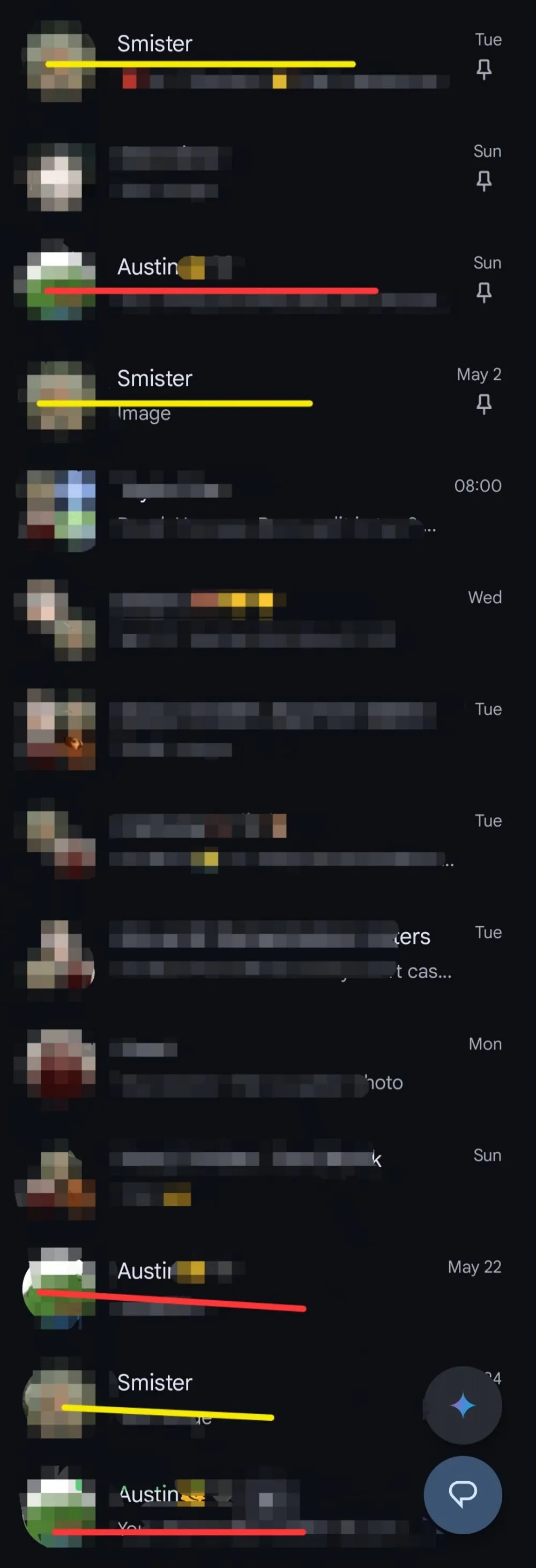
Messages from the same person can suddenly begin appearing inside a new conversation rather than continuing inside the existing thread.
What makes the issue especially confusing is that both threads may display exactly the same information.
The duplicate can show:
From the user's perspective, there may be no obvious reason why Google Messages considers the conversations different.
It simply behaves as if the same person has somehow become two separate contacts.
Deleting the Duplicate May Not Fix It
Naturally, some users have tried deleting the newly created duplicate thread.
Unfortunately, that does not appear to be a reliable workaround.
Reports suggest that once the contact sends another message, Google Messages can recreate the secondary conversation again.
That indicates the problem may sit deeper inside how the app is identifying or associating RCS conversation sessions rather than simply being an interface glitch.
Until Google fixes the underlying cause, manually cleaning up duplicate threads may therefore provide only temporary relief.
Messages for Web May Show Something Different
Another interesting detail is that the bug does not always appear consistently across Google's different messaging interfaces.
Some affected users report that Messages for Web correctly combines the apparently separate conversations.
Microsoft's Phone Link can also display them as one continuous message history.
Meanwhile, the Google Messages Android app itself continues showing two or more different threads.
That suggests the underlying message data may still be associated correctly somewhere in the system while the Android client is incorrectly separating the conversations locally.
If that is the case, it could explain why deleting one thread does not permanently solve the issue.
The incoming message may simply trigger the same incorrect association again.
Google Is Asking Users to Submit Feedback
Google has acknowledged the issue and says its Messages team is actively investigating.
In response to affected users on Reddit, the company asked people experiencing the problem to submit feedback directly through the Google Messages application.
Google specifically requested that reports include the hashtag:
#splittingthreads
That should help engineers identify relevant diagnostic information and separate these reports from unrelated Google Messages problems.
For users experiencing the bug, sending feedback could be worthwhile because issues involving RCS can depend heavily on carrier configuration, device state and conversation metadata.
The more examples Google receives, the easier it may be to identify a common pattern.
The Timing Is Not Great for Google Messages
The conversation-splitting problem arrives while Google is already dealing with another Messages issue involving RCS connectivity.
Google previously acknowledged that some users were having trouble maintaining proper RCS connections and said it was working with carrier partners to resolve the situation.
RCS has become increasingly important to Google's messaging strategy.
It provides richer messaging features such as read receipts, typing indicators, higher-quality media sharing and encrypted conversations compared with traditional SMS.
Now that RCS interoperability has expanded across Android and iPhone, reliability matters even more.
Users are much less likely to care about advanced messaging features if ordinary conversations cannot remain inside the same thread.
Why Thread Splitting Is More Than a Cosmetic Problem
At first glance, duplicate conversations may sound like a relatively minor interface annoyance.
But message history provides context.
If somebody asks, "What time did we agree on?" the answer may be sitting inside the original thread while the latest discussion has been moved somewhere else.
The same problem becomes worse with work conversations containing addresses, confirmation numbers, documents or previous decisions.
Group chats can become even harder to follow when replies are distributed across several copies of what should logically be the same conversation.
There is also the risk of users assuming older messages have been lost when they are actually sitting inside another thread.
A messaging application needs to make conversation continuity feel almost invisible.
When users suddenly have to think about how the app itself is organising their messages, something has gone wrong.
RCS Adds More Complexity Than Traditional SMS
Modern messaging is considerably more complicated than ordinary SMS.
An RCS conversation can involve phone-number identities, carrier provisioning, encryption information, device registrations and backend conversation state.
Users never normally see any of this.
They simply open a contact and send a message.
But if part of that identity or session information changes unexpectedly, the application may potentially interpret an existing conversation as a new one.
Google has not yet publicly explained the technical cause of the current bug, so it would be premature to say exactly what is happening.
The fact that Messages for Web may merge conversations that Android separates, however, makes the issue particularly interesting.
It suggests that whatever is going wrong may involve how the Android app interprets conversation identity rather than the messages themselves being completely separate at the backend.
There Is No Reliable Fix Yet
For now, there does not appear to be a universal workaround.
Restarting the phone, deleting duplicate conversations or clearing up individual threads may help temporarily for some users, but reports indicate the problem can return.
Affected users should therefore be cautious about deleting entire message histories while attempting to tidy things up.
If a conversation contains important information, backing it up before experimenting with app data or resetting messaging settings would be sensible.
The safest option may simply be to report the problem to Google and wait for an update unless the duplication becomes severe enough to require troubleshooting.
Final Thoughts
Google Messages has become far more capable over the past few years, but basic reliability still matters more than almost any new feature.
A messaging app should provide one obvious place for each conversation.
The current bug breaks that expectation by splitting both group and one-to-one RCS chats into duplicate threads that may contain different portions of the same message history.
Google says it is investigating and is asking affected users to submit feedback with #splittingthreads, so hopefully a proper fix will arrive soon.
Until then, users experiencing the issue may have to tolerate a slightly messy inbox.
Because no matter how sophisticated RCS becomes, a conversation should still remain one conversation.











Comments 0