

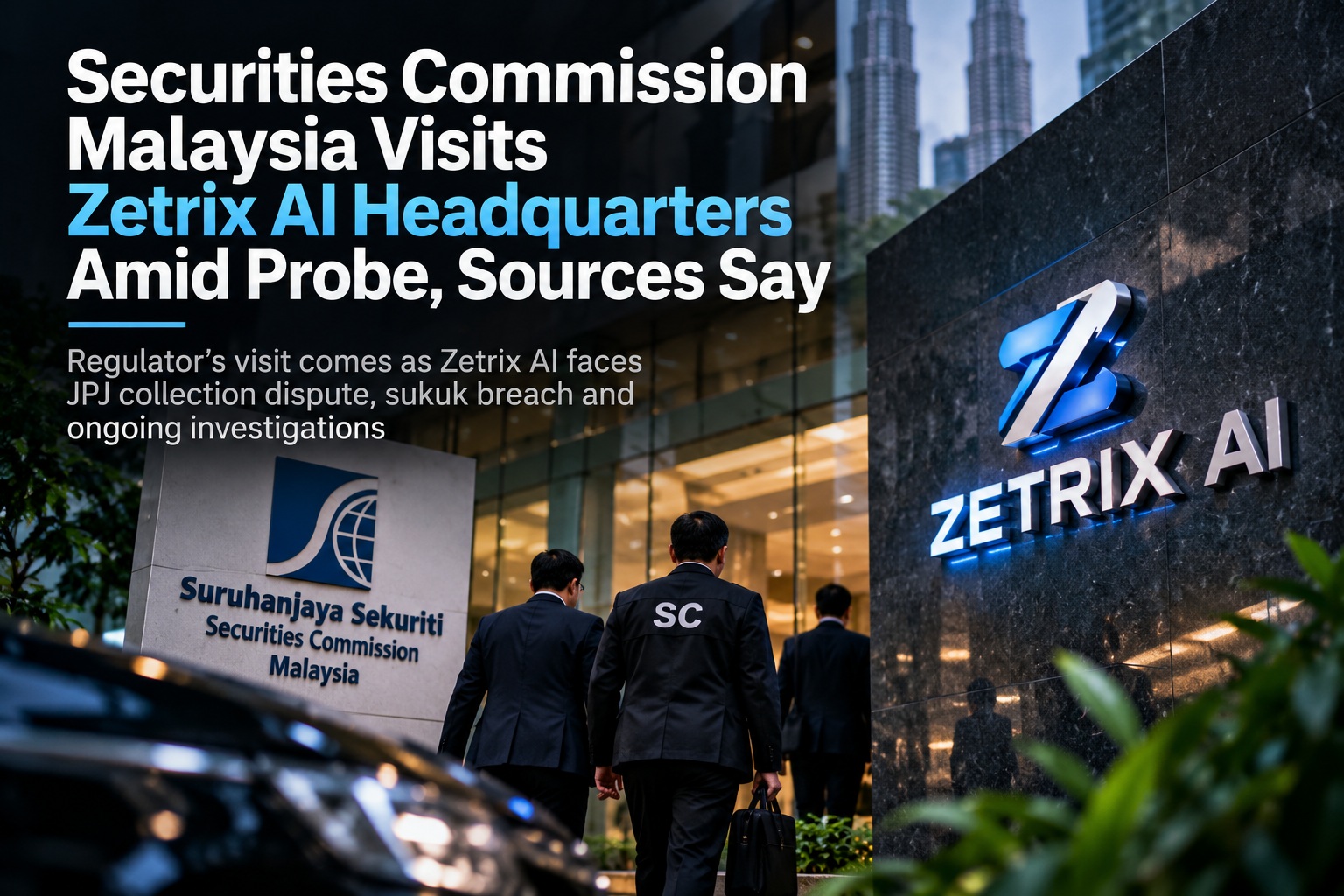
The Securities Commission Malaysia has reportedly visited the Petaling Jaya headquarters of Zetrix AI as part of an investigation involving the company. The visit was reported on 28 October, citing people familiar with the matter, adding another layer of regulatory scrutiny to a company that has already faced several major issues in recent months.
Zetrix AI, formerly known as MyEG Services Bhd, operates digital services for Malaysian government agencies and is also behind the Zetrix blockchain platform. Earlier this year, the company secured US$40 million in financing from the International Finance Corporation to support the expansion of its blockchain and digital identity infrastructure.
SC Visit Adds To Growing Regulatory Pressure
Details surrounding the Securities Commission's investigation remain limited for now, including the exact scope of the probe and what regulators were seeking during the visit. However, the development comes at a difficult time for Zetrix AI, which has been dealing with several separate financial, contractual and government-related issues.
The company's troubles intensified from late August onwards, eventually leading to the suspension of one of its government collection roles and the involvement of multiple enforcement agencies. The SC visit therefore adds another regulatory dimension to an already complicated situation.
Until more information is disclosed, it remains unclear whether the investigation is directly connected to Zetrix AI's recent financial problems or involves another matter entirely.
Zetrix AI Was Previously Known As MyEG
Zetrix AI is the company formerly known as MyEG Services Bhd, a name long associated with digital government services in Malaysia. The company has historically handled various online transactions and payment services involving public-sector agencies.
In recent years, it has expanded into blockchain infrastructure through the Zetrix platform, positioning itself around digital identity, cross-border services and enterprise blockchain applications. The rebranding reflects that broader technology focus rather than its earlier identity primarily as an e-government service provider.
Despite the diversification, its government-related businesses remain important, which makes recent problems involving public collections particularly significant.
Company Secured US$40 Million From IFC Earlier This Year
In February, Zetrix AI secured approximately US$40 million from the International Finance Corporation. The funding was intended to support the expansion of the company's digital identity and blockchain infrastructure.
At the time, the financing represented a significant vote of confidence in the company's technology strategy. Zetrix AI had been positioning itself as a participant in Malaysia's growing digital infrastructure and blockchain ecosystem.
The regulatory and financial developments that followed later in the year have therefore created a sharp contrast with the optimism surrounding that investment.
JPJ Suspended Zetrix AI As A Collection Agent
One of the most serious setbacks came in early October when the government suspended Zetrix AI's status as a collection agent for the Road Transport Department, or JPJ.
The suspension related to approximately RM314 million in revenue that had reportedly not been remitted to the department. The outstanding amount involved money collected on behalf of the government, placing the issue well beyond an ordinary commercial payment dispute.
The size of the amount and the public nature of the funds immediately attracted significant attention.
Government Is Pursuing Legal Action
Transport Minister Anthony Loke Siew Fook told Parliament that the government was in the process of pursuing legal action against the company, including a potential civil suit.
According to the minister, Zetrix AI failed to settle the outstanding collections and penalties within the period required by the government. The matter therefore progressed beyond administrative discussions into formal legal action.
Loke also stressed a broader principle surrounding public-sector collections: companies appointed to collect money on behalf of government agencies cannot treat those funds as working capital for their own businesses.
Government Collections Are Not Operating Funds
The minister's comments highlighted an important distinction between money belonging to a company and funds merely passing through it on behalf of the government.
A collection agent may temporarily receive payments from the public, but those funds ultimately belong to the relevant government department. They therefore need to be transferred according to agreed timelines and procedures.
Using those collections to finance day-to-day operations would create significant financial and governance concerns because the money does not belong to the service provider.
That point has become central to the government's response to the Zetrix AI situation.
Police And MACC Are Reportedly Sharing Intelligence
The Royal Malaysia Police and the Malaysian Anti-Corruption Commission are also reportedly sharing intelligence connected to the investigation into the outstanding JPJ collections.
The involvement of multiple enforcement bodies demonstrates the seriousness with which authorities are treating the matter. It does not automatically imply wrongdoing beyond what has already been reported, but it does mean the situation is being examined from several angles.
Zetrix AI has said that it is cooperating fully with the relevant authorities.
Company Says Daily Operations Remain Unaffected
Despite the investigations and government action, Zetrix AI has maintained that its day-to-day business operations continue as usual.
This distinction is important because the company operates several services beyond the affected JPJ collection arrangement. Suspension from one government function does not necessarily mean the entire company has stopped operating.
Still, the combination of legal, regulatory and financial issues could create uncertainty among investors, creditors and business partners if the situation remains unresolved for an extended period.
A Separate Sukuk Problem Emerged Shortly Afterwards
Roughly two weeks after the JPJ suspension, Zetrix AI disclosed another serious issue: it had breached a covenant connected to its RM2 billion sukuk programme.
The covenant requires managing director Wong Thean Soon to remain the company's largest shareholder. However, a substantial reduction in his ownership stake meant that condition was no longer being satisfied.
This created a separate financial problem unrelated to the JPJ collections but equally important to the company's creditors.
Forced Share Sales Reduced Wong's Stake Dramatically
Wong's shareholding reportedly fell from 29.25% on 1 April to approximately 1.84% following forced sales of pledged shares.
That is an enormous reduction over a relatively short period. Because his status as the largest shareholder formed part of the sukuk covenant, the forced selling triggered a compliance problem for the company.
The issue illustrates how changes in shareholder structure can have consequences that extend well beyond the equity market when financing agreements contain ownership-related conditions.
Socso Became The Largest Shareholder
Following the reduction in Wong's stake, the Social Security Organisation, or Socso, became Zetrix AI's largest shareholder.
Socso reportedly holds around 216 million shares, representing approximately 2.72% of the company. Although that percentage may appear relatively small, it became the largest single holding after Wong's stake was reduced.
The change in shareholder ranking is what caused the company to fall outside the terms specified by the sukuk covenant.
Zetrix AI Missed The 22 October Deadline
The company attempted to reach an agreement with sukukholders to remedy the covenant breach, but no solution was reached before the 22 October deadline.
A meeting held the following day also ended without agreement. Zetrix AI has indicated that another meeting will be arranged as it continues discussions with creditors.
Until an agreement is reached or the covenant is brought back into compliance, the situation remains unresolved.
Potential Sukuk Exposure Is Significant
If the issue ultimately develops into a payment default, Zetrix AI's obligations under the sukuk programme could become substantial.
The company reportedly faces approximately RM2 billion in principal, along with another RM164.5 million in future coupon payments.
That does not mean those amounts are currently due immediately, but they illustrate the scale of the financing involved and why resolving the covenant breach is important.
Any escalation could have significant consequences for the company's financial position.
Wong Reportedly Wants Six Months To Restore Compliance
Wong is reportedly seeking approximately six months to restore compliance with the shareholder covenant.
Presumably, that would involve rebuilding his shareholding or otherwise reaching an arrangement that satisfies sukukholders. Whether investors will agree to provide that amount of time remains uncertain.
Creditors will need to weigh the benefits of allowing the company time to resolve the issue against the risks associated with extending a waiver or amendment.
The Problems Are Separate But Happening At The Same Time
It is important to distinguish the various issues surrounding Zetrix AI. The JPJ collection dispute, the sukuk covenant breach and the Securities Commission investigation are separate developments unless regulators later confirm a connection.
However, the fact that they are occurring within such a short period increases the overall pressure on the company.
From an investor's perspective, multiple unresolved issues can create greater uncertainty than one isolated problem because each situation introduces its own financial, legal or regulatory risks.
The SC Investigation Could Become The Next Major Development
The Securities Commission's reported visit may become particularly important once more details emerge.
As Malaysia's capital markets regulator, the SC oversees areas including securities, listed-company conduct and capital-market activities. Any investigation involving a listed company naturally attracts attention because it could affect investors and market confidence.
For now, however, the precise subject of the investigation has not been publicly disclosed, so it would be premature to assume what the regulator is examining.
Investors Will Be Watching For Further Disclosures
Zetrix AI shareholders and sukukholders will likely be watching closely for additional announcements regarding all three major issues.
Investors will want clarity on the SC investigation, progress in recovering or settling the JPJ-related amounts and whether the sukuk covenant breach can be resolved without triggering more serious consequences.
The company may also need to reassure stakeholders that its remaining businesses and technology projects continue operating normally.
Clear communication will become increasingly important while several uncertainties remain unresolved simultaneously.
The Company's Blockchain Ambitions Continue In The Background
The controversy comes at a time when Zetrix AI has been trying to position itself as a significant blockchain and digital identity infrastructure provider.
Its Zetrix blockchain platform has been promoted for enterprise and cross-border applications, while the earlier IFC financing was intended to support further growth in those areas.
Whether the current regulatory and financial pressures affect those expansion plans remains to be seen.
For the moment, the company's technology ambitions are being overshadowed by questions surrounding governance, financial obligations and government-related collections.
Reputation May Become An Important Challenge
Even if the various matters are ultimately resolved, Zetrix AI could still face reputational consequences.
Companies providing services to government agencies depend heavily on trust, particularly when those services involve public payments or sensitive digital infrastructure.
Financial disputes or regulatory investigations can therefore create challenges when bidding for future contracts or convincing partners that governance controls are sufficiently strong.
Rebuilding confidence may eventually become just as important as resolving the immediate financial issues.
The JPJ Matter Could Have Wider Implications
The government's response may also influence how public agencies manage other private-sector collection arrangements in the future.
Authorities could potentially review settlement procedures, reporting requirements or the financial controls imposed on companies collecting money on behalf of government agencies.
If the Zetrix AI situation exposes weaknesses in the existing model, stricter safeguards could eventually be introduced across other collection services.
That would make the issue relevant beyond one individual company.
The Sukuk Situation Highlights Covenant Risk
The ownership covenant also provides a useful example of how financing agreements can contain conditions that companies need to maintain continuously.
Borrowers sometimes focus heavily on scheduled principal and interest payments, but breaches can occur even when payments remain current. Changes in ownership, financial ratios or other contractual requirements may still trigger problems.
For investors, these covenants provide protection by imposing conditions on how the borrower operates.
For companies, however, they can become significant constraints when unexpected events cause those conditions to be breached.
Final Thoughts
The reported Securities Commission visit to Zetrix AI's Petaling Jaya headquarters adds another layer of uncertainty to what has already been a difficult period for the company.
Zetrix AI is currently dealing with the fallout from its suspension as a JPJ collection agent over approximately RM314 million in unremitted revenue, while authorities are pursuing legal action and enforcement agencies are reportedly sharing intelligence around the matter.
Separately, the company has breached a covenant under its RM2 billion sukuk programme after managing director Wong Thean Soon's stake fell dramatically following forced share sales. Zetrix AI failed to reach an agreement with sukukholders before the 22 October deadline, leaving another significant issue unresolved.
The exact nature of the Securities Commission investigation has not yet been disclosed, so it would be inappropriate to assume that the regulatory visit is directly connected to either of those matters.
What is clear is that Zetrix AI now faces several important challenges at the same time. The company will need to resolve its government collection dispute, reach an acceptable arrangement with sukukholders and provide clarity around the regulatory investigation while maintaining confidence in its ongoing businesses.
For shareholders, creditors and government partners, the next few developments could be particularly important in determining how quickly the company can move past one of the most difficult periods in its recent history.











Comments 0