

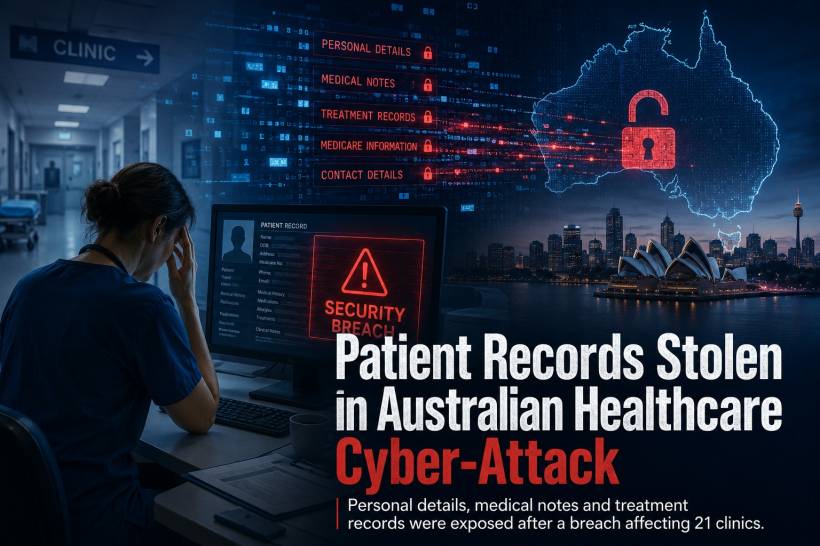
A major Australian healthcare provider has confirmed that personal and medical information was stolen during a cyberattack affecting 21 clinics across the country. Partnered Health said the breach involved clinics in several major cities, including Sydney, Melbourne and Canberra. The incident occurred on 23 June and exposed information that patients would reasonably expect to remain among the most private records held about them.
The stolen data reportedly includes identity details, government and insurance information, consultation notes, referral letters and diagnostic results. The scale and sensitivity of the breach make it more serious than an ordinary leak involving email addresses or passwords.
Medical and Personal Information Was Taken
Partnered Health confirmed that a malicious actor accessed information stored within parts of its clinic network.
The compromised personal information may include:
The breach also extended to clinical information recorded during patient care. This may include treatment details, general practitioner consultation notes, referral letters, pathology reports and diagnostic findings.
Medical records can reveal far more than basic identity information. They may contain details about a person's health conditions, medications, test results, previous treatments and communications between healthcare professionals.
Once such information is stolen, it cannot be reset in the same way as a password or replaced like a payment card.
Twenty-One Clinics Were Affected
Partnered Health operates a large network of medical services across Australia, but the breach was reportedly limited to 21 clinics identified during the investigation. The organisation has more than 60 medical centres nationwide, alongside skin cancer, allied health and mental health services. Its broader operations reportedly reach more than five million people. It has not been made clear how many individual patients had records exposed or whether every type of information was taken from each affected clinic.
The organisation said investigations were continuing, which means the final number of affected individuals and the full extent of the stolen information may still change. For patients, that uncertainty can be particularly frustrating. People may know that their clinic was involved without immediately knowing which documents or records were accessed.
Partnered Health Apologises to Patients and Staff
Partnered Health acknowledged that patients and employees trusted the organisation with highly sensitive information and apologised for the concern and inconvenience caused by the incident. That acknowledgement is important, but affected patients will also need clear and practical communication. A useful breach notification should explain what happened, when it happened, which information was involved and what steps the individual should take next. Generic warnings may not be enough when the compromised data includes Medicare numbers, medical records and insurance details. Different types of stolen information create different risks, and patients need advice relevant to their own exposure.
Healthcare providers should also offer a reliable contact channel so affected individuals can ask questions without adding pressure to clinic staff who may not have access to the incident investigation.
Authorities Have Been Notified
The healthcare group reported the breach to the Australian Cyber Security Centre, the Office of the Australian Information Commissioner and law enforcement. Involving these authorities allows the incident to be assessed from several perspectives. Cybersecurity agencies can provide technical guidance and help identify links to known threat groups or attack methods. Privacy regulators can assess whether the organisation met its obligations for protecting and reporting personal data. Law enforcement may investigate the attackers and any attempt to sell, publish or misuse the stolen information. However, reporting the incident does not guarantee that the data can be recovered or removed from criminal possession.
Once information has been copied from a compromised system, the organisation may have limited control over where it goes next.
Legal Action Seeks to Prevent Publication
Partnered Health has also sought an interim injunction from the Supreme Court of New South Wales. The legal action is intended to prevent the accessed data from being used or published. Such orders can establish that anyone distributing or exploiting the material is acting unlawfully. They may also discourage legitimate organisations, platforms or individuals from republishing the stolen records. The practical challenge is that cybercriminals may operate anonymously or outside the country. A court order can provide an important legal safeguard, but it cannot physically delete every copy of data already taken.
If the attackers upload records to underground forums or leak sites, preventing further distribution may become difficult. The injunction should therefore be viewed as one part of the response rather than a replacement for technical containment, patient notification and identity-protection measures.
Why Healthcare Records Are So Valuable
Healthcare organisations are attractive targets because they store several valuable categories of information in one place. A patient record may combine identity details, contact information, government identifiers, insurance data and medical history. Criminals can use this information for identity fraud, targeted scams, false insurance claims or convincing impersonation attempts. For example, an attacker who knows the name of a patient's clinic, the type of treatment received and their insurance provider could create a highly believable phone call or email.
The scammer might claim that an outstanding payment is due, that a Medicare record must be updated or that the patient needs to confirm personal information before receiving test results.
Because the message contains accurate medical context, the victim may be more likely to trust it.
Medical Data Can Create Long-Term Risks
Financial credentials can be cancelled. Passwords can be changed. A person's medical history cannot be replaced. This makes healthcare data particularly harmful when exposed. Sensitive clinical details may be used for embarrassment, coercion or discrimination. Mental health information, reproductive health records, diagnostic results and treatment histories can all carry significant personal consequences if disclosed. Even when attackers do not publish the records, affected individuals may experience ongoing anxiety because they cannot know whether the information will reappear months or years later. Healthcare organisations therefore have a responsibility to consider the emotional and privacy impact of a breach, not only its technical or financial consequences.
The Incident Happened During a Planned Acquisition
The breach comes as Bupa moves to acquire Partnered Health. The acquisition was announced in June, placing the healthcare group in the middle of a major corporate transition when the cyberattack occurred. Mergers and acquisitions can create additional cybersecurity complexity. Organisations may be reviewing systems, exchanging due-diligence information, preparing integrations and managing changes in staff responsibilities.
Attackers are aware that companies undergoing major transactions may be distracted or operating within a changing technical environment. There is no indication that the acquisition itself caused the breach. However, the incident will likely increase scrutiny of Partnered Health's cybersecurity controls, data-governance arrangements and future integration plans. Any acquiring organisation would need to understand how the attack occurred, whether the threat actor was fully removed and whether similar weaknesses remain elsewhere in the network.
Healthcare Networks Can Be Difficult to Secure
Large medical groups often operate across many clinics that were established at different times or acquired from different providers. As a result, the organisation may inherit different systems, network designs, security tools and working practices. One clinic may use a newer cloud-based platform, while another relies on an older local server. Some sites may have centrally managed devices, while others continue using equipment configured years earlier. This fragmentation creates opportunities for attackers. A weakness in one clinic may become an entry point into shared services or central systems. Remote-access tools, outdated software, stolen staff credentials and unprotected internet-facing systems are all common areas of concern.
Consolidating security controls across a distributed healthcare network is therefore essential, but it can be difficult and expensive.
The Response Must Go Beyond Resetting Passwords
The appropriate response depends on how the attacker gained access and what systems were compromised. Password resets may be necessary, but they are not sufficient on their own. Partnered Health will need to determine whether attackers created hidden accounts, installed remote-access tools, stole authentication tokens or maintained access through another compromised system. A thorough response may involve rebuilding affected servers, rotating privileged credentials, reviewing remote-access activity and checking whether data was altered as well as stolen.
Healthcare organisations must also confirm that backups remain trustworthy. Restoring from a backup created after the attacker gained access could reintroduce malicious tools or compromised configurations.
Patient Care Must Continue During the Investigation
Cybersecurity investigations in healthcare cannot be handled like ordinary corporate IT incidents. Clinics must continue delivering care while systems are examined, isolated or rebuilt. Doctors still need access to allergy information, medication histories and diagnostic results. Staff must continue processing referrals, scheduling appointments and communicating with other providers. If electronic systems become unavailable, clinics need tested downtime procedures that allow essential care to continue safely. This may include printed forms, manual registration processes, alternative communication channels and clearly defined methods for entering information back into the system once services recover.
The incident demonstrates why business continuity and cybersecurity must be planned together. Preventing a breach is important, but healthcare providers must also be prepared to operate safely when prevention fails.
Australia Is Seeing Record Levels of Data Breaches
The Partnered Health incident occurred amid a broader rise in reported data breaches across Australia. The Office of the Australian Information Commissioner received 1,205 breach notifications during the 2025 calendar year, representing an 8% increase compared with 2024. Major Australian organisations across healthcare, aviation, telecommunications and financial services have all faced significant cyber incidents in recent years.
One prominent case involved a cyberattack affecting Qantas, where information belonging to approximately 5.7 million customers was reportedly compromised. The steady increase in notifications may partly reflect better reporting, but it also shows that large organisations continue to struggle with increasingly persistent attackers. Holding more customer information creates greater responsibility. Businesses must continually assess whether every piece of data needs to be retained and whether access is restricted to people who genuinely require it.
Data Minimisation Can Reduce the Damage
Cybersecurity often focuses on keeping attackers out, but limiting the quantity of stored information can be just as important. Healthcare providers are legally and clinically required to retain many records. However, that does not mean every system or employee should have unrestricted access to everything.
Older data should be archived securely, sensitive records should be segmented and permissions should follow the principle of least privilege. A receptionist may need demographic and appointment information but not full access to every clinical note. A clinician may need patient records for care but not administrative access to infrastructure. Reducing unnecessary access limits what an attacker can steal after compromising a single account.
What Affected Patients Should Watch For
Patients connected to the affected clinics should be cautious about communications that refer to medical services, Medicare, insurance or outstanding payments. A scam may appear more convincing because the attacker already knows accurate information. Patients should avoid providing personal details through unexpected calls, emails or text messages, even when the sender claims to represent a familiar clinic. They should contact the healthcare provider through a verified telephone number or official website rather than using links included in a suspicious message. It may also be sensible to monitor Medicare and insurance activity for unfamiliar claims and check financial accounts for unusual transactions.
Any official advice issued by Partnered Health should be followed, particularly if it provides identity-protection or support services for affected individuals.
Final Thoughts
The Partnered Health cyberattack demonstrates the serious consequences of a breach involving medical information. Names and contact details are sensitive enough, but consultation notes, referrals and diagnostic results expose a much deeper part of a person's private life. The organisation has notified authorities, apologised to those affected and sought legal action to prevent the data from being used or published. The more difficult task will be determining exactly what was stolen, ensuring the attacker no longer has access and supporting patients facing long-term uncertainty. For the wider healthcare sector, the incident is another warning that cybersecurity cannot remain solely an IT responsibility. Protecting patient data requires secure infrastructure, strong access controls, staff awareness, clear governance and tested continuity plans. When healthcare information is compromised, the consequences extend far beyond system downtime—they affect patient trust, personal privacy and confidence in the entire care system.











Comments 0