

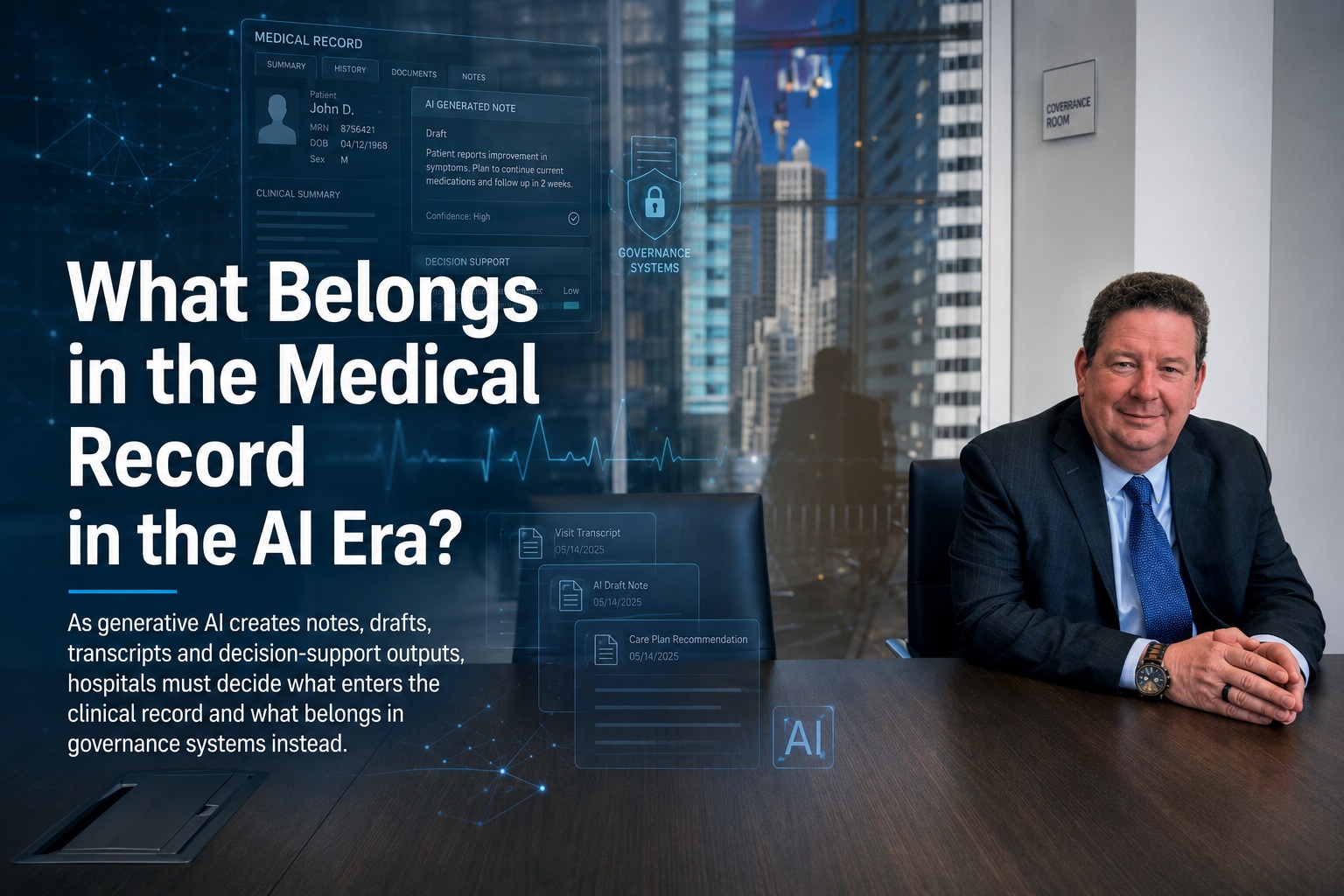
Generative AI is quickly becoming part of everyday healthcare operations. Ambient clinical scribes can listen to consultations and prepare draft notes. Decision-support tools can suggest possible diagnoses, treatments or medication options. Patient-facing chatbots can help draft replies, explain instructions and answer routine questions.
What patients and clinicians usually see, however, is only the final layer.
Behind the scenes, an AI system may also generate raw transcripts, prompts, intermediate drafts, alternative recommendations, confidence scores, coding suggestions, model outputs, audit logs and technical metadata.
That creates a surprisingly difficult question for hospitals and health systems:
It may sound like a records-management issue, but the implications go much further. The decision can affect patient safety, privacy, regulatory compliance, litigation exposure, billing reviews and even the practical ability of healthcare staff to find useful information inside an increasingly crowded clinical record.
AI Is Creating More Information Than the Medical Record Was Designed to Hold
Traditional clinical documentation already generates a large volume of data, but generative AI introduces another layer of content that sits somewhere between temporary working material and formal clinical documentation.
Consider an ambient scribe used during a consultation.
A single encounter might produce:
Not all of these items necessarily need to sit beside the final note in the patient's medical record.
The challenge is deciding where the boundary should be.
Thomas F. O'Neil III, a managing director at research and consulting firm BRG, argues that AI-created drafts should not automatically be treated as part of the legal medical record.
The more practical threshold is clinician review and acceptance.
In other words, AI may help prepare the documentation, but the clinical record becomes authoritative when a qualified clinician has reviewed the information, confirmed its accuracy and accepted responsibility for it.
That distinction becomes increasingly important as healthcare organisations begin generating far more temporary AI content than would ever have existed in a conventional documentation process.
The Final Clinical Note and the AI Working Process Are Not the Same Thing
A useful way to think about this is to separate the clinical record from the AI working record.
The clinical record should document what actually happened in the patient's care.
The AI working process may contain all sorts of material that helped produce that final documentation, including rejected suggestions, incomplete reasoning, uncertain alternatives and technical system information.
Those things may still be valuable, but they do not necessarily belong in the same place.
For example, an AI system might initially suggest three possible diagnoses before the clinician determines that only one is clinically supported.
Keeping all three inside the formal medical record could potentially create confusion later.
Someone reviewing the record months or years afterward might incorrectly interpret the discarded alternatives as diagnoses that were seriously considered or clinically established.
This is where careful information governance becomes essential.
AI-Assisted Documentation Needs a Provenance Trail
One concept becoming increasingly important is provenance.
Provenance simply means being able to determine where information came from and how it was created.
In an AI-assisted environment, healthcare organisations may need to know:
This does not necessarily mean storing every intermediate AI draft forever.
Instead, organisations need enough governance information to reconstruct how important AI-assisted clinical information entered the record.
That becomes especially important when AI is involved in decisions that directly affect diagnosis, treatment or patient safety.
An ambient documentation tool that simply prepares a draft note presents a very different level of risk from an AI system recommending a medication dosage or suggesting a diagnosis.
The retention policy should therefore reflect the clinical significance of the AI's role.
Risk Should Determine What Gets Retained
One of the biggest mistakes healthcare organisations could make is applying a single retention rule to every type of AI output.
Different use cases carry different levels of risk.
For example:
The more directly AI influences clinical decision-making, the stronger the argument becomes for maintaining sufficient documentation about what the system produced and how the clinician responded.
O'Neil describes AI as increasing the volume and speed of ambiguous intermediate content.
Healthcare organisations have always dealt with temporary drafts and working notes, but AI can now create them at an unprecedented scale.
That makes traditional principles such as ownership, classification and consistent retention policies even more important.
Did the AI Output Influence the Clinical Decision?
Jim Flynn, a healthcare attorney and managing director at Epstein Becker Green, suggests a practical test:
If an AI recommendation played a meaningful role in shaping a diagnosis, treatment plan or clinical reasoning process, there may be a stronger case for retaining it as part of the clinical record.
Once information enters the medical record, however, it carries a very different status.
It may become subject to regulatory review, patient-access requests, audits, investigations or legal discovery.
That means healthcare organisations should be cautious about automatically placing every AI-generated artifact into the same clinical repository.
Generative AI systems can produce much more information than the final clinical decision itself.
They may generate:
Some of this information may be highly useful for auditing or evaluating the AI system without necessarily being appropriate for inclusion in the patient's chart.
That is where separate governance repositories become useful.
Accountability Should Come Before Automation
Alaap Shah, a digital health attorney at Epstein Becker Green, places accountability at the centre of AI documentation governance.
If a clinician signs a note containing AI-generated material, that clinician is effectively taking responsibility for the clinical information contained in the final document.
That creates a simple but important governance principle:
Nothing should enter the official medical record unless it is clear who is accountable for it and how AI contributed to its creation.
This is especially important because AI-generated text can appear extremely polished even when it contains subtle inaccuracies.
A clinician cannot safely treat AI-generated documentation as correct simply because it reads professionally.
The workflow needs to preserve human review as a meaningful clinical step rather than a ceremonial click of an approval button.
A Three-Layer Approach to AI Information
A practical healthcare AI governance model could separate information into three broad categories.
1. Clinician-Reviewed Clinical Information
This is AI-assisted content that has been reviewed, corrected where necessary and accepted by the clinician.
Examples might include:
This information belongs in the formal medical record because it represents the clinician-approved account of patient care.
2. Draft and Advisory AI Content
This includes temporary or supporting information generated during the workflow.
Examples could include:
This material should generally be governed through organisational data-classification and retention policies rather than automatically becoming permanent clinical documentation.
3. Technical and AI Governance Records
This category includes information used to demonstrate how the AI system was operated and governed.
Examples include:
These records may be extremely important for compliance and risk management, but they usually belong in a technical governance repository rather than inside an individual patient's clinical note.
Keeping Everything Can Be Just as Risky as Deleting Everything
There can be a natural temptation to retain every AI-generated artifact.
The reasoning sounds sensible: storage is relatively cheap, and keeping everything may appear safer in case the information is needed later.
In reality, over-retention can become a liability.
Imagine an AI system that generates five versions of a clinical note before the clinician approves the final version.
If every version is preserved indefinitely, a future legal dispute could involve analysing every wording change, every rejected diagnosis and every alternative recommendation.
Something that represented nothing more than an ordinary drafting process could later be interpreted as evidence of uncertainty or disagreement.
Flynn warns that excessive retention can make legal discovery significantly more complicated.
Thousands or millions of AI-generated artifacts could also create enormous administrative burdens for hospitals responding to investigations or regulatory requests.
More Data Means More Material for Auditors to Examine
Over-retention can also expand regulatory exposure.
Large collections of AI prompts, inference logs and model outputs may contain:
The more information an organisation retains, the more material regulators, auditors and litigators may potentially request or review.
That does not mean healthcare organisations should intentionally destroy useful information.
It means retention decisions need to be purposeful rather than automatic.
Deleting Too Much Creates a Different Problem
The opposite extreme is equally dangerous.
If an organisation deletes every AI-related artifact immediately after the clinical note is signed, it may later become impossible to demonstrate that the AI system was being properly governed.
Suppose a hospital is asked:
Without appropriate governance records, the organisation may have no reliable way to answer those questions.
That is why the emerging approach is not simply "retain less."
It is better described as:
Keep the right information, for the right reason, in the right location, for the right amount of time.
The Medical Record Should Remain Clinically Useful
There is another issue that sometimes gets overlooked: usability.
Medical records are already enormous.
Clinicians frequently need to search through years of consultations, test results, medication histories and correspondence to understand a patient's condition.
Adding every AI transcript, prompt, alternative diagnosis and confidence score could make those records significantly harder to navigate.
The purpose of the medical record should remain primarily clinical.
It should communicate what happened, what clinicians observed, what decisions were made and why those decisions matter for future care.
If AI-generated technical information overwhelms that purpose, the medical record becomes less useful to the healthcare professionals who depend on it.
AI Governance Records Should Live Separately
A strong governance architecture therefore needs at least two clearly defined information environments.
The first is the patient medical record.
It should contain the clinically relevant, reviewed and accepted documentation required for patient care.
The second is an AI governance and audit repository.
That system can maintain information needed to demonstrate responsible use of AI, such as:
Keeping these environments separate allows healthcare organisations to preserve accountability without turning every patient's medical record into a technical AI audit file.
Policies Will Need to Be Specific to Each AI Use Case
Healthcare organisations should also avoid writing a single vague policy saying that "AI-generated information will be retained according to organisational requirements."
That will probably not be enough.
Each AI application should have clearly defined rules covering:
These decisions should ideally involve clinical leadership, health information management, cybersecurity, privacy, compliance, legal teams and IT governance rather than being left entirely to the technology department.
The Bigger Challenge Is Not AI Documentation — It Is AI Accountability
The debate over what belongs in the medical record is ultimately part of a much larger question about accountability.
AI systems may increasingly participate in clinical workflows, but responsibility for patient care still needs to remain clearly defined.
Hospitals need to know when AI acted merely as a documentation assistant and when it materially influenced a clinical decision.
They also need to demonstrate that the technology was properly evaluated, monitored and governed.
That requires more sophisticated information management than simply saving everything or deleting everything.
Final Thoughts
Generative AI is creating a new layer of information inside healthcare that did not exist at this scale before.
Some of that information clearly belongs in the medical record. Some belongs in technical governance systems. Some may only need to exist temporarily while clinicians complete their work.
The challenge is drawing those boundaries carefully.
The medical record should remain a clear, clinically meaningful account of patient care, while separate AI governance records should provide enough evidence to demonstrate how the technology was used and controlled.
That distinction could become increasingly important as AI systems move beyond documentation and begin playing larger roles in diagnosis, treatment planning and clinical decision support.
In the AI era, good healthcare information governance may therefore depend less on asking "Should we keep this data?" and more on asking three better questions:
Those questions may ultimately determine whether AI makes clinical documentation more useful and accountable—or simply makes the medical record much bigger.











Comments 0