

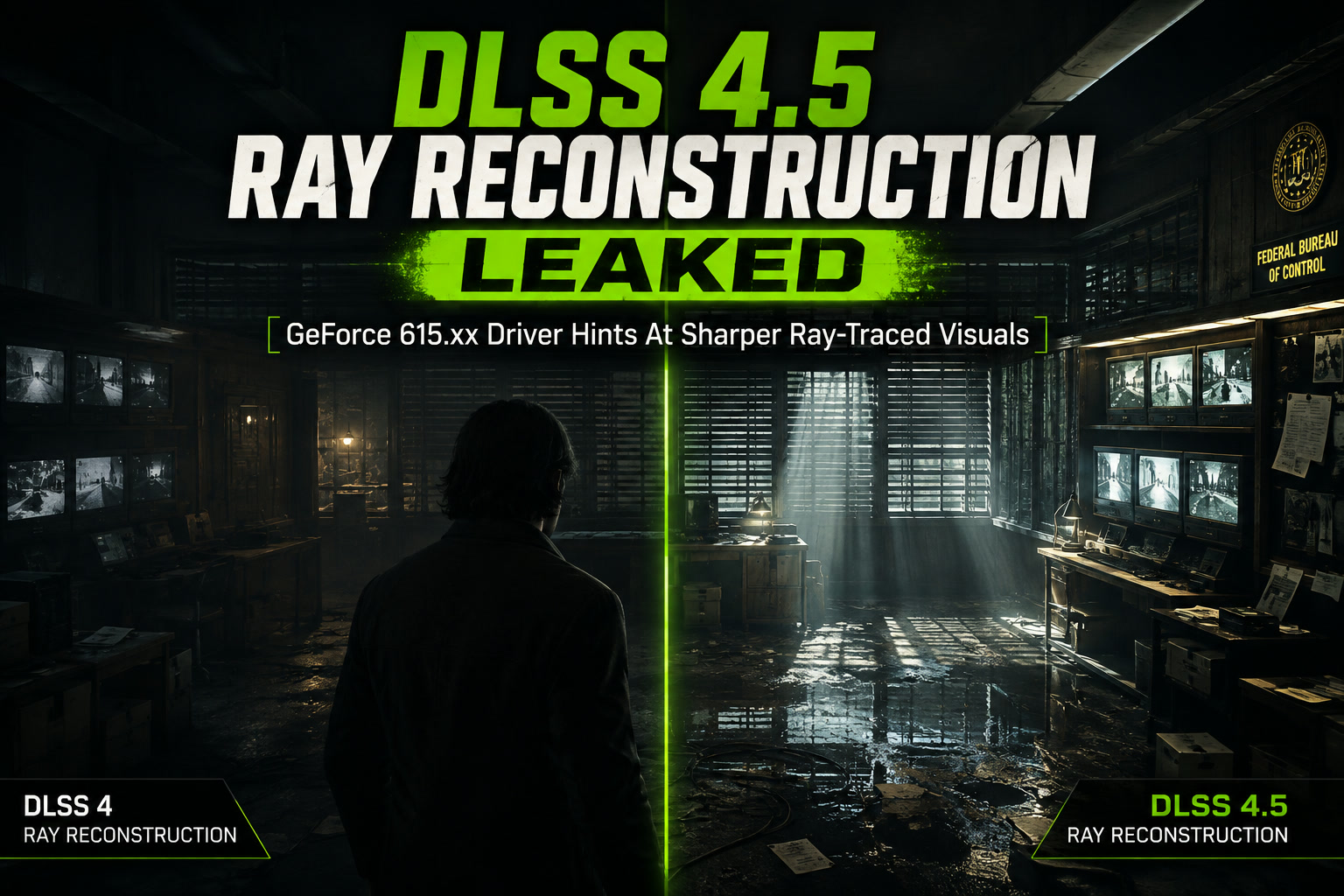
NVIDIA appears to have accidentally revealed details of its upcoming GeForce 615.xx driver, offering an early look at what could be one of the company's more interesting graphics updates this year. The unreleased driver reportedly includes support for DLSS 4.5 Ray Reconstruction, alongside Game Ready optimisations for upcoming titles such as Resonance: A Plague Tale Legacy and Hell Let Loose: Vietnam.
Since Resonance: A Plague Tale Legacy is scheduled to arrive next week, the leak suggests NVIDIA's new driver — and potentially DLSS 4.5 Ray Reconstruction itself — may not be far behind.
For GeForce RTX owners, the bigger story is the Ray Reconstruction update, which promises improved ray-traced image quality across RTX 20, 30, 40 and 50 Series GPUs.
What Exactly Is DLSS Ray Reconstruction?
Ray tracing can produce extremely realistic lighting, reflections and shadows, but rendering those effects accurately requires a huge amount of GPU processing power.
Games therefore usually rely on fewer ray samples and then use denoising techniques to clean up the resulting image.
Traditional denoisers work reasonably well, but they can sometimes remove fine details along with unwanted noise.
NVIDIA's DLSS Ray Reconstruction takes a different approach.
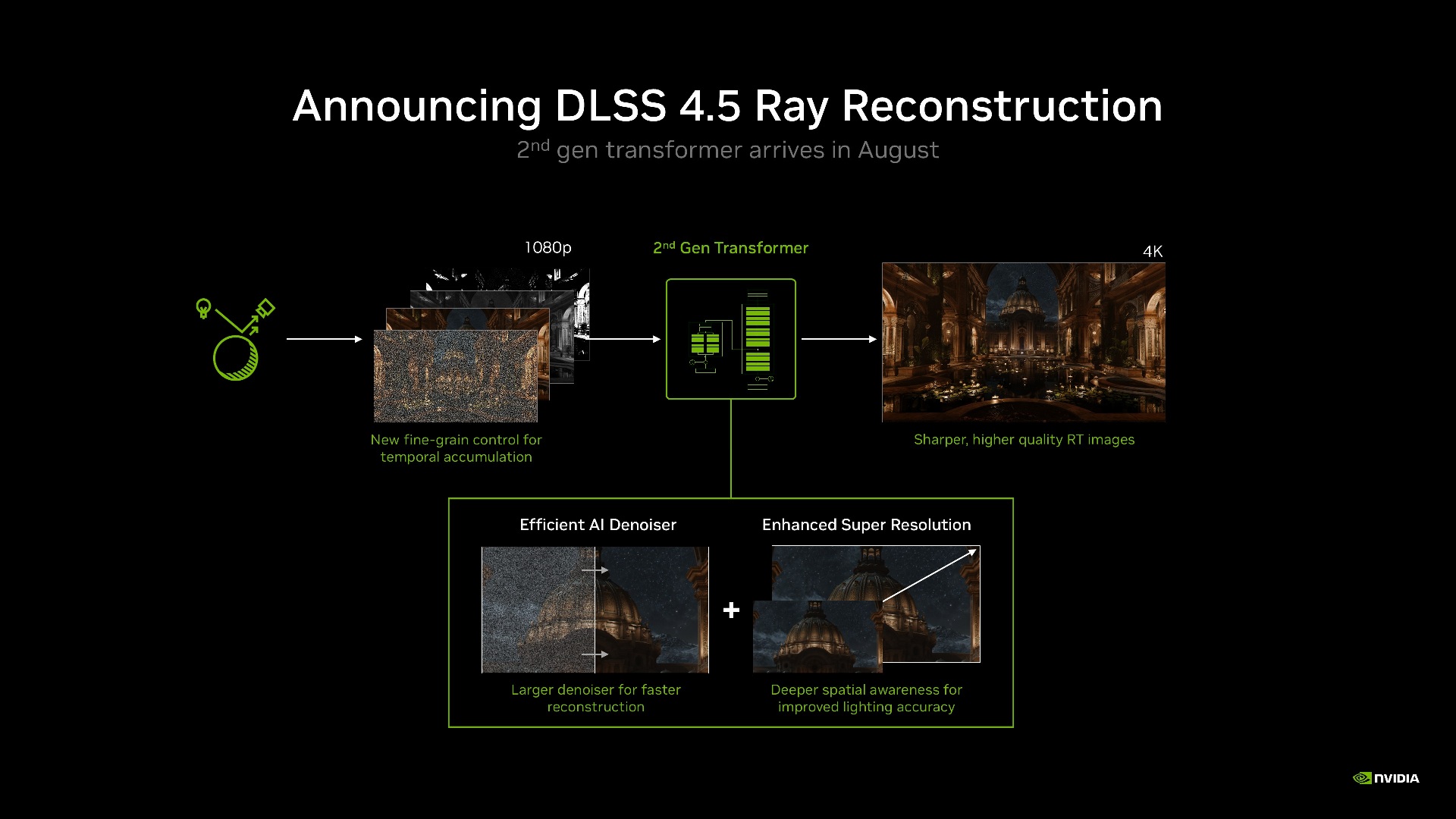
Instead of relying entirely on conventional hand-tuned denoisers, Ray Reconstruction uses an AI model to analyse the image and intelligently determine which information should be preserved.
This allows the system to reconstruct more detailed ray-traced effects while potentially requiring fewer ray samples.
The result can be sharper reflections, more stable lighting and fewer artefacts compared with traditional denoising methods.
DLSS 4.5 Brings a New Ray Reconstruction Model
With DLSS 4.5, NVIDIA is reportedly upgrading the underlying Ray Reconstruction model.
The new version uses a larger training dataset, supports additional developer controls and processes more parameters than the previous implementation.
According to the leaked information, the new model offers around 35% more compute capability while processing approximately 20% more parameters.
Those improvements should give the AI more information to work with when reconstructing ray-traced scenes.
NVIDIA has also reportedly incorporated improvements originally developed for DLSS Super Resolution, particularly around motion information and temporal stability.
That could help address some of the weaknesses users occasionally notice in AI-reconstructed images.
Better Motion Stability and Fewer Artefacts
One of the biggest challenges with any temporal reconstruction technology is maintaining image consistency while the camera or objects are moving.
An image can look excellent when standing still but suddenly produce ghosting, shimmering or strange trails once movement begins.
DLSS 4.5 Ray Reconstruction reportedly targets several of these problems.
Expected improvements include:
Particle effects are particularly difficult for reconstruction technologies because smoke, sparks, fire and debris can change dramatically between frames.
A stronger AI model could help preserve these effects without creating distracting trails or losing fine detail.
Older RTX Cards Are Included
Perhaps one of the best parts of the update is that DLSS 4.5 Ray Reconstruction is not being limited to NVIDIA's newest graphics cards.
The new model is expected to work across:
That means owners of older RTX GPUs may also receive a visual upgrade without replacing their hardware.
Of course, performance will still depend heavily on the individual GPU.
An RTX 2060 obviously does not have the same ray-tracing performance as an RTX 5080.
But allowing the same reconstruction model to operate across several generations gives older cards access to newer image-quality improvements.
That has increasingly become one of DLSS' strongest advantages.
NVIDIA can continue improving the AI models long after the GPU itself has been purchased.
Ray Reconstruction Can Make Ray Tracing More Practical
Ray tracing remains extremely demanding.
Even powerful modern graphics cards can struggle when games enable multiple ray-traced effects simultaneously.
That is why technologies such as DLSS have become almost inseparable from high-end ray tracing.
Instead of trying to brute-force every pixel at native resolution, modern games increasingly combine lower-resolution rendering, AI reconstruction and fewer ray samples to produce an image that looks close to — or occasionally better than — traditional native rendering.
Ray Reconstruction extends that idea to the denoising stage.
If the AI can recover more useful detail from fewer ray samples, developers may be able to deliver better-looking lighting without increasing GPU workload proportionally.
That could be especially important as path tracing becomes more common in demanding PC games.
DLSS 4.5 Could Launch With 27 Supported Games
NVIDIA has reportedly confirmed that 27 games will support DLSS 4.5 Ray Reconstruction at launch.
The lineup includes several major titles already known for pushing ray-traced graphics hard.
Among them are:
Other supported games reportedly include Crimson Desert, EVERSPACE 2, FBC: Firebreak, NARAKA: BLADEPOINT, PRAGMATA and several additional titles.
That is a fairly strong launch catalogue for what is effectively an upgrade to an existing rendering technology.
DLSS Overrides Could Bring the Upgrade to Existing Games
Some of these games may receive DLSS 4.5 Ray Reconstruction through DLSS Overrides inside the NVIDIA App.
This is an increasingly useful feature.
Instead of waiting for every game developer to manually update a title with the newest DLSS model, NVIDIA can sometimes allow users to override the bundled version and use a newer model through its driver software.
That helps older games benefit from improvements after their original development has effectively finished.
It also means NVIDIA can roll out AI model improvements much faster than traditional graphics features that require direct integration into game engines.
However, compatibility can still vary from game to game.
A newer model is not automatically guaranteed to look better in every scene, so NVIDIA and developers still need to validate each implementation carefully.
The GeForce 615.xx Driver Could Arrive Soon
The leaked driver also lists Game Ready support for Resonance: A Plague Tale Legacy and Hell Let Loose: Vietnam.
Game Ready drivers normally arrive close to the release dates of major supported games.
Since Resonance: A Plague Tale Legacy is expected next week, that provides a reasonable clue that the GeForce 615.xx driver could arrive around the same period.
If DLSS 4.5 Ray Reconstruction is bundled with that release, RTX users may not have to wait much longer to test the new model for themselves.
As always with leaked driver information, exact release timing can still change before NVIDIA makes an official announcement.
DLSS Is Becoming More Than Just Upscaling
It is easy to still think of DLSS as simply NVIDIA's AI upscaling technology.
That description is becoming increasingly outdated.
The DLSS ecosystem now includes technologies covering:
Together, these technologies are gradually changing how games are rendered.
The GPU no longer needs to calculate every part of the final image traditionally.
Instead, developers increasingly combine conventional rendering with AI-generated or AI-reconstructed information.
DLSS 4.5 Ray Reconstruction is another step in that direction.
The Real Benefit Is Better Image Quality Without New Hardware
The most interesting part of DLSS 4.5 may ultimately be that many gamers will receive the improvement through software alone.
GPU upgrades have become increasingly expensive, so improvements that extend the useful life of existing hardware are particularly welcome.
Someone running an RTX 30 or RTX 40 Series card may gain cleaner ray-traced effects simply by installing a new driver and enabling the updated model in supported games.
That does not increase the raw ray-tracing hardware inside the GPU.
But smarter reconstruction can sometimes achieve something nearly as valuable: making better use of the performance already available.
Final Thoughts
The leaked GeForce 615.xx driver suggests NVIDIA is preparing to roll out DLSS 4.5 Ray Reconstruction very soon.
The updated model reportedly brings more parameters, greater compute capability, improved motion handling and better temporal stability, with the goal of producing cleaner and more detailed ray-traced imagery.
Even better, the technology is expected to support every GeForce RTX generation from the RTX 20 Series onward.
With 27 games apparently ready for launch support and major titles such as Cyberpunk 2077, Alan Wake 2, DOOM: The Dark Ages and Indiana Jones and the Great Circle included, there should be plenty of opportunities to see whether the improvements are genuinely noticeable.
At this stage, NVIDIA's biggest advantage may not simply be producing faster GPUs.
It is that the company can keep improving how existing RTX hardware renders games through increasingly capable AI models — and DLSS 4.5 Ray Reconstruction looks set to be the next example of that strategy.











Comments 1