

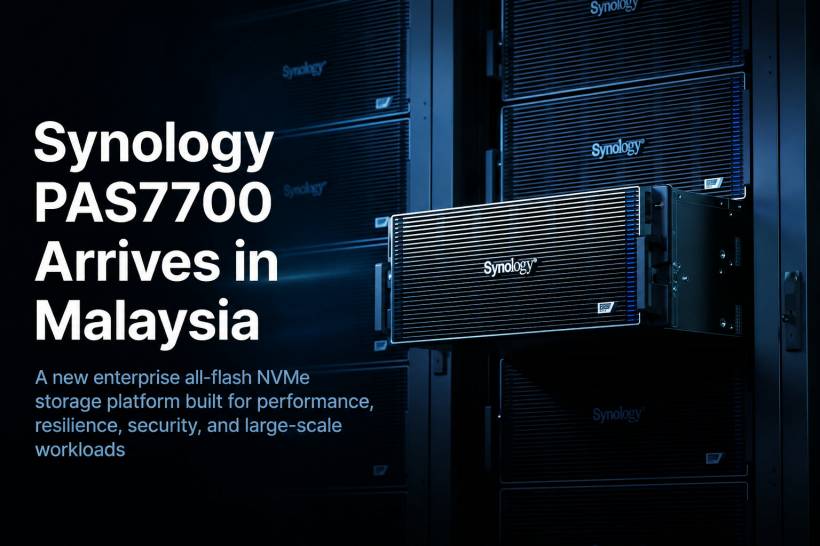
Synology has officially introduced the PAS7700 enterprise storage system in Malaysia, bringing one of its most performance-focused platforms to organisations that need fast, reliable, and highly available storage. The system was first shown during Computex 2025, and it is clearly designed for businesses where storage is not just a background IT component, but a critical part of daily operations.
This is not the kind of storage system aimed at casual file sharing or small office use. The PAS7700 is built for demanding environments such as large databases, virtual machines, AI-related workloads, engineering files, healthcare systems, manufacturing operations, semiconductor design, and game development. In these industries, slow storage can quickly affect productivity, system performance, and even service continuity.
Why Enterprise Storage Still Matters
As businesses generate more data, storage systems are no longer judged only by how much capacity they provide. Speed, reliability, redundancy, security, and recovery features now matter just as much. A company may have terabytes or petabytes of data, but if that data cannot be accessed quickly or safely, the storage platform becomes a bottleneck.
This is especially true for organisations running virtualised environments, database-heavy applications, AI workflows, and large collaborative projects. These workloads can place heavy pressure on storage systems because many users, applications, and servers may be reading and writing data at the same time.
The PAS7700 is Synology's answer to that kind of environment. It focuses on high throughput, very low latency, dual-controller availability, and enterprise-grade data protection features.
Built Around All-Flash NVMe Performance
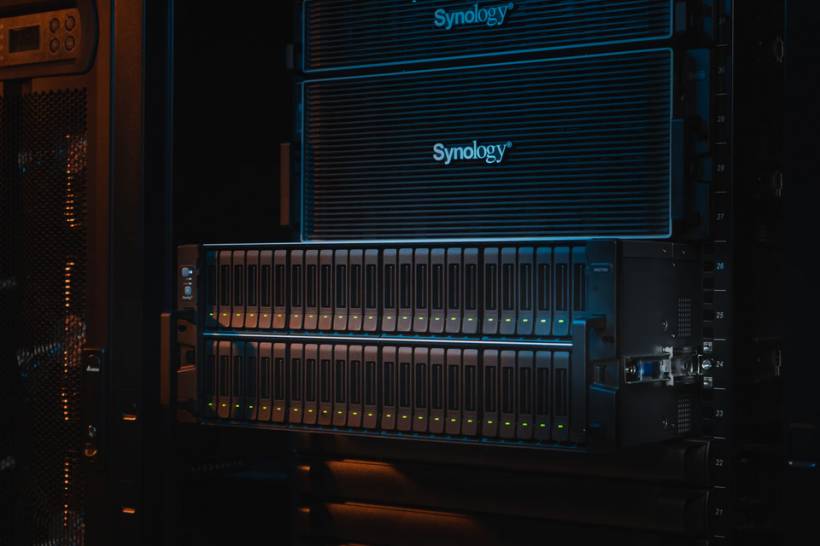
One of the biggest highlights of the PAS7700 is its all-flash NVMe design. The system comes in a 4U chassis with dual controllers and 48 NVMe SSD bays. That alone makes it clear that this is built for performance-driven deployments rather than slower traditional storage workloads.
With expansion units, Synology says the platform can scale up to 1.65PB of raw storage capacity. That level of capacity is important for organisations dealing with fast-growing datasets, especially where large files, virtual machines, media assets, research data, or production workloads are involved.
Performance is also a major selling point. Synology claims the PAS7700 can deliver up to 2 million IOPS, latency below one millisecond, and sequential throughput of up to 30GB/s. In practical terms, this means the system is designed to handle many simultaneous operations while keeping response times low.
Support for Enterprise Connectivity
Enterprise storage needs to work with different environments, and the PAS7700 supports a wide range of storage protocols and connectivity options. This includes Fibre Channel, iSCSI, SMB, NFS, and NVMe-oF.
That flexibility matters because not every organisation runs the same infrastructure. Some may rely heavily on virtual machines, while others may need high-speed block storage, shared file access, or low-latency connections for specialised workloads. By supporting multiple protocols, the PAS7700 can fit into a wider range of IT setups.
For IT teams, this kind of flexibility can reduce the need for separate storage platforms for different use cases. Instead, one central enterprise storage system can support multiple workloads across the organisation.
Active-Active Architecture for Better Availability
A major part of the PAS7700's design is its active-active controller architecture. In a traditional active-standby setup, one controller handles the workload while the other waits as a backup. If the active controller fails, the standby controller takes over.
The PAS7700 takes a different approach by allowing both controllers to operate at the same time. This improves resource utilisation and helps maintain service continuity if one controller or network component encounters a problem.
For businesses where downtime is expensive or disruptive, this matters a lot. A storage outage can affect databases, virtual machines, file access, production systems, and business applications. Active-active architecture helps reduce that risk by keeping the system more resilient.
Security and Data Protection Are a Big Focus
Performance is important, but modern enterprise storage also needs strong protection against data loss, tampering, and ransomware. Synology is positioning the PAS7700 as a storage system that addresses these concerns directly.
The platform supports Self-Encrypting Drives, immutable snapshots, WORM folders, Snapshot Replication, and Hyper Backup. These features help organisations protect important data, recover from incidents, and reduce the risk of unauthorised changes.
Immutable snapshots and WORM folders are especially relevant in today's cybersecurity environment. If data is accidentally deleted, altered, or targeted by ransomware, having protected recovery points can make a huge difference. It gives organisations a better chance of restoring operations without losing critical information.
Monitoring and Operational Visibility
Enterprise storage systems also need to be monitored closely. A small hardware issue can become a bigger service problem if it is not detected early. The PAS7700 includes monitoring tools that allow IT administrators to check hardware health and identify potential issues before they interrupt services.
This kind of visibility is important for IT teams managing critical workloads. Instead of reacting only when something fails, administrators can take a more proactive approach to maintenance and planning.
For organisations with limited tolerance for downtime, early detection and proper monitoring can be just as important as raw performance.
Improving Long-Term Storage Efficiency
Another important part of the PAS7700 is storage efficiency. High-performance NVMe storage is powerful, but it is also a significant investment. Businesses need to make sure that expensive SSD capacity is used wisely.
Synology says the PAS7700 supports inline and offline deduplication. Deduplication helps reduce duplicate data, which can save storage space and improve overall efficiency. It may also help extend SSD lifespan by reducing unnecessary writes.
The company also plans to introduce Synology Tiering through future updates. This feature is designed to automatically move less frequently used data to higher-capacity storage systems, while keeping active workloads on faster NVMe storage. This makes sense for enterprise environments because not all data needs the same level of performance all the time.
Why This Matters for Malaysian Enterprises
The launch of the PAS7700 in Malaysia is significant because more local organisations are moving toward data-heavy operations. Healthcare providers are dealing with imaging, records, and system integration. Manufacturers rely on production data and engineering workflows. Game development and creative industries manage large assets. Businesses using AI or virtualisation need fast and dependable infrastructure.
For these environments, storage performance can directly affect how quickly teams work and how reliably systems operate. A slow or unstable storage layer can cause wider problems across the organisation.
By bringing the PAS7700 to Malaysia, Synology is targeting businesses that need more than standard network storage. This is a platform for organisations that require speed, resilience, scalability, and stronger data protection in one system.
Availability and Pricing
The Synology PAS7700 is now available in Malaysia. However, pricing was not announced publicly. That is not unusual for enterprise storage products because final pricing usually depends on configuration, capacity, support requirements, expansion needs, and deployment scope.
For large-scale deployments, organisations will likely need to work with Synology's business partners or distributors to get a proper quotation and deployment plan.
Final Thoughts
The Synology PAS7700 is clearly positioned as a serious enterprise storage platform rather than a general-purpose NAS. With its all-flash NVMe design, dual active-active controllers, high IOPS performance, low latency, broad protocol support, and strong data protection features, it is aimed at organisations where storage performance and uptime are business-critical.
For Malaysian enterprises dealing with databases, virtualisation, AI workloads, healthcare data, engineering files, manufacturing systems, or large collaborative projects, the PAS7700 offers a storage platform built for speed and resilience. It is not just about storing more data. It is about keeping important workloads running smoothly, securely, and efficiently as business demands continue to grow.











Comments 0