

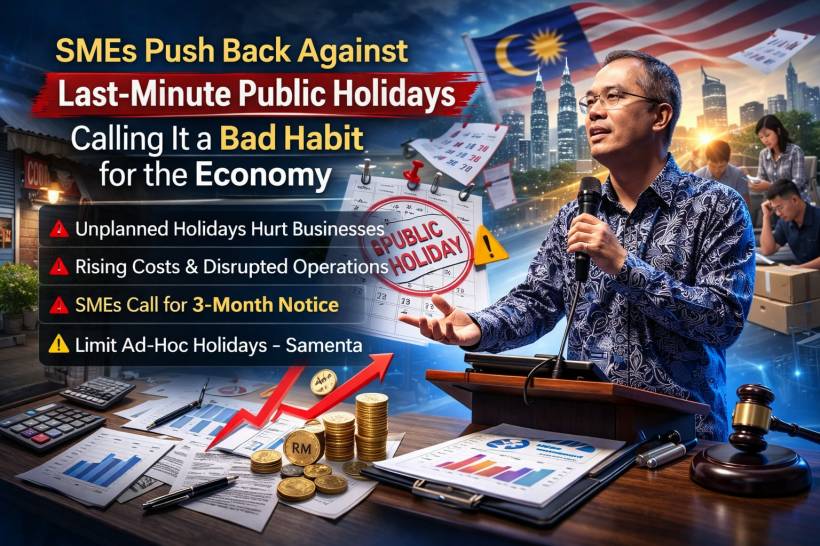
The debate over ad-hoc public holidays in Malaysia is clearly not going away. While many workers welcome an extra day off, business groups are warning that these last-minute announcements may be doing more harm than good, especially for smaller companies already operating under pressure.
This time, the criticism comes from the Small and Medium Enterprises Association (Samenta), which says the government should stop declaring what it describes as "surprise" public holidays. In its view, this has become an unhealthy economic habit, one that creates unnecessary disruption and adds fresh costs to businesses that are already trying to stay afloat in a difficult environment.
The latest criticism follows the prime minister's recent announcement of an additional public holiday for the upcoming Hari Raya Aidilfitri celebration. For the public, that may sound like a thoughtful and festive gesture. But for many SMEs, the response is far less enthusiastic.
Why SMEs are unhappy with sudden holiday announcements
At the heart of the complaint is a simple issue: planning.
Businesses, especially small and medium enterprises, do not operate comfortably in an environment of sudden change. Their schedules are often tightly managed around payroll, staffing, inventory, logistics, customer commitments, and delivery deadlines. When a public holiday is announced at short notice, all of that planning can be thrown off balance.
Samenta president Datuk William Ng argued that businesses rely on predictability to function properly. Without that, the cost of disruption rises quickly.
For manufacturers, a sudden holiday may mean paying extra to keep operations running or facing penalties for missing contractual deadlines. In service-based industries, the problems can look different but still hurt. Retailers, food operators, and logistics-related businesses may suddenly have to deal with staffing shortages, changed operating hours, disrupted delivery schedules, or perishable stock that becomes harder to manage.
In other words, what feels like a bonus day from one perspective may look like an unplanned bill from another.
Small businesses feel the impact more sharply
Large corporations may have bigger cash reserves, deeper staffing pools, and more room to absorb operational shocks. SMEs usually do not have that luxury.
That is what makes this issue especially sensitive. Smaller businesses are often the least equipped to handle sudden cost increases, yet they are the ones expected to adapt the fastest. A last-minute holiday can force them into uncomfortable choices: pay more, delay work, disappoint customers, or absorb losses.
For a business already navigating inflation, uncertain demand, wage pressure, and tight margins, even a seemingly small disruption can carry real consequences.
This is why Samenta is framing the issue not as a complaint about holidays themselves, but about the lack of structure around how they are announced.
The "good intention, bad timing" problem
One of the more interesting aspects of this debate is that the criticism is not necessarily aimed at the intention behind the holiday.
The government's reasoning is easy to understand. Extra festive leave gives people more time with family, helps with travel arrangements, and creates a more relaxed celebration period. From a social and political point of view, that message is appealing.
But Samenta's argument is that good intentions do not automatically produce good economic outcomes.
The association says that messaging matters just as much as motive. If businesses are already struggling and trying to recover, the declaration of extra holidays may send the wrong signal. It can appear disconnected from the day-to-day pressure faced by entrepreneurs, employers, and small operators who are trying hard to maintain stability.
So the issue here is not whether celebrations matter. It is whether sudden decisions are the right way to support them.
The productivity argument
Samenta also pointed to research from the Centre for Future Labour Market Studies (EU-ERA), which promotes what it calls an "Optimal 10" rule for public holidays.
The basic idea is that economic productivity reaches an effective balance at around 10 gazetted public holidays a year. Beyond that point, the gains from extra rest days begin to taper off, while the downsides start becoming more visible. Those downsides include disrupted business operations, higher manpower costs, and weaker productivity flow.
According to this view, adding more holidays does not always translate into better outcomes. At some point, the interruptions begin to outweigh the benefits.
Samenta argues that Malaysia is already among the countries in the region with a high number of public holidays. Adding unscheduled extra days on top of that, it says, risks pushing the economy further into diminishing returns.
Whether one agrees fully with that argument or not, it does raise an important policy question: how many public holidays are helpful, and when do they start becoming economically counterproductive?
Why the timing matters more than the holiday itself
A key point in Samenta's position is that the problem is not only the number of holidays, but the way they are introduced.
A scheduled holiday gives businesses time to prepare. They can plan staffing, adjust production, communicate with customers, and manage stock or deliveries accordingly. A surprise holiday removes that preparation window.
That difference is huge.
A holiday that is known months in advance can be built into budgets and workflows. A holiday announced suddenly becomes a reactive problem. It may require overtime, rescheduling, emergency staffing adjustments, or rushed operational changes.
This is why the association is focusing on the need for advance notice rather than simply saying there should never be extra holidays under any circumstance.
What Samenta wants changed
To address the issue, Samenta is calling for a review of the Public Holidays Act 1951.
More specifically, it wants the government to amend Section 8 of the Act so that the power to declare ad-hoc public holidays is limited to genuine national emergencies or major national events, such as the installation of a new Yang di-Pertuan Agong.
That would make surprise holidays the exception rather than something that can be used more casually.
The association is also proposing a minimum notice period of at least three months for any non-emergency additional holiday. The logic is straightforward: if businesses are given enough warning, they can prepare properly and reduce the financial shock.
This suggestion tries to strike a middle ground. It does not remove the government's ability to declare extra holidays entirely, but it does call for clearer rules and more discipline in how that power is used.
A broader question about economic priorities
This issue also taps into a larger national conversation about how Malaysia wants to balance social goodwill with economic competitiveness.
Public holidays are popular, and understandably so. They matter culturally, socially, and emotionally. They give families time together, support festive traditions, and create moments of pause in a hectic year.
But from the business side, especially among SMEs, there is growing concern that unpredictability is becoming too normal. When the economy is fragile, policy signals matter. Business groups want consistency, clarity, and a sense that planning is respected.
That does not mean workers' needs should be ignored. It means governments may need to think more carefully about how they structure such decisions so that one group's relief does not become another group's burden.
Final thoughts
Samenta's criticism highlights a tension that governments often face but cannot easily avoid. A surprise public holiday may be welcomed by the public, especially during a festive season, but it can also create very real problems for businesses trying to manage costs and commitments.
The association's message is blunt: last-minute holidays may be politically popular, but they are economically disruptive, especially for SMEs. Its call is not just for fewer ad-hoc holidays, but for a more disciplined and predictable approach.
In the end, this is really a debate about more than just one extra day off. It is about whether policy should lean more toward short-term goodwill or long-term planning. And for many smaller businesses in Malaysia right now, planning is the thing they say they need most.











Comments 0