

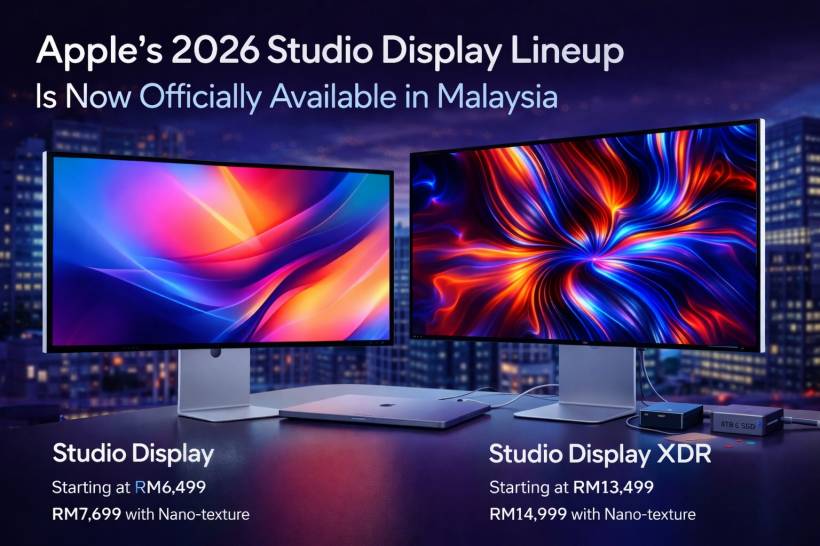
Apple's latest Studio Display monitors have now officially reached the Malaysian market, joining the growing list of Apple products that were introduced earlier this year and have since started appearing locally. Alongside newer Macs and other March announcements, Apple's updated display lineup is now available through Apple Store TRX, the company's official online store, and authorised retailers across the country.
For buyers who have been waiting to complete an Apple desktop setup locally, this is a fairly notable release. The company is not just bringing back its display options for professional users, but also refreshing them with updated internals and clearer separation between the standard model and the more premium Studio Display XDR.
Two Display Options for Different Kinds of Users
Apple is offering two main models in this 2026 refresh: the regular Studio Display and the more advanced Studio Display XDR.
The standard Studio Display starts at RM6,499 for the regular glass version, while the Nano-texture glass option raises the price to RM7,699. The more premium Studio Display XDR starts from RM13,499, with the Nano-texture variant going up to RM14,999.
That pricing immediately tells you how Apple is positioning these monitors. The Studio Display is meant for users who want a premium Apple screen for creative work, office productivity, or a polished desktop setup, while the XDR version is aimed more directly at users who need stronger brightness, smoother motion, and higher-end display performance.
The Standard Studio Display Still Covers the Essentials Well
The regular Studio Display remains a serious monitor in its own right. It comes with a 27-inch 5K Retina panel with a resolution of 5,120 by 2,880, which already places it well above the level of typical mainstream displays. Apple says it offers up to 600 nits of peak brightness, along with a 60Hz refresh rate.
In other words, this is not meant to be a gaming monitor or a spec-chasing display built around extremely high refresh numbers. Its focus is more on clarity, colour quality, and a clean viewing experience for creative and professional users.
Apple is also continuing to support True Tone, which adjusts the display to suit ambient lighting for a more natural-looking image. Buyers can also choose the optional Nano-texture glass finish, which is meant to reduce glare without heavily compromising image quality.
More Than Just a Screen
Like several of Apple's recent displays and Macs, the Studio Display is being positioned as more than just a panel on a stand. It also includes a 12MP Centre Stage camera built into the top bezel, along with Desk View, which can automatically keep users framed during calls while also offering a top-down view of the desk area.
That may sound like a small detail, but it reflects how Apple increasingly treats these products as hybrid work tools rather than simple peripherals. The same thinking applies to the built-in audio and microphone hardware.
The Studio Display includes a six-speaker system with force-cancelling woofers and a three-microphone array, giving users a more complete out-of-the-box setup for meetings, calls, media playback, and day-to-day work without needing extra accessories immediately.
Connectivity Gets a Modern Refresh
Apple has also equipped the Studio Display with four USB-C ports, including two Thunderbolt 5 ports.
One of those Thunderbolt 5 ports is used as the upstream host connection and can deliver up to 96W of power, which makes it useful for charging and connecting compatible devices through a single cable. The second Thunderbolt 5 port works as a downstream option for faster accessories or daisy-chaining multiple displays. The remaining two USB-C ports support data transfer speeds of up to 10Gb/s, which should be useful for external storage and other peripherals.
This setup helps make the Studio Display more practical for users who want their monitor to also function as part of a cleaner desktop hub.
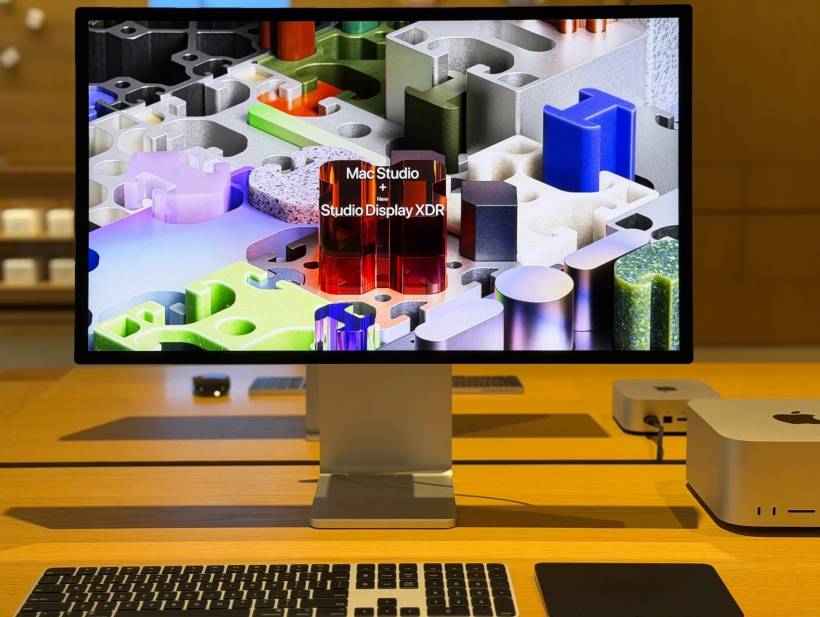
The Studio Display XDR Pushes Further
While the regular Studio Display looks strong on paper, the Studio Display XDR is where Apple clearly starts aiming at more demanding users.
In terms of overall design and general feature set, the XDR model remains fairly similar to the standard version. The major difference lies in the display technology itself. Instead of the regular panel used on the standard Studio Display, the XDR model adopts Apple's XDR display technology, built around a Mini LED backlight with 2,304 local dimming zones.
That change allows the monitor to deliver much stronger brightness and better control over contrast. Apple says the Studio Display XDR can reach 1,000 nits in SDR and up to 2,000 nits in HDR, which is a major jump over the standard model.
For users working with HDR content, high-end video editing, colour-sensitive workflows, or simply wanting a more advanced display experience, that alone may be enough to justify the step up.
Higher Refresh Rate Makes the XDR More Flexible
Another important difference is motion performance. The Studio Display XDR supports a 120Hz refresh rate, along with Adaptive Sync.
That makes the experience smoother not only for scrolling and interface navigation, but also for certain creative workflows and higher-frame-rate content. It is not being marketed as a gaming-first display, but the added smoothness still makes it feel more modern and premium compared to the standard 60Hz Studio Display.
Apple has also equipped this model with the A19 Pro chip, which gives it a more capable internal platform than the regular Studio Display, which uses the standard A19.
A Clear Split Between Premium and More Premium
What is interesting about this release is how clearly Apple has separated the two monitors. The standard Studio Display still feels premium, and for many users it will already be more than enough. It offers a sharp 5K panel, solid brightness, modern connectivity, built-in camera and audio features, and the polished Apple design language people expect.
The Studio Display XDR, however, is designed for buyers who want more than just a good-looking Apple monitor. It is for those who want stronger brightness, Mini LED technology, higher refresh rates, and a more advanced overall display experience.
That makes the choice easier to understand. One is a premium display for general professional use. The other is a more specialised premium display for users who are willing to pay significantly more for better panel technology and performance.
Final Thoughts
Apple's 2026 Studio Display lineup is now officially available in Malaysia, giving local buyers a clearer range of premium monitor options for Mac-based setups. The standard Studio Display continues to offer strong fundamentals with a sharp 5K screen, Apple-style integration, and a clean desktop experience, while the Studio Display XDR pushes further with Mini LED, much higher brightness, and smoother 120Hz visuals.
For Malaysian users building out a professional Apple workspace, these displays are clearly meant to do more than just look elegant on a desk. They are designed to be central pieces of the overall setup, blending display quality, connectivity, media features, and Apple ecosystem convenience into a single package.











Comments 0