

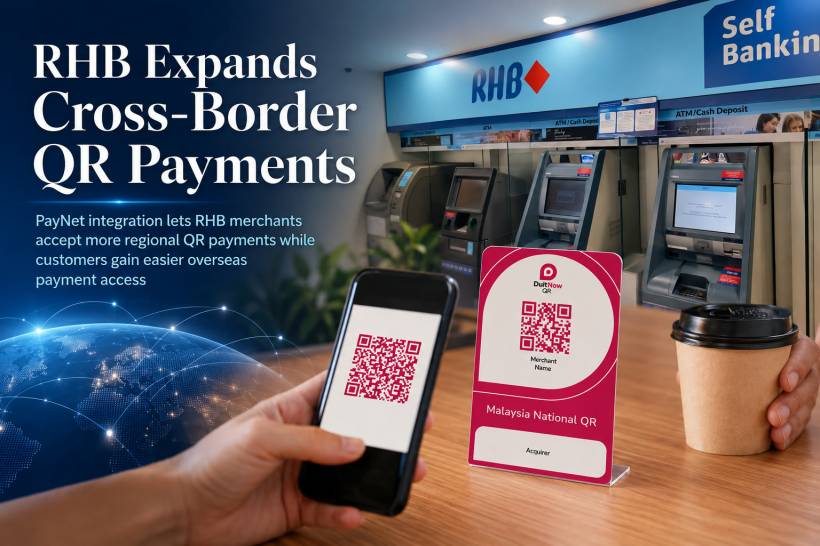
Paying for everyday purchases while travelling around Asia is becoming increasingly simple, with QR payments gradually removing the need to carry large amounts of cash or rely entirely on international cards. RHB Bank is now extending this convenience to more merchants and travellers through a new integration with Payments Network Malaysia, better known as PayNet.
The collaboration expands RHB's cross-border payment ecosystem, allowing participating RHB merchants in Malaysia to accept QR payments from a wider selection of overseas banking applications and digital wallets. It also gives RHB customers more ways to make payments when visiting selected countries in Southeast Asia.
RHB Merchants Can Accept More Overseas QR Payments
Through the PayNet integration, RHB merchants can now receive payments from participating banking apps and e-wallets originating from China, Singapore, Indonesia, Cambodia, Thailand and South Korea.
For international visitors, this means they may be able to pay at participating Malaysian businesses using the same applications they already use at home. Instead of registering for a new local wallet, withdrawing Malaysian ringgit or depending on a physical payment card, visitors can simply scan the merchant's QR code through a compatible app.
The payment process feels familiar to the customer, while the merchant continues receiving payments through Malaysia's existing payment infrastructure.
This can be particularly useful for businesses that frequently serve tourists, including restaurants, hotels, retail outlets, convenience stores, transport operators and attractions.
A More Familiar Experience for International Visitors
Payment familiarity can make a significant difference to the customer experience.
Travellers often hesitate when they are unsure whether their preferred cards or digital wallets will work overseas. Currency exchange, transaction fees and unfamiliar payment terminals can create additional friction at the point of sale.
Cross-border QR connectivity helps reduce some of these barriers by allowing customers to use banking or wallet applications they already recognise and trust. The app may handle the currency conversion and transaction confirmation while the merchant receives the payment through the connected local network.
For Malaysian businesses, this can help reduce payment-related confusion and make it easier to complete purchases with overseas customers.
RHB Customers Can Also Pay Across Selected Regional Markets
The integration is not limited to accepting payments from visitors entering Malaysia.
RHB customers can already use the RHB Mobile Banking app to make QR payments in Singapore, Indonesia, Cambodia and Thailand, provided the merchant participates in the supported cross-border payment network.
This gives customers a convenient alternative when travelling within the region. Rather than searching for a cash machine or deciding which card to use, they can scan a compatible merchant QR code through the RHB app.
China and South Korea are currently included in the acceptance network for overseas visitors paying RHB merchants, but they are not listed among the markets where RHB customers can make outbound QR payments through the app.
The difference shows that cross-border payment arrangements are often introduced gradually and may not offer identical functionality in both directions from the beginning.
How Cross-Border QR Payments Work
Although the customer experience may look similar to an ordinary domestic QR transaction, several payment systems are working behind the scenes.
When a visitor scans a Malaysian merchant's QR code, the overseas banking or wallet application communicates through participating payment networks. These systems verify the transaction, process the currency conversion where required and route the payment to the Malaysian merchant.
The merchant does not necessarily need to maintain separate QR codes for every participating overseas wallet. The goal of an interoperable network is to connect different payment systems through a common infrastructure.
This is important because fragmented QR payment environments can create unnecessary complexity. A business may otherwise need to display several different codes at the counter, each supporting a particular bank or wallet.
Greater interoperability helps move the market towards a more unified experience for both customers and merchants.
Supporting Malaysia's Tourism Economy
RHB said the expansion comes as Malaysia welcomes increasing numbers of regional and international visitors.
According to RHB Group Wholesale Banking Managing Director Nurjesmi Mohd Nashir, merchants increasingly need to provide payment experiences that are familiar, convenient and secure for international customers.
By accepting participating overseas banking apps and wallets, RHB merchants can serve visitors without forcing them to change how they normally pay. At the same time, RHB customers retain access to cross-border QR payments when travelling in participating regional markets.
The timing is particularly relevant as Malaysia prepares for and promotes Visit Malaysia 2026, which is expected to encourage higher tourism activity and cross-border spending.
When tourists can pay more easily, they may be more willing to spend at smaller businesses that previously relied heavily on cash or domestic payment methods.
Smaller Merchants May Benefit the Most
Large hotels and international retailers already tend to support several payment options. Smaller businesses, however, may not have access to the same range of card terminals or international payment arrangements.
QR payments can offer a more accessible route to digital acceptance.
A small café, market seller or independent retailer may be able to serve international customers using its existing QR setup, provided it is connected to the relevant participating network. This reduces the need to install multiple payment terminals or manage separate merchant relationships for different overseas wallets.
The expansion could therefore make cross-border digital payments available beyond major shopping districts and tourist attractions.
However, merchants should still understand the applicable settlement process, fees and transaction records so that cross-border payments can be reconciled properly with daily sales.
PayNet's Role in Connecting Payment Networks
PayNet operates key components of Malaysia's national payment infrastructure and plays an important role in improving interoperability between banks, digital wallets and merchants.
Its involvement allows individual financial institutions such as RHB to connect with a wider regional payment ecosystem instead of negotiating and operating every cross-border connection independently.
PayNet Chief Commercial Officer Azrul Fakhzan B. Mainor described the expansion of cross-border QR acceptance as a collaborative effort involving multiple participants across the payment industry.
The aim is not only to make transactions easier for visitors, but also to strengthen regional connectivity and create more opportunities for Malaysian businesses.
This broader approach is important because cross-border QR payments require cooperation between banks, payment-network operators, regulators and overseas partners. A single institution cannot create full regional interoperability on its own.
QR Payments Are Becoming an Important Regional Standard
Southeast Asia has seen rapid adoption of QR payments, supported by widespread smartphone use and strong digital-banking growth.
Many consumers already use QR codes for small everyday purchases, including food, transport, retail items and services. Extending these domestic systems across national borders is a natural next step.
For travellers, QR payments may offer several practical benefits:
The long-term goal is to make regional payments feel almost as straightforward as domestic transactions, even though different currencies and regulatory systems remain involved.
Security and Convenience Must Develop Together
Convenience is important, but cross-border payment growth must also be supported by strong security controls.
Customers should still verify the merchant name and transaction amount before approving a QR payment. Fraudsters can replace or tamper with physical QR labels, potentially redirecting payments to the wrong recipient.
Users should avoid scanning payment codes received through suspicious messages or unofficial websites. Payments should be completed only through the official RHB Mobile Banking app or another trusted participating application.
Merchants should also inspect displayed QR codes regularly and ensure that payment confirmations are verified through their official merchant systems rather than relying solely on screenshots shown by customers.
As QR usage expands across borders, user awareness will remain essential to preventing social engineering and payment redirection scams.
Malaysia Is Moving Towards a More Unified QR Ecosystem
The RHB announcement also comes as Bank Negara Malaysia moves to streamline the country's QR payment landscape.
Proprietary QR payment networks are expected to be phased out over the next two years. Merchants will instead transition towards the Real-time Retail Payments Platform, operated by PayNet.
This shift is intended to reduce fragmentation and improve interoperability. Rather than requiring businesses and consumers to navigate multiple closed systems, payments can be routed through a common national platform.
A unified infrastructure can also make future cross-border integrations easier because overseas partners connect with a recognised national payment network rather than numerous separate proprietary systems.
For consumers, the visible experience may remain as simple as scanning a QR code. Behind that code, however, Malaysia's payment ecosystem is moving towards a more standardised and connected foundation.
What This Means for RHB Merchants
RHB merchants serving international visitors may now be able to accept a wider range of familiar overseas payment apps without substantially changing the checkout experience.
This could help businesses:
Merchants should confirm whether their current QR arrangement is enabled for cross-border acceptance and understand how foreign transactions will appear in settlement and reporting records.
They should also ensure that employees know how to recognise successful payments and respond to failed or disputed transactions.
Final Thoughts
RHB's integration with PayNet reflects the growing importance of interoperable QR payments across Asia.
For Malaysian merchants, the development opens the door to payments from participating banking apps and e-wallets across six regional markets. For RHB customers, it provides a convenient way to make QR payments when travelling in Singapore, Indonesia, Cambodia and Thailand.
The initiative is particularly timely as Malaysia prepares for increased tourism under Visit Malaysia 2026. Making payments easier for international visitors could benefit both major retailers and smaller local businesses.
More broadly, the announcement shows how Malaysia's payment infrastructure is evolving from separate domestic systems towards a connected regional network. As proprietary QR networks are gradually replaced by PayNet's central platform, customers and merchants can expect QR payments to become more consistent, interoperable and useful across borders.











Comments 0