

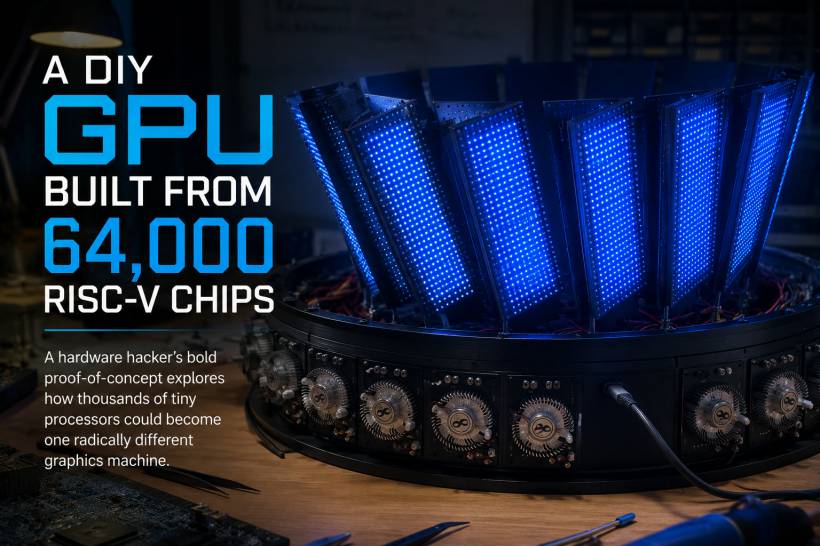
A hardware creator known online as Bitluni has set out to build one of the most unusual graphics projects in recent memory: a homemade GPU-like system made from tens of thousands of tiny RISC-V microcontrollers. This is not a normal graphics card in the way most PC users would understand it. There is no NVIDIA, AMD or Intel GPU die at the centre of the project. Instead, the idea is to use thousands of individual low-cost chips, with each chip acting almost like its own tiny computing unit and visual pixel. When combined together, they would form both the display and the processing structure behind it.
It is an ambitious, strange and very hardware-hacker kind of idea.
A GPU Made From Thousands of Tiny Processors
The full plan reportedly involves around 64,000 RISC-V chips. That number is already massive, but it is actually a scaled-down version of the original idea. Bitluni estimated that a Full HD version would require roughly two million chips, which would be far more expensive, power-hungry and difficult to build.
Instead, the target has been reduced to a more practical 320 x 200 resolution. By today's standards, that is extremely low, but for a proof-of-concept project, it is still large enough to demonstrate the idea.
The concept is simple in theory but complicated in practice: each chip contributes to the overall visual output, and together the chips behave like a giant distributed display system.
The Prototype Already Uses 8,192 Chips
Bitluni has not yet built the full 64,000-chip version. The current prototype is smaller, but still impressive. It uses 8,192 chips arranged across custom circuit boards.
Each board handles a 16 x 32 pixel block, and the layout has a circular design that was loosely inspired by the classic Cray-1 supercomputer. That gives the project a retro-futuristic look, somewhere between an experimental computer, an art installation and a deeply technical engineering challenge.
This is part of what makes the project interesting. It is not only about raw performance. It is also about showing what can be done when someone takes cheap, simple hardware and connects it together in a creative way.
The Chips Are Cheap, but the Scale Is Not
The chips being used are QingKe CH570 microcontrollers, each costing around US$0.13, or roughly RM0.50. Individually, that sounds extremely affordable.
Each chip includes a 32-bit RISC-V CPU running at 100MHz, along with features such as a USB controller, a 2.4GHz transceiver and Bluetooth 5.0 LE support.
However, low cost per chip quickly becomes expensive when multiplied by thousands. The 8,192-chip prototype alone costs more than US$1,000 in microcontrollers. Scaling that up to 64,000 chips would push the chip cost alone to around US$8,320, or roughly RM33,900, before factoring in custom boards, power delivery, cooling, wiring, testing and other components.
So while each chip is cheap, the full project is definitely not.
Power Delivery Is One of the Biggest Challenges
One of the most serious parts of the project is power consumption. Each microcontroller may only draw a small amount of current on its own, but thousands of them running together add up very quickly.
Bitluni's prototype reportedly draws over 2,000W, which is already more than what many high-end gaming PCs use under load. Managing that kind of power safely requires serious planning, proper power supplies and custom voltage conversion hardware.
This is where the project moves beyond a fun experiment and into complex engineering territory. Running thousands of tiny chips is not just about soldering them together. The system also needs stable power distribution, heat management, signal coordination and fault tolerance.
More Proof-of-Concept Than Practical Gaming GPU
Despite being described as a homemade GPU, this project is not meant to compete with a modern graphics card. It is unlikely to run modern games in any normal sense, and it does not follow the usual design of a commercial GPU.
Instead, its value is in the experiment itself. It asks a fun question: what happens if you build a visual computing system using thousands of small general-purpose processors instead of a traditional graphics architecture?
That makes it more of a technical demonstration, hardware art project and educational showcase than a practical replacement for a gaming GPU.
Why the Project Is So Interesting
What makes this project stand out is the sheer scale of the idea. RISC-V is often discussed in the context of open instruction sets, embedded devices, low-cost computing and custom processor designs. Bitluni's project pushes that idea into a visually dramatic direction.
It also shows how accessible hardware experimentation has become. A single low-cost microcontroller may not seem powerful, but with enough of them arranged creatively, they can become part of something much larger.
Of course, building something like this requires deep knowledge of electronics, power systems, PCB design, programming and debugging. It is not a weekend beginner project, but it is a fascinating look at what skilled makers can attempt with modern low-cost components.
Final Thoughts
Bitluni's 64,000-chip RISC-V GPU project is not practical in the commercial sense, and that is exactly what makes it interesting. It is not trying to beat a GeForce or Radeon card. It is trying to explore a completely different way of thinking about graphics, processing and display hardware.
Whether the final version becomes a working GPU, a giant programmable display, or simply a brilliant hardware experiment, the project already succeeds in one area: it reminds us that computing can still be playful, strange and deeply creative.











Comments 0