

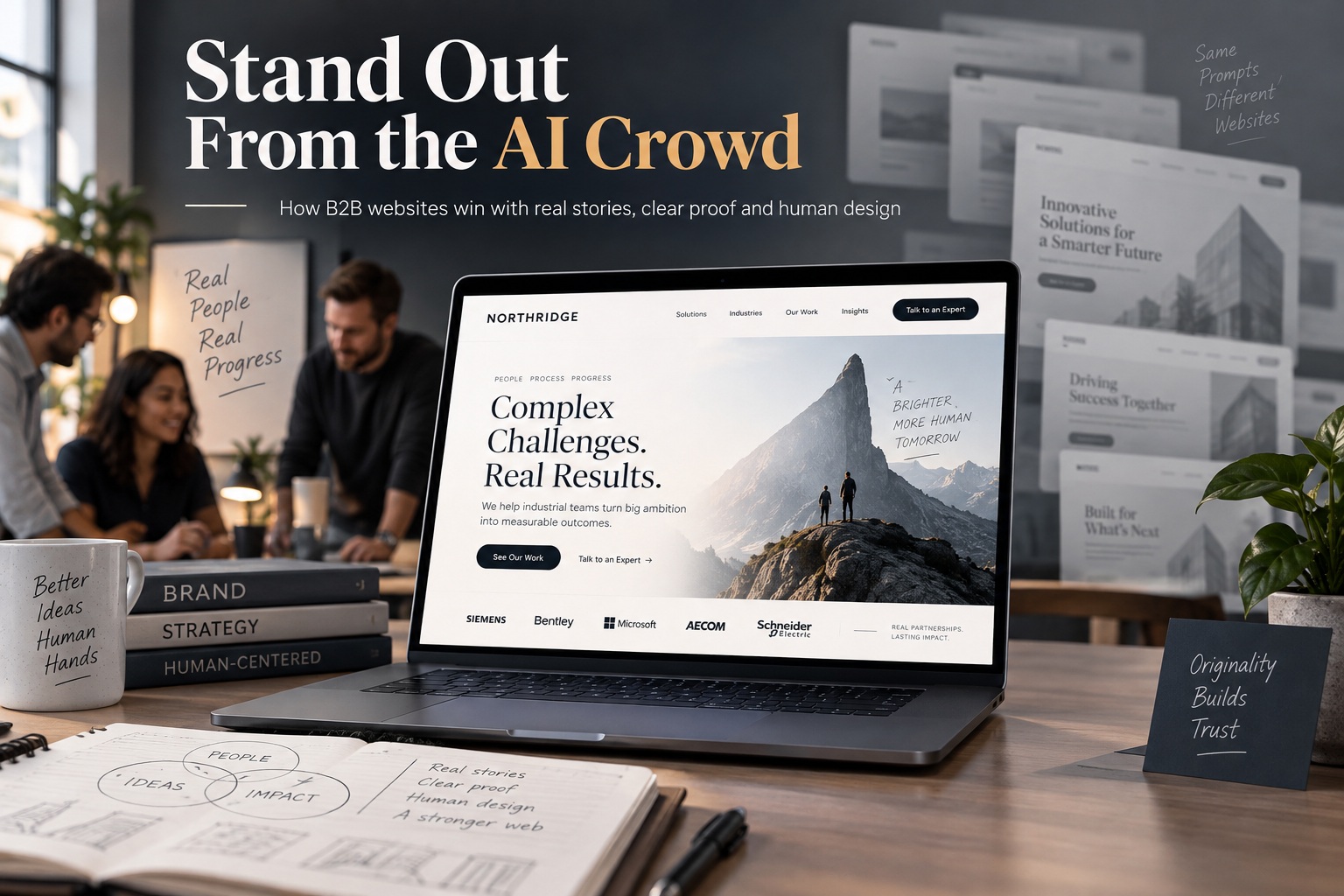
Artificial intelligence has made it easier than ever to produce website copy, layouts and marketing content, but that convenience has created a new problem: a growing number of B2B websites are starting to look and sound almost identical. The same polished phrases, familiar page structures and predictable promises appear from one company to the next. Standing out now requires more than having a modern website; businesses need to communicate things that are genuinely specific to who they are, how they work and why customers choose them.
The simplest test is to ask whether a competitor could copy your homepage word for word and still sound believable. If the answer is yes, the problem is not necessarily AI itself. The real problem is that the website is communicating ideas that are too generic to belong exclusively to your business.
Why So Many B2B Websites Sound The Same
Generic B2B copy existed long before generative AI arrived. Corporate websites have traditionally been written and reviewed by multiple stakeholders, with each person trying to make the language safe enough for everyone to approve. Over time, distinctive ideas are often replaced with phrases such as "trusted partner", "tailored solutions", "driving growth" and "industry-leading expertise".
These expressions sound professional, but they rarely tell prospective customers anything meaningful. AI systems have been trained on enormous amounts of public web content containing exactly this kind of language, so when businesses ask them to generate corporate copy without strong context, the result naturally resembles thousands of existing websites. AI did not create generic B2B writing, but it can reproduce it at enormous scale.
The Design Problem Is Similar
The visual side of B2B websites has followed a similar pattern. Many templates and AI-powered website builders rely on familiar structures: a large hero headline, a coloured background, three service cards with icons, a row of client logos and several calls to action. There is nothing inherently wrong with any of those elements, and they often work because visitors already understand them.
The problem appears when every company uses the same structure with little brand personality. A visitor may move from one website to another without feeling that anything meaningful has changed beyond the logo and colour palette. Good design should make information easier to understand while also giving the company a recognisable character.
Try The Logo Swap Test
One of the easiest ways to identify generic positioning is to temporarily imagine the homepage without your company logo. Read the headline, introduction and service descriptions and ask whether a direct competitor could publish exactly the same words. If they could, your website probably does not communicate enough about what makes your business different.
This test works even when every sentence was written manually rather than generated by AI. Phrases such as "we help businesses succeed through innovative solutions" may sound polished, but they could describe almost any consultancy, software company, agency or professional service firm. Specificity is what transforms generic marketing language into something recognisable.
Look For Words That Say Very Little
Certain words appear so frequently on business websites that they have gradually lost much of their impact. Terms such as "innovative", "seamless", "cutting-edge", "empower", "solutions", "partner" and "excellence" are not necessarily wrong, but they often appear without enough evidence to make them useful.
Search your website for these terms and examine the sentences around them. If you describe your service as seamless, explain what specifically makes the experience seamless. If you claim to be innovative, show what you have actually introduced or improved rather than relying on the adjective itself.
A useful rule is that every significant claim should be supported by something concrete. The stronger the evidence, the less your website will sound like generated marketing copy.
Replace Broad Claims With Real Examples
Consider a sentence such as "We deliver results". It sounds positive, but the reader still knows almost nothing. What results were delivered, for whom and what actually changed? Without context, the phrase becomes another piece of background noise.
Compare that with a statement such as: "We redesigned a supplier's website so buyers could find technical specifications without contacting the sales team." That single sentence identifies the type of customer, the work performed and the practical outcome. It gives the reader something tangible to understand.
Real examples are powerful because competitors cannot easily copy them. They come from your own projects, customers and experience, which is exactly the kind of information generic AI-generated content does not automatically possess.
Use Numbers That Belong To Your Business
Specific figures immediately make website copy feel more credible. Instead of saying your company has "years of experience", state how long it has operated. Rather than claiming to serve "many customers", explain how many organisations you have worked with or which industries account for most of your projects.
For example, "We have supplied equipment to more than 200 food manufacturers since 2015" communicates far more than "We are an experienced supplier". The number gives readers a sense of scale, while the industry reference helps them understand whether your experience is relevant to their needs.
Metrics do not need to be spectacular. They simply need to be accurate and meaningful.
Share Opinions That Reveal How You Think
B2B websites often avoid strong opinions because companies worry about alienating potential customers. The result is usually safe content that says almost nothing about how the company actually approaches its work. A thoughtful opinion can be far more memorable than another broad claim about quality.
A software company might say, for example, that not every business needs custom software because existing products can sometimes solve the problem more efficiently. That statement reveals something about the company's decision-making philosophy. It suggests that the business may recommend the most sensible option rather than automatically selling the most expensive project.
You do not need deliberately provocative opinions. The goal is simply to express what your experience has taught you, particularly where your approach differs from common industry assumptions.
Explain Your Process In Plain Language
Many websites claim to follow a "proven process", but few explain what that process actually involves. Instead of presenting a generic diagram with labels such as Discover, Design, Deliver and Grow, describe what really happens after someone becomes a client. Explain who they speak to, what information you request and what they should expect during the first week.
Small operational details make businesses feel more real. Perhaps every new project begins with a 60-minute technical workshop. Maybe customers receive a written summary before any design work starts. Perhaps the founder remains involved throughout the project rather than disappearing after the sales meeting.
These details may seem ordinary internally because your team sees them every day. To a prospective customer, however, they can be exactly what distinguishes your company from a competitor.
Use Real People Instead Of Generic Stock Imagery
If customers will eventually work with actual people from your business, show those people on the website. Real team photography usually communicates more trust and personality than another stock photograph of strangers shaking hands in a glass meeting room. The images do not need to look like an expensive advertising campaign.
Authenticity often matters more than perfection. Showing your office, workshop, equipment or team members can provide visual evidence that there is a real organisation behind the website. It also gives customers a better idea of who they will interact with after making an enquiry.
AI-generated imagery can still have a role in creative work, but it should not replace every visual connection to the actual company.
Build The Design Around Your Brand
Once the messaging is distinctive, the visual design should reinforce it. Start by examining the websites of your main competitors. Look at the colours, typography, photography and overall visual tone they use, then identify where your industry has become visually repetitive.
Being different does not mean choosing unusual colours simply for attention. A strong visual identity should still suit the character of the company and appeal to the intended audience. The objective is recognition: someone should gradually associate a particular visual style with your business across the website, presentations, social media and other communications.
Consistency strengthens that recognition. Using completely different styles across each platform makes even a good brand feel fragmented.
Use Visuals That Explain Something
Every image on a B2B website should ideally have a reason to exist. A diagram showing how a complicated service works can be more valuable than an attractive but unrelated office photograph. A chart built from your own data can demonstrate expertise in a way generic illustrations cannot.
Photographs of real installations, behind-the-scenes processes, finished projects or products can also communicate information that words struggle to explain. Short videos can be particularly useful for demonstrating machinery, software workflows or complicated services. The strongest visuals do more than decorate the page; they help prospective customers understand the business.
This is another area where original material provides an advantage. Competitors can easily use the same stock library or image-generation tool, but they cannot reproduce your real projects and processes.
Remove More Instead Of Constantly Adding
B2B websites often become cluttered because every department wants its message included. The homepage ends up containing every service, slogan, credential, award, testimonial, button and corporate statement the organisation can think of. Instead of helping visitors understand the business, the sheer amount of information makes the important message harder to find.
A strong website is usually selective. Decide which information is most important to the audience and give it enough visual space to be understood. Secondary information can live deeper within the website where interested visitors can explore it.
Removing unnecessary content also makes distinctive material more visible. A genuine customer result surrounded by ten generic marketing claims loses much of its impact.
You May Not Need A Complete Redesign
When a website feels dated or generic, redesigning everything can seem like the obvious solution. However, replacing the visual design without addressing the underlying message often produces a newer-looking website that still sounds exactly like everyone else. The company has changed the presentation without solving the differentiation problem.
Start by identifying what makes the business worth choosing. Gather the real statistics, customer stories, opinions, processes, photography and expertise that competitors cannot easily reproduce. Once the message is clear, design the website around those strengths.
Sometimes that will justify a complete redesign. In other situations, improving the copy, photography and content hierarchy may transform an existing website without rebuilding everything.
Use AI To Support Your Voice, Not Replace It
AI itself is not the enemy of distinctive B2B websites. It can help structure information, explore alternative wording, analyse long drafts and speed up repetitive content tasks. The problem appears when businesses ask AI to invent their positioning instead of providing the information that makes the company unique.
The strongest workflow is to give AI material that only your organisation possesses: customer outcomes, internal knowledge, real figures, specialist opinions and documented processes. AI can then help refine and organise that information without turning the company into another collection of generic claims.
If the source material is distinctive, AI can help communicate it. If the source material is generic, the result will almost inevitably be generic as well.
Final Thoughts
Standing out from the growing volume of AI-generated business websites does not require avoiding AI or inventing increasingly extravagant designs. It requires saying things that are genuinely true about your business and difficult for anyone else to copy. Real numbers, specific examples, clear opinions, genuine processes and authentic photography provide the raw material that makes a B2B website recognisable.
The design should then amplify those differences rather than hiding them inside a familiar template. Before publishing any sentence or visual element, ask whether it helps visitors understand something specific about your company. If a competitor could replace your logo with theirs and leave everything else unchanged, there is still work to do.











Comments 0