

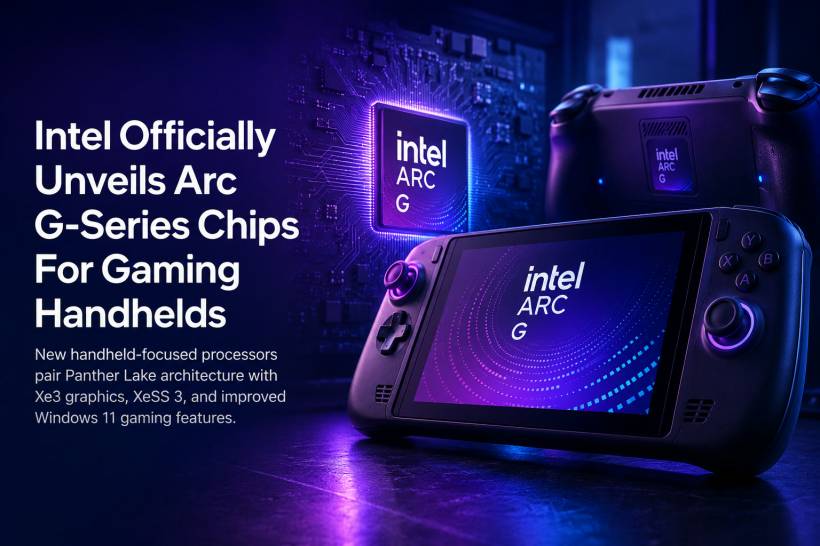
Intel has officially introduced its new Arc G-Series processors, a lineup designed specifically for next-generation gaming handhelds. After months of rumours, leaks, and speculation, the announcement confirms that Intel is now making a stronger push into the portable gaming PC market.
The new chips were revealed ahead of Computex 2026 and are built on the same Panther Lake architecture as Intel's Core Ultra Series 3 processors. However, unlike regular laptop chips, the Arc G-Series is aimed directly at Windows 11 gaming handhelds, where performance, battery life, thermals, and software experience all need to be carefully balanced.
This is an important move for Intel because handheld gaming PCs have become a serious product category. Devices such as the Steam Deck, ROG Ally, Lenovo Legion Go, MSI Claw, and OneXPlayer systems have shown that many players want PC gaming in a portable form. Intel's new Arc G-Series appears to be its answer to that growing demand.
Two Chips To Start The Lineup
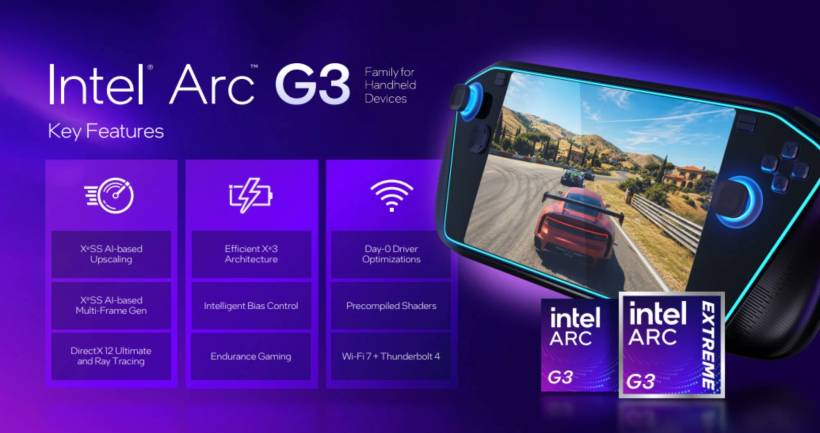
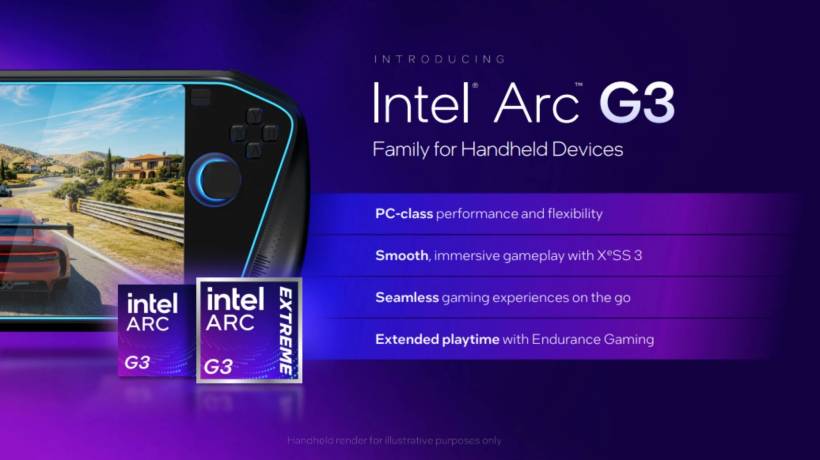
The first Arc G-Series lineup includes two processors: the Intel Arc G3 and the Intel Arc G3 Extreme. These chips are expected to appear in upcoming gaming handhelds from several hardware partners, including Acer, MSI, and OneXPlayer.
Intel has already mentioned devices such as the Acer Predator Atlas 8, MSI Claw 8 EX AI+, and future OneXPlayer models as early systems that will use the new platform. This suggests that Intel is not treating the Arc G-Series as a small experimental product. Instead, the company appears to be building a proper handheld ecosystem around it.
For gaming handheld makers, having a processor designed specifically for portable gaming could make product development easier. Rather than adapting standard laptop chips into smaller handheld bodies, manufacturers can work with hardware that is already tuned for that kind of device.
Built With Handheld Gaming In Mind
Intel says the Arc G-Series processors were developed specifically for handheld gaming PCs. That matters because handhelds have a very different set of requirements compared to normal laptops.
A gaming handheld has to deliver playable frame rates while staying cool enough to hold comfortably. It also needs to manage battery life carefully, support controller-based use, and run modern Windows games without making the user feel like they are wrestling with a desktop operating system on a tiny screen.
To support that, the chips reportedly include two Performance cores, eight Efficiency cores, and four Low-Power Efficiency cores. This kind of core arrangement is designed to provide power when a game needs it, while also saving energy during lighter tasks or background activity.
The processors are built on Intel's 18A process node, which is an important part of the company's broader manufacturing roadmap. For handhelds, the efficiency gains from a newer process can be just as important as raw performance, because every watt matters in a portable gaming device.
A Better Windows Handheld Experience
One of the most interesting parts of Intel's announcement is its focus on improving the Windows handheld experience. Windows-based gaming handhelds are powerful, but the software experience has often been one of their weaker points.
The standard Windows desktop was not really designed for small screens and controller-first navigation. Users often have to deal with tiny icons, pop-up windows, launchers, updates, and settings menus that feel awkward on a handheld.
To address this, Intel is supporting Windows 11's full-screen Xbox mode. This mode is designed to offer a more console-like interface, making it easier to browse games, launch titles, and navigate the system using handheld controls.
If implemented well, this could make Intel-powered handhelds feel more polished out of the box. A smoother interface may not sound as exciting as faster graphics, but for everyday use, it can make a big difference.
Xe3 Graphics Take Centre Stage
The biggest technical highlight of the Arc G-Series is Intel's latest Xe3 graphics architecture. The new chips can feature up to Intel Arc B390 integrated graphics, giving them the graphics foundation needed for modern portable PC gaming.
This includes support for real-time ray tracing and Intel's XeSS 3 technology. Ray tracing is still demanding, especially on portable hardware, but support for the feature shows that Intel wants these chips to handle more advanced visual workloads.
The more practical feature for many players will likely be XeSS 3. Intel's AI-assisted graphics suite is designed to improve performance and image quality by combining several technologies that work together during gameplay.
XeSS 3 And Smarter Performance Boosting
XeSS 3 includes AI upscaling, multi-frame generation, and latency reduction. These features are meant to help games run more smoothly without forcing users to drop visual quality too heavily.
XeSS Super Resolution handles AI-based upscaling. In simple terms, the game can render at a lower internal resolution, and the system then reconstructs the image to look sharper on screen. This can improve frame rates while still maintaining good visual quality.
XeSS Multi-Frame Generation adds interpolated frames between rendered frames to make motion look smoother. Meanwhile, Xe Low Latency is designed to reduce input lag, which is especially important for fast-paced games where response time matters.
For handheld gaming, this kind of technology is useful because portable devices do not have the same thermal and power headroom as full gaming laptops or desktops. Smarter rendering techniques can help extend what the hardware is capable of.
Precompiled Shaders Could Reduce Stutter
Intel is also introducing a feature called Intel Precompiled Shaders. This system downloads prebuilt shader files from Intel's cloud servers for supported games.
Shader compilation has been a common source of stutter in modern PC games. When a game has to compile shaders during launch or gameplay, it can cause pauses, frame drops, or longer loading times. By providing precompiled shaders ahead of time, Intel hopes to reduce those issues.
The company says supported titles currently include Black Myth: Wukong, Call of Duty: Black Ops 6, Call of Duty: Black Ops 7, and The Outer Worlds 2. More games are expected to be added later.
This feature could be especially helpful on handhelds, where users expect a quick and convenient gaming experience. Portable gaming feels better when games launch quickly and run smoothly without long setup delays.
Modern Connectivity For Portable Gaming
The Arc G-Series platform also includes modern connectivity features. Intel has highlighted integrated Wi-Fi 7 R2 support, dual Bluetooth 6 connectivity, and Thunderbolt 4 with up to 40Gbps bandwidth.
These features are important because handheld gaming PCs are no longer just standalone devices. Many users connect them to external displays, controllers, docks, storage drives, headsets, keyboards, and other accessories.
Thunderbolt 4 support can help with faster data transfers and external peripheral support. Wi-Fi 7 R2 could improve wireless performance, especially for large downloads, cloud saves, streaming, and online multiplayer. Dual Bluetooth 6 support may also help users manage multiple wireless accessories more smoothly.
For players with large game libraries, faster connectivity can make a handheld feel less restricted and more like a flexible part of a wider gaming setup.
Availability And What Comes Next
Intel and its partners are expected to reveal more information about Arc G-Series-powered handhelds during Computex 2026. That should give a clearer picture of pricing, performance targets, battery expectations, and how different manufacturers plan to design their devices around the new chips.
Systems using the Arc G-Series processors are scheduled to begin rolling out from June 2026, with wider availability expected throughout the rest of the year.
The real question will be how these chips perform in actual retail devices. Specifications and feature lists are promising, but handheld gaming depends heavily on real-world tuning, cooling design, battery size, software polish, and driver support.
Final Thoughts
Intel's Arc G-Series marks a serious attempt to compete in the growing gaming handheld market. By creating chips specifically for portable gaming PCs, Intel is showing that it understands this category needs more than just repurposed laptop hardware.
The combination of Panther Lake architecture, Xe3 graphics, XeSS 3, precompiled shaders, modern connectivity, and a more console-like Windows experience could make future Intel-powered handhelds much more competitive.
Still, success will depend on execution. If Intel and its partners can deliver strong performance, good battery life, stable drivers, and a smooth handheld interface, the Arc G-Series could become an important platform for Windows gaming handhelds. For now, Computex 2026 should give us a better look at how serious Intel's handheld gaming ambitions really are.











Comments 0