

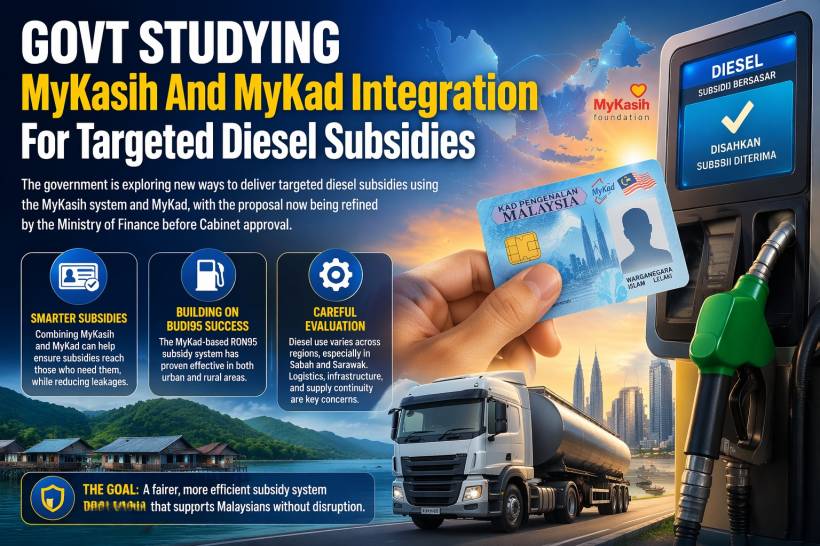
Malaysia's government is taking another step in refining how subsidies are delivered, with a new proposal that could combine the MyKasih system and the MyKad to manage targeted diesel subsidies more efficiently. The idea reflects the government's ongoing effort to ensure subsidies reach the people who truly need them, while reducing leakages and improving transparency in the system.
Communications Minister Fahmi Fadzil confirmed that the proposal is currently being refined by the Ministry of Finance Malaysia. Once the details are finalised, the plan will be presented to the Cabinet for approval.
While the concept may sound technical at first, it actually reflects a broader policy shift in Malaysia: moving away from blanket subsidies and toward smarter, targeted systems that rely on digital infrastructure already widely used by Malaysians.
Moving Toward Smarter Subsidy Delivery
Subsidies have long been a key part of Malaysia's economic policy, especially for essential items such as fuel. However, the government has been working to refine how these subsidies are distributed to ensure they benefit the intended groups without unnecessary spending.
According to Fahmi, the integration proposal was discussed during a Cabinet meeting as part of ongoing economic measures coordinated by the National Economic Action Council. The discussion focused on improving how assistance programmes can be delivered more accurately through digital systems.
The proposed approach would combine the capabilities of MyKasih, which is already used to distribute targeted financial assistance, with the MyKad identification system. Since nearly every Malaysian citizen already carries a MyKad, integrating subsidy mechanisms into the card could make verification and access far more streamlined.
In simple terms, this could allow subsidies to be delivered directly through a system that already identifies eligible recipients automatically.
Lessons From the RON95 Subsidy Programme
The proposal also builds on earlier initiatives introduced by Amir Hamzah Azizan, who previously highlighted the potential of integrating MyKad into subsidy systems.
One of the most notable examples is the BUDI95 programme for RON95 petrol, which uses MyKad verification to help manage targeted fuel subsidies.
Officials say the system has produced encouraging results. By linking subsidy eligibility directly to a verified identity card, authorities can better control who receives the subsidy while reducing abuse or unintended distribution.
Importantly, the government notes that the system has worked effectively in both urban and rural areas without significantly changing how consumers purchase fuel. Drivers simply continue using fuel as usual while eligibility checks occur in the background.
Because of this success, policymakers are now studying whether the same model could be extended to diesel subsidies.
Why Diesel Subsidies Are More Complex
While applying the same concept to diesel may sound straightforward, the reality is more complicated.
Diesel usage patterns vary widely across Malaysia. In Peninsular Malaysia, diesel is commonly used by logistics operators, heavy vehicles, and certain industries. But in East Malaysia, particularly Sabah and Sarawak, diesel plays an even more critical role in daily life.
In many parts of these states, diesel fuels not only transport systems but also electricity generation in remote areas. Some communities rely on diesel-powered generators due to limited access to the national electricity grid.
Additionally, certain rural regions do not have conventional petrol stations. Instead, fuel may be distributed through alternative supply chains such as small depots, river transport, or mobile deliveries.
These differences mean that implementing a nationwide diesel subsidy system requires careful planning to ensure that supply remains stable and accessible across every region.
Balancing Efficiency With Practical Realities
Because of these complexities, the government has emphasised that any new system must be thoroughly evaluated before it is rolled out.
Amir Hamzah has noted that while the MyKad approach shows promise, the authorities need to ensure that logistics, infrastructure, and system readiness are fully prepared. Introducing a new subsidy mechanism too quickly could risk unintended disruptions—particularly in areas that rely heavily on diesel.
Ensuring supply continuity is therefore a major priority. The government wants to avoid situations where communities or industries suddenly face difficulty accessing subsidised fuel due to technical or logistical gaps.
For that reason, the evaluation process will consider usability, nationwide system capacity, and the unique fuel distribution challenges found in different regions.
Final Thoughts
Malaysia's exploration of integrating MyKasih and MyKad for diesel subsidies reflects a broader transformation in how government assistance programmes are delivered. Instead of broad subsidies that benefit everyone regardless of need, policymakers are moving toward targeted systems that rely on digital identity and verified eligibility.
If implemented successfully, this approach could improve efficiency, reduce subsidy leakages, and ensure that financial support reaches those who genuinely require it. At the same time, authorities remain cautious about rolling out the system too quickly, particularly given the complex role diesel plays in regions like Sabah and Sarawak.
For now, the proposal remains under review by the Ministry of Finance. But if it gains Cabinet approval, Malaysia could soon see another major step toward a more modern and data-driven subsidy system.











Comments 0