

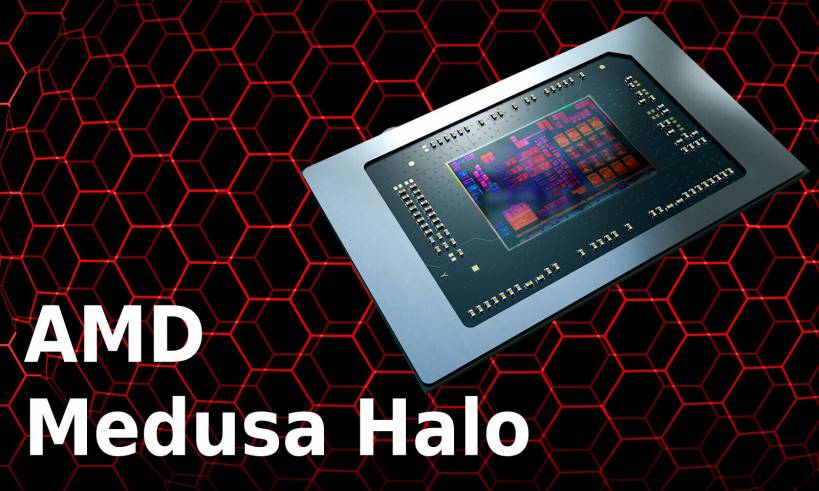
A fresh leak is making the rounds: AMD's next "Halo" class APU (often referred to as "Medusa Halo") might support LPDDR6, the next-generation low-power memory standard. The source of the chatter is a post from leaker Olrak29 on X, where they suggested an internal platform identifier ("SM8975") supports both LPDDR5X and LPDDR6, and then doubled down when asked specifically about Medusa Halo.
Before anyone engraves "LPDDR6 confirmed" onto a CPU box, it's worth stating the obvious: AMD hasn't officially announced "Medusa Halo" (or even fully outlined what comes after today's Strix Halo in a public roadmap). This is still rumor territory.
What "LPDDR6 support" would actually mean (and why it matters)
The excitement here isn't about a bigger number on a spec sheet. For Halo-style APUs, memory bandwidth is the lifeblood of the integrated GPU.
With a typical gaming laptop that has a dedicated GPU, the graphics chip has its own fast VRAM (like GDDR6). But with a big APU, the integrated GPU shares the same memory pool as the CPU. That means:
• More bandwidth can also help AI workloads that move lots of data around (think large models, image generation, or video effects)
• Unified memory becomes more attractive when it's not constantly "starving" the GPU
That's why people keep paying attention to Strix Halo's memory design and why LPDDR6 rumors instantly sound plausible as a next step.
LPDDR6 isn't "unreleased" anymore, but products are still ramping up
One key detail: LPDDR6 has been standardized. JEDEC published LPDDR6 in July 2025, with data rates stated in the 10,667 to 14,400 MT/s range (depending on the exact configuration).
So when people cite "14,400 MT/s," that number isn't random. It lines up with the upper end of the published spec range.
Where the uncertainty remains is product timing and adoption in real devices, because standards usually show up in shipping platforms later (after validation, controller support, OEM design cycles, cost, and supply all line up).
The simple math: why people are hyped about "460.8 GB/s"
A lot of rumor coverage focuses on an attention-grabbing bandwidth figure: 460.8 GB/s "theoretical." The reason is straightforward.
If you take LPDDR6 at 14,400 MT/s and pair it with a wide memory bus (Halo APUs are rumored/assumed to use very wide buses), the theoretical bandwidth jumps dramatically versus LPDDR5X designs. One recent breakdown compares current Strix Halo bandwidth around 256 GB/s (using LPDDR5X) to ~460.8 GB/s with LPDDR6 on a similar 256-bit bus, which is roughly an 80% uplift on paper.
Important caveat: theoretical bandwidth is not the same as real-world performance. But it's still a meaningful indicator for whether the iGPU could scale further without instantly hitting a memory wall.
Where Strix Halo fits in right now (and why it frames the rumor)
To understand why "Medusa Halo + LPDDR6" sounds like a logical next chapter, it helps to look at what AMD is already doing with Strix Halo today.
At CES 2026, AMD announced two additional Strix Halo chips: Ryzen AI Max+ 392 and Ryzen AI Max+ 388, positioning them as more accessible options while retaining strong integrated graphics capability.
This matters because AMD is clearly investing in the "big APU" idea: high iGPU performance, unified memory, and enough compute to make thin laptops, mini PCs, and even gaming handheld-style devices genuinely interesting without a discrete GPU.
So when a rumor claims the next Halo generation might take the "same concept, but with a lot more bandwidth," it matches the direction AMD is already pushing.
"Gorgon Halo" vs "Medusa Halo": the awkward gap between rumors and reality
The rumor you provided also mentions we're still waiting for "Gorgon Halo," often described in leaks as a refresh/follow-up after Strix Halo. Some reporting frames Gorgon Halo as a nearer-term step, with Medusa Halo further out.
The practical takeaway is:
• "Gorgon Halo" is widely rumored, but not officially confirmed by AMD
• "Medusa Halo" is even more speculative, and timelines attached to it are educated guesswork
That doesn't make the leak useless. It just means you should treat "LPDDR6 support" as "AMD may be planning for it," not "AMD will definitely ship it, and soon."
So… will Medusa Halo only use LPDDR6?
Probably not as a hard rule.
Even if AMD's memory controller and platform are designed with LPDDR6 in mind, vendors often keep options open across a product stack. Availability, price, and validation matter, and laptop makers may want different memory configurations depending on target cost and thermal envelopes.
In other words, the most believable version of the rumor is: AMD is preparing the platform to support LPDDR6 when it makes sense, not that every Medusa Halo device will be LPDDR6-only on day one. That interpretation also lines up with how leak coverage is framing it (support, not exclusivity).
Final thoughts
This "Medusa Halo + LPDDR6" rumor is less about a mysterious codename and more about AMD's next big lever for APU performance: memory bandwidth. With Halo-class designs, faster memory doesn't just help benchmarks, it changes what kind of "no dGPU required" machines OEMs can realistically build.
Still, the responsible stance is simple: LPDDR6 is real as a standard, and it makes technical sense for a future Halo APU, but AMD hasn't confirmed Medusa Halo at all. For now, Strix Halo is the concrete story, and everything beyond that is a watch-and-wait situation—especially with rumored in-between refreshes like Gorgon Halo floating around in the leak ecosystem.











Comments 0