

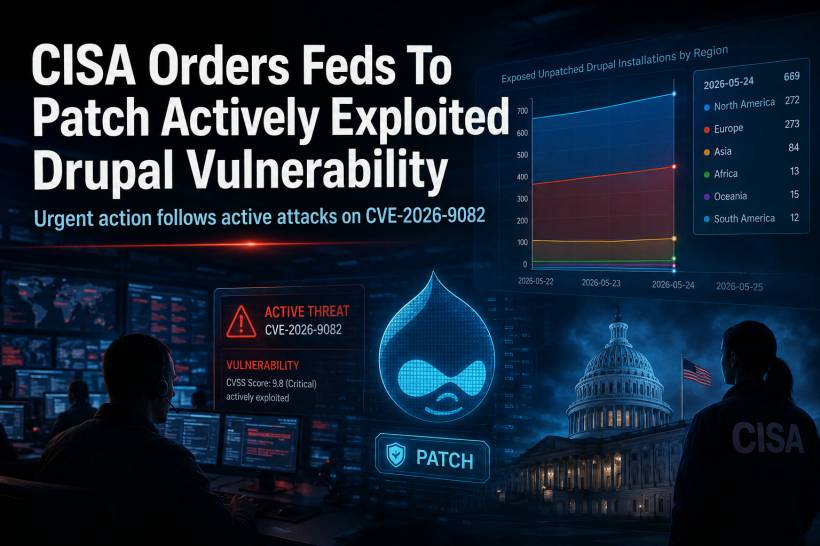
CISA has issued an urgent warning to U.S. federal agencies over a newly exploited Drupal vulnerability, giving them until Wednesday evening to patch affected systems. The issue is not just another routine CMS bug. It is an SQL injection flaw that has already been seen in real-world attacks, which makes the response window much shorter and far more serious.
Drupal is widely used by organisations that manage large, complex websites and data-heavy platforms. This includes government agencies, universities, research institutions, enterprise companies, and media organisations. Because of that, a serious Drupal vulnerability can quickly become a high-value target for attackers, especially when the affected systems are exposed to the internet.
Why This Drupal Vulnerability Matters
The vulnerability is tracked as CVE-2026-9082 and was discovered by Google/Mandiant researcher Michael Maturi. The flaw exists in Drupal's database abstraction API, which is an important layer used by the CMS to interact with databases.
What makes this vulnerability especially dangerous is that it can be exploited without authentication. In simple terms, an attacker does not need to log in or have a valid user account to attempt exploitation. By sending specially crafted requests to a vulnerable Drupal site running on PostgreSQL, an attacker may be able to trigger arbitrary SQL injection.
SQL injection is one of the oldest and most damaging web application attack methods, but it remains dangerous because of what it can expose. Depending on the affected system and how it is configured, successful exploitation could lead to sensitive data exposure, privilege escalation, or even remote code execution. That moves the issue beyond simple information leakage and into the territory of full system compromise.
Drupal Classified The Flaw As Highly Critical
The Drupal security team classified the vulnerability as "highly critical" before releasing patches. That rating is important because it tells site owners and administrators that the issue should not be treated as low-priority maintenance.
Even more concerning, exploitation attempts were already detected in the wild. Once a vulnerability moves from theoretical risk to active exploitation, defenders no longer have the luxury of waiting for a normal patch cycle. Attackers are already scanning, testing, and attempting to abuse exposed systems.
Cybersecurity firm Imperva reported that after CVE-2026-9082 was disclosed, it observed more than 15,000 attack attempts targeting almost 6,000 individual websites across 65 countries. According to Imperva, gaming and financial services sites made up nearly half of the observed attacks so far.
That detail is worth noting because it shows how quickly attackers can pivot once a public vulnerability becomes available. They are not only targeting government sites. Any vulnerable Drupal installation connected to the internet can become part of the attack surface.
Hundreds Of Drupal Sites Remain Exposed
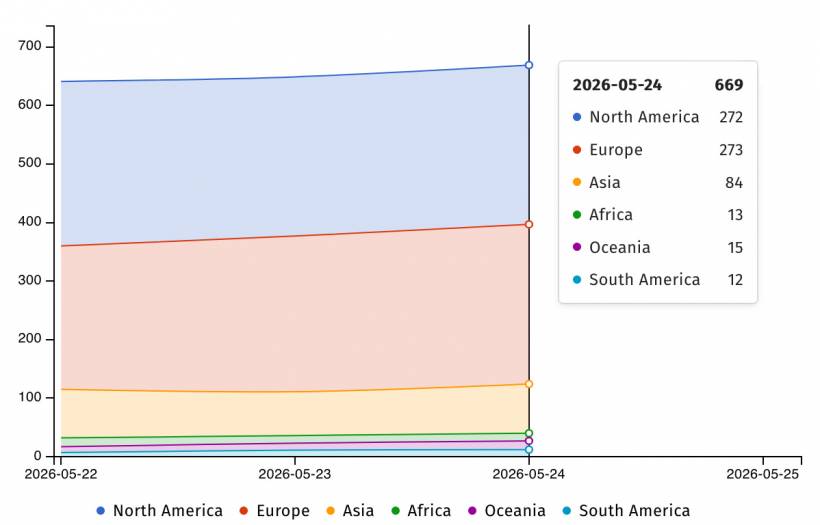
Internet security monitoring group Shadowserver is also tracking exposed Drupal installations that remain unpatched. According to its observations, nearly 670 vulnerable Drupal systems are still accessible online, with most of them located in North America and Europe.
This number may not sound massive compared to vulnerabilities affecting millions of consumer devices, but Drupal is often used in environments where the data and system access are more valuable. A single exposed Drupal platform in a government, education, or enterprise environment can create serious security and operational risks.
For organisations running Drupal, this is a reminder that CMS security is not just about keeping the public website online. The CMS often connects to databases, user accounts, internal workflows, content approval systems, and sometimes other business platforms. If attackers gain a foothold through the CMS, the impact can spread beyond the website itself.
CISA Adds The Flaw To Its Known Exploited Vulnerabilities Catalog
CISA has now added CVE-2026-9082 to its Known Exploited Vulnerabilities Catalog, commonly known as the KEV Catalog. This catalog is used to highlight vulnerabilities that are not only serious, but already being exploited by attackers.
Under Binding Operational Directive 22-01, U.S. Federal Civilian Executive Branch agencies are required to patch vulnerabilities listed in the KEV Catalog within a defined deadline. For this Drupal flaw, CISA has ordered agencies to secure affected systems by midnight on Wednesday, May 27.
Although this directive formally applies only to U.S. federal agencies, CISA is also urging private organisations and other defenders to treat the issue with the same urgency. That is sensible advice because attackers do not limit their activity based on whether an organisation is covered by a government directive.
What Organisations Should Do Now
For Drupal administrators, the priority is clear: apply the vendor patches immediately. If patching cannot be done right away, organisations should review Drupal's official mitigation guidance and reduce exposure wherever possible.
That may include checking whether affected Drupal installations are publicly accessible, confirming whether PostgreSQL is being used, reviewing web application firewall rules, monitoring logs for suspicious requests, and verifying that backups and recovery plans are in place. However, mitigation should not be treated as a permanent substitute for patching.
CISA has also advised organisations to discontinue use of affected products if mitigations are not available. That may sound extreme, but for actively exploited vulnerabilities, leaving a known vulnerable system online can be far more expensive than taking temporary service disruption.
Drupal Has Been Targeted Before
This is not the first time Drupal has appeared in CISA's exploited vulnerability tracking. Over the past several years, CISA has flagged multiple Drupal vulnerabilities that were abused in the wild. Some of those were also linked to ransomware activity.
That history matters because widely used CMS platforms are attractive targets. Attackers know that many organisations delay updates due to compatibility concerns, custom modules, legacy integrations, or lack of maintenance resources. Once a working exploit becomes public or widely understood, unpatched CMS installations can quickly become easy targets.
For large organisations, this is also a reminder that website security should be treated as part of core infrastructure security. A public-facing CMS may look like a marketing or content platform, but from an attacker's perspective, it can be an entry point into a much wider environment.
Final Thoughts
CVE-2026-9082 is a serious reminder that CMS vulnerabilities can quickly become urgent security incidents, especially when exploitation begins before organisations have time to react. Because this Drupal flaw can be exploited without authentication and may lead to serious outcomes such as data exposure, privilege escalation, or remote code execution, delaying the patch is a risky move.
For U.S. federal agencies, the deadline is now fixed by CISA. For everyone else running Drupal, the message is still the same: patch quickly, check exposure, monitor for signs of exploitation, and do not assume that only government or high-profile organisations are being targeted. Once a vulnerability is actively exploited, every unpatched system becomes part of the attacker's search list.











Comments 0