

On paper, a 12-core CPU sounds like it should be comfortably competitive in 2026-era workloads, especially if you're lining it up against mainstream desktop parts. But real performance is a mix of architecture, clocks, platform maturity, and software optimisation, not just core count. That's why the latest Linux benchmark results for Loongson's 12-core 3B6000 are getting attention.
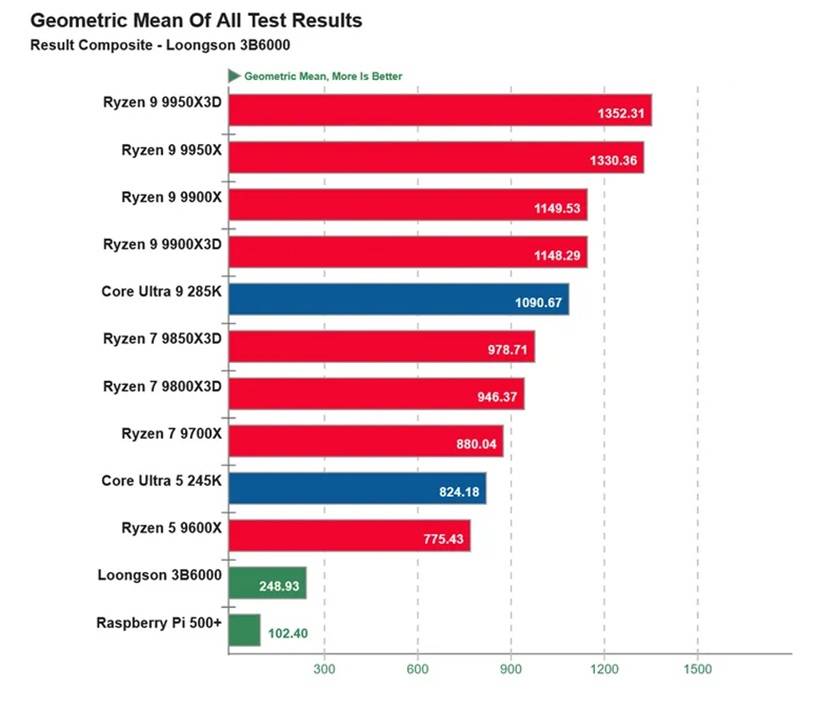
A Linux reviewer at Phoronix managed to test the 3B6000 across a wide set of Linux benchmarks, and the headline result was blunt: despite having 12 cores, the chip reportedly landed far behind modern x86 desktop CPUs, including AMD's six-core Ryzen 5 9600X.
Why this matters: Loongson is rarely tested outside China
Loongson CPUs aren't commonly found in typical global PC channels. Most coverage and real-world usage tends to remain inside China, so independent benchmarking outside that ecosystem is relatively rare.
In this case, the 3B6000 reportedly arrived via the Loongson Hobbyists Community, which helped get the chip into the hands of a reviewer who could run standardised Linux tests and publish comparable results.
The test platform: not a typical consumer desktop build
The CPU reportedly came in a micro-ATX evaluation board setup, described as a 3B6000x1-7A2000x1-EVB. In practical terms, this sounds more like a development or evaluation platform than a polished consumer motherboard.
The board was described as having two DIMM slots, one M.2 slot, two PCIe x16 slots, and only a small number of USB ports. That's enough to test the CPU properly, but it's also a reminder that this chip is being evaluated in a niche environment, not a mainstream desktop ecosystem with the usual refinements.
The big headline: "last place" across many Linux benchmarks
According to the benchmark summary, the 3B6000 performed poorly across dozens of Linux benchmarks, including workloads where modern x86 chips benefit from advanced instruction set support (the write-up mentions tests involving AVX-512 capable applications).
In the overall picture, the 3B6000 was described as sitting near the bottom of the charts, roughly three times slower than the Ryzen 5 9600X in aggregate terms. The only CPU it consistently beat in the comparison was said to be a quad-core ARM chip (referenced as the Raspberry Pi 500).
So even with double the core count of a six-core desktop CPU, the Loongson chip still struggled to compete in most tests.
The interesting part: it wasn't slow in everything
This is where it gets more nuanced and, honestly, more interesting.
There were a few benchmark exceptions where the 3B6000 looked surprisingly decent:
Those results don't erase the overall picture, but they do suggest that in certain compute patterns or optimised paths, the 3B6000 can show flashes of competitiveness. That usually points to a mix of "some workloads fit the chip well" and "other workloads expose its weaknesses hard."
The likely culprit: clock speed
The simplest explanation given for the overall shortfall is also one of the most common: frequency.
The 3B6000 is reported to run at 2.5GHz. In a world where mainstream Intel and AMD desktop chips often boost much higher, that's a major handicap. Even if your architecture has decent instructions-per-clock (IPC), low clocks can crush single-thread performance and drag down multi-thread results in workloads that don't scale perfectly.
The write-up also mentions Loongson's LA664 architecture being roughly in the territory of AMD Zen 3-level IPC, but that any architectural gains are heavily limited by the low operating frequency.
In other words, if the "per clock" ability is respectable but you're running at half the clock speed, you've basically tied one hand behind your back before the benchmark even starts.
The bigger picture: catching up is about more than cores
This story is a good reminder that CPU performance isn't a straight-line "more cores equals faster" equation.
A few realities tend to matter more in modern desktop-class performance:
So even though "12 cores" sounds big, a 12-core chip with low clocks, less mature platform support, and less optimised software pipelines can end up feeling slower than a mainstream 6-core part that's built for high clocks and broad software compatibility.
What Loongson is aiming for next
Loongson reportedly isn't standing still. The write-up mentions the company working on a newer architecture called LA864, with claims or expectations that it could reach performance closer to Intel's 13th/14th Gen Raptor Lake range.
Just as importantly, it's also suggested that future chips could run at higher clock speeds around 3.0 to 3.5GHz. That still wouldn't match the peak boost frequencies often seen on modern Intel and AMD parts, but it would be a meaningful jump compared to 2.5GHz, and could change how competitive the platform feels, especially in everyday workloads.
Final thoughts
The Loongson 3B6000 benchmark story isn't really about "China vs the West" or "12 cores vs 6 cores." It's a practical lesson in how CPUs actually win: high clocks, strong IPC, mature platforms, and software ecosystems that know how to use the hardware.
Right now, the 3B6000 appears to be held back most by frequency and overall competitiveness across broad workloads, with a few standout exceptions that hint there's still potential in specific scenarios. If Loongson can genuinely lift clock speeds and keep improving architecture and platform support in the next generation, the conversation could look very different. But based on these Linux benchmarks, the 3B6000 still sits firmly in the "interesting to evaluate" category rather than "ready to challenge mainstream desktop CPUs."











Comments 0