

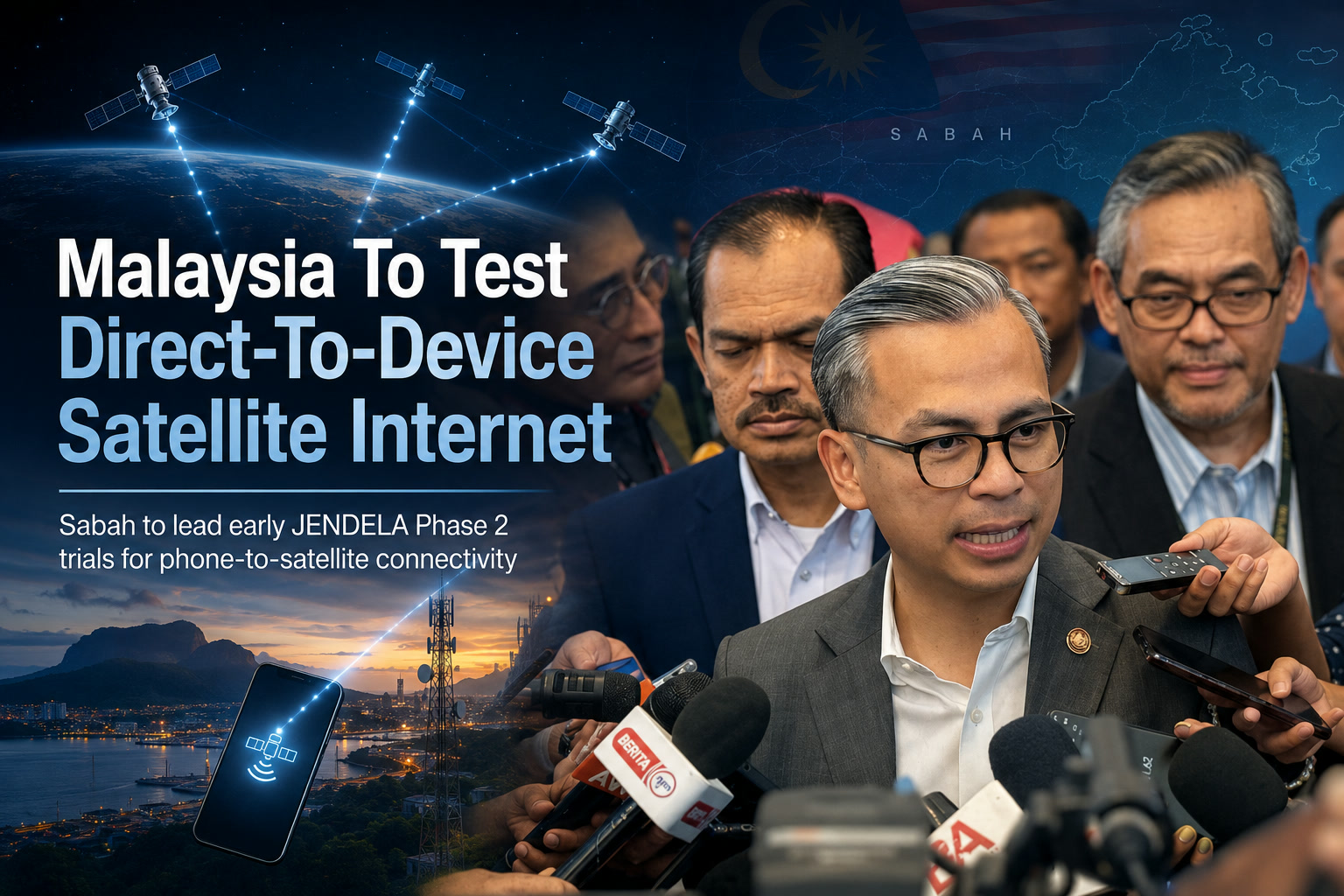
Malaysia is preparing to take another step toward satellite-powered mobile connectivity, with direct-to-device satellite internet trials set to begin in Sabah under JENDELA Phase 2.
The technology could eventually allow compatible smartphones to connect directly to satellites without depending entirely on conventional telecommunications towers. For remote communities where building new towers can be expensive, complicated and painfully slow, that could make a significant difference.
Communications Minister Datuk Seri Fahmi Fadzil said several locations in Sabah will be identified for proof-of-concept testing, with additional areas in Sarawak and Peninsular Malaysia also expected to participate.
What Is Direct-To-Device Satellite Connectivity?
Direct-to-device, or D2D, technology is designed to let ordinary compatible mobile phones communicate directly with satellites overhead.
Traditional mobile connectivity depends heavily on ground infrastructure. Your phone connects to a nearby telecommunications tower, which then links into the operator's wider network. That model works extremely well in populated areas, but becomes much harder to justify in places where communities are scattered across mountains, islands, forests or other difficult terrain.
Satellite D2D offers another route.
Instead of waiting for a new tower to be constructed, a compatible handset could potentially establish a connection with a satellite directly. The user would not necessarily need a satellite dish, portable terminal or separate modem.
For Malaysia, that makes the technology particularly interesting for rural Sabah and Sarawak, where geography has always made conventional infrastructure deployment more challenging.
Sabah Will Be One Of The First Testing Grounds
Fahmi said suitable locations in Sabah will be selected to test the technology under the upcoming second phase of the Jalinan Digital Negara, or JENDELA, programme.
The trials will focus on determining whether D2D connectivity can provide a practical alternative in areas where conventional mobile infrastructure remains limited.
Sabah is a logical place to begin. The state contains many communities separated by long distances and difficult terrain, making the economics of traditional tower deployment very different from those in major towns and cities.
Sarawak and selected areas in Peninsular Malaysia are also expected to be included in the broader testing programme.
The goal appears to be finding the right connectivity solution for each location rather than assuming every underserved community requires exactly the same infrastructure.
JENDELA Phase 2 Will Cover More Than 300 Locations
Fahmi also revealed that JENDELA Phase 2 will involve more than 300 locations nationwide.
Not every location will receive the same technology.
Some areas will still require conventional telecommunications towers, particularly where population density and long-term usage justify permanent terrestrial infrastructure.
Other locations could be served using satellite connectivity or other technologies that do not require a traditional tower installation.
That flexible approach is important because Malaysia's connectivity gaps are not all the same. A rural village with hundreds of residents may justify a conventional mobile tower, while a much smaller settlement deep in the interior may be better served through satellite technology.
Instead of forcing one solution everywhere, JENDELA Phase 2 appears to be taking a more location-specific approach.
Building A Mobile Tower Can Take Years
One of the strongest arguments for D2D satellite technology is deployment speed.
According to Fahmi, constructing a new telecommunications tower can take at least two years in some cases. The process involves site selection, approvals, land matters, power connections, backhaul infrastructure, construction and equipment installation.
Remote areas introduce even more complications.
Transporting equipment into difficult terrain can increase costs significantly. Finding reliable electricity and network backhaul may also become major challenges.
By comparison, satellite D2D could potentially provide a much faster path to basic connectivity because much of the infrastructure is already orbiting above the user.
Once the satellite network and telecommunications integration are available, coverage can potentially extend to areas where building a tower would otherwise take years.
Compatible Smartphones Could Be All Users Need
Another major advantage is the lack of specialised consumer hardware.
Traditional satellite broadband normally requires additional equipment, such as an external dish or satellite terminal. That makes it useful for homes, businesses and fixed locations, but considerably less convenient when somebody simply wants connectivity while travelling.
D2D changes that model.
A compatible smartphone could potentially communicate with the satellite network directly, making the experience much closer to ordinary cellular service.
That could be extremely valuable for people living or travelling in places where terrestrial coverage disappears.
The first services are likely to be relatively limited compared with normal 4G or 5G networks, but even basic messaging or emergency connectivity could be enormously useful in remote areas.
Satellite Connectivity Could Improve Emergency Communications Too
The potential benefits extend beyond ordinary internet access.
Malaysia regularly deals with floods, landslides and other natural disasters that can damage communications infrastructure or isolate communities temporarily.
A satellite connection that does not depend on a nearby tower could provide another layer of resilience.
Emergency responders could potentially remain connected even when terrestrial infrastructure is unavailable, while residents in affected areas could have another way to contact authorities or family members.
That does not mean satellite D2D should replace normal mobile networks. Instead, it could become an additional communications layer for places and situations where conventional coverage is difficult or unavailable.
Starlink Is Expected To Play A Role In The Trials
Malaysia has been discussing direct-to-device satellite connectivity for some time, with government interest going back to at least 2024.
More recently, Fahmi confirmed that Starlink is expected to test its D2D technology in Malaysia.
Starlink already provides conventional satellite broadband through its terminals, but its direct-to-device technology takes a different approach by connecting satellites directly with compatible mobile phones.
If those tests prove successful and regulatory requirements are completed, Malaysia could potentially see wider deployment sometime in 2027.
That timeline remains dependent on the outcome of the trials, technical performance and agreements with local telecommunications operators.
D2D Will Not Make Mobile Towers Obsolete
It is tempting to imagine satellites replacing mobile towers completely, but that is unlikely to happen.
Terrestrial mobile networks remain far more suitable for heavily populated areas where millions of users require large amounts of bandwidth.
A mobile tower can provide much greater capacity within its coverage area than a satellite serving users across an enormous geographic region.
D2D is therefore more likely to complement existing infrastructure.
Cities and major towns will continue relying heavily on fibre-connected 4G and 5G networks, while satellites can help fill the difficult gaps where constructing that infrastructure makes less economic or practical sense.
The ideal network may eventually involve phones moving between terrestrial and satellite connectivity depending on what is available.
This Could Be Particularly Significant For Sabah And Sarawak
East Malaysia stands to benefit considerably if the technology works as expected.
Sabah and Sarawak contain vast rural areas where providing universal mobile coverage has always been more complicated than simply adding another tower.
Communities may be separated by forests, mountains and rivers, while population density can be extremely low across large regions.
Satellite connectivity fundamentally changes the economics because coverage does not require physical infrastructure at every individual settlement.
One satellite can potentially serve an enormous region from orbit.
That could help Malaysia reduce some of the remaining digital divide between urban centres and remote communities.
Affordability Will Still Matter
Technical coverage is only part of the equation.
For D2D satellite services to make a meaningful difference, they also need to be affordable.
If the service costs significantly more than ordinary mobile connectivity, some of the communities that would benefit most may struggle to use it.
Telecommunications operators and policymakers will therefore need to consider pricing carefully, particularly if D2D becomes part of Malaysia's broader universal-connectivity strategy.
Device compatibility will matter too.
Early satellite-capable phones may initially be concentrated among newer or more expensive devices. Wider adoption will depend on the technology eventually becoming available across mainstream smartphones.
Final Thoughts
Malaysia's upcoming D2D satellite trials could represent an important evolution of the country's connectivity strategy.
Instead of relying exclusively on the expensive and time-consuming process of constructing telecommunications towers in every underserved area, JENDELA Phase 2 will explore whether satellites can fill some of those gaps faster and more efficiently.
Sabah is set to become one of the key proving grounds, with additional testing planned elsewhere in Malaysia and Starlink expected to participate in the country's D2D experiments.
If the technology performs well, 2027 could potentially mark the beginning of a new kind of mobile coverage in Malaysia, where losing sight of the nearest telecommunications tower no longer automatically means losing connectivity.
For remote communities in particular, that could be much more than another technology upgrade. It could mean finally receiving practical mobile connectivity in places where building conventional infrastructure has never been easy.











Comments 0