

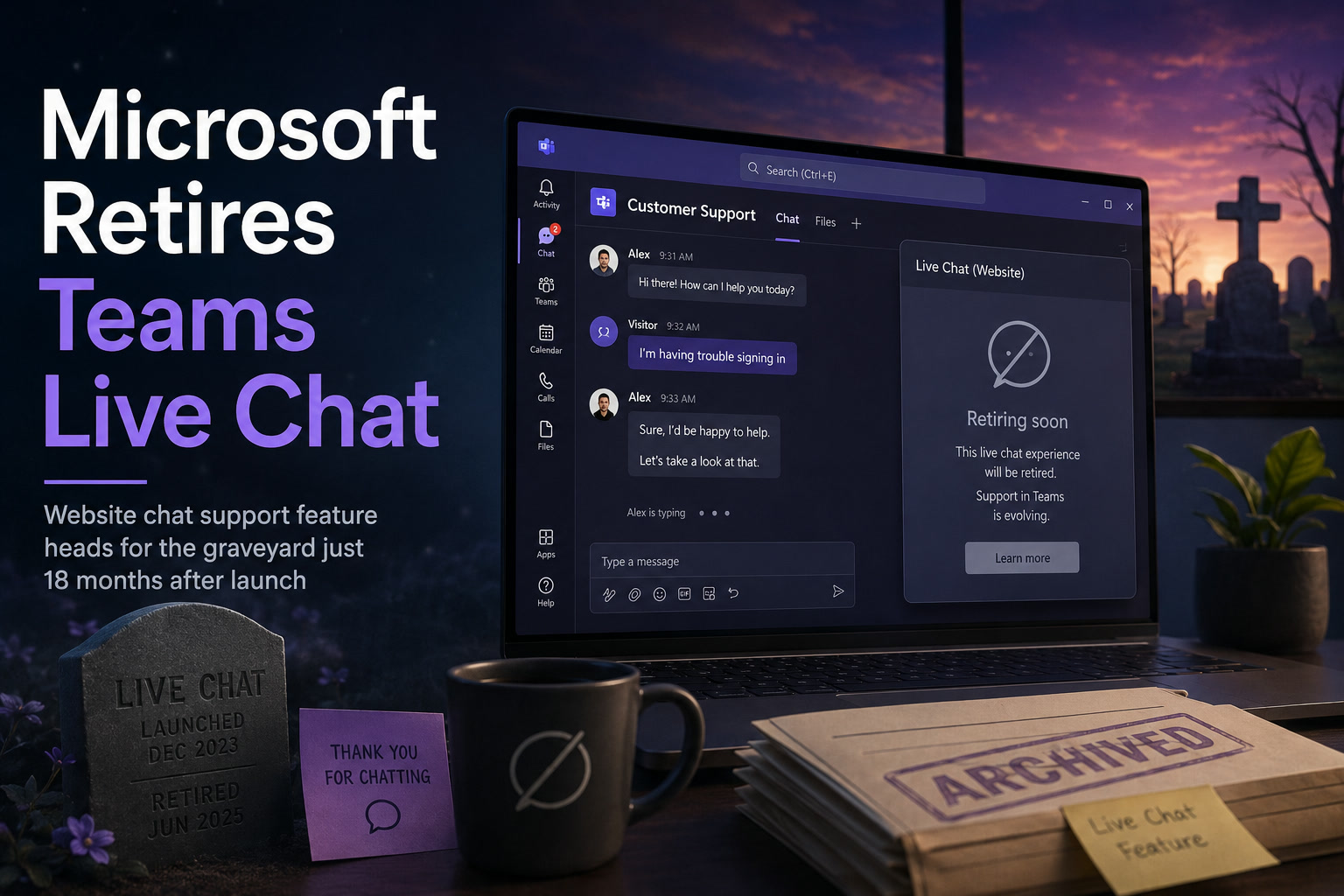
Microsoft is sending another Teams feature to the retirement list. Live chat in Microsoft Teams will officially shut down on 5 October 2026, barely a year and a half after the company introduced it as a new way for businesses to communicate with customers directly from their websites.
The feature itself was fairly straightforward. Businesses could add a chat widget to their website, visitors could start a conversation, and those messages would then appear inside Microsoft Teams for employees to respond to. It was particularly aimed at small and medium-sized businesses already using Microsoft 365, giving them a lightweight customer-support channel without needing a dedicated contact-centre platform.
New Live Chat Setups Have Already Been Blocked
Microsoft stopped allowing new Live chat configurations on 6 August 2026, marking the beginning of the shutdown process. Existing customers can continue using the service for now, but once 5 October arrives, new website messages will no longer be delivered into Teams.
Microsoft is also advising organisations to remove the Live chat widget from their websites before the retirement date. Any remaining widgets will eventually be hidden automatically once the service is switched off.
Existing Teams channels and historical customer data will remain available, so businesses will not suddenly lose their previous conversations. What disappears is the ability to start new chats, escalate conversations or continue using the system as an active customer-support channel.
It Was A Simple Idea That Made Sense For Small Businesses
Live chat was included with Teams through Microsoft 365 Business Basic, Business Standard and Business Premium subscriptions. Administrators could define operating hours and assign up to 25 employees to handle incoming conversations.
For smaller businesses, the attraction was obvious. Instead of deploying a separate customer-service platform, staff could respond to website visitors using the same Teams environment they already used internally.
It was never intended to compete with a full enterprise contact centre, but that simplicity was arguably part of its appeal.
That makes its relatively short lifespan slightly surprising.
Microsoft Was Much More Enthusiastic About It In 2025
When Live chat launched in March 2025, Microsoft positioned it as a meaningful improvement to the customer experience for smaller organisations.
At the time, Microsoft executives described it as a faster and more engaging way for businesses to connect with customers directly through Teams.
Fast-forward around 18 months and the messaging has changed considerably. Microsoft now says it wants to focus investment on newer customer-engagement and communication experiences, which is corporate language for saying resources are moving somewhere else.
And given Microsoft's current priorities, it is not particularly difficult to guess where some of that investment is heading.
Microsoft Wants Customers Looking At Dynamics 365 And Copilot Instead
Businesses currently relying on Teams Live chat are being directed toward Dynamics 365 Contact Center with Live Chat and Microsoft's increasingly AI-focused Copilot Studio tools.
That suggests Microsoft is moving away from offering a lightweight standalone website-chat feature inside Teams and toward broader customer-service platforms that combine automation, AI agents and contact-centre capabilities.
For larger organisations, that may actually make sense. Customer support increasingly involves more than simply transferring a message from a website into a chat window. Businesses want automated triage, conversation histories, CRM integration, analytics and AI-assisted responses.
The downside is obvious for smaller companies that only wanted a simple widget connected to Teams. Moving to a more sophisticated platform can also mean more configuration, complexity and potentially additional cost.
Teams Has Been Losing Quite A Few Features Recently
Live chat is not disappearing in isolation. Microsoft has been gradually simplifying Teams and retiring features that no longer fit its direction.
Earlier this year, Microsoft announced the retirement of Teams Live Events, with newer Teams event capabilities taking its place. Together Mode, the feature that arranged meeting participants inside a shared virtual environment, has also been discontinued.
It reflects a broader effort to clean up Teams after years of expansion.
Microsoft spent a long time adding features to Teams as it attempted to turn the application into a central workplace platform. That strategy inevitably created a product containing a large collection of overlapping tools, experiments and specialised functions.
Now some of those additions are being reconsidered.
AI Looks Increasingly Likely To Fill The Gap
Microsoft has not explained exactly what its mysterious "newer customer engagement and communication experiences" will involve. However, recommending Copilot Studio provides a fairly strong clue.
The company's direction across Microsoft 365 has become increasingly centred around AI agents and Copilot-powered workflows. Customer support is an obvious area for that technology.
Instead of every website conversation immediately going to a human employee, Microsoft's future model could involve AI agents handling common questions, retrieving information and escalating only the conversations that actually need human attention.
That could potentially be much more powerful than the old Live chat model.
Whether smaller businesses actually need that level of automation is another matter.
What Existing Users Should Do Before October
Organisations currently using Teams Live chat should begin planning their replacement rather than waiting until the shutdown date. The most immediate step is identifying which websites still contain the widget and deciding where customer conversations should be directed afterwards.
Companies already invested heavily in Microsoft's business ecosystem may naturally consider Dynamics 365 or Copilot Studio. Others may decide that a simpler third-party website-chat service better fits what they actually need.
Either way, the important deadline is 5 October 2026. After that date, Live chat will effectively become read-only history inside Teams.
Final Thoughts
Teams Live chat was not one of Microsoft's biggest products, but its short lifespan illustrates how quickly the company's priorities are changing.
What launched in 2025 as a convenient way for small businesses to connect website visitors directly with Teams is already being replaced by Microsoft's broader vision of AI-powered customer engagement and contact-centre automation.
For Microsoft, consolidating around Dynamics 365 and Copilot Studio probably makes strategic sense. For businesses that only wanted a simple chat box connected to Teams, however, the replacement options may feel considerably heavier than the feature they are losing.
And so another Teams experiment joins the growing collection of Microsoft features that looked useful when they launched, only to disappear as the company's attention moved elsewhere.











Comments 0