

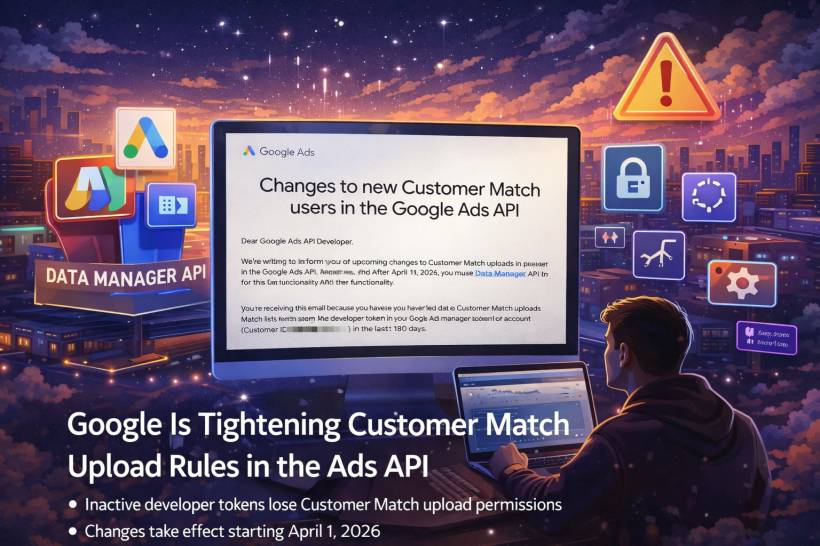
Google is making an important change that could quietly break some existing advertising workflows if nobody is paying attention. Starting April 1, 2026, certain developers will no longer be able to upload Customer Match data through the Google Ads API. The restriction is aimed at developer tokens that are either new to Customer Match or have not uploaded Customer Match data during the six-month window from October 2025 through March 2026. If those tokens are not on Google's allowlist, upload attempts will fail.
That may sound like a niche technical update, but for agencies, internal marketing teams, SaaS platforms, and developers managing audience pipelines, it is a change worth taking seriously now rather than later.
What Is Actually Changing?
Google is not shutting down the Google Ads API as a whole. This is a narrower change focused specifically on Customer Match uploads.
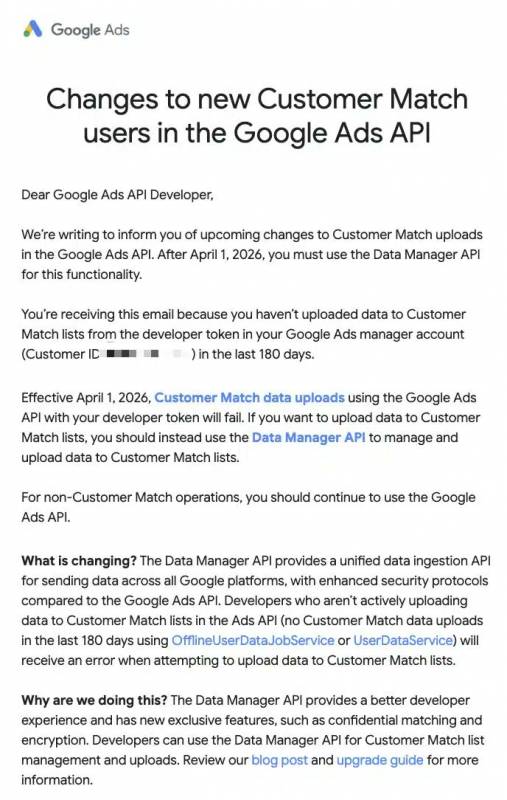
From April 1, 2026, the Google Ads API will no longer accept what Google calls "new adopters" of Customer Match. In practical terms, developers who have not previously adopted Customer Match, or who have not uploaded data to a Customer Match list between October 2025 and March 2026, will hit an error if they try to upload after the cutoff date. Google says existing adopters can continue importing user data through the Google Ads API while they move toward the newer Data Manager API.
So this is less of a sudden full shutdown and more of a gatekeeping change. If your developer token is already active in this area, you may still be fine for now. If it has gone quiet, that is where the trouble starts.
Why Google Is Pushing People Away From the Old Workflow
Google's direction here is pretty clear: it wants Customer Match ingestion to move toward the Data Manager API.
The company has been positioning the Data Manager API as a more unified system for sending audience and conversion data into Google's advertising ecosystem. Google says the platform is designed to simplify data ingestion across products while also adding privacy-focused capabilities such as confidential matching and encrypted handling for some audience and conversion workflows. Google also expanded the Data Manager API in February 2026 with end-to-end user list management and broader audience ingestion options, including support for User IDs for Customer Match in Google Ads.
In other words, this is not just a random restriction. It is part of a broader migration path. Google is nudging developers toward a newer API that it sees as the long-term home for this kind of first-party audience data work.
What Will Happen If You Ignore It?
If your developer token is not allowlisted after the change rolls out, uploads to Customer Match lists through the Google Ads API will fail. Google says affected users will receive the error CUSTOMER_NOT_ALLOWLISTED_FOR_THIS_FEATURE when trying to upload user data using either OfflineUserDataJobService or UserDataService.
That means this is not one of those soft policy changes where performance gradually degrades or a warning appears for a few weeks. The workflow simply stops working.
That is why this matters operationally. A lot of teams do not think about Customer Match upload infrastructure every week. It may be sitting in a stable background process, working quietly. Changes like this can be missed until an audience stops refreshing and campaign performance starts slipping.
Why This Matters More Than It Looks
At first glance, this sounds like an API housekeeping change for developers. But the real impact is on marketers and businesses that rely on first-party audience activation.
Customer Match is often tied to remarketing, customer retention, suppression lists, upsell campaigns, and other targeting strategies built around owned customer data. If those lists stop updating, the effects may not be obvious on day one, but over time they can lead to stale audiences, weaker targeting, and campaign inefficiencies.
This is especially important because Google had already been tightening Customer Match rules in other ways. In 2025, for example, Google capped Customer Match list membership duration at 540 days and pushed advertisers to refresh lists regularly. That larger pattern makes this latest move feel like part of an ongoing effort to modernize and tighten how audience data is handled.
The Safer Move: Check Your Token and Plan the Migration
The practical next step is straightforward.
If your team uses Customer Match uploads through the Google Ads API, check whether your developer token has actually been used for Customer Match within the October 2025 to March 2026 activity window. If not, you should assume you may be affected and start preparing a migration to the Data Manager API. Google is explicitly recommending the Data Manager API as the primary user data import API for new adopters.
For teams with live integrations, this is the kind of thing worth validating before April rather than after. It is much better to discover now that a workflow is considered inactive than to learn it from failed uploads in production.
Final Thoughts
Google's change to Customer Match uploads in the Ads API is not the end of the Google Ads API, and it is not a blanket ban on all Customer Match usage. But it is a meaningful shift.
The message is simple: if you are inactive, or just getting started, Google wants you on the Data Manager API instead. Existing users get more breathing room, but the long-term direction is obvious. Customer data ingestion is being centralized into a newer, more security-focused system.
For advertisers and developers, this is one of those updates that is easy to overlook because it sounds technical. But if Customer Match is part of your targeting strategy, it is worth checking now before April 1, 2026 arrives and the old workflow starts returning errors.











Comments 0