

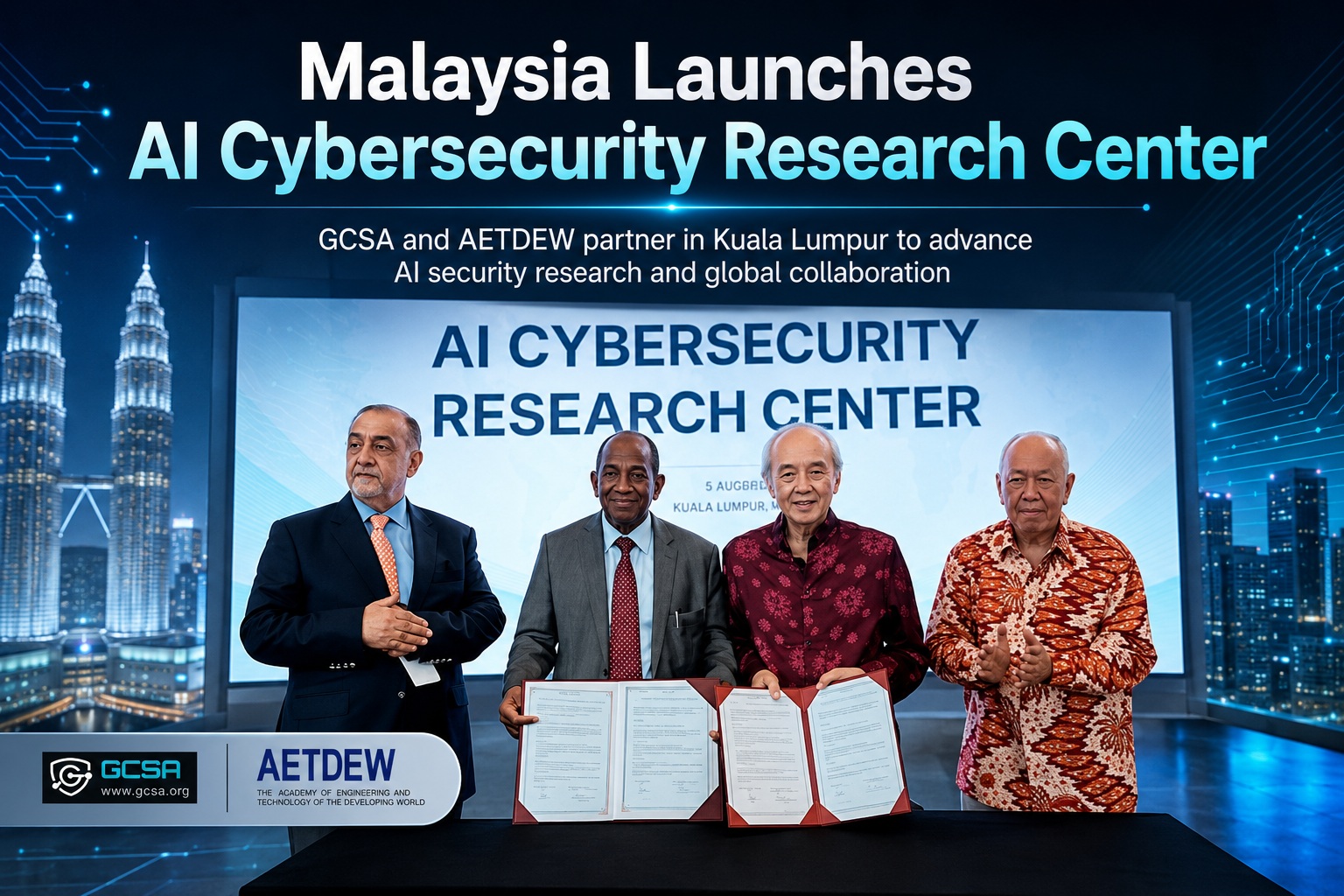
Malaysia is strengthening its position in the artificial intelligence and cybersecurity space with the establishment of a new AI Cybersecurity Research Center in Kuala Lumpur. The initiative follows a cooperation agreement between the Global Cybersecurity Alliance (GCSA) and the Academy of Engineering and Technology of the Developing World (AETDEW), marking the beginning of a long-term partnership focused on emerging cybersecurity challenges created by artificial intelligence.
The new centre is intended to serve as an international platform connecting governments, businesses, universities, research institutions and cybersecurity specialists.
Bringing AI and Cybersecurity Expertise Together
Under the collaboration, AETDEW will contribute its engineering and technology expertise, while GCSA will provide its experience in AI cybersecurity and international security cooperation.
Together, the organisations plan to work across several areas, including AI security research, professional development, technology exchange, research commercialisation and international collaboration.
The broader goal is to ensure that cybersecurity capabilities continue evolving alongside increasingly powerful AI technologies.
As AI becomes more deeply integrated into business operations, government services and critical infrastructure, the risks surrounding misuse, vulnerabilities and automated cyberattacks are also becoming more complicated.
The Research Center aims to study those challenges while developing practical approaches that organisations can eventually apply in real environments.
AI Is Changing Both Cyber Defence and Cyber Threats
H.E. Kabiné Komara, former Prime Minister of Guinea and Senior Advisor on International Finance and Security Governance, highlighted how quickly artificial intelligence is transforming the digital landscape.
AI can help defenders analyse enormous quantities of security information, identify suspicious behaviour and automate parts of incident response.
At the same time, the technology can also assist attackers.
Cybercriminals may use AI to generate malicious code, automate reconnaissance, improve phishing campaigns or adapt attacks more quickly.
That means cybersecurity organisations increasingly need to understand AI not only as a defensive technology but also as part of the evolving threat landscape.
The new centre is expected to act as a bridge between international experts working on those problems.
Protecting Critical Infrastructure Is Becoming More Important
Dr. Moneef R. Zou'bi, Academician of the New York Academy of Sciences and the World Academy of Art and Science, said AI is reshaping both cybersecurity and the foundations of digital trust.
One particularly important area is critical infrastructure.
Energy systems, telecommunications, healthcare, transportation, financial services and government platforms are becoming increasingly digital and interconnected.
AI can make these systems more efficient, but deeper automation also creates new dependencies.
A vulnerability in an AI-enabled system could therefore have consequences that extend well beyond an ordinary software application.
Research into secure AI architectures, threat detection and resilient infrastructure will likely become increasingly important as more organisations adopt autonomous and AI-assisted systems.
Talent Development Will Be a Major Focus
The collaboration is not limited to research.
GCSA and AETDEW also plan to develop professional cybersecurity talent.
This is important because advanced AI security requires expertise across multiple disciplines.
Cybersecurity professionals increasingly need knowledge covering areas such as:
There is already a global shortage of experienced cybersecurity professionals, while AI introduces another layer of technical complexity.
Creating research programmes and training opportunities could help Malaysia and other participating countries develop the specialists required to secure increasingly intelligent digital systems.
Turning Research Into Practical Security Solutions
Another important objective is research commercialisation.
Academic cybersecurity research can produce valuable ideas, but those ideas only create broader impact when they can be converted into technologies, standards or services that organisations can actually deploy.
The Research Center therefore intends to support the transition from research into practical applications.
That may involve cybersecurity frameworks, monitoring technologies, AI risk-management approaches or other tools capable of being used across industry and government.
This connection between research and implementation will be particularly important as cyber threats evolve quickly.
Security solutions that remain purely theoretical may already be outdated by the time organisations need them.
Developing Countries Will Receive Particular Attention
One of the more significant aspects of the partnership is its emphasis on the needs of developing countries and emerging economies.
Many countries are accelerating digital transformation but do not necessarily have the same cybersecurity resources available to large developed economies.
They may be deploying cloud services, digital identity platforms, online government services and AI technologies while still building the security infrastructure needed to protect them.
This creates a potential gap.
Digital adoption may progress faster than cybersecurity capability.
The Research Center intends to help address that imbalance through knowledge sharing, applied research and international cooperation.
The objective is to ensure that digital transformation remains secure and sustainable rather than simply fast.
Malaysia Could Become a Regional Hub for AI Security Research
Establishing the centre in Kuala Lumpur also gives Malaysia an opportunity to strengthen its role within the regional cybersecurity ecosystem.
Malaysia already has a growing digital economy, expanding data-centre infrastructure and increasing adoption of artificial intelligence across government and private industry.
As these technologies become more important, specialised cybersecurity research becomes equally valuable.
An international research centre could help connect Malaysian researchers and engineers with experts from other countries while providing a platform for regional collaboration.
It could also create opportunities for universities, technology companies and government agencies to participate in research programmes that may otherwise be difficult to establish independently.
International Cooperation Is Essential in Cybersecurity
Cyber threats rarely respect national borders.
An attacker can operate from one country, compromise infrastructure in another and route malicious traffic through systems located in several more jurisdictions.
That makes international cooperation particularly important.
GCSA describes its wider mission as bringing together governments, businesses, individual users and cybersecurity experts to develop collaborative defence strategies.
Its work focuses particularly on emerging risks involving AI and Web3 technologies, along with cross-border security standards and frameworks.
The partnership with AETDEW extends that approach into a dedicated research environment.
AI Security Will Become More Important as Adoption Accelerates
The timing of the new centre is significant.
Organisations around the world are moving quickly from experimenting with AI toward embedding it directly into operational systems.
AI agents are beginning to interact with business applications.
Generative AI is being integrated into enterprise software.
Governments are exploring AI-powered public services.
Businesses are introducing automated decision-making into everyday operations.
Every one of these developments introduces new cybersecurity questions.
What happens if an AI system is manipulated?
Can attackers poison the data used by a model?
How should organisations detect malicious instructions given to AI agents?
What permissions should autonomous systems receive?
And how can businesses verify that AI-generated actions are trustworthy?
These questions are gradually becoming part of mainstream cybersecurity.
Final Thoughts
The establishment of Malaysia's new AI Cybersecurity Research Center reflects how closely artificial intelligence and cybersecurity are becoming connected.
AI promises significant benefits for digital transformation, but it also introduces new vulnerabilities, attack techniques and questions around trust.
Through the partnership between GCSA and AETDEW, the centre aims to combine research, talent development, technology exchange and international cooperation while paying particular attention to the needs of developing economies.
For Malaysia, the initiative also represents an opportunity to build deeper expertise in an area that will only become more important.
As organisations increasingly rely on intelligent and autonomous systems, cybersecurity can no longer focus only on protecting traditional computers and networks.
The next challenge will be ensuring that the AI systems making decisions, accessing data and controlling digital processes can themselves be trusted and secured.











Comments 0