

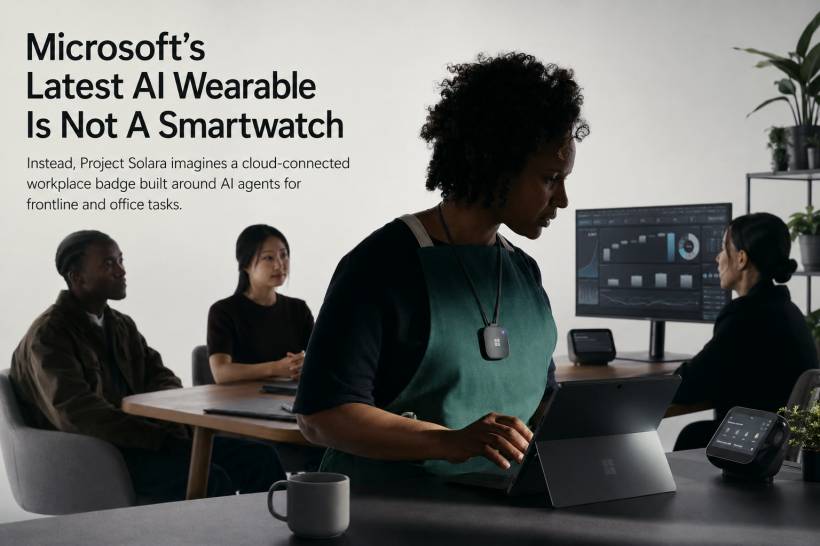
Microsoft is continuing to push deeper into artificial intelligence, even as some Windows 11 users remain unhappy with how heavily Copilot is being integrated into the operating system. At its annual Build event, the company showed that its AI ambitions are moving beyond laptops, desktops, and software. This time, Microsoft demonstrated a new wearable concept in the form of an AI-powered workplace badge.
The device, currently known as the "Badge Concept," is part of Project Solara, Microsoft's broader vision for bringing AI agents into daily work environments. Instead of looking like a smartwatch or fitness tracker, the badge is designed more like something an employee might wear on a lanyard in an office, hospital, or frontline workplace.
While it is still only a concept for now, the idea gives a clear look at where Microsoft thinks workplace AI could be heading next.
What Is Project Solara?
Project Solara is Microsoft's attempt to imagine a future where AI is not limited to a chat window on a PC. Instead, the company wants AI agents to become more naturally integrated into the way people work, especially in environments where using a traditional computer is not always practical.
AI agents are essentially more focused versions of an AI system. Rather than simply asking a general chatbot to answer questions, an AI agent can be designed to perform specific tasks, understand particular workflows, and assist users in a more targeted way.
Through Solara, Microsoft appears to be exploring how these agents could be used across different types of devices, not just Windows PCs. The company also showed off a "Desk Concept," which looks somewhat similar to smart displays like Amazon's Echo Show. However, the badge attracted more attention because of how different it feels from Microsoft's usual hardware ideas.
A Badge That Connects AI To The Workplace
The Badge Concept is designed to be worn, making it more accessible during hands-on tasks. Microsoft envisions it being used in situations where workers may need help while moving around or handling physical work.
For example, a worker could encounter a problem, point the badge's camera at what they are working on, and ask the AI agent for guidance. Instead of needing to stop, open a laptop, and type a question, the user could interact with the AI more directly through the wearable.
Microsoft sees potential use cases in sectors such as healthcare and frontline work. These are environments where workers often need quick access to information, instructions, documentation, or support while staying mobile.
In theory, this kind of device could help with tasks such as:
• Checking procedures or instructions
• Capturing and digitising documents
• Getting visual assistance through the camera
• Receiving step-by-step workflow support
• Communicating with AI agents without relying on a full PC
The concept is clearly aimed at business and enterprise users rather than everyday consumers.
Powered By The Cloud Instead Of Local AI
One important detail is that the badge is not meant to run a large AI model directly on the device. Instead, Microsoft describes it as a "chip-to-cloud" experience. That means the badge would connect to the cloud and use Copilot remotely.
This approach makes sense for a small wearable device. Running advanced AI models locally would require more processing power, more memory, and better battery capacity. By relying on the cloud, Microsoft can keep the device simpler while still giving users access to more powerful AI capabilities.
However, this also means the badge would likely depend heavily on internet access. In workplaces with poor connectivity, strict data security rules, or sensitive information, that could become a major challenge.
Camera, Microphone, Sensors And A Touchscreen
Although Microsoft has not confirmed final hardware specifications, the Badge Concept is being presented as a device that could include a camera, microphone, sensors, a touchscreen, and internet connectivity.
These components would allow the AI agent to see, hear, and respond to the user's work environment. The camera could help the AI understand visual context, the microphone could support voice commands, and the touchscreen could provide quick controls or information.
That said, the inclusion of a camera and microphone on a workplace wearable will almost certainly raise privacy and security questions. In offices, hospitals, warehouses, and customer-facing environments, always-available recording hardware needs to be handled carefully.
Employers would need clear rules around when the device can record, what data is stored, how long it is kept, and who can access it.
Not Windows, But A Microsoft Version Of Android
Interestingly, Microsoft is not building the Badge Concept on Windows. It is also not reviving one of its older mobile platforms. Instead, the company is adapting Android for this new form factor.
The platform is being referred to as the Microsoft Device Ecosystem Platform. It is not a full standard Android experience, but rather a repackaged version of Google's open-source software base, adjusted for Microsoft's device and AI needs.
This is not too surprising. Android is already widely used across many device categories, including phones, tablets, wearables, TVs, and embedded systems. Using Android as a foundation could allow Microsoft to build experimental devices more quickly without starting from zero.
A Just-In-Time User Interface
One of the more interesting ideas behind Project Solara is what Microsoft calls a "just-in-time UI." Instead of using a fixed interface with the same menus and buttons all the time, the device could generate or change its interface based on the task at hand.
For example, if the user is scanning documents, the interface might only show a camera button and an upload button. If the user is inspecting equipment, the interface might change to show checklist items, voice notes, or visual guidance.
The idea is to make the interface less cluttered and more relevant to the current job. This fits Microsoft's larger argument that AI devices should not simply copy the old PC interface, but instead adapt to what users are actually doing in the moment.
Of course, this will only work well if the AI understands the user's needs accurately. A flexible interface sounds useful, but it could also become frustrating if it changes too often or presents the wrong controls at the wrong time.
Still A Concept With No Launch Date
For now, Microsoft has not announced when, or even whether, the Badge Concept will become a real product. There is no launch date, no confirmed price, and no final hardware specification.
That uncertainty is important because Microsoft has a long history of showing interesting hardware concepts that never fully reach the market. Over the years, the company has explored foldable devices, fitness bands, phones, and other experimental hardware, only for some projects to be delayed, cancelled, or discontinued.
So while Project Solara is interesting, it should not be treated as a guaranteed upcoming product just yet.
AI Wearables Still Have A Difficult Road Ahead
Microsoft is also entering a product category that has not had an easy time. AI wearables have attracted attention in recent years, but many have struggled to prove that they are genuinely useful in everyday life.
One of the most notable examples is Humane's AI Pin, which launched with big promises but failed to build long-term confidence among users. After Humane was acquired by HP, early adopters were left disappointed, with some feeling that their expensive device had quickly become useless.
That example shows the biggest risk for AI wearables: the idea may sound futuristic, but the product must solve real problems better than a phone, laptop, or existing workplace tool.
For Microsoft, the advantage is that it is targeting enterprise and workplace use rather than trying to convince ordinary consumers to wear an AI gadget every day. Businesses may be more willing to test specialised devices if they can clearly improve productivity, training, documentation, or frontline support.
A Glimpse Into Microsoft's AI-First Hardware Future
The Badge Concept may not be ready for launch, but it shows how Microsoft is thinking about the future of AI hardware. The company is not just trying to put Copilot into existing devices. It is also exploring new types of devices designed around AI agents from the beginning.
Whether that future actually includes wearable badges remains to be seen. There are still major questions around privacy, reliability, battery life, connectivity, workplace acceptance, and real-world usefulness.
Still, Project Solara gives us an early look at Microsoft's bigger AI vision. The company appears to believe that AI will eventually move beyond the desktop and become a constant assistant across different work environments.
For now, the AI badge is more of a concept than a product. But it is a sign that Microsoft is preparing for a future where workplace computing may no longer be limited to screens, keyboards, and traditional devices.











Comments 0