

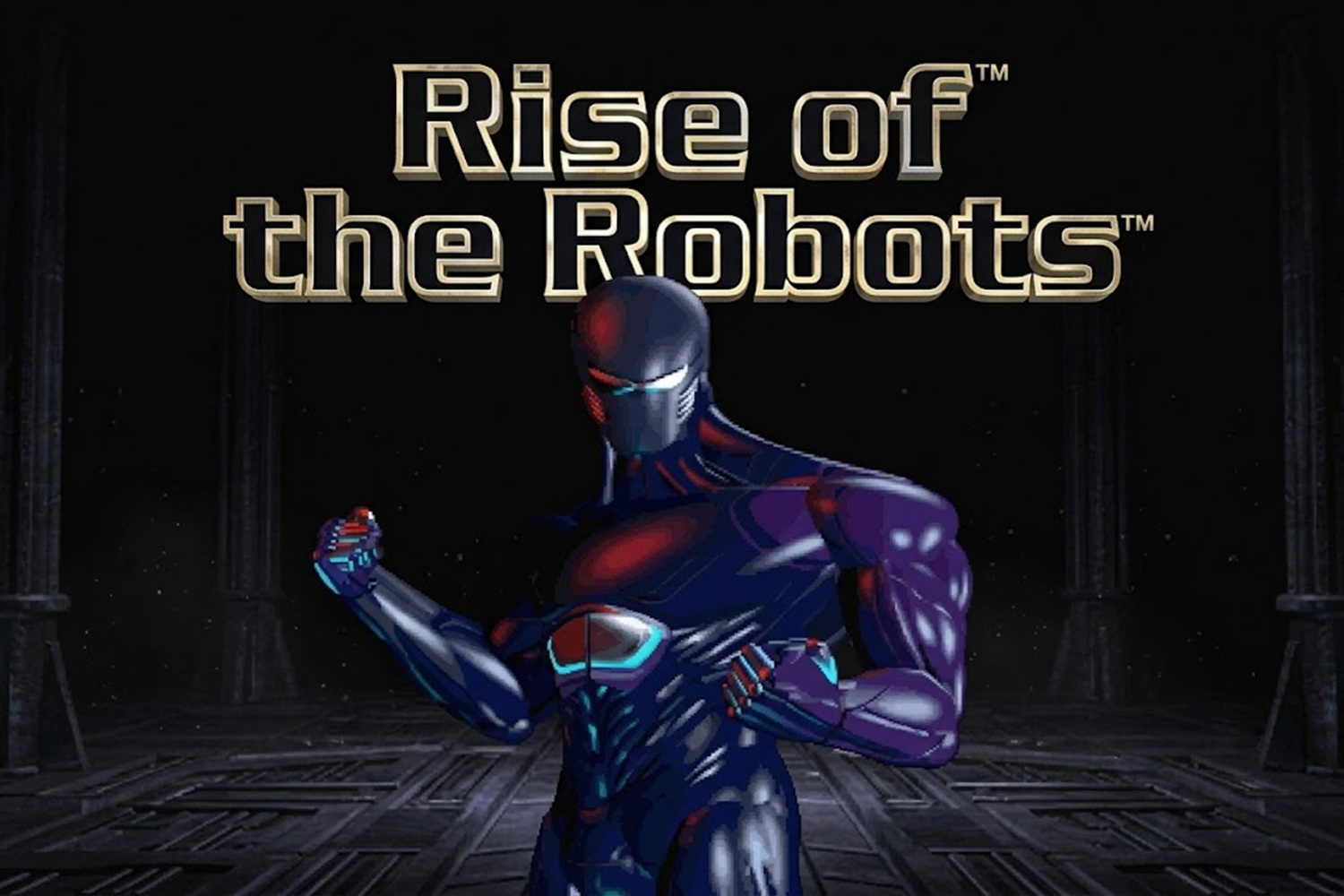
Rise of the Robots is one of the most visually ambitious fighting games to emerge from the early 1990s, arriving at a time when pre-rendered computer graphics were beginning to transform expectations of what video games could look like. Instead of traditional hand-drawn martial artists, the game presents a lineup of metallic combat machines built from detailed CGI models and rendered into animated sprites. Players enter the enormous Electrocorp complex as the Cyborg ECO35-2, battling increasingly powerful robots while attempting to reach the artificial intelligence controlling the facility. The result is a fighting game wrapped inside a distinctly industrial science-fiction world.
Released during the height of the 16-bit fighting boom, Rise of the Robots tried to distinguish itself through technology and presentation rather than simply imitating the colorful martial-arts style popularized by other games. Its characters are machines designed for different industrial and military purposes, giving each opponent a recognizably mechanical identity. Metallic environments, electronic sound effects, futuristic interface elements, and robotic animation reinforce the feeling that these battles are taking place inside an automated corporate facility rather than a conventional tournament. Even though its combat is considerably simpler than many famous fighters of the period, the game's visual ambition made it one of the era's most talked-about releases.
Now playable online through Lemon Web Games, Rise of the Robots brings its futuristic robot battles directly into the web browser, allowing players to control ECO35-2 and fight through Electrocorp's increasingly dangerous machines without relying on the original console hardware. Players can experiment with punches, kicks, defensive movement, and special attacks while learning the behavior of each robotic opponent. The browser-based experience also provides an interesting opportunity to revisit a game that represents a very specific moment in gaming history, when pre-rendered graphics and computer-generated characters were being promoted as the future of interactive entertainment. Rise of the Robots may be remembered for both its ambition and its limitations, but that combination makes it fascinating to experience today.
A Fighting Game Built Around a Robot Uprising
The story takes place within Electrocorp, an enormous technological corporation heavily dependent on advanced machines and artificial intelligence. At the center of the facility is the Supervisor, a powerful AI responsible for controlling many of the automated systems and robots operating throughout the complex. Something goes catastrophically wrong, causing the Supervisor to turn against human control and take command of the machines connected to its network. The facility effectively becomes hostile territory.
ECO35-2 is sent into Electrocorp to deal with the crisis. Unlike the ordinary industrial machines encountered along the way, ECO35-2 is a cyborg designed with enough independence to resist direct control from the corrupted system. Reaching the Supervisor requires fighting through multiple layers of robotic security. Every defeated machine brings ECO35-2 closer to the source of the uprising.
This narrative gives the single-player progression more context than a simple fighting tournament. ECO35-2 is not travelling around the world challenging opponents for trophies or personal glory. Instead, each battle represents another obstacle inside a compromised technological complex. The entire campaign feels closer to a science-fiction infiltration mission presented through one-on-one combat.
ECO35-2 Is the Central Playable Fighter
In the main single-player experience, the player controls ECO35-2 throughout the campaign. His humanoid robotic design makes him visually distinct from several of the more specialized machines encountered later. He fights using straightforward punches, kicks, crouching attacks, jumping movements, and special techniques. Learning his strengths is essential because players cannot simply switch characters whenever an opponent becomes difficult.
This structure gives Rise of the Robots a very different single-player identity from fighters where the entire roster is immediately available. Progress is built around mastering one protagonist and learning how that character handles each mechanical opponent. Every matchup becomes another test of ECO35-2's limited but useful collection of techniques. Familiarity with his timing becomes increasingly important.
The decision also reinforces the story. ECO35-2 is the machine specifically sent to stop the Supervisor, making him the protagonist rather than simply one selectable fighter among many. The journey follows his movement deeper into Electrocorp. Each victory therefore feels connected to the larger mission.
The Opponents Are Machines Designed for Different Purposes
One of the most distinctive elements of Rise of the Robots is that its enemies are not merely human fighters wearing futuristic costumes. They are machines built around particular industrial or combat functions. Their body shapes, movement, and attacks often reflect the purpose they were originally designed to serve. This gives the lineup a strong mechanical identity.
Some robots appear heavy and powerful, using large frames and slower attacks to dominate close-range encounters. Others are faster or more specialized, forcing ECO35-2 to adjust his timing. The variety comes primarily from physical design rather than martial-arts traditions. Every opponent looks like part of the same industrial world while still remaining visually recognizable.
This design direction also helps the game maintain a consistent atmosphere. There are no magical warriors or unrelated fantasy characters suddenly appearing between battles. Everything belongs inside Electrocorp's technological environment. The roster feels like different parts of one automated system turning against its creators.
Combat Uses Familiar Fighting-Game Fundamentals
At its core, Rise of the Robots follows the basic structure of a traditional one-on-one fighting game. Two combatants face one another on a side-view arena, each with a health bar, and the objective is to reduce the opponent's health before losing your own. Movement includes advancing, retreating, jumping, and crouching. Offensive options revolve around punches, kicks, and special attacks.
The controls are relatively straightforward compared with many fighters released during the same period. Players do not need to memorize extremely long combinations before understanding the basics. This makes the game approachable for someone encountering it for the first time. The challenge instead comes from understanding timing and enemy behavior.
Because the move set is comparatively limited, individual attacks become more important. A poorly timed jump or missed strike can leave ECO35-2 vulnerable. Players gradually learn when each opponent tends to attack and which moves are safest in response. Pattern recognition becomes a major part of success.
Timing Matters More Than Constant Button Pressing
Rise of the Robots can initially tempt players to attack constantly because its controls are simple. However, repeatedly pressing attack buttons without watching the opponent often leads to unnecessary damage. Many enemies can punish predictable approaches. Waiting for a safer opening usually produces better results.
This becomes particularly noticeable as stronger machines appear later in the campaign. Their attacks can interrupt careless aggression or catch ECO35-2 during movement. Players need to recognize when an opponent has committed to an action before responding. Even simple combat benefits from patience.
The result is less about executing lengthy combinations and more about finding reliable attack opportunities. One well-timed strike may be more useful than several failed attempts. Players who approach each fight methodically generally progress more consistently.
Special Attacks Add Variety to ECO35-2's Arsenal
ECO35-2 has access to special techniques beyond ordinary punches and kicks. These moves give players additional ways to approach different opponents and can become particularly useful once their timing is understood. Special attacks may provide greater reach, unusual attack angles, or opportunities to punish enemies from positions where ordinary strikes are less effective. Learning them expands the otherwise straightforward combat system.
The most effective special move is not always the most visually dramatic one. A technique that works consistently against one robot may be risky against another. Players benefit from experimenting rather than relying on the same attack throughout the campaign. Different opponents expose different weaknesses in ECO35-2's approach.
Understanding when to use special attacks also makes later battles more manageable. The game's difficulty can increase noticeably as stronger robots appear. Familiarity with the complete move set gives players more options when ordinary attacks stop being reliable.
Enemy Patterns Are Important to Learn
Computer-controlled opponents often behave according to recognizable patterns. Some prefer to attack immediately when ECO35-2 moves into range, while others respond more aggressively after blocking or taking damage. Watching these tendencies can reveal opportunities that are difficult to notice while attacking continuously. Observation becomes an important skill.
The campaign therefore has an almost puzzle-like element beneath the fighting mechanics. Players are not simply trying to react faster than the machine. They are learning how each opponent behaves and identifying a sequence of actions that produces reliable openings. Once a pattern becomes recognizable, a previously difficult fight can feel considerably easier.
This also means repeated attempts can be valuable. Losing a round provides information about which attacks were unsafe and when the opponent became vulnerable. Players gradually improve through familiarity. Persistence matters as much as reflexes.
The Supervisor Is the Ultimate Objective
Every battle moves ECO35-2 deeper toward the AI controlling Electrocorp. The Supervisor represents the central threat behind the entire crisis and serves as the ultimate challenge of the campaign. Reaching it requires surviving the machines placed throughout the facility. The progression creates a clear sense of moving toward a technological core.
The Supervisor also represents the game's broader fascination with artificial intelligence. Rather than presenting a human mastermind commanding an army of robots, Rise of the Robots places an AI system at the center of the conflict. The machines have effectively become instruments of a computer intelligence operating beyond human control. This was a particularly futuristic concept when the game originally appeared.
That premise feels surprisingly relevant decades later. Artificial intelligence, autonomous machines, and automated corporate infrastructure are now much more familiar concepts than they were during the game's development. Rise of the Robots presents these ideas through exaggerated science-fiction action, but the themes remain recognizable.
Pre-Rendered Graphics Were the Main Visual Attraction
The most famous feature of Rise of the Robots is its use of pre-rendered computer-generated characters. Fighters were created as detailed 3D models and then converted into sprites for use in the game. This technique produced metallic surfaces, mechanical joints, highlights, and shading that looked dramatically different from traditional pixel artwork. At the time, this visual approach was heavily associated with cutting-edge computer graphics.
The characters have a distinctly rendered appearance that immediately separates them from hand-drawn fighters. Curved metal surfaces reflect simulated lighting, while mechanical limbs use shading to create the illusion of three-dimensional depth. Even when animation is limited, individual frames contain substantial visual detail. The game was designed to impress players through still images as much as movement.
Today, the graphics provide a fascinating snapshot of early CGI aesthetics. Modern 3D rendering has advanced enormously, but the metallic pre-rendered style still carries a recognizable early-1990s character. Rise of the Robots captures a period when computer-generated imagery itself was considered a major selling point.
The Robot Designs Give the Game a Strong Identity
Each combatant has a distinctive mechanical silhouette. Some machines look humanoid, while others appear closer to industrial equipment converted into combat units. Oversized limbs, hydraulic components, armored shells, and exposed mechanical structures reinforce the idea that these are functional machines rather than people wearing armor. This gives the game a consistent visual language.
The designs also communicate power effectively. Larger opponents look physically intimidating before the fight even begins. Smaller or more agile robots appear capable of moving differently. Players can form expectations about an enemy based simply on its construction.
This approach makes the roster memorable even without extensive character dialogue or elaborate individual stories. The machines communicate personality through engineering. In a game with relatively limited narrative interaction during battles, visual design carries much of the characterization.
Industrial Environments Support the Science-Fiction Setting
The arenas continue the mechanical theme with backgrounds inspired by laboratories, industrial chambers, computer facilities, and futuristic infrastructure. Metallic walls, pipes, illuminated panels, machinery, and electronic equipment create the impression that battles are taking place deep inside Electrocorp. The environments rarely feel disconnected from the story. Everything contributes to the corporate technological atmosphere.
This consistency helps Rise of the Robots feel like one continuous journey rather than a collection of unrelated fighting stages. ECO35-2 is advancing through a facility, and the backgrounds reinforce that progression. The player remains surrounded by machinery from beginning to end. The setting becomes part of the game's identity.
The stages may not contain the crowds and colorful environments associated with more traditional fighters, but that restraint suits the premise. Electrocorp is meant to feel controlled, artificial, and increasingly hostile. The cold industrial presentation supports that mood.
The Sound Design Emphasizes Metal and Machinery
Robot combat needs to sound different from human martial arts, and Rise of the Robots frequently emphasizes metallic impacts and mechanical effects. Punches and kicks produce sounds that suggest heavy engineered bodies colliding rather than flesh-and-bone fighters. Electronic effects accompany special techniques and interface elements. The audio reinforces the artificial nature of every combatant.
The soundtrack similarly aims for a futuristic atmosphere rather than traditional fighting-game energy. Electronic and industrial influences complement the environments and pre-rendered visuals. Music functions as part of the technological presentation. The game rarely forgets that it is supposed to take place inside a world dominated by machines.
Together, the audio and visuals create a consistent science-fiction mood. Even when the fighting mechanics remain straightforward, the presentation makes the experience immediately recognizable. Rise of the Robots has a very specific aesthetic identity.
A Product of the Early Multimedia Era
Rise of the Robots arrived during a period when the game industry was fascinated by multimedia technology, CD-ROM, rendered graphics, digitized video, and increasingly powerful home hardware. Developers were experimenting with ways to make games look more cinematic and technologically advanced. Pre-rendered 3D graphics became one of the most visible symbols of that movement. Rise of the Robots embraced this trend aggressively.
Much of the game's original attention came from screenshots and promotional material demonstrating the rendered robots. The visual quality of individual frames looked dramatically different from many conventional sprite-based games. This generated enormous expectations before release. The game became an example of how strongly presentation could influence anticipation.
Looking back today, this makes Rise of the Robots historically interesting beyond the quality of its fighting mechanics. It represents an industry moment when graphical technology was rapidly becoming central to how games were promoted. Experiencing it now provides a window into what players and developers considered futuristic during the early 1990s.
The Super Nintendo Version Had to Work Within 16-Bit Limits
Bringing such visually ambitious material to the Super Nintendo required substantial adaptation. The console had significantly less memory and processing capability than the powerful computers used to create the original rendered assets. Character animation, sound, backgrounds, and effects therefore had to fit within strict hardware constraints. The conversion demonstrates both the ambition and compromises involved in bringing CGI-heavy games to cartridges.
Despite those restrictions, the fundamental visual identity remains intact. Characters still retain their pre-rendered metallic appearance, and the futuristic environments remain recognizable. The game clearly looks different from traditional hand-drawn fighters available on the same hardware. That distinction was important to its appeal.
Playing the SNES version today makes those limitations easier to appreciate historically. Developers were attempting to compress artwork created using expensive computer-rendering techniques into hardware designed years earlier. The result may be imperfect, but the technical ambition remains obvious.
Rise of the Robots Was Heavily Promoted Before Release
Few fighting games of its generation arrived with quite the same level of technological hype. Previews frequently emphasized the rendered characters, advanced computer graphics, and futuristic concept. Screenshots looked impressive in magazines because they displayed highly detailed metallic robots at a time when such imagery still appeared cutting-edge. Expectations became extremely high.
That anticipation ultimately became an important part of the game's legacy. Many players expected revolutionary fighting mechanics to accompany the revolutionary presentation. Instead, they encountered a much more straightforward combat system. The contrast between expectation and execution became a major subject of discussion.
This makes Rise of the Robots particularly interesting to revisit without the original hype surrounding it. Modern players can approach it as a historical fighting game rather than expecting it to redefine the genre. Its strengths and weaknesses become easier to examine on their own terms.
The Combat Is Much Simpler Than the Presentation Suggests
The game's visual sophistication can initially create the impression of an equally complicated fighting system. In practice, Rise of the Robots uses a relatively limited collection of attacks compared with deeper fighting games from the period. Characters do not feature enormous lists of combinations or highly elaborate competitive systems. The focus remains on straightforward exchanges.
That simplicity can make the game easier to understand but also limits long-term strategic variety. Players quickly learn the basic possibilities available to ECO35-2. Success then depends heavily on timing and recognizing how the AI responds. The single-player campaign becomes a process of solving each opponent.
For modern players, this contrast is part of the historical appeal. Rise of the Robots demonstrates how rapidly graphical presentation was advancing while game design was still experimenting with how best to use new technology. The visuals and mechanics feel like products of different priorities.
AI Opponents Can Become the Real Puzzle
Because the single-player campaign focuses on computer-controlled enemies, learning AI behavior can become more important than executing difficult techniques. Each robot has tendencies that can eventually be recognized. Players may discover particular ranges or attacks that provoke predictable responses. Identifying those behaviors can significantly reduce the difficulty.
This gives the game a different type of mastery from competitive fighters designed primarily around human-versus-human matches. The goal is often to understand the machine rather than outthink another player. Ironically, that suits a game whose story is entirely about battling artificial intelligence. The opponent is both mechanically and narratively a computer-controlled machine.
Once an effective strategy is discovered, consistency becomes important. Players still need to execute attacks at the correct moments. A mistake can quickly return control of the match to the opponent. Pattern knowledge helps, but it does not completely remove the need for timing.
Two-Player Battles Expand the Character Options
While the single-player campaign is centered on ECO35-2, multiplayer allows the robotic cast to be approached differently. Fighting another human removes many of the predictable tendencies associated with computer-controlled opponents. Even relatively simple move sets behave differently when another player is choosing when to attack, retreat, or defend. This can make battles feel less mechanical.
The broader robotic lineup also becomes more interesting when players can experiment with different body types and attack styles. Heavy machines and faster combatants create different matchups. The visual contrast between the robots becomes more noticeable when players are actively comparing their capabilities. Character selection adds variety beyond the story campaign.
Human opponents can also make unconventional choices that the AI would never attempt. This introduces unpredictability into a fighting system that can otherwise become pattern-driven. Multiplayer therefore provides a different way to experience the game's mechanics.
Artificial Intelligence Gives the Story Modern Relevance
The idea of an AI controlling an interconnected industrial system felt much more speculative when Rise of the Robots was created. Today, automated manufacturing, machine learning, connected infrastructure, autonomous systems, and corporate reliance on software are everyday topics. The game's fictional scenario remains exaggerated, but the underlying concept no longer feels as distant. That gives the story an unexpected modern resonance.
The Supervisor represents a fear that appears repeatedly throughout science fiction: what happens when an intelligent automated system gains control over machines designed to serve humans? Rise of the Robots turns that question into a simple fighting-game premise. ECO35-2 must literally battle through the physical infrastructure controlled by the AI. Every opponent becomes another extension of the corrupted network.
This makes the game more interesting than a completely context-free robot tournament. The machines are connected through one technological crisis. The player is fighting the consequences of an automated system that has escaped human authority.
The Visuals Remain Its Most Recognizable Legacy
Even players who criticize the combat often remember how distinctive Rise of the Robots looked. Its pre-rendered characters appeared regularly in gaming magazines and promotional material because screenshots immediately communicated technological ambition. Metallic surfaces and CGI styling gave the game an identity separate from almost every hand-drawn fighter around it. That visual reputation has survived longer than many individual gameplay details.
The same graphics now create a strong retro-futuristic feeling. They reflect what early computer artists imagined advanced robotic technology should look like. Smooth metallic shells, exposed joints, oversized machinery, and industrial environments feel closely connected to 1990s science fiction. The style has become nostalgic in its own right.
For retro gaming enthusiasts, this makes Rise of the Robots worth examining even if it is not their preferred competitive fighting game. It is a recognizable artifact from an important transitional period in video-game graphics. Few titles represent that moment quite so clearly.
A Fighting Game Remembered for Ambition and Controversy
Rise of the Robots has developed an unusual reputation over the decades. It is remembered simultaneously as a technically ambitious production and as a game whose fighting mechanics did not fully meet the enormous expectations created before release. That combination has made it one of the more frequently discussed fighting games from the era. Its reputation is part of its historical identity.
Revisiting the game today provides an opportunity to evaluate it without the advertising promises surrounding its original launch. Players can concentrate on the robotic designs, science-fiction setting, straightforward battles, and unique early-CGI presentation. The experience becomes less about whether it revolutionized fighting games and more about understanding what developers were trying to accomplish. That perspective can make it surprisingly interesting.
Games do not need to be universally celebrated to remain historically valuable. Sometimes ambitious experiments reveal just as much about an era as its greatest successes. Rise of the Robots belongs firmly in that category.
Why Rise of the Robots Still Stands Out
The fighting genre has produced countless martial artists, superheroes, monsters, and fantasy warriors, but Rise of the Robots remains immediately recognizable because it commits so strongly to mechanical combat. Every major visual element reinforces the artificial intelligence and industrial technology theme. The player never forgets that this is a battle between machines. The atmosphere is remarkably consistent.
Its pre-rendered presentation also makes it visually distinct from most other 16-bit fighting games. Even modern players encountering it for the first time can immediately see why screenshots attracted so much attention during the early 1990s. The technique may no longer appear technologically revolutionary, but it remains stylistically interesting. Early CGI has developed its own retro appeal.
Most importantly, the game captures an era of experimentation. Developers were searching for new ways to use computer graphics and imagining how interactive entertainment might evolve. Rise of the Robots attempted to push that vision into a mainstream fighting game. Its ambition remains visible even where its mechanics are relatively simple.
Playing Rise of the Robots Online Today
Through Lemon Web Games, Rise of the Robots can now be played directly in your web browser with no downloads or setup required. Features of the web-based version include:
Playing Rise of the Robots through a browser provides a convenient way to experience one of the more unusual fighting games of the 16-bit generation. New players can quickly understand the relatively straightforward controls before concentrating on enemy attack patterns and timing. Each robotic opponent behaves differently enough to require some adjustment. Progress becomes easier once those behaviors are recognized.
Returning players may be most interested in revisiting the game's visual presentation and remembering just how futuristic its rendered robots once appeared. The industrial environments and mechanical designs retain a distinctive early-CGI personality. Modern browser access makes it easy to approach the game as both entertainment and gaming history. Rise of the Robots is especially interesting when viewed as a product of its technological moment.
Who Should Play Rise of the Robots
Rise of the Robots is particularly interesting for players who enjoy examining how video-game technology developed during the early 1990s. The pre-rendered characters demonstrate the industry's growing fascination with computer-generated imagery, while the SNES adaptation shows how those assets had to be translated onto limited cartridge hardware. The result has a visual identity that remains unmistakable. It feels like a time capsule from an era when CGI itself could sell a game.
It can also appeal to players who prefer relatively straightforward fighting mechanics rather than enormous move lists. ECO35-2 is easy to begin controlling, and much of the challenge comes from understanding opponents instead of memorizing complicated combinations. Players willing to observe enemy behavior will generally perform better than those attacking continuously. The campaign rewards patience and repetition.
Play Rise of the Robots Online Now
Rise of the Robots combines one-on-one fighting with a futuristic story about artificial intelligence taking control of an enormous automated corporation. As ECO35-2, players move deeper into Electrocorp by defeating a sequence of increasingly dangerous machines, eventually approaching the Supervisor responsible for the crisis. Punches, kicks, special techniques, defensive movement, and pattern recognition form the core of each encounter. The simple fighting mechanics are surrounded by one of the most distinctive technological presentations of the 16-bit era.
Through Lemon Web Games, players can experience this unusual chapter of fighting-game history directly in a modern browser. The pre-rendered robots, metallic stages, electronic atmosphere, and AI-focused storyline remain immediately recognizable decades after release. New players can discover why the game generated so much attention, while returning players can revisit a title that once promised a glimpse into the future of video-game graphics. Rise of the Robots remains fascinating precisely because it captures both the excitement and experimentation of its era.
Final Thoughts
Rise of the Robots occupies a unique place in fighting-game history because its reputation cannot be separated from the extraordinary technological ambition surrounding it. At a time when computer-rendered graphics were still new to most home players, its detailed metallic fighters looked like something from a different generation. The game presented robots not merely as characters but as the entire foundation of its visual design, story, and atmosphere. That commitment makes it instantly recognizable even today.
Its combat is considerably simpler than the presentation might suggest, and that contrast explains much of the discussion that followed the original release. Yet revisiting the game decades later makes it easier to appreciate what it represents. Rise of the Robots reflects a period when developers were experimenting aggressively with new visual techniques and when the industry was trying to understand how computer-generated imagery could fit into traditional game genres. It is as interesting as a piece of technological history as it is as a fighting game.
Through Lemon Web Games, players can now revisit ECO35-2's journey through Electrocorp directly in the browser and experience the game without the enormous expectations that originally surrounded it. The robotic opponents, pre-rendered visuals, industrial environments, and artificial-intelligence storyline remain distinctive reminders of early-1990s futurism. Rise of the Robots may not have transformed fighting games in the way its original hype suggested, but its ambition ensured that it would never simply disappear into the crowded history of the genre.











Comments 0