

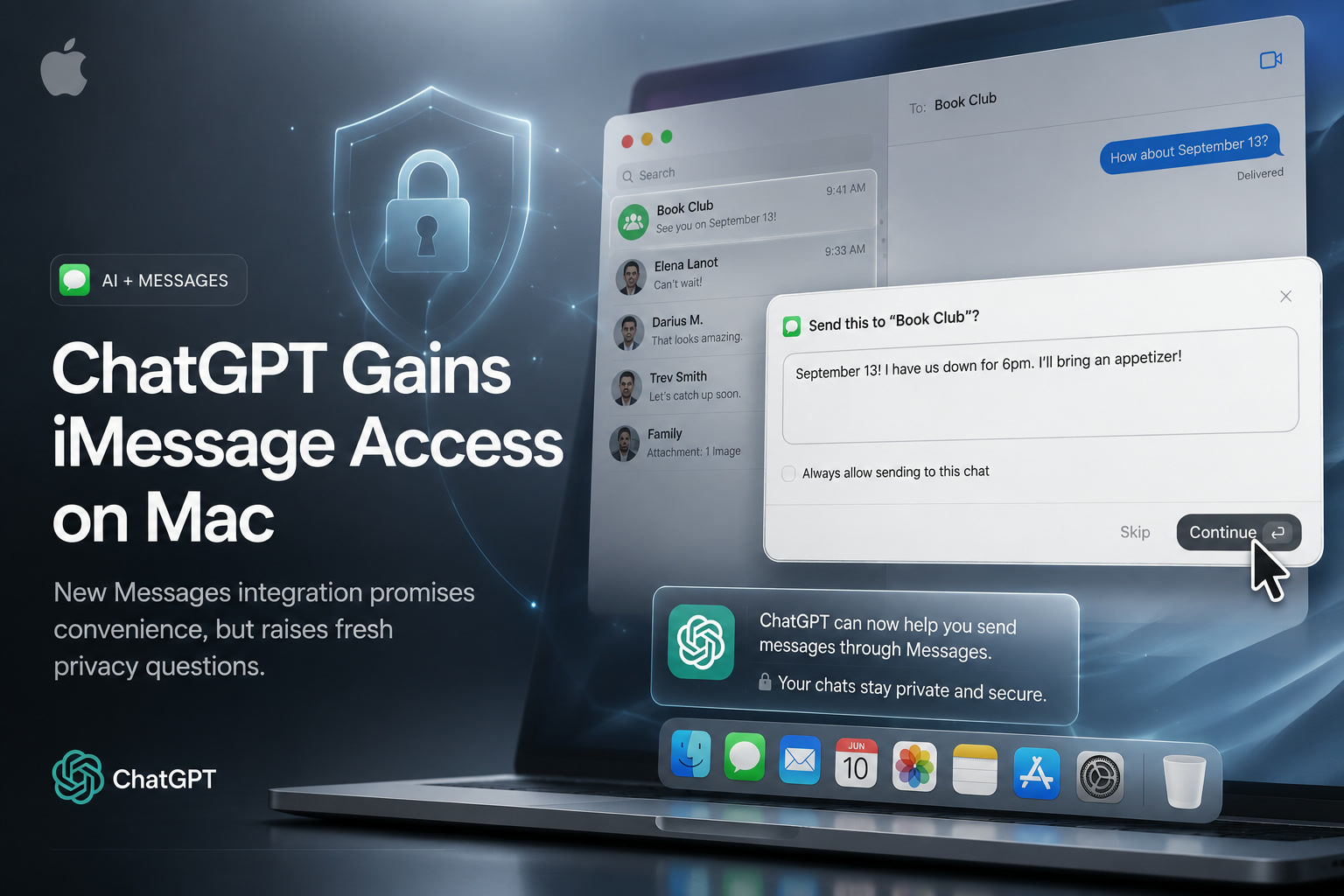
ChatGPT on the Mac is becoming much more than a chatbot sitting in its own window. OpenAI has introduced a new Apple Messages plugin that allows ChatGPT to work directly with conversations stored in Apple's Messages app. On supported Apple-silicon Macs, ChatGPT can now search conversations, catch users up on missed discussions, prepare replies and even send messages through Messages. OpenAI says the integration works with iMessage, SMS and RCS conversations available on the Mac.
That could be genuinely useful.
Instead of copying a long conversation into ChatGPT and asking it to summarise everything, you could potentially say something like:
"What did we decide about dinner yesterday, and draft a reply confirming the time?"
ChatGPT could find the conversation, work out what was discussed, prepare an appropriate response and — with your approval — send it.
But there's an obvious trade-off here.
For ChatGPT to become that useful, you're giving it access to something many people consider among the most private collections of information on their computer: their message history.
ChatGPT Is Moving From Answering Questions to Acting on Your Mac
This update is part of a much bigger shift in how OpenAI is positioning ChatGPT.
Traditional ChatGPT works largely like this:
You provide information → ChatGPT responds.
Increasingly, however, OpenAI wants ChatGPT to operate more like an agent:
Apple Messages is a good example of that transition.
OpenAI's current implementation allows the Messages plugin to:
That last point is particularly important.
By default, OpenAI says ChatGPT will ask you to approve both the message and its recipients before anything is sent.
That's probably a safeguard worth leaving enabled.
Imagine Coming Back to 100 Messages After a Busy Day
There are some very practical use cases here.
Imagine finishing a day of meetings and opening your Mac to discover dozens of unread Messages conversations.
Instead of checking every thread individually, you could potentially ask:
"Which conversations from today still need a reply?"
Or:
"Summarise everything my family discussed about the weekend trip."
Or:
"Find the restaurant Sarah mentioned last week."
Or even:
"Draft follow-up messages for anyone I haven't replied to since yesterday."
This is where AI agents start becoming genuinely useful.
The difficult part isn't generating the text anymore.
It's giving the AI enough context to understand what needs to be done.
Message history provides an enormous amount of context.
And that's precisely why the privacy question becomes much more complicated.
ChatGPT Needs Some Serious macOS Permissions
This isn't an integration you enable with one innocent-looking checkbox.
Because Apple's Messages database is protected by macOS, ChatGPT requires additional permissions before it can interact with it.
The setup may involve permissions such as:
Full Disk Access, access to Contacts, macOS automation capabilities and other system permissions required for ChatGPT to interact with Messages.
Apple explains that Full Disk Access can allow an authorised application to access protected files and areas of the Mac's filesystem that would otherwise remain unavailable. Importantly, macOS requires the user to grant this permission manually through System Settings → Privacy & Security.
So ChatGPT isn't silently unlocking your Messages database simply because you've installed the application.
You have to authorise the relevant access.
Still, approving those permissions is a meaningful decision.
The Permission Warning Is Worth Actually Reading
We're all guilty of clicking Allow when an application asks for access to something.
Camera?
Allow.
Microphone?
Allow.
Contacts?
Allow.
Notifications?
Allow.
With this feature, however, I'd pay considerably more attention to what you're approving.
Your Messages history can contain an extraordinary amount of personal information.
Think about what might be sitting inside years of conversations:
Financial discussions.
Home addresses.
Phone numbers.
Travel plans.
Family matters.
Work conversations.
Passwords someone probably shouldn't have sent you.
Photos.
Medical information.
Personal arguments.
Private jokes.
Confidential business discussions.
There may be information in there that even you've forgotten exists.
Giving an AI assistant the ability to search across that history is therefore considerably different from allowing it to read one document you've deliberately uploaded.
OpenAI Says It Doesn't Build a Giant Index of Your Messages
One reassuring detail is that OpenAI says the Messages integration works through the Mac locally and doesn't create an index of your entire message history.
In other words, ChatGPT isn't supposed to ingest years of conversations upfront simply because you've enabled the plugin.
Instead, the local integration uses the Mac's existing capabilities to locate information when ChatGPT needs it.
That distinction is important.
It reduces the need to build a permanently searchable duplicate database of every conversation.
But it shouldn't be interpreted as:
"Nothing from my Messages conversations can ever be processed by OpenAI."
If ChatGPT is asked to summarise or reason about a conversation, relevant content necessarily needs to become part of the AI task. Exactly how that data is processed and retained can depend on your ChatGPT plan, workspace policies and data-control settings.
So "runs locally" and "doesn't index everything" are useful safeguards — but they don't magically eliminate every privacy consideration.
The Biggest Risk May Actually Be Sending the Wrong Thing
Reading messages is one thing.
Sending them is where the stakes become much higher.
AI-generated text can be wrong.
It can misunderstand tone.
It can confuse people.
It can misinterpret sarcasm.
It can choose inappropriate wording.
And an autonomous system could potentially select the wrong recipient or draw the wrong conclusion from an earlier conversation.
That's why the confirmation step matters so much.
If ChatGPT drafts:
"Sure, I'll be there at 8pm."
you probably want to check:
Who is receiving it?
Which event are we talking about?
Was it 8pm or 8am?
Did they actually ask you to confirm?
The convenience disappears very quickly if an AI sends something embarrassing to your boss, partner or client.
I would therefore be extremely cautious about enabling any persistent setting that allows Messages to be sent without confirmation.
This Is Another Step Toward the AI Agent Era
The Messages integration also gives us another glimpse of where ChatGPT is going.
We're moving beyond:
"Write me an email."
towards:
"Find the email, understand what they're asking, check my calendar, write the response and send it."
Messages is simply another piece of that puzzle.
Eventually, an AI assistant could theoretically connect:
Messages → Calendar → Contacts → Email → Documents → Browser → Tasks
and coordinate actions between them.
For example:
"John asked about dinner next week. Check my calendar, find an evening we're both free and message him three options."
That sounds wonderfully convenient.
But notice how many personal systems the AI needs access to before it can complete that seemingly simple request.
That's the fundamental tension surrounding AI agents.
The more useful they become, the more access they need.
And Apple Has Spent Years Marketing Privacy as a Feature
This integration becomes particularly interesting because it's happening on Apple's platform.
Apple has spent years positioning privacy as one of the biggest differentiators between its products and competing ecosystems.
Messages is especially sensitive because iMessage uses end-to-end encryption between supported Apple devices.
For users, that creates an expectation that their conversations remain private.
However, once those messages reach your Mac, they exist on the device and can potentially be accessed by software that you've explicitly authorised.
That isn't Apple breaking iMessage encryption.
It's you granting another application access to information that has already been decrypted on your computer.
The distinction is technically important.
You can have perfectly secure end-to-end encryption between two phones and still introduce a privacy risk if one of those devices gives another application broad access to the resulting messages.
Apple and OpenAI Are Also Becoming Competitors
The timing makes this development even more interesting.
Apple filed a lawsuit against OpenAI in July 2026, accusing OpenAI and two former Apple employees of misappropriating confidential information relating to Apple's unreleased hardware and technologies.
OpenAI has rejected those allegations and has since asked the court to dismiss the case, saying it doesn't need or want Apple's trade secrets. The legal dispute remains ongoing.
At the same time, the two companies continue to cooperate in other areas.
Apple already integrates ChatGPT into Apple Intelligence, allowing Siri and other Apple experiences to hand certain requests over to ChatGPT when appropriate.
So the relationship is increasingly complicated.
They're partners.
They're competitors.
And now they're courtroom opponents as well.
Messages Is Also Territory Apple Wants Siri to Own
There's another reason this integration matters.
A smarter Siri is supposed to understand much more personal context stored on Apple devices.
Imagine asking Siri:
"When is Mum arriving tomorrow?"
and having it find the answer inside Messages.
Or:
"What restaurant did James recommend last month?"
and Siri searches your communications.
That kind of deeply personalised assistance is one of the major promises surrounding Apple's evolving AI strategy.
ChatGPT gaining similar access through macOS puts OpenAI much closer to that territory.
Apple naturally has an advantage because it owns the operating system.
But OpenAI arguably has an advantage in the sophistication and flexibility of its AI models.
The interesting competition may therefore become:
Who becomes the assistant that understands everything happening on your computer?
For Malaysians, iMessage May Not Be the Biggest Part of This Story
Here in Malaysia, the immediate impact could be somewhat smaller.
iMessage certainly has Malaysian users, particularly among people heavily invested in Apple's ecosystem, but WhatsApp remains far more deeply embedded in everyday communication.
Businesses use it.
Families use it.
Schools use it.
Work groups use it.
Delivery drivers use it.
Practically everyone uses it.
So ChatGPT reading iMessage is interesting.
ChatGPT eventually receiving similar deep integration with WhatsApp would be considerably more significant for Malaysian users.
Imagine ChatGPT being able to search years of WhatsApp conversations and answer:
"Find the contractor who quoted me RM2,500 last year."
or:
"Summarise what the family group decided about Hari Raya."
or:
"Which client conversations haven't I replied to this week?"
The productivity potential would be enormous.
And so would the privacy concerns.
WhatsApp Access Would Raise the Stakes Dramatically
This is probably the part worth watching.
Once one messaging platform becomes accessible to an AI assistant, the obvious question becomes whether other messaging services will follow.
Potential future integrations could involve platforms such as:
Telegram
Messenger
Signal
Slack
Microsoft Teams
Each would create its own privacy and security considerations.
An AI assistant that can read your messages could become incredibly valuable.
An AI assistant that can read all of your messages across every platform would effectively have a searchable representation of much of your personal and professional life.
That's powerful.
And potentially uncomfortable.
There Is Also the Problem of Prompt Injection
There's another security concern that becomes more important whenever AI agents can read external content and perform actions.
It's called prompt injection.
Imagine someone sends you a carefully constructed message containing instructions intended not for you, but for the AI agent reading it.
A poorly protected agent could potentially interpret those instructions as something it should act upon.
Modern AI-agent systems are increasingly designed with safeguards against this type of attack, but no defence should be assumed to be perfect.
The risk becomes particularly important when an AI can both:
read external content
and
perform actions such as sending messages.
That's another reason keeping human approval between AI reasoning and real-world actions remains valuable.
Convenience Versus Privacy Is Becoming the Central AI Question
What makes this feature interesting is that neither side of the argument is particularly difficult to understand.
The convenience is obvious.
Having ChatGPT search hundreds of conversations for something you vaguely remember could save an enormous amount of time.
Having it summarise a 70-message family conversation would be useful.
Having it draft responses to routine messages could reduce digital clutter.
But privacy concerns are equally understandable.
Messages aren't just another folder of documents.
They're conversations involving other people.
And those people haven't necessarily agreed for an AI system to analyse what they wrote.
That's a subtle but important ethical question.
You may be comfortable giving ChatGPT access to your own private information.
But when you grant access to Messages, you're also potentially granting access to information that other people sent to you with an expectation of privacy.
Final Thoughts
ChatGPT's Apple Messages integration is exactly the type of feature that demonstrates why AI agents are both exciting and slightly unsettling.
On one hand, this is the kind of capability many people have wanted from digital assistants for years.
Instead of manually hunting through old conversations, ChatGPT can search them.
Instead of reading hundreds of messages, it can summarise them.
Instead of composing every routine reply yourself, it can prepare one.
And if you approve it, it can even send the response through Messages.
That's genuinely useful.
But giving an AI assistant access to years of private conversations shouldn't be treated like enabling another harmless convenience feature.
Users should understand the permissions they're granting, keep message-send confirmations enabled, review their ChatGPT data controls and think carefully about whether the productivity benefit is worth the additional access.
The bigger story isn't really iMessage anyway.
It's what this tells us about the future of ChatGPT.
AI assistants are gradually moving out of the chatbot window and into the applications containing our actual lives.
Messages today.
Calendars, documents, browsers and countless other apps tomorrow.
And as that happens, one question is going to become increasingly important:
How much of your digital life are you comfortable letting an AI understand in exchange for making it easier to manage?











Comments 0