

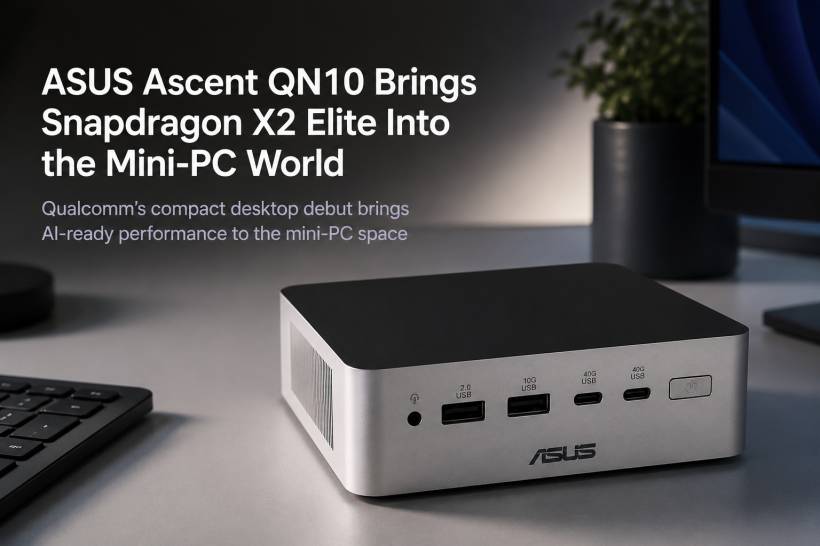
The ASUS Ascent QN10 is an interesting new entry in the compact desktop market because it marks one of the first major mini-PC designs to use Qualcomm's Snapdragon X2 platform. Until now, Snapdragon X chips have mostly been associated with laptops, especially thin and light Windows machines focused on battery efficiency, AI performance, and always-connected style productivity. With the Ascent QN10, Qualcomm and ASUS are now showing that the same type of platform can also work in a small desktop form factor.
This is a notable shift because mini-PCs have traditionally been dominated by Intel and AMD processors. Most users expect compact desktops to use familiar x86 chips, especially for office work, multitasking, media use, light creative work, and business deployments. The ASUS Ascent QN10 changes that conversation slightly by bringing an ARM-based Snapdragon processor into a space where Qualcomm has not had the same level of visibility.
At the centre of the device is the Qualcomm Snapdragon X2 Elite, a chip designed to deliver a balance of performance, efficiency, and on-device AI capability. In laptop form, Snapdragon X chips are usually promoted for their power efficiency and neural processing performance. In a mini-PC, the pitch becomes slightly different. Battery life is no longer the main selling point, but low power consumption, quiet operation, compact size, AI acceleration, and modern connectivity become much more important.
A Compact Desktop Built Around AI Workflows
The ASUS Ascent QN10 is clearly aimed at users who want a small but capable work machine. Qualcomm describes the device as proof that a platform originally reshaping laptops can also deliver a premium desktop experience in a compact, efficient design. That may sound like typical launch marketing, but the concept itself is sensible.
Many modern users do not need a large desktop tower. A compact machine that can sit neatly on a desk, behind a monitor, or inside a small workspace is often enough for office work, web applications, meetings, cloud tools, light content creation, and multitasking. The Ascent QN10 appears to target exactly that type of user, especially prosumers and business users who want something clean, small, and efficient.
The AI side is also a major part of the story. The Snapdragon X2 Elite includes an NPU rated at 80 TOPS, which is designed to handle local AI workloads more efficiently. This could be useful for AI-assisted productivity, local agents, coding tools, creative assistants, automation workflows, and other software that can take advantage of on-device AI processing.
The NPU Is One of the Biggest Selling Points
The 80 TOPS NPU is one of the main reasons the Ascent QN10 stands out from many traditional mini-PCs. TOPS, or trillion operations per second, is commonly used to describe AI processing capability. While real-world usefulness depends heavily on software support, a strong NPU gives the system a dedicated engine for AI tasks instead of relying only on the CPU or GPU.
Qualcomm has mentioned support for local AI agents and tools such as OpenClaw, Hermes, Cursor, Claude Desktop, OpenAI Codex, and OpenCode. For developers, content creators, researchers, and productivity-focused users, this could make the Ascent QN10 more appealing as AI tools become more integrated into daily workflows.
That said, the success of this kind of machine will depend on how well Windows on ARM continues to mature. Hardware capability is only one part of the equation. App compatibility, driver support, native ARM versions of software, and performance under emulation will all affect how practical the device feels in everyday use.
Small Size, Big Workspace Potential
One of the biggest advantages of the ASUS Ascent QN10 is its size. The device is packed into a body measuring under 0.7 litres, which makes it extremely compact for a desktop-class machine. This kind of footprint is useful for users who want a clean desk setup, businesses that need many small workstations, or offices where space is limited.
Small form factor PCs are also popular in reception counters, meeting rooms, digital signage setups, education labs, call centres, and shared workspaces. A compact device that consumes less power and still supports modern connectivity can be very practical in those environments.
The Ascent QN10 is not just small for the sake of being small. It also appears to be built with productivity in mind. ASUS lists support for up to four 4K monitors, which is impressive for a compact device. This makes it suitable for users who rely on multiple screens for dashboards, spreadsheets, communication tools, creative timelines, monitoring systems, or general multitasking.
Memory, Storage, and Connectivity
According to the listed specifications, the ASUS Ascent QN10 can be configured with up to 32GB of LPDDR5x RAM. That should be enough for most productivity and prosumer workloads, especially if the system is used for office tasks, web-based tools, communication apps, light media editing, and AI-assisted workflows.
For storage, it comes with 512GB of M.2 SSD storage and supports dual SSDs. That dual SSD support is useful because compact PCs often have limited upgrade paths. Having room for another SSD gives users more flexibility, especially if they want to separate system storage from project files, media files, or work data.
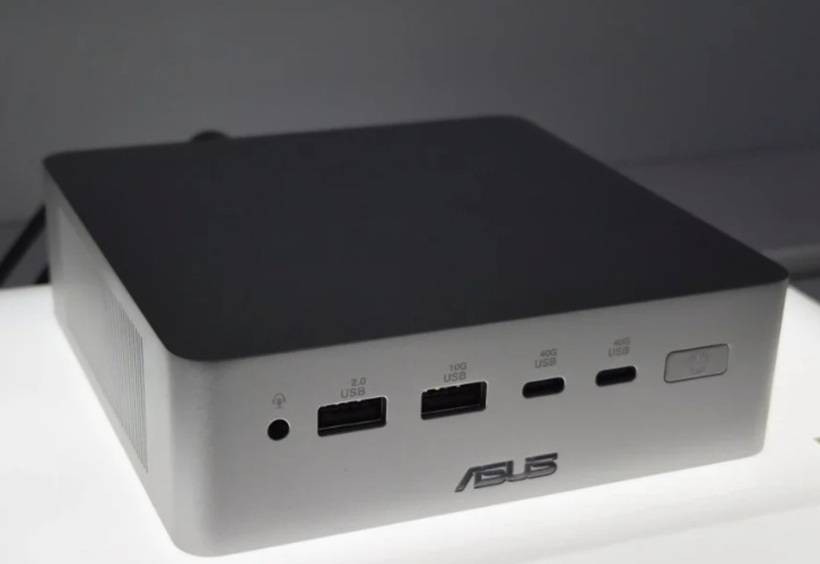
Connectivity is also quite complete for a device of this size. The Ascent QN10 includes seven USB ports, an HDMI port, WiFi 7, Bluetooth 5.4, a 3.5mm audio jack, and an RJ45 LAN port. The inclusion of wired LAN is important because many business and office environments still prefer stable wired networking for desktop machines.
Security Is Part of the Pitch
Qualcomm also highlights what it calls enterprise-grade, chip-to-cloud security. This is clearly meant to appeal to business users, IT departments, and organisations that care about device management, identity protection, and secure workflows.
For mini-PCs used in offices, healthcare, education, retail, and enterprise environments, security matters just as much as performance. Devices may be connected to internal systems, cloud platforms, customer data, shared dashboards, or remote management tools. If ASUS and Qualcomm can provide a strong security foundation, the Ascent QN10 may be more attractive to organisations looking for compact managed desktops.
However, as always, security claims need to be evaluated in real-world deployment. IT teams will still need to look at OS support, endpoint protection compatibility, management tools, patching, encryption, identity integration, and application requirements before choosing a Snapdragon-based mini-PC at scale.

Can It Really Replace a Traditional Mini-PC?
This is the biggest question. On paper, the ASUS Ascent QN10 looks like a modern and efficient mini-PC with strong AI hardware and good connectivity. For many everyday tasks, it could be more than enough. Web browsing, Microsoft 365, email, video meetings, dashboards, file management, light editing, and AI-assisted productivity should fit the target use case well.
The more complicated part is software compatibility. Windows on ARM has improved a lot, but some users still rely on specialised x86 applications, legacy drivers, hardware dongles, industry-specific tools, or software that may not behave perfectly under emulation. For casual office use, this may not be a major issue. For technical, engineering, medical, industrial, or creative workflows, it needs closer testing.
So the Ascent QN10 may not replace every Intel or AMD mini-PC immediately, but it could become a very interesting alternative for users whose workloads are already modern, cloud-based, browser-based, or supported properly on Windows on ARM.
Pricing and Availability Are Still Unknown
Like many products revealed around Computex 2026, the ASUS Ascent QN10 does not yet have confirmed pricing or availability details. That makes it difficult to judge its real market position for now.
Price will matter a lot. If ASUS positions it too high, users may compare it against powerful Intel and AMD mini-PCs with broader software compatibility. If the pricing is competitive, the Ascent QN10 could appeal to users who want a compact, efficient, AI-ready desktop with modern connectivity and low power usage.
Availability will also be important. Snapdragon-based Windows devices are still not as common as traditional x86 systems in many markets, so regional rollout, support, warranty, and business channel availability could affect adoption.
Final Thoughts
The ASUS Ascent QN10 is more than just another compact desktop. It represents Qualcomm's next step in pushing Snapdragon X chips beyond laptops and into the wider PC market. By bringing the Snapdragon X2 Elite into a mini-PC, ASUS is testing whether users are ready for ARM-based compact desktops built around efficiency, AI performance, and modern workplace needs.
The idea makes sense. Many users no longer need large desktop towers, and many workplaces are moving toward smaller, cleaner, more efficient computing devices. With support for multiple 4K monitors, WiFi 7, dual SSDs, seven USB ports, and an 80 TOPS NPU, the Ascent QN10 has the right ingredients to be a serious productivity machine.
The only remaining questions are pricing, availability, and how well the software experience holds up in real-world use. If ASUS gets those parts right, the Ascent QN10 could be an early sign of a new category of Snapdragon-powered mini-PCs that are built not just for basic computing, but for the AI-driven desktop workflows that are slowly becoming part of everyday work.











Comments 0