

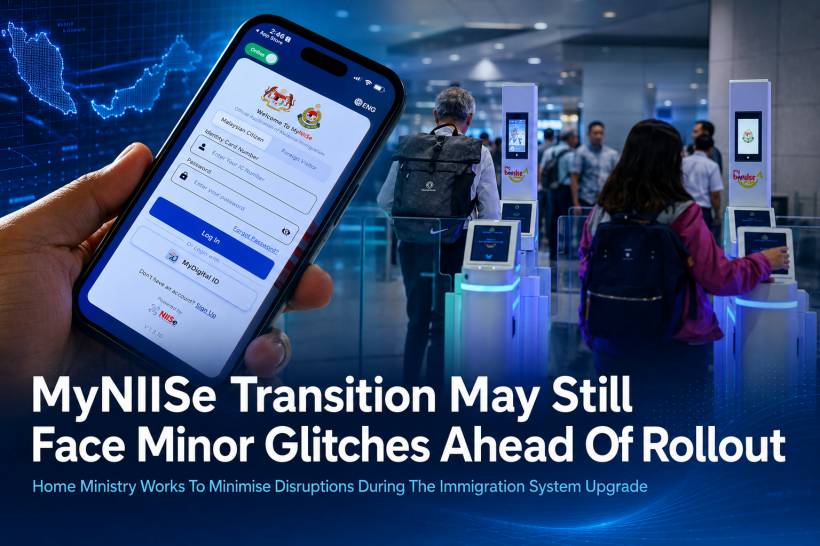
Malaysia's immigration system is moving into a major new phase with the upcoming rollout of the National Integrated Immigration System, better known as MyNIISe. The Ministry of Home Affairs has said that it is working to reduce disruptions as much as possible, but it has also been realistic about the challenges involved. Moving from an older, long-running immigration platform to a newer integrated system is not something that happens overnight without any bumps along the way.
Home Minister Datuk Seri Saifuddin Nasution Ismail explained that MyNIISe is now in its final phase of implementation. However, because the transition involves migrating and integrating processes from a system that has been used for many years, occasional technical glitches may still happen. In other words, the government is not pretending that the changeover will be completely perfect from day one, but it is positioning MyNIISe as a necessary step toward fixing long-standing immigration system issues.
Why The Upgrade Is Needed
The current immigration system has been under pressure for some time, especially at major entry points where even short disruptions can create serious congestion. Malaysia's borders handle a heavy flow of travellers every day, and when the system slows down or goes offline, the impact is immediately felt by the public.
This became especially clear after a nationwide disruption on 22 April, which reportedly caused major congestion and left thousands of travellers stranded. Incidents like this highlight how dependent modern border control is on reliable digital infrastructure. Immigration clearance is no longer just about stamping passports at a counter. It involves databases, biometric checks, automated gates, security screening, network connectivity, and coordination between different agencies.
Because of this, the Home Ministry appears to be treating MyNIISe not merely as a technology refresh, but as a broader attempt to modernise the way immigration clearance is handled across the country.
The Challenge Of Replacing An Old System
Saifuddin acknowledged that the existing system is an old one that has been inherited for a long time. That statement is important because it reflects a common challenge in public sector technology projects. Many government systems are built over many years, with layers of upgrades, patches, integrations, and operational dependencies added along the way.
Replacing such a system is rarely simple. Even if the new platform is better designed, the migration process itself can introduce risks. Data needs to be transferred correctly, old and new systems may need to run side by side for a period, hardware and network infrastructure must be ready, and frontline officers need to be trained to use the new tools properly.
That is why the ministry has warned that some glitches could still occur during the transition period. The key difference is whether those glitches are isolated and manageable, or whether they cause widespread disruption. That is where proper preparation becomes critical.
A New System To Reduce Congestion
MyNIISe is expected to play a major role in improving immigration clearance, especially at busy entry points. The system is scheduled for full implementation at the country's entry points in September and will support several methods of verification, including facial recognition, QR code scanning, and conventional passport checks.
This multi-channel approach is important because different travellers may go through different types of clearance depending on the location, situation, and available facilities. Facial recognition could help speed up automated processing, QR code scanning may support faster digital verification, while traditional passport checking remains necessary as a backup and for standard procedures.
If implemented well, MyNIISe could help reduce bottlenecks by making the clearance process faster and more flexible. However, as with any large-scale digital system, success will depend not only on the software itself, but also on how well the surrounding infrastructure supports it.
Preparing For Problems Before They Happen
One notable point raised by Saifuddin is the instruction for MyNIISe vendors to adopt a "pre-mortem" approach. This is a more proactive way of managing system risk. Instead of waiting for something to fail and then investigating what went wrong afterwards, vendors are expected to identify possible failure points before the system goes fully live.
This is a sensible approach, especially for a system that will support critical national entry points. A pre-mortem exercise forces teams to ask difficult questions in advance. What happens if facial recognition slows down? What if the network connection at a checkpoint becomes unstable? What if QR verification fails during peak travel hours? What if multiple entry points experience high traffic at the same time?
By thinking through these scenarios early, vendors and agencies can prepare backup procedures, technical escalation paths, and operational workarounds. This does not guarantee that problems will never happen, but it improves the chances of responding quickly and reducing public inconvenience.
The RTS Link Adds More Pressure To Get It Right
The ministry's focus on the Johor Bahru-Singapore Rapid Transit System Link also makes sense. Once operational, the RTS Link is expected to handle a large number of daily commuters between Malaysia and Singapore. That means immigration clearance will need to be fast, stable, and predictable.
For commuters, even a small system delay can quickly become frustrating if it affects daily travel. For the authorities, any recurring disruption could create congestion not only at immigration counters but also across connected transport areas. This is why system reliability must be tested not just in theory, but under realistic high-volume conditions.
The visits to the CIQ Complex at BSI and the Bukit Chagar Station show that the ministry is looking at MyNIISe as part of a larger border management ecosystem, rather than just a backend IT project.
A Realistic But Important Step Forward
The government's message is essentially this: the current system has known weaknesses, MyNIISe is being introduced to address them, but the transition period may still come with some minor technical issues. That is a more realistic position than promising a completely flawless rollout.
For travellers, the hope is that any early-stage glitches will be temporary and limited. For the ministry and vendors, the priority should be clear communication, strong contingency planning, and rapid incident response. When people are stuck at immigration counters, what matters most is not just whether a system failed, but how quickly the issue is resolved and whether officers have a practical backup process.
Final Thoughts
MyNIISe represents an important upgrade for Malaysia's immigration infrastructure. With facial recognition, QR code scanning, and conventional passport verification built into the system, it has the potential to make border clearance faster and more modern. But the real test will come during actual deployment, especially at high-traffic entry points.
Technology upgrades of this scale are never just about launching a new system. They are about managing change, preparing users, testing infrastructure, and ensuring that failures do not turn into major public disruptions. If the Home Ministry and its vendors can properly anticipate risks before rollout, MyNIISe could become a meaningful step forward in reducing congestion and improving the traveller experience at Malaysia's borders.











Comments 0