

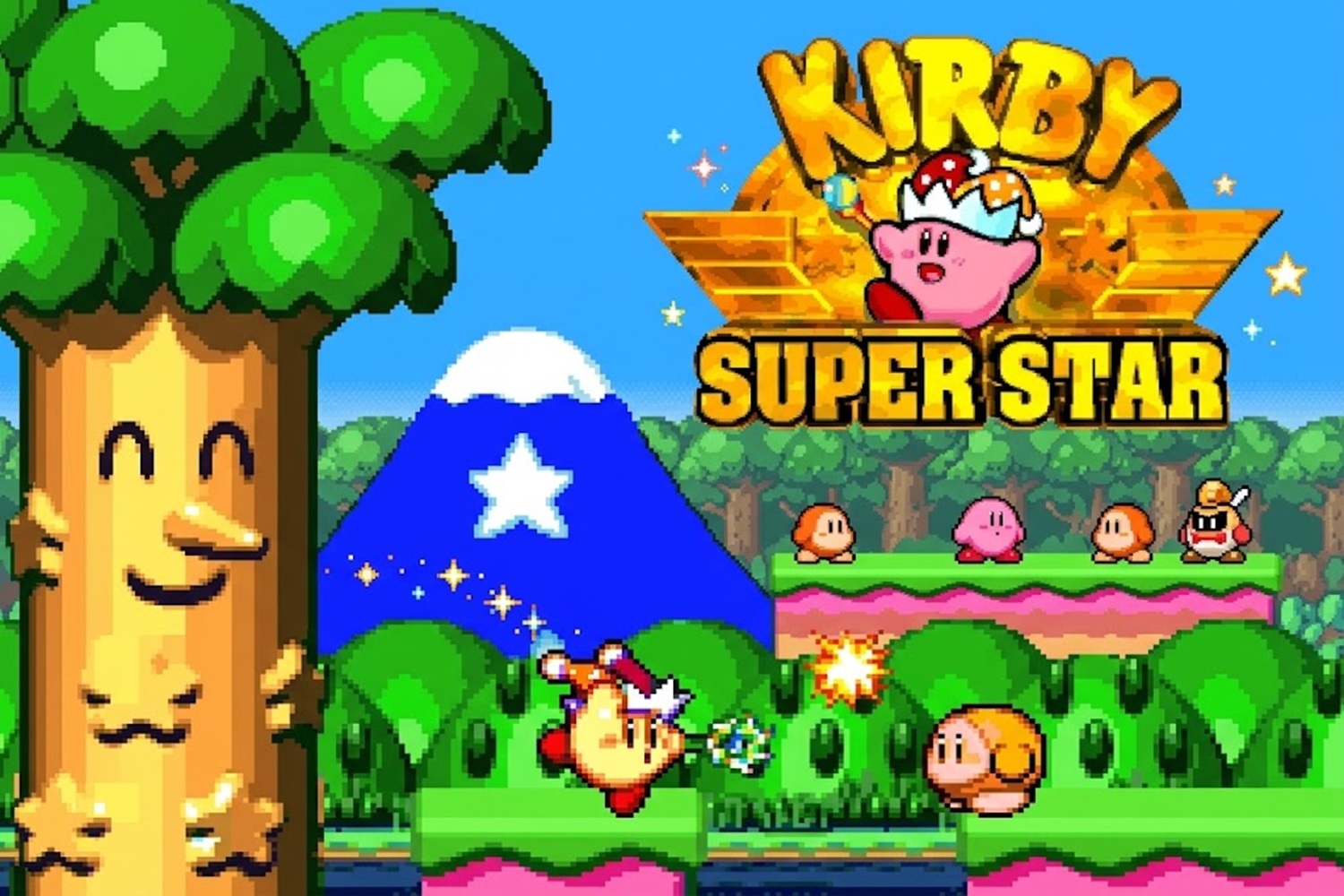
Kirby Super Star is one of the most ambitious entries from Kirby's 16-bit era, combining multiple adventures, competitive challenges, mini-games, boss battles, treasure hunting, and cooperative play into a single remarkably varied package. Released in 1996, the game takes Kirby's familiar ability to inhale enemies and copy their powers, then builds several different styles of gameplay around that central idea. One adventure might send Kirby through a traditional platforming journey, while another focuses on collecting hidden treasures, racing King Dedede, escaping a massive battleship, or searching the galaxy for reusable abilities. Rather than stretching one campaign across the entire game, Kirby Super Star constantly gives players something different to do.
The variety is supported by one of the most flexible versions of Kirby's Copy Ability system. Powers such as Sword, Beam, Bomb, Fighter, Wheel, Plasma, Mirror, Ninja, Yo-Yo, Hammer, Fire, Ice, Wing, Jet, Stone, Parasol, and several others provide their own collections of attacks rather than functioning as single-purpose abilities. Kirby can also sacrifice many copied powers to create a Helper, turning the ability into a companion character that fights alongside him. A second player can control that Helper, transforming much of the adventure into cooperative platforming without changing Kirby's fundamental mechanics.
Now playable online through Lemon Web Games, Kirby Super Star brings its collection of colorful adventures, Copy Abilities, Helper mechanics, treasure hunting, racing, boss battles, and cooperative gameplay directly into the web browser. Players can begin with the approachable Spring Breeze, chase Dyna Blade across Dream Land, search for valuable treasures in The Great Cave Offensive, race against King Dedede in Gourmet Race, infiltrate Meta Knight's Halberd, explore the galaxy in Milky Way Wishes, or eventually test their skills against a long sequence of bosses in The Arena. Each mode uses the same responsive Kirby foundation while introducing different objectives and structures. That variety is a major reason Kirby Super Star remains one of the most replayable games in the series.
A Collection Rather Than One Traditional Adventure
Kirby Super Star does not follow the usual structure of presenting one long campaign from beginning to end. Instead, the game is divided into multiple adventures that can be selected separately, with additional modes becoming available as players progress. Some are relatively short introductions to Kirby's mechanics, while others contain larger maps, more complicated objectives, and tougher encounters. The structure makes the entire package feel more like a collection of Kirby experiences than a single linear journey.
This approach allows each adventure to experiment without needing to support an entire game by itself. Treasure hunting can dominate one mode while time pressure defines another. A racing challenge can sit comfortably beside a traditional platforming campaign because neither needs to become the permanent format. Kirby Super Star continually changes the rules while preserving the movement, combat, and Copy Ability systems underneath.
The format also makes the game easy to revisit. Players do not necessarily need to restart one enormous campaign when they want to play again. They can return directly to a favorite adventure, search for missed treasures, challenge a boss rush, or play a quick mini-game. The variety gives the package considerable long-term appeal.
Spring Breeze Reintroduces Kirby's Original Adventure
Spring Breeze serves as one of the most approachable starting points in Kirby Super Star. It reimagines the basic journey from Kirby's Dream Land using the expanded mechanics and presentation of Super Star. King Dedede has once again caused trouble for Dream Land, and Kirby travels through familiar environments while defeating enemies and confronting several recognizable bosses. The adventure is deliberately short and accessible.
For new players, Spring Breeze works well as an introduction to movement, inhaling, Copy Abilities, guarding, and Helper creation. Stages are relatively straightforward, allowing players to experiment without immediately facing complicated objectives. The mode demonstrates how much more capable Kirby has become compared with his earliest appearance. Even basic enemies can now provide powers with complete attack sets.
Experienced players can finish Spring Breeze quickly, but that simplicity is part of its purpose. It establishes the fundamental controls before the game begins introducing more unusual structures. The adventure feels almost like a warm-up before Kirby Super Star starts showing how flexible its systems can be.
Dyna Blade Expands the Traditional Platforming Formula
Dyna Blade begins when a giant bird causes trouble by disturbing Dream Land's crops. Kirby sets out to discover what is happening, travelling through several stages before eventually confronting Dyna Blade directly. The mode retains the traditional side-scrolling structure of Spring Breeze but expands it with a broader map and optional areas. It feels closer to a conventional Kirby adventure.
Hidden routes and trial areas encourage players to explore beyond the obvious path. These optional sections can provide access to useful abilities and opportunities to experiment with Kirby's move set. The world map also makes progression feel more open than Spring Breeze. Players can see themselves moving toward the final confrontation rather than simply advancing through a fixed sequence.
The conclusion gives the story a typically lighthearted Kirby twist. Rather than relying on a straightforward villain narrative, Dyna Blade's actions eventually reveal a more sympathetic explanation. That tone fits the series perfectly, mixing energetic action with playful storytelling.
Gourmet Race Turns Platforming Into Competition
Gourmet Race changes the objective completely by placing Kirby in direct competition with King Dedede. Instead of slowly exploring stages or searching for hidden items, players race toward the finish while collecting as much food as possible. Speed matters, but simply reaching the end first is not the only concern. Food collected along the route also contributes to the result.
This creates a clever balance between taking the fastest path and grabbing additional points. A direct route may save time, while a slightly longer route could contain more food. Players gradually learn which detours are worthwhile and which only slow them down. Familiar movement mechanics suddenly become part of a racing strategy.
The courses are short enough to encourage repeated attempts. Learning jumps, slopes, platforms, and food placement allows players to improve their performance over time. Gourmet Race is simple compared with the larger adventures, but it remains one of the most recognizable parts of Kirby Super Star because it transforms ordinary platforming into a cheerful competition.
The Great Cave Offensive Becomes a Treasure Hunt
The Great Cave Offensive is one of the most distinctive adventures in Kirby Super Star. After falling into a huge underground cave, Kirby needs to explore the enormous area while searching for hidden treasures. The objective is not merely to reach the exit. Players can discover 60 treasures scattered throughout the cave, many hidden behind puzzles, secret passages, or environmental challenges.
These treasures range from ordinary valuables to playful references that longtime Nintendo fans may recognize. Finding everything requires much more exploration than simply following the main route. Some collectibles are easy to notice, while others demand specific abilities or careful observation. The mode rewards curiosity more strongly than almost any other part of the game.
Because the cave is divided into interconnected regions, navigation becomes important. Players may need to remember where certain obstacles appeared and return after obtaining a useful power. The Great Cave Offensive gives Kirby Super Star an almost exploration-adventure quality. Completing the mode is straightforward, but discovering every treasure becomes a much larger challenge.
Sixty Treasures Give Completionists Plenty to Find
The treasure system provides The Great Cave Offensive with excellent replay value. Players can finish the adventure while leaving many valuables undiscovered, making another journey worthwhile. Each treasure contributes to the total value collected, creating a clear measure of how thoroughly the cave has been explored. Finding the full set becomes an achievement in itself.
Some treasures are hidden behind breakable blocks or unusual environmental arrangements, while others require precise use of Kirby's abilities. A certain obstacle may strongly suggest that another Copy Ability would make reaching the reward easier. This encourages players to think about abilities as exploration tools rather than only weapons. Combat and puzzle solving begin to overlap.
The hunt also changes how players look at level design. Suspicious corners, unusual walls, and apparently unnecessary platforms may conceal something valuable. Instead of constantly moving right, players are encouraged to investigate. That slower and more observant style gives the mode its own identity.
Revenge of Meta Knight Raises the Stakes
Revenge of Meta Knight presents one of the most dramatic adventures in Kirby Super Star. Meta Knight and his crew aboard the Battleship Halberd attempt to take control of Dream Land, believing its peaceful inhabitants have become too lazy. Kirby launches an assault on the massive airship and gradually destroys important sections while the crew desperately tries to stop him. The scenario feels much more urgent than the earlier adventures.
Dialogue from the Halberd's crew appears during the mission, giving players a sense of what is happening aboard the ship as Kirby advances. The crew reacts to damaged systems, defeated defenders, and Kirby's increasingly successful infiltration. This creates a stronger narrative flow without interrupting the action for lengthy scenes. Players feel as though they are actively dismantling a functioning battleship.
Many sections also use time limits, increasing the tension. Players cannot always wander indefinitely searching every corner. The combination of urgency, escalating destruction, and crew dialogue gives Revenge of Meta Knight a cinematic quality unusual for a 16-bit platformer. It remains one of the most memorable adventures in the package.
The Battleship Halberd Became a Kirby Icon
The Halberd itself is more than a background location. Its enormous engines, weapon systems, interior corridors, launch areas, and mechanical defenses make it feel like a genuine machine that Kirby is invading piece by piece. Different sections of the adventure reveal more of the ship's scale. By the time the mission approaches its conclusion, players understand how much damage Kirby has caused.
The Halberd also gives Meta Knight a stronger identity beyond simply being another swordsman. He commands a dedicated crew and operates from a massive warship designed around military power. This stands in contrast to Kirby's cheerful simplicity. Their conflict becomes as much about personality as combat.
The ship later became one of the most recognizable elements associated with Meta Knight throughout the wider Kirby series. Kirby Super Star played an important role in establishing that connection. Its appearance here remains one of the game's most memorable set pieces.
Meta Knight Offers One of the Most Memorable Rivalries
Meta Knight occupies an unusual position in Kirby's world. He can behave as an opponent, rival, or reluctant ally depending on the situation, and Kirby Super Star strengthens that mysterious identity. Revenge of Meta Knight places him directly against Kirby while still presenting him as a warrior with his own principles. He is not simply another chaotic villain.
His swordsmanship also creates a thematic contrast with Kirby's enormous selection of abilities. Meta Knight relies heavily on discipline and blade techniques, while Kirby can adapt by copying enemies encountered throughout the adventure. Their eventual confrontation therefore feels appropriately different from ordinary boss fights. The battle has the atmosphere of a duel.
Meta Knight's popularity would continue growing after Kirby Super Star, but this game already establishes many of the qualities associated with him. His mask, sword, cape, Halberd, and sense of warrior honor are all central to his presentation. The result is one of Kirby's most enduring rivalries.
Milky Way Wishes Changes the Copy Ability Rules
Milky Way Wishes is one of the largest and most mechanically unusual adventures in Kirby Super Star. The sun and moon begin fighting, and Kirby travels across multiple planets seeking a way to resolve the conflict. Rather than following one continuous world, the adventure allows players to visit different planets across the galaxy. Each location introduces its own visual style and challenges.
The biggest change involves Copy Abilities. Kirby can no longer simply inhale most powered enemies and immediately obtain their abilities in the usual way. Instead, players search for Copy Essence Deluxe items hidden across the planets. Once discovered, these abilities become permanently selectable for the remainder of the adventure.
This completely changes how players think about powers. Finding an ability is no longer a temporary convenience; it becomes another permanent option added to Kirby's growing collection. By the later parts of the adventure, players can switch between many abilities whenever needed. The system turns exploration into a form of character progression.
Copy Essence Deluxe Rewards Exploration
Copy Essence Deluxe items are often placed in locations that require careful exploration. Some can be found relatively easily, while others are hidden behind optional routes or obstacles. Players who rush directly toward each planet's exit may miss useful powers. Thorough exploration therefore creates a noticeably larger ability library.
Once collected, abilities can be selected repeatedly without searching for another specific enemy. This gives players enormous freedom during combat. A difficult boss can be approached with Sword, Plasma, Hammer, Fighter, or another preferred ability depending on the player's style. Experimentation becomes easy.
The mechanic also highlights how deep Kirby Super Star's Copy Ability system actually is. When abilities can be switched freely, players begin comparing their movement options, attack ranges, defensive properties, and special techniques. What initially seemed like simple temporary powers reveal themselves as small fighting styles of their own.
Marx Brings a Major Twist to the Adventure
Milky Way Wishes gradually introduces Marx, a seemingly friendly character who encourages Kirby to seek the power capable of stopping the conflict between the sun and moon. His role initially appears helpful, providing direction for the galactic journey. As the story develops, however, his true intentions become much more important. The adventure ultimately leads toward one of the most recognizable confrontations in Kirby Super Star.
Marx stands out because his appearance initially fits Kirby's cheerful world perfectly. His playful design does not immediately suggest the scale of the threat he eventually represents. That contrast makes the later transformation especially effective. Kirby games frequently hide strange or powerful final threats behind colorful presentation, and Marx became one of the most famous examples.
The final stages of Milky Way Wishes also increase the spectacle considerably. After travelling between planets and collecting abilities, the adventure begins moving toward increasingly dramatic encounters. The transition gives the mode a satisfying sense of escalation. What began as another strange problem in Dream Land develops into a cosmic crisis.
The Copy Abilities Are Far Deeper Than They First Appear
Earlier Kirby games often treated copied powers as relatively straightforward tools. Kirby Super Star expands many abilities into complete move sets. Sword does not simply provide one slash, Fighter offers more than one punch, and Beam can be used in multiple ways depending on movement and button input. Learning an ability can feel almost like learning a character in a fighting game.
This makes experimentation extremely rewarding. A player who initially uses an ability by repeatedly pressing one button may later discover attacks triggered while running, jumping, crouching, or holding different directions. Certain abilities are better for aerial combat, while others dominate at close range. Some also provide unusual defensive or movement options.
The expanded move sets help prevent the game from becoming repetitive despite the large amount of content. Switching from Hammer to Plasma or from Yo-Yo to Wing can completely change the rhythm of a stage. Kirby remains the same character, but his combat style can transform constantly.
Sword Provides a Familiar All-Round Fighting Style
Sword is one of Kirby's most recognizable Copy Abilities and gives him a green cap strongly reminiscent of a classic fantasy hero. The ability offers quick slashes, aerial attacks, and techniques that work well against both ordinary enemies and bosses. Its straightforward range makes it easy to understand while still providing enough depth for experienced players. Sword is an excellent all-purpose choice.
Because Kirby Super Star gives abilities several attacks, Sword can handle more situations than a single basic slash would suggest. Players can strike rapidly at close range, attack while airborne, and use directional techniques to approach enemies. The ability feels responsive without becoming overly complicated. It is especially comfortable for players who prefer direct combat.
Sword also works well with the Helper system. Creating a Blade Knight companion allows another character to fight alongside Kirby using sword techniques. This visually reinforces the idea that Kirby has converted a copied power into a separate ally.
Fighter Turns Kirby Into a Close-Range Specialist
Fighter gives Kirby a martial-arts-inspired collection of punches, kicks, and energy-based techniques. The ability is particularly effective at close range, where multiple attacks can be chained together quickly. Different directional inputs produce different moves, rewarding players who spend time learning the complete set. Fighter can feel remarkably technical for a Kirby power.
The ability also demonstrates how Kirby Super Star borrows ideas from fighting games. Command variety, positioning, and attack timing matter more than simply activating the power. Experienced players can move through enemies with considerable speed. Boss battles become especially satisfying once the stronger techniques are understood.
Fighter may initially appear less dramatic than powers involving explosions or giant weapons, but its versatility makes it extremely effective. Players who enjoy active close-range combat can use it throughout large portions of the game. It is another example of the game's surprisingly sophisticated ability design.
Plasma Rewards Movement and Charging
Plasma operates differently from many other Copy Abilities because Kirby can generate electrical energy through movement. Building enough charge allows increasingly powerful projectiles to be fired. Players therefore need to think about movement as part of the attack system. Charging power while avoiding danger becomes a useful skill.
A fully powered Plasma attack can deal impressive damage while allowing Kirby to remain at range. This makes the ability particularly useful during certain boss encounters. Instead of standing directly beside a dangerous enemy, players can move, build energy, and wait for a safe opportunity to fire. The rhythm feels completely different from Hammer or Fighter.
Plasma is a good example of how varied the abilities become. Kirby Super Star does not merely change the appearance of the projectile. Entire mechanics can shift according to the selected power. That variety keeps combat interesting across the many adventures.
Mirror Adds Defense and Trickery
Mirror allows Kirby to attack with magical-looking reflective techniques while also providing defensive options. Its projectiles and visual effects give it one of the most distinctive appearances in the game. Players can attack from a comfortable distance without relying entirely on direct physical contact. The ability feels both playful and surprisingly useful.
Certain techniques can also help Kirby defend against incoming attacks. This makes Mirror appealing during sections where direct aggression would be dangerous. Players can maintain pressure while reducing exposure. Understanding defensive possibilities becomes particularly valuable against bosses.
Mirror demonstrates that Copy Abilities do not need to fit conventional categories such as sword, fire, or ice. Kirby Super Star is willing to experiment with unusual concepts. That creativity contributes enormously to the game's personality.
The Helper System Changes the Entire Experience
One of Kirby Super Star's most important innovations is the Helper system. After obtaining many Copy Abilities, Kirby can convert the power into a companion based on the enemy that normally provides it. The Helper then follows Kirby and fights automatically. This immediately changes the feel of combat.
Helpers can attack enemies, assist during bosses, and sometimes interact with hazards while Kirby concentrates on movement. The AI is not always perfect, but having another fighter on screen adds energy to every encounter. The system makes the world feel more active. Kirby is no longer necessarily adventuring alone.
The most significant feature is that another player can take direct control of the Helper. This turns much of Kirby Super Star into a cooperative game. One player controls Kirby while the second manages the current companion, creating a very different social experience from traditional single-player Kirby.
Two-Player Co-Op Makes Kirby Super Star Special
Cooperative play remains one of the game's greatest strengths. A second player can join without needing a completely separate character campaign. Instead, they take control of whichever Helper Kirby has created. This keeps the cooperative system closely connected to Copy Abilities.
The arrangement also creates an interesting relationship between the players. Kirby determines which Helper is currently available by choosing an ability, while the second player adapts to that companion's attacks and movement. Changing abilities can therefore change the second player's entire fighting style. Cooperation becomes flexible rather than fixed.
Boss battles are especially entertaining with two players. One character can attack aggressively while the other keeps distance, or both can surround the boss from different directions. Even simple stages become more chaotic and amusing when two people are moving independently. The cooperative design helped make Kirby Super Star a favorite multiplayer experience for many players.
Helpers Make Copy Abilities Feel Like Characters
Every Helper is based on an enemy associated with a particular power. Sword can produce Blade Knight, Beam can create Waddle Doo, and other abilities similarly transform into recognizable companions. This creates a direct connection between Kirby's powers and the creatures inhabiting Dream Land. Enemies effectively become temporary playable characters.
Each Helper inherits attacks related to its corresponding ability. A second player therefore experiences different mechanics depending on which companion is active. Someone controlling a Sword-based Helper behaves very differently from someone using Plasma or Bomb. This adds considerable variety to cooperative play.
The concept also fits Kirby's personality. Instead of treating every enemy as something that must simply be destroyed, the game allows former opponents to become allies. The transformation feels playful rather than aggressive. It is a mechanic that suits the series perfectly.
Boss Battles Showcase the Ability System
Kirby Super Star includes a wide range of bosses across its different adventures. Some return from earlier Kirby games, while others are more closely connected to specific scenarios. Each encounter challenges players to find openings while avoiding large attacks and environmental hazards. Copy Abilities dramatically influence how those battles unfold.
A short-range ability may require Kirby to stay dangerously close to a boss, while Beam or Plasma can attack from safer positions. Hammer can deliver enormous damage if players can find the right opening. Wing or Jet can provide unusual mobility. There is rarely one required solution.
Helpers add another layer to boss encounters because they can continue attacking from another position. In cooperative play, both players can deliberately coordinate their abilities. The same boss may feel completely different depending on which power Kirby brings into the room.
The Arena Becomes the Ultimate Combat Test
The Arena is designed for players who have already become comfortable with Kirby Super Star's combat mechanics. Instead of exploring traditional stages, Kirby faces a long sequence of bosses with limited opportunities to recover health. The order of many encounters varies, forcing players to remain prepared for different threats. Survival becomes the main objective.
Between battles, players receive only limited healing resources. Using too much recovery early can leave Kirby vulnerable during the later fights. This creates a strategic layer absent from normal stages. Players need to think about the entire run rather than only the current boss.
Ability choice also becomes crucial. A power that performs well against one boss may be awkward against another, so versatile abilities are particularly valuable. Skilled players can attempt increasingly aggressive approaches, while newer players may prioritize safety. The Arena provides an excellent final challenge for anyone who has mastered the rest of the game.
Megaton Punch Turns Timing Into Destruction
Megaton Punch is a compact mini-game built around precise timing. Rather than running through stages, players attempt to deliver the strongest possible punch by completing a sequence of timing-based inputs. Better accuracy produces a more powerful result. The entire challenge can be understood almost immediately.
The visual payoff is exaggerated in classic Kirby fashion. A successful punch produces enormous destruction, making the simple timing game feel far more dramatic than its controls suggest. Players naturally want to retry after missing the ideal input by a small margin. Improving the score becomes addictive.
Because rounds are extremely short, Megaton Punch works perfectly as a quick break between longer adventures. It demonstrates how Kirby Super Star can generate entertainment from even a very small idea. Not every mode needs an elaborate campaign.
Samurai Kirby Tests Pure Reaction Speed
Samurai Kirby is another short mini-game, but its focus is completely different. Kirby faces an opponent in a dramatic samurai-style standoff and waits for the signal to attack. Pressing the button too early results in failure, while reacting too slowly allows the opponent to strike first. The concept is almost entirely about reaction speed.
The presentation makes the tiny mechanical challenge surprisingly entertaining. Both characters wait motionless as the tension builds, then the entire duel ends almost instantly. Later opponents require faster reactions. The simplicity makes every successful strike satisfying.
Like Megaton Punch, Samurai Kirby adds variety without demanding a long commitment. Players can replay it repeatedly in only a few minutes. These mini-games strengthen the feeling that Kirby Super Star is a collection designed to offer many different kinds of fun.
The Visual Presentation Is Packed With Personality
Kirby Super Star is filled with expressive animation and colorful environments. Kirby's movements are especially lively, changing considerably depending on the current Copy Ability. Hats, weapons, projectiles, transformations, and Helper characters give the screen constant visual variety. Even ordinary actions feel playful.
Enemies are similarly expressive. Many use exaggerated animations that communicate their behavior clearly while maintaining the cheerful tone of the series. Bosses can be significantly larger and more dramatic without losing the cartoon-like presentation. The visual language remains easy to understand even during chaotic battles.
Backgrounds range from bright Dream Land fields to caves, mechanical interiors, star-filled space environments, and the massive Halberd. Each adventure establishes its own visual identity. The variety prevents the collection from ever feeling like the same stages rearranged repeatedly.
Music Gives Every Adventure Its Own Character
The soundtrack contributes heavily to the sense that each mode is a separate experience. Spring Breeze uses cheerful melodies suitable for an introductory adventure, while Revenge of Meta Knight becomes more urgent and dramatic. Milky Way Wishes expands into more mysterious and cosmic-sounding themes. Gourmet Race provides energetic music perfectly suited to competition.
Many compositions are immediately recognizable because they match the action so closely. Fast stages receive energetic themes, while quieter environments allow more playful or atmospheric melodies. Boss battles increase the intensity without abandoning Kirby's characteristic sound. The soundtrack is constantly reinforcing the mood.
The music also helps transitions between adventures feel meaningful. Moving from a relaxed Dream Land stage into the mechanical tension of the Halberd is not only a visual change. The audio makes the shift obvious immediately. Kirby Super Star uses music to support its anthology-like structure.
The Game Balances Accessibility With Hidden Depth
Kirby has traditionally been designed to remain approachable for younger or less experienced players, and Kirby Super Star preserves that philosophy. Basic movement is easy to understand, enemies are clearly readable, and many adventures can be completed without mastering every advanced technique. A player can simply enjoy inhaling enemies and discovering new abilities. The game rarely makes basic fun difficult to access.
Beneath that accessibility is considerable mechanical depth. Copy Abilities contain multiple moves, Helpers create cooperative possibilities, treasure hunting rewards exploration, and The Arena demands strong knowledge of boss patterns. Experienced players can challenge themselves far beyond simply reaching the credits. The game works at multiple skill levels.
This balance is one of its strongest qualities. Beginners can enjoy the cheerful platforming immediately, while experienced players can study ability interactions and optimize boss strategies. Kirby Super Star never needs to become intimidating in order to provide depth.
Different Adventures Encourage Different Skills
Spring Breeze rewards basic platforming and combat, while Dyna Blade expands exploration. Gourmet Race emphasizes movement efficiency and route planning. The Great Cave Offensive rewards curiosity and puzzle solving, and Revenge of Meta Knight adds urgency through its timed structure. Milky Way Wishes focuses heavily on ability collection and strategic switching.
The Arena then removes much of the exploration and concentrates almost entirely on combat mastery. Megaton Punch and Samurai Kirby test timing and reactions instead. Few platform games from the period change objectives this frequently without feeling disconnected. Kirby's core mechanics hold everything together.
This variety also means players can have very different favorite parts of the game. Some may prefer treasure hunting, while others return repeatedly to boss battles or cooperative platforming. Kirby Super Star does not insist that one style represents the entire experience. It gives each idea room to work.
Kirby Super Star Became One of the Series' Most Influential Games
Many concepts introduced or heavily expanded here became important to later Kirby games. Meta Knight's Halberd gained lasting importance, Marx became one of the series' most recognizable final threats, and the more elaborate Copy Ability move sets influenced future combat design. The Helper concept also demonstrated how naturally Kirby mechanics could support cooperative play. The game's influence continued long after the original release.
Its anthology structure also became closely associated with Kirby Super Star itself. Rather than being remembered as one adventure with a single gimmick, it is remembered as a package filled with memorable scenarios. Players often discuss individual modes almost as though they were separate games. That says a great deal about how distinct each adventure feels.
The game's ideas were substantial enough that it later received an expanded remake, further demonstrating how strongly its design endured. Yet the original 16-bit version retains a particular charm through its pixel artwork, music, and compact pacing. It remains enjoyable without needing modern additions.
Why Kirby Super Star Remains So Replayable
Replayability comes from variety more than sheer length. A player might revisit Gourmet Race for only a few minutes, then move into The Arena for a difficult combat challenge. Another session could focus on finding the remaining treasures in The Great Cave Offensive or playing through Revenge of Meta Knight with a second player. The game adapts easily to different moods.
Copy Abilities add another layer because the same stage can feel different depending on the chosen power. Fighting with Hammer produces a different rhythm from using Plasma or Wing. Cooperative play changes things again by adding another independent character to the screen. Familiar content rarely needs to be approached exactly the same way.
Completion-focused players also have meaningful goals. Collecting all 60 treasures, finding Copy Essence Deluxe abilities, clearing harder modes, and mastering mini-games provide plenty of reasons to return. Kirby Super Star rewards both casual sessions and deeper mastery.
Playing Kirby Super Star Online Today
Through Lemon Web Games, Kirby Super Star can now be played directly in your web browser with no downloads or setup required. Features of the web-based version include:
Playing Kirby Super Star through a browser makes it easy to experience the game in short sessions or work through the larger adventures gradually. Beginners can start with Spring Breeze before moving toward more complicated modes, while experienced players can immediately begin experimenting with advanced Copy Ability techniques. The structure remains unusually flexible. There is almost always another challenge available without requiring the player to commit to an enormous campaign.
The variety also makes Kirby Super Star particularly enjoyable to revisit. Someone returning after many years may remember the basic Kirby mechanics but forget where treasures are hidden or how particular bosses behave. Cooperative play adds another layer when a second player controls a Helper. The game remains approachable, but there is enough depth to make repeated sessions worthwhile.
Who Should Play Kirby Super Star
Kirby Super Star is particularly suitable for players who enjoy variety. The game rarely asks players to repeat the same objective for very long, shifting between traditional platforming, racing, exploration, treasure hunting, timed missions, ability collecting, mini-games, and boss battles. That constant change keeps the experience fresh. Players can also choose which modes they want to revisit instead of replaying everything in order.
It is equally suitable for newcomers because the controls remain easy to understand despite the deeper ability system. Kirby can still inhale enemies, float through the air, and copy powers with minimal explanation. More advanced techniques can be learned gradually. The game allows players to enjoy it immediately while still providing plenty to master later.
Play Kirby Super Star Online Now
Kirby Super Star takes the simple idea of Kirby copying enemy abilities and expands it into one of the most varied adventures in the entire series. Spring Breeze provides an accessible beginning, Dyna Blade expands traditional exploration, Gourmet Race turns platforming into competition, The Great Cave Offensive becomes a treasure hunt, Revenge of Meta Knight delivers an urgent assault on the Halberd, and Milky Way Wishes completely changes how Copy Abilities are collected. Additional challenges such as The Arena, Megaton Punch, and Samurai Kirby provide even more ways to play.
Through Lemon Web Games, players can experience this classic collection directly in a modern browser and discover why Kirby Super Star remains so highly regarded. The expanded Copy Abilities give combat surprising depth, while the Helper system adds cooperative possibilities rarely seen in platformers of its era. Every mode brings a different idea without losing the cheerful movement and accessible controls that define Kirby. Few classic platformers offer this much variety within one game.
Final Thoughts
Kirby Super Star remains special because it refuses to define Kirby through only one type of adventure. Treasure hunting, racing, cooperative combat, traditional platforming, timed infiltration, cosmic exploration, reaction mini-games, and boss rush challenges all coexist within the same package. Rather than making the experience feel unfocused, the shared movement and Copy Ability systems keep everything connected. Each mode feels different while still unmistakably belonging to Kirby.
The expanded abilities are arguably the game's most important mechanical achievement. Sword, Fighter, Plasma, Mirror, Hammer, Bomb, Wing, Jet, Yo-Yo, and many others behave more like complete fighting styles than simple temporary powers. Turning those abilities into Helpers adds another layer, especially when a second player takes control. That combination of accessibility and mechanical depth remains impressive decades later.
Through Lemon Web Games, Kirby Super Star can once again be enjoyed directly in the browser, whether players want a quick Gourmet Race, a cooperative journey through Dream Land, a search for every hidden treasure, or a demanding run through The Arena. Its colorful presentation and cheerful personality make it immediately welcoming, while its variety keeps it interesting long after the first adventure is complete. For both longtime Kirby fans and players discovering it for the first time, Kirby Super Star remains one of the strongest and most creative platforming collections of the 16-bit era.











Comments 0