

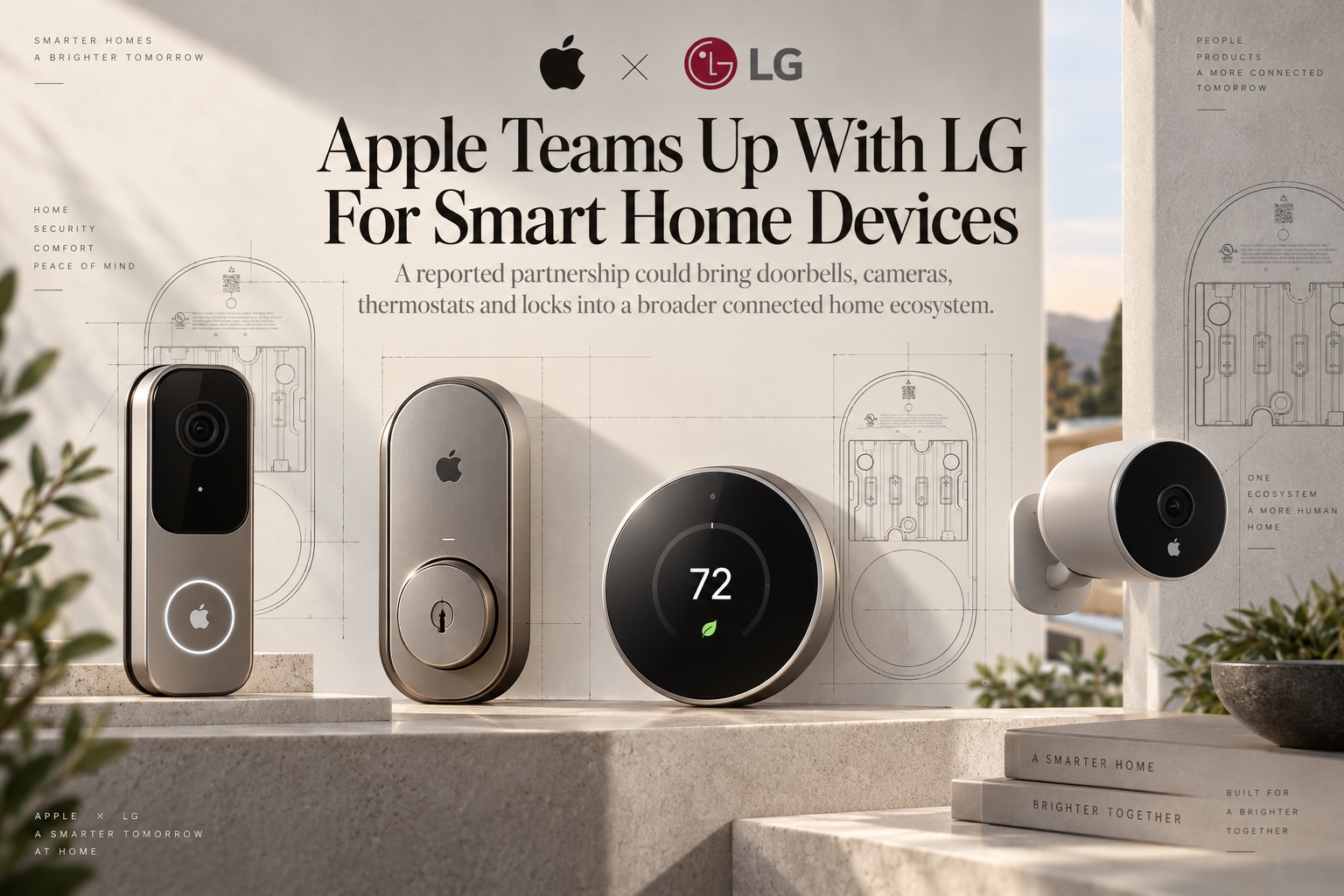
Apple's ambitions in the smart home market may extend far beyond the rumoured HomePad. New reports suggest the company is working with LG on a broader range of connected home products, including cameras, doorbells, thermostats and smart locks. Rather than manufacturing these devices entirely on its own, Apple is reportedly taking a partnership approach, with LG handling much of the production and support while Apple contributes to engineering, design and software integration.
The collaboration would place the HomePad at the centre of a much larger smart home ecosystem. While the HomePad itself is currently expected to be unveiled on 13 October, the other connected appliances are reportedly still several months away. If the partnership moves forward as described, Apple could significantly expand its presence in smart home hardware without having to manufacture every product under its own name.
HomePad Could Become The Centre Of The Ecosystem
The HomePad has long been rumoured as Apple's dedicated smart home hub, designed to control connected devices throughout the home. Its role as a central display and control interface suggested from the beginning that Apple was planning something larger than a standalone smart screen. The latest reports now offer a clearer picture of what that broader ecosystem could eventually include.
Instead of relying entirely on existing third-party HomeKit or Matter devices, Apple could help shape a family of products specifically designed to work closely with the HomePad. This would give the company greater control over the experience while still allowing manufacturing partners to handle much of the physical hardware. The result could be a more tightly integrated smart home platform without every product needing an Apple logo.
Doorbells, Cameras, Thermostats And Smart Locks Reportedly Planned
The reported partnership with LG covers a surprisingly wide range of smart home categories. These include a video doorbell, indoor and outdoor security cameras, a thermostat, a smart deadbolt lock and other connected devices. Together, these products would give Apple a much stronger presence in home security, environmental control and automation.
Such a lineup would also make the HomePad considerably more useful. A smart display becomes far more valuable when it can show doorbell video, control temperatures, monitor cameras and manage access to the home. Rather than simply serving as another screen, the HomePad could become the primary dashboard for an interconnected household.
LG Would Handle Manufacturing And Product Support
One of the more unusual aspects of the reported partnership is that the products are expected to carry LG branding rather than Apple's. LG would reportedly be responsible for manufacturing the devices and supporting customers after purchase. Apple, meanwhile, would remain closely involved in engineering, product design and feature development.
This approach is not entirely new for Apple. The company has previously worked with brands such as Belkin and Logitech on accessories and connected products that complement its ecosystem. The difference here is the scale, as a coordinated family of smart home devices would represent a much deeper partnership than a single accessory.
Apple Would Still Shape The Experience
Even if LG's name appears on the hardware, Apple would reportedly maintain significant influence over how the products are designed and how they function. That could include everything from industrial design decisions to software behaviour and integration with the HomePad. Apple would therefore be able to maintain a consistent ecosystem experience without directly handling manufacturing.
This model could also reduce some of the risks involved in entering entirely new hardware categories. LG already has extensive experience producing home electronics and connected appliances, while Apple can focus on user experience, software and interoperability. For Apple, that could be a faster route into the smart home market than developing every device from scratch.
Thread And Matter Will Play An Important Role
Many of the reported devices are expected to support Thread and Matter, two technologies that have become increasingly important for modern smart home systems. Matter provides a common standard designed to improve compatibility between products from different manufacturers, while Thread offers a low-power mesh networking system well suited to connected home devices.
Apple, Google, Amazon and other major technology companies have all embraced Matter, making it an increasingly important foundation for cross-platform smart home compatibility. Supporting these standards would allow the reported LG devices to work more broadly while still offering deeper integration with Apple's own ecosystem. Wi-Fi and Bluetooth are also expected to be used where appropriate.
UWB Could Add More Precise Location Features
Ultra-wideband, or UWB, is another technology reportedly under consideration for selected products. UWB can provide much more precise device-to-device location awareness than conventional Bluetooth. Apple already uses the technology in products such as AirTag and recent iPhones, so expanding it into smart home devices would fit naturally with its existing hardware strategy.
In a smart home environment, UWB could potentially improve proximity-based interactions between the user, the HomePad and connected devices. Not every product would necessarily need it, but devices involving access control or room-level awareness could benefit from more precise positioning. The exact applications remain unclear for now.
LG Has Already Sought FCC Approval For Several Devices
LG has reportedly submitted regulatory filings with the U.S. Federal Communications Commission covering several of the products. These include devices listed as the LG Video Doorbell, Wired, Floodlight Cam, Outdoor Cam Plug-In, Indoor Cam Plug-In, Smart Deadbolt Lock, Smart Thermostat and Temperature Sensor. The filings reportedly include diagrams showing some of the hardware configurations.
However, the available documentation is limited. LG has apparently requested that more detailed materials remain confidential until early next year, suggesting the products are still some distance from release. None of the current regulatory filings explicitly mention Apple's involvement, so the connection between these devices and the reported partnership remains based on insider information rather than official confirmation.
The Products May Arrive Months After HomePad
Even if the HomePad is unveiled on 13 October as rumoured, the rest of the smart home lineup is not expected to launch immediately. The connected appliances reportedly remain several months away from commercial availability. Apple may therefore introduce the HomePad first before gradually expanding the ecosystem with partner-developed accessories.
This staged approach could make sense strategically. Apple could establish the HomePad as the central interface first, then add compatible security and home-control products over time. It would also give LG more time to complete regulatory approvals, manufacturing preparation and product support arrangements.
A Different Approach To Apple's Smart Home Expansion
Apple has traditionally preferred controlling both hardware and software directly, but the smart home market is broad enough that partnerships may be more practical. Doorbells, locks, thermostats and cameras each require different manufacturing expertise, support infrastructure and regional certification. Working with LG could allow Apple to move into these categories more quickly without building entirely new hardware divisions for each one.
At the same time, Apple could still maintain a high level of control over the overall experience. If the products are engineered around Apple's ecosystem from the beginning, users could get tighter integration without Apple itself needing to become the manufacturer of every device. That could become an important model for the company's future home strategy.
Final Thoughts
The reported Apple and LG partnership suggests that Apple's smart home plans may be far more ambitious than simply launching the HomePad. A lineup containing cameras, a video doorbell, smart locks, thermostats and sensors would give the company a much stronger foundation for building a complete connected home ecosystem around its upcoming hub.
For now, though, much of the information remains unofficial. The HomePad is expected to be unveiled first, while the broader LG-made device lineup may not appear for several more months. If the reports prove accurate, Apple could soon be taking a much more aggressive approach to the smart home market, using partnerships to expand faster while keeping the overall experience closely tied to its own ecosystem.











Comments 0