

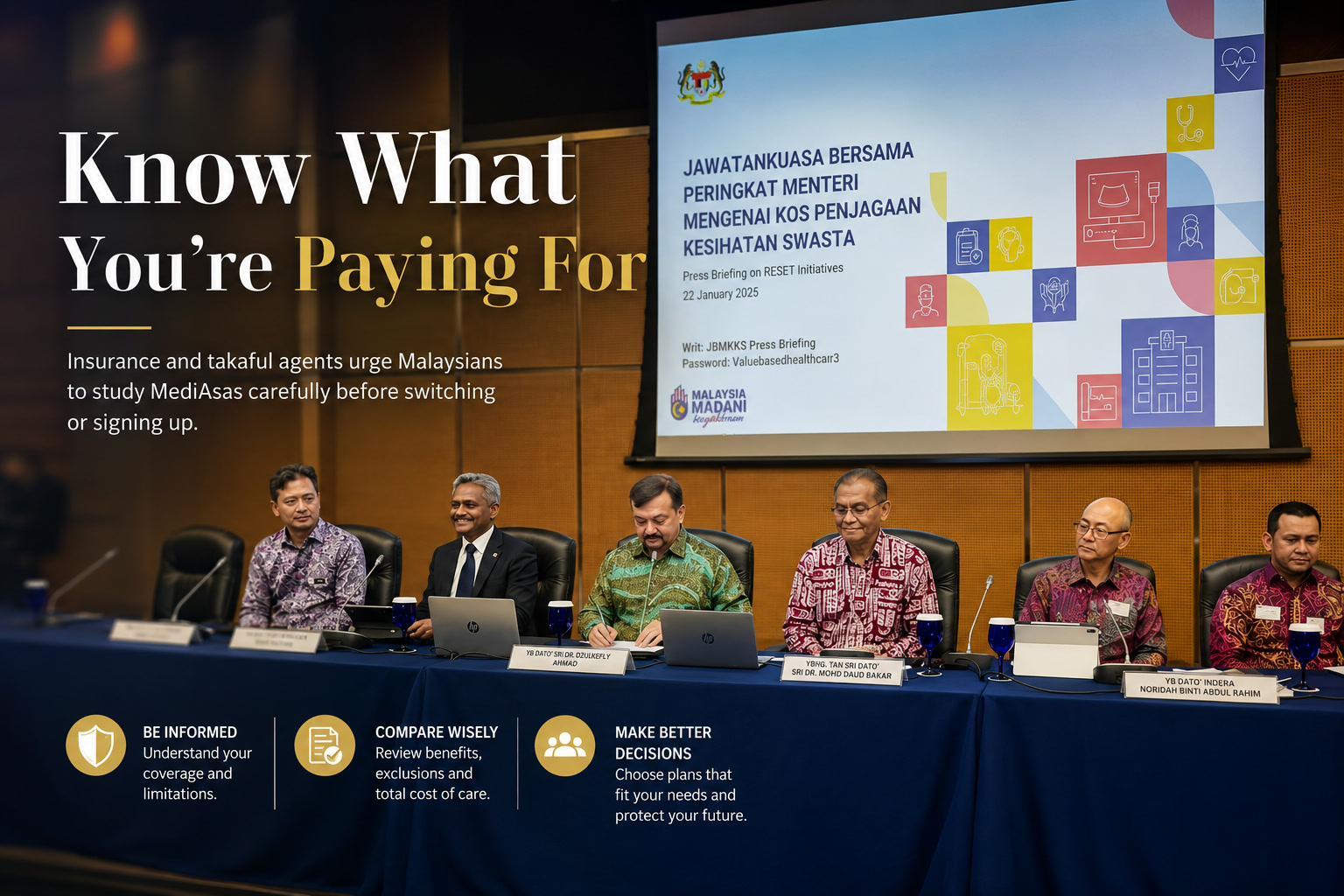
Malaysia's upcoming MediAsas medical and health insurance/takaful plan is being promoted as a more affordable option for private medical coverage, but insurance and takaful agents are urging consumers not to make decisions based on price alone.
Following Bank Negara Malaysia's publication of its pilot MediAsas FAQ, agents have highlighted several areas that consumers should understand carefully before purchasing the plan or cancelling an existing medical card.
These include exclusions for pre-existing conditions, the seven-year "no look-back" provision, annual coverage limits, deductibles, co-payments, hospital network restrictions and the possibility of future premium increases.
The common advice is simple: understand the coverage, compare it with what you already have, and only then decide whether MediAsas is suitable for you.
Affordable Does Not Automatically Mean Better
MediAsas is expected to cost roughly RM60 to RM550 per month, depending on the plan, age and other factors.
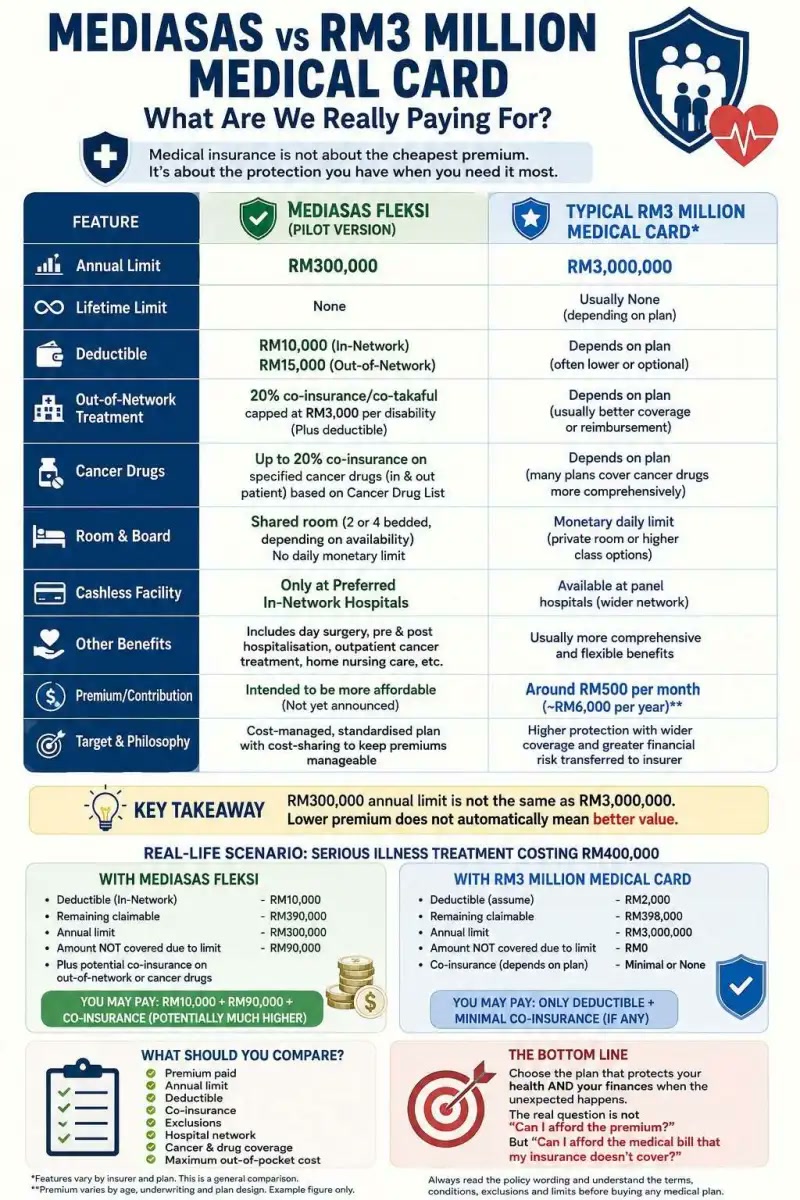
Its standard MediAsas Teras option provides an annual limit of RM100,000 for policyholders aged 59 and below, rising to RM150,000 for those aged 60 and above. MediAsas Fleksi increases the annual limit to RM300,000.
Those figures may look attractive, especially to people who currently have no private medical insurance.
However, several agents cautioned that lower premiums often come with greater cost-sharing or narrower benefits.
MediAsas Fleksi, for example, includes annual deductibles of RM10,000 for treatment at preferred in-network providers and RM15,000 for out-of-network providers.
That means policyholders may still need to pay a significant amount themselves before insurance coverage begins.
As one agent put it, consumers should not select MediAsas simply because the monthly contribution looks inexpensive.
Think Carefully Before Cancelling an Existing Medical Card
One of the strongest warnings from agents is directed at people who already have medical insurance.
Consumers are being advised not to surrender an existing comprehensive policy simply because MediAsas appears cheaper.
An older medical card may offer higher annual limits, lower deductibles, fewer cost-sharing requirements or broader hospital access. Cancelling such a policy could also create problems if the person later tries to obtain new coverage after developing a medical condition.
The better approach is to compare the two products side by side.
Look at the annual limit, deductible, co-payment requirements, exclusions, room and board entitlement, hospital network, waiting periods and renewal conditions.
A lower premium only represents better value if the protection still matches your needs.

Pre-Existing Conditions Remain an Important Limitation
MediAsas is a fully underwritten product, meaning insurance and takaful operators can assess an applicant's medical history before deciding whether to offer coverage.
BNM's pilot FAQ lists a number of major exclusions, including pre-existing illnesses, congenital conditions and certain mental health conditions.
Applicants who disclose an existing medical condition may also be asked to undergo further medical assessment.
This is especially important for older Malaysians or people already living with chronic illnesses.
Someone considering MediAsas should therefore understand exactly what conditions are covered, excluded or subject to additional underwriting before terminating an existing policy.
The Seven-Year 'No Look-Back' Rule Has Raised Questions
Another feature receiving considerable attention is MediAsas' seven-year no-look-back period.
After seven continuous years from the policy's risk commencement date, claims generally cannot be disputed purely because of non-disclosure or misrepresentation, although exceptions remain for fraudulent, deliberate or reckless behaviour and certain predefined medical conditions.
Some insurance and takaful agents have compared this with the commonly understood two-year contestability period associated with other medical policies.
That difference has surprised some consumers.
The issue is particularly important because seven years is a long time to maintain a policy while remaining potentially exposed to questions surrounding earlier medical information.
Anyone considering MediAsas should therefore understand how the provision actually works rather than assuming it functions like the waiting periods found in conventional medical cards.
Premiums Are Not Guaranteed to Stay at Today's Level
Another reason not to judge MediAsas purely by its launch price is that premiums or takaful contributions are not guaranteed to remain unchanged.
According to the information highlighted by agents, pricing can increase as policyholders get older and may also be repriced because of rising medical costs, claims experience or regulatory requirements.
That means a plan that looks significantly cheaper today may not remain equally affordable over the long term.
Consumers should therefore consider whether they could still comfortably afford the plan after future increases.
The same principle applies to existing medical insurance, but it becomes especially relevant when people are considering switching products primarily to save money.
RM300,000 Can Disappear Quickly During a Serious Illness
Several commentators have also questioned whether MediAsas' annual coverage limits are sufficient for severe medical events.
RM300,000 may appear generous under normal circumstances.
However, treatment for cancer, major heart surgery, stroke, organ failure, lengthy intensive-care admissions or multiple operations can potentially result in very large hospital bills.
The real purpose of medical insurance is not simply to cover ordinary years.
It is to provide protection during the extraordinary year when something goes seriously wrong.
That is why comparing only monthly premiums can be misleading.
A more useful question is how much financial protection the plan provides against a RM500,000 or even RM1 million medical event.
For retirees and older Malaysians in particular, sufficient medical coverage may be important for protecting savings accumulated over decades.
Understand, Compare, Decide
The advice coming from agents broadly mirrors BNM's own guidance for purchasing medical and health insurance or takaful.
Consumers should assess their needs, browse the available options and choose the plan that best fits their situation.
Before signing up, important questions include:
The product disclosure sheet should also be reviewed carefully before committing.
MediAsas May Still Have a Useful Role
Not all feedback from insurance professionals has been negative.
Some agents see MediAsas as a positive attempt to provide Malaysians with a more affordable entry point into private medical coverage.
For someone who currently has no medical insurance, the product may provide meaningful basic protection that would otherwise be unavailable.
But affordable does not mean comprehensive.
Deductibles, co-payments, network restrictions and exclusions mean policyholders may still bear a significant portion of certain medical bills themselves.
That makes MediAsas potentially suitable for some consumers, but not automatically the best replacement for every existing medical card.
Final Thoughts
MediAsas could become an important option for Malaysians seeking more affordable medical coverage when it launches publicly in January 2027.
However, the strongest message from insurance and takaful professionals is that consumers should avoid making decisions based solely on the monthly premium.
A cheaper medical plan can still expose someone to higher deductibles, lower annual limits, narrower hospital networks and greater out-of-pocket expenses.
Likewise, an expensive policy is not automatically better simply because it costs more.
The right question is not "Which plan is cheapest?"
It is "Which plan gives me the level of protection I actually need at a cost I can sustainably afford?"
For anyone considering switching from an existing medical card to MediAsas, the safest approach remains the same: understand, compare and decide carefully before cancelling anything.











Comments 0