

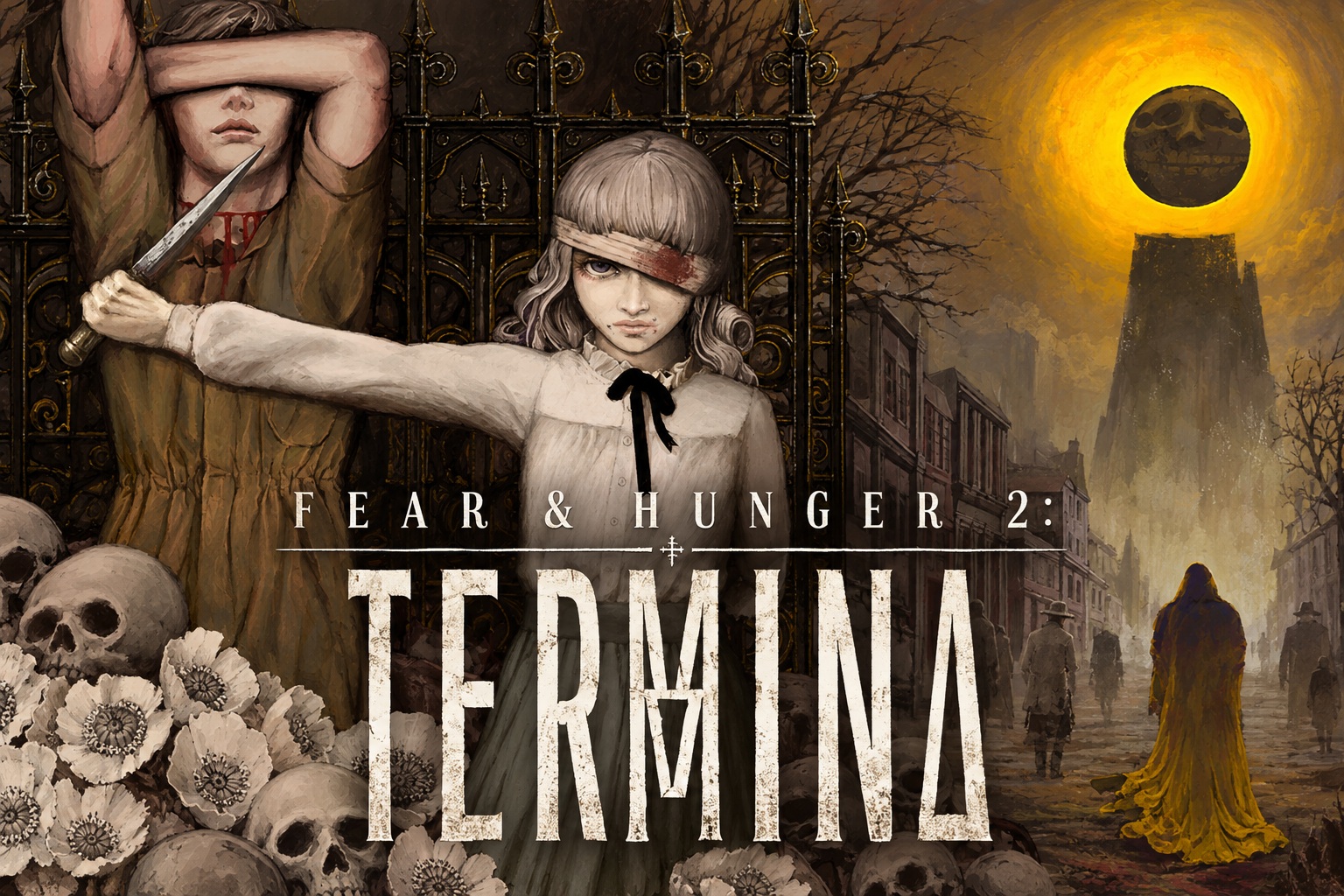
Fear & Hunger 2: Termina takes the merciless survival philosophy of the original Fear & Hunger and places it inside a much larger, more open world where time itself becomes another resource. Set in 1942, the story begins when fourteen strangers arrive by train near the isolated town of Prehevil and discover that leaving is no longer an option. A sickly green moon hangs above the town, strange dreams introduce a mysterious figure named Per'kele, and the passengers gradually learn that they have become unwilling contestants in the Festival of Termina. They have only three days before the festival reaches its conclusion, and the rules appear horrifyingly simple: eventually, only one contestant is supposed to remain.
The sequel retains the original game's turn-based limb-targeting combat, Hunger and Mind management, brutal injuries, limited resources, occult magic, and willingness to permanently punish bad decisions, but dramatically expands almost everything surrounding those systems. Prehevil contains streets, apartments, churches, tunnels, forests, shops, military facilities, abandoned houses, underground passages, and numerous locations that can be approached in different orders. Contestants follow their own schedules as Morning becomes Evening and Evening becomes Night, meaning people can move, disappear, die, become recruitable, or transform depending on when the player reaches them. Instead of one dungeon waiting patiently to be explored, Termina creates a world that continues changing while the player decides what matters most.
Now playable online through Lemon Web Games, Fear & Hunger 2: Termina brings its three-day survival structure, eight playable protagonists, fourteen contestants, limb-based combat, firearms, crafting, occult progression, moonscorching, multiple endings, and deeply unsettling exploration directly into the web browser. Players must decide when to sleep, which contestants to trust, which battles are worth the resources, and how much of Prehevil can realistically be explored before time runs out. Knowledge remains more important than conventional grinding, but Termina provides far more tools for shaping a successful run than its predecessor. For players who appreciated the oppressive world of Fear & Hunger but wanted broader exploration, stronger character variety, and even more complicated strategic choices, Termina is an extraordinary evolution of the concept.
Prehevil Replaces the Dungeon With an Entire Doomed Town
The biggest immediate difference from the first Fear & Hunger is scale. Instead of spending most of the journey inside one enormous dungeon, players explore Prehevil and the surrounding countryside. Streets connect residential areas, churches, shops, ruins, forests, tunnels, and military infrastructure, while underground routes create additional ways to move through the city.
The town feels abandoned without ever feeling empty. Bodies, barricades, hostile residents, supernatural creatures, military remnants, and evidence of recent violence suggest that something catastrophic has already happened before the contestants arrive. Surviving citizens can be even more disturbing than monsters because it is often unclear whether they remain completely human.
Prehevil gradually becomes something players learn in the same way they learned the dungeon in the first game. Shortcuts, dangerous streets, safe buildings, ritual circles, useful shops, recruitable characters, and hidden routes eventually form a mental map. Knowledge of the city becomes one of the player's most valuable resources.
Fourteen Contestants Enter the Festival
The Festival of Termina revolves around fourteen individuals who arrive in Prehevil with separate backgrounds, motivations, and reasons for travelling there. Eight can be selected as the protagonist: Levi, Marina, Daan, Abella, O'saa, Olivia, Marcoh, and Karin. The remaining contestants—Henryk, Tanaka, Samarie, Pav, Caligura, and August—continue pursuing their own agendas throughout the three days.
These characters do not simply wait in fixed locations until the player decides to speak with them. Their situations change according to time and earlier events. Someone who could have become a valuable companion during Day 1 may be missing, injured, dead, or transformed by Day 2.
This makes the contestants feel unusually important. They are potential allies, sources of skills, story characters, rivals, and ultimately participants in a festival that seemingly expects them to kill one another. Every interaction carries possibilities that may not become obvious until another playthrough.
Eight Playable Characters Create Very Different Runs
The eight selectable protagonists represent one of Termina's greatest improvements in replayability. Each arrives with a distinct profession, soul type, background, skills, and relationship with the larger conflict. Choosing another character can change which problems are easy, which resources matter most, and how certain events are understood.
Levi is a former soldier whose familiarity with firearms fits naturally into Termina's expanded weapon system. Marina is an occultist with deep connections to Prehevil and strong access to supernatural knowledge. Daan is a doctor whose understanding of anatomy can make injuries and enemy weaknesses much easier to manage.
Abella brings mechanical expertise and practical engineering skills, while O'saa is a Yellow Mage whose occult abilities and connection to Nas'hrah offer another magical perspective. Olivia's botanical knowledge gives plants and medicinal resources additional value, Marcoh's boxing background makes his bare-handed combat unusually powerful, and Karin approaches events as a journalist accustomed to investigating conflict. Each protagonist encourages a different style without completely locking the player into one strategy.
Levi Shows the Scars of War
Levi enters the festival as a former child soldier whose life has already been shaped by violence before the horrors of Prehevil begin. His background provides practical familiarity with firearms, making him a natural choice for players interested in Termina's expanded gunplay. Yet his past also introduces vulnerabilities that distinguish him sharply from an uncomplicated action hero.
The game repeatedly connects personal trauma to mechanics and dialogue rather than treating backstories as decoration. Levi may know how to survive armed conflict, but Prehevil is not simply another battlefield. Supernatural threats and psychological pressure create problems that military experience cannot solve.
His story reflects one of Termina's recurring themes: almost every contestant arrives already carrying damage from the outside world. The festival does not create all their suffering. It exploits what was already there.
Marina Connects Directly to Prehevil's Occult History
Marina is particularly important because Prehevil is not simply another unfamiliar destination for her. Her history is tied to the town and its religious institutions, giving numerous locations and characters additional significance. Players interested in the occult side of Fear & Hunger's world will find her especially compelling.
Her skills support ritual and supernatural progression, making the game's expanded divine systems easier to explore. Engravings, sigils, affinities, and other occult mechanics can become central parts of a Marina playthrough. Knowledge again becomes a weapon.
Her personal story also demonstrates how much more character-focused Termina can be compared with the original. Exploring Prehevil is not only about understanding the festival. It can also mean confronting a protagonist's past.
Daan Turns Anatomy Into a Survival Tool
Daan's medical background is extremely practical in a game filled with mutilation, infection, poison, broken bones, and strange creatures. His knowledge can reveal information about defeated enemies and help the player understand what makes them vulnerable. Medical skills also create additional options for treating dangerous conditions.
This makes Daan especially suitable for players who enjoy analyzing Fear & Hunger's combat rather than simply maximizing damage. An enemy that initially seems impossible may have an anatomical weakness that changes the entire encounter. Diagnosis transforms experimentation into knowledge.
His personal mystery is equally important. Daan arrives carrying unresolved questions about his own past and gradually becomes connected to some of Termina's strangest supernatural elements. His story can become considerably darker depending on how the festival develops.
Abella Brings Engineering Into the Survival System
Abella's mechanical expertise introduces practical solutions rarely available in the original game. She understands machinery, electrical systems, traps, and crafted weapons, making her extremely useful both as a protagonist and companion. In a city filled with locked infrastructure and improvised technology, those skills create meaningful alternatives.
Crafting can allow ordinary materials to become dangerous weapons or useful traps. Instead of relying only on whatever equipment happens to be found, the player can deliberately construct additional tools. Preparation becomes more flexible.
Abella also demonstrates how Termina blends twentieth-century technology with supernatural horror. Guns, generators, electrical systems, military tunnels, and machinery exist beside rituals, gods, and impossible creatures. Neither side feels completely separate from the other.
O'saa Brings Powerful Occult Knowledge
O'saa arrives as a Yellow Mage whose understanding of magic makes him one of the more unusual contestants. His connection to Nas'hrah also provides a direct link to figures and ideas established in the original Fear & Hunger. Returning players can immediately recognize that Termina exists in the same larger world even though the story stands independently.
Magic can be extraordinarily powerful, but Mind remains an important resource. Strong spells therefore need to be weighed against the cost of using them repeatedly. The old Fear & Hunger tension between power and survival remains intact.
O'saa is particularly valuable for players interested in divine affinities and supernatural combat. His journey reveals how much the religious landscape has changed since the era of the first game. Old powers remain influential even when their presence has become less direct.
Olivia Makes Plants and Preparation More Important
Olivia is a botanist whose knowledge allows ordinary-looking vegetation to become much more meaningful. Herbs and plants that other characters might simply collect can become components of stronger survival strategies. Her expertise creates another route through the game's resource systems.
She also uses a wheelchair, which fundamentally distinguishes her movement and certain interactions from the rest of the cast. Rather than treating every protagonist as mechanically identical outside combat, Termina allows personal circumstances to influence how exploration feels.
Olivia's connection to the larger events surrounding Prehevil becomes increasingly significant later in the story. Like several contestants, she has reasons for being there that extend far beyond coincidence. Her personal journey can intersect directly with one of the game's largest mysteries.
Marcoh Turns His Body Into a Weapon
Marcoh's boxing background makes him especially unusual because fighting without a conventional weapon can remain genuinely effective. His fists are not simply a desperate fallback after better equipment disappears. With the right development, bare-handed combat can become one of his greatest strengths.
His skill tree supports defensive movement, counterattacks, improved guarding, speed, and increasingly powerful physical techniques. This gives players a protagonist capable of approaching battles almost like a tactical fighter rather than an ordinary RPG warrior.
Marcoh's presence also reinforces Termina's twentieth-century atmosphere. He feels more like a character from a crime drama or boxing story who has accidentally wandered into cosmic horror. That contrast makes the festival feel even stranger.
Karin Investigates Instead of Simply Surviving
Karin enters Prehevil as a journalist shaped by reporting on war and political conflict. She naturally treats the strange situation as something to investigate, giving her dialogue a skeptical and analytical quality. Her worldview provides an interesting contrast to characters already comfortable with occult explanations.
Practical skills can support exploration and gathering information, while her background makes many of the game's military and political elements especially relevant. Prehevil has experienced more than supernatural catastrophe. Human armies and political ambition have also played major roles.
Karin helps connect Termina's horror to its historical setting. The game is not only about gods manipulating individuals. Nations, wars, propaganda, and human institutions remain equally capable of producing horror.
Three Days Create Constant Pressure
Termina takes place across three days, each divided into Morning, Evening, and Night. Time does not simply pass continuously while walking around. Major progression occurs when the player sleeps, which advances the period and changes the state of the world. This gives players some control over the clock while making every rest meaningful.
Sleeping can restore or enable important functions, but moving time forward changes contestant schedules and events. A character available during Day 1 Morning may be somewhere completely different by Evening. Waiting too long can permanently close certain recruitment opportunities or story routes.
This means the player is constantly deciding whether the benefits of rest justify what might change afterward. Saving progress can be psychologically expensive because time itself is valuable. Termina makes the calendar another survival resource.
Moonscorching Creates a Deadline Worse Than Death
The pale green moon over Prehevil is not merely atmospheric. Prolonged exposure to the Festival of Termina can cause participants to undergo moonscorching, transforming them into grotesque manifestations connected to their personalities, trauma, and inner selves. The results are some of the game's most memorable creature designs.
Contestants who are not recruited or protected can eventually moonscorch at specific points in the timeline. By the final stages of the festival, even previously familiar characters may become hostile creatures. The player is effectively watching the cast disappear as time advances.
Moonscorching gives the three-day structure emotional weight. Delaying is not simply losing access to a shop or quest. It can mean losing a person entirely. The festival gradually consumes everyone.
Per'kele Explains the Rules but Not the Truth
Per'kele appears through dreams and presents himself as a guide to the Festival of Termina. His smiling, theatrical personality contrasts sharply with the violence surrounding the contestants. He explains that only one participant is expected to remain when the festival ends, effectively framing the situation as a supernatural battle royale.
Yet Fear & Hunger rarely allows an apparently knowledgeable character to provide the complete truth. Per'kele understands far more than he initially reveals, and the forces behind Termina are more complicated than simply obeying the Moon God. The player's understanding changes dramatically across different ending routes.
This uncertainty makes his dream appearances increasingly suspicious. He seems helpful because he provides structure, but accepting his explanation without question can limit how the player understands the festival. Termina constantly rewards skepticism.
Rher's Moon Watches Everything
The Trickster Moon God Rher is closely associated with the Festival of Termina and the moonscorching afflicting both contestants and residents of Prehevil. The enormous moon dominating the sky gives the entire game a visible supernatural presence. Players are never allowed to forget that something ancient is watching.
Rher's influence also appears through sigils, servants, dreams, and transformed creatures. Yet the nature of the festival becomes more complicated as players discover how divine traces can continue influencing the world even when the gods themselves are distant or absent.
This continues one of the strongest ideas from the original game: humanity exists beneath forces far greater than itself, but those forces are not necessarily guiding civilization with benevolent purpose. Divine attention can be as dangerous as divine abandonment.
Combat Retains the Limb-Targeting System
Termina preserves one of the original game's defining mechanics by allowing players to target individual enemy limbs. Arms can be destroyed to eliminate attacks, legs can be removed to destabilize opponents, and heads may become easier targets after balance is lost. Combat is still about understanding anatomy rather than simply reducing one shared health bar.
Enemy designs have become even more varied, making knowledge especially important. Some threats wield firearms or melee weapons, while others rely on supernatural organs or strange appendages. Destroying the wrong part first can leave the most dangerous attack untouched.
This system continues to reward experience rather than grinding. A player who understands the enemy can often win efficiently with modest equipment. Someone attacking randomly may suffer permanent injuries despite having stronger weapons.
Guarding Is More Important Than It Looks
Guarding reduces incoming damage and can protect characters from many dangerous coin-flip attacks when timed correctly. New players frequently underestimate it because spending a turn without attacking feels passive. In Fear & Hunger, however, survival often matters more than dealing damage immediately.
Enemies frequently telegraph devastating attacks through dialogue, animation, or changes in stance. Recognizing that signal and guarding at the correct moment can prevent catastrophic consequences. Knowledge converts an apparently random danger into something controllable.
This mechanic reinforces the idea that Termina is not unfair in exactly the way it first appears. The game can be cruel, but many situations have solutions hidden behind observation and experience. The challenge is discovering them before the consequences arrive.
Firearms Change Both Exploration and Battle
Guns play a much larger role in Termina than in the first game, fitting its 1942 setting. Pistols, rifles, shotguns, and other firearms can provide powerful options during turn-based combat. Ammunition scarcity prevents them from becoming effortless solutions.
More importantly, certain firearms can also be used directly in the overworld. Shooting an approaching enemy before conventional combat begins can damage or disable parts of the target, potentially making the subsequent battle much safer. This adds a new tactical layer to exploration.
Ammunition therefore becomes another resource that must be evaluated carefully. Spending several bullets now may prevent limb loss and healing costs, but those rounds will not be available for a more dangerous enemy later. Firearms increase power without removing scarcity.
Overworld Combat Gives Players More Control
Termina expands how players interact with hostile enemies before the turn-based battle screen appears. Guns, traps, movement, doors, and environmental positioning can sometimes change the conditions of an encounter. This makes exploration more active than simply touching an enemy and entering combat.
Abella's trap-related skills are especially useful here. Bear traps or other crafted devices can disable targets before the player commits to a fight. Certain enemies can be avoided entirely through careful movement.
The result feels more flexible than the first game. Direct combat remains dangerous, but players have more ways to prepare. Termina gives the survivor a larger toolbox while making the world larger and more unpredictable.
Hunger Still Controls the Pace
Every party member needs food, and Hunger gradually becomes a serious problem if ignored. Larger parties consume more supplies, meaning recruiting everyone possible can create logistical difficulties. A strong four-person combat group may become difficult to feed across three long days.
Food quality also matters because some meals provide far greater benefits than basic ingredients. Cooking-related skills can turn supplies into more efficient resources. Characters such as Henryk can become particularly valuable because food knowledge directly supports survival.
The mechanic prevents unlimited exploration. Even without the festival deadline, the party cannot wander forever without replenishing supplies. Termina continues making ordinary human needs part of the horror.
Mind Remains Essential for Both Sanity and Magic
Mind gradually deteriorates under stress and supernatural pressure, just as it did in the original. Low Mind can create serious problems, while many spells consume additional Mind directly. Magical characters therefore need a steady supply of restorative items if they plan to cast aggressively.
Alcohol, tobacco, and other consumables can become surprisingly valuable because psychological stability matters as much as physical health. An item that would be considered minor in another RPG may determine whether a powerful spell remains available during the next battle.
Managing Mind also reinforces the setting. Prehevil is not merely dangerous because enemies can damage the body. Existing inside the city for too long can damage the characters psychologically. Survival remains multidimensional.
Contestant Souls Make Character Death Mechanically Important
One of Termina's darkest progression systems involves the souls of the contestants. Each participant possesses a unique soul associated with their personal skill tree. If the player kills a contestant and collects their soul, those abilities can become accessible through the Hexen with Soul Stones.
This creates a deliberate moral tension. Other contestants may be potential friends or valuable party members, yet killing them provides mechanical progression and also advances the festival's apparent objective. The game makes cooperation and personal advancement compete directly.
Not every run needs to become a massacre. Alternative routes allow players to pursue other objectives, and several endings interpret the festival differently. But simply knowing that another character's death could unlock useful skills changes how every encounter feels.
The Hexen Is More Flexible Than Before
The Hexen returns as the central skill-development system but has been expanded considerably. Contestant abilities, god-affinity skills, and other progression branches allow characters to create highly specialized builds. Soul Stones remain essential for unlocking many of these abilities.
Skills can improve combat, crafting, movement, healing, magic, resource efficiency, or exploration. This makes development much broader than simple increases to attack and defense. A single new ability can change how the player approaches an entire section of Prehevil.
Because contestant skills are tied to particular souls, party composition and progression become deeply connected. Deciding who remains alive can affect what the protagonist can eventually learn. Character relationships and mechanics overlap continuously.
God Affinity Has Become More Structured
Ritual circles located throughout Prehevil allow players to interact with divine sigils and increase affinity with specific gods. Skin Bibles and other knowledge help reveal which symbols belong to which divine forces. Choosing how to use these circles becomes another long-term strategic decision.
Affinity can unlock supernatural abilities through the Hexen, making ritual knowledge practically useful. Different gods support different types of magic or utility. Players can deliberately shape a build around particular divine relationships.
However, ritual circles are limited resources. Using one for a specific god means it cannot necessarily be repurposed later. Termina repeatedly turns permanent choices into part of exploration.
Crafting Provides More Ways to Prepare
Termina introduces a stronger crafting system, allowing useful materials to become healing items, traps, weapons, ammunition-related tools, food, and other resources depending on learned recipes and skills. This gives junk items more potential value. Something that initially looks useless may become essential later.
Crafting also makes character knowledge more meaningful. Abella's engineering skills, Olivia's botanical understanding, and Henryk's cooking expertise all change what can be produced from available resources. Party members effectively expand the player's survival toolkit.
The larger world makes this especially useful. Prehevil contains enough materials and routes that preparation can become a deliberate play style. Players can enter dangerous locations with plans rather than relying entirely on lucky loot.
Recruiting Contestants Can Create Powerful Parties
Several contestants can become party members if the player reaches them at the correct time and satisfies their recruitment conditions. A full party can dramatically increase combat capability because each member adds another action per turn. Different skills can also complement one another.
The cost is resource consumption. Everyone requires food, Mind maintenance, healing, and equipment. Keeping four people alive across multiple days can be harder logistically than surviving alone.
Party slots also create strategic decisions because only a limited number of characters can travel together simultaneously. Some companions can be left at safe locations and retrieved later. Managing people becomes another layer of preparation.
Unrecruited Contestants Continue Living Their Own Lives
One of Termina's greatest strengths is that characters continue acting even when the player ignores them. Tanaka may travel into dangerous areas, Henryk may pursue his own objectives, Samarie follows motivations connected to Marina, and Pav becomes involved in events surrounding military forces. The player is only one participant in a larger timeline.
This creates the feeling that Prehevil exists independently. Arriving somewhere late can reveal the aftermath of an event the player never witnessed. A character who seemed important during the morning may be gone by night.
Repeated playthroughs therefore reveal scenes that are impossible to see during one run. Following a different route through the city changes which stories unfold in front of the player. Time becomes narrative branching.
Moonscorched Contestants Reflect Their Inner Selves
When contestants succumb to moonscorching, their transformed forms are not random monsters. Their designs often reflect personality, trauma, obsession, identity, or suppressed fears. This makes the transformations both grotesque and psychologically revealing.
Encountering a moonscorched character can therefore provide information about who they were before changing. A transformation may communicate something that ordinary dialogue only hinted at. Horror becomes characterization.
These encounters are especially disturbing when the player previously travelled with or spoke to the person. The monster has a history. Termina turns familiar characters into some of its most unsettling enemies.
The City Contains More Than Festival Participants
Prehevil is filled with hostile residents, transformed townspeople, supernatural beings, soldiers, occult figures, and creatures unrelated to the fourteen contestants. The festival has affected the entire area, and many inhabitants seem to have undergone their own versions of transformation. Exploration constantly introduces another threat.
Enemies such as Needles demonstrate that not everything dangerous is passively waiting in one location. Some threats actively pursue or interfere with the contestants. The player can never assume that clearing one street permanently makes it safe.
This gives Termina a more dynamic horror atmosphere than the original dungeon. Danger exists across an entire urban environment. Familiar roads can change character depending on the time and events occurring nearby.
Needles Is One of the Most Memorable Pursuers
Needles quickly became one of Termina's recognizable enemies because his appearance and behavior communicate danger immediately. He is not simply another random monster standing in a corridor. His presence can become a recurring threat depending on the player's route.
Fighting him carelessly can be disastrous because his attacks and status effects create serious problems. Avoidance, preparation, firearms, or stronger party setups may be safer than rushing directly into combat. Once again, knowledge determines whether the encounter feels impossible.
Needles represents Termina's broader design philosophy well. The game gives players more combat tools than Fear & Hunger 1, then creates enemies dangerous enough that those tools genuinely matter.
The Second Great War Shapes the World
Termina takes place after a major international conflict known as the Second Great War, and its aftermath is visible throughout Prehevil. Military equipment, damaged infrastructure, soldiers, political tension, and references to the Bremen forces make human warfare part of the horror. The supernatural catastrophe does not exist in isolation.
Characters such as Levi, Karin, Pav, and August interact with this historical context differently. Some experienced the war directly, while others investigated or fought against the political forces surrounding it. Their backgrounds make the setting feel larger than the festival.
The war also creates a bridge between ordinary human ambition and supernatural power. Political leaders are not separate from occult forces. Termina repeatedly shows how the two can become intertwined.
Kaiser Connects Termina to the First Game's History
Players familiar with the original Fear & Hunger will eventually recognize deeper connections between the events of Termina and figures from the earlier era. The mysterious Kaiser leading Bremen forces is central to this continuity. His ambitions have developed across centuries, changing form while retaining the desire to reshape humanity.
These connections are rewarding without making knowledge of the first game mandatory. New players can understand Termina as a standalone story, while returning players recognize historical echoes that completely change how certain characters are interpreted.
The sequel therefore expands the original rather than simply repeating it. Events beneath the Dungeons of Fear & Hunger have consequences far beyond their own period. History continues moving.
Project Logic Becomes Central to the Deeper Mystery
Beneath the apparent battle royale lies another major storyline involving technological and occult experimentation within Prehevil. Exploring tunnels, military facilities, and hidden infrastructure gradually reveals that powerful forces have gathered around something much larger than the Festival of Termina. The contestants have arrived during an extraordinary historical moment.
This mystery connects characters, military activity, divine influence, and the future of humanity. Players following certain routes may ultimately discover that surviving the festival is not necessarily the most important objective available. There are ways to challenge the framework itself.
This gives Termina several layers of narrative progression. First the player wants to survive Prehevil, then understand the festival, and finally understand what else is happening beneath it. Every answer creates another question.
Different Endings Interpret the Festival in Different Ways
Fear & Hunger 2: Termina contains several major endings that reflect very different responses to the situation. One path involves events surrounding Project Logic, while others engage more directly with the rules of the festival and Per'kele's intentions. The game does not insist that becoming the last contestant alive is automatically the best outcome.
These endings can require extremely different behavior throughout the run. Preserving contestants may matter enormously for one route, while another can involve embracing the festival's apparent purpose. Exploration and timing determine which possibilities remain available.
This makes replaying worthwhile even after successfully completing the game. One ending may answer questions that another barely addresses. Understanding Termina fully requires approaching Prehevil from several directions.
Saving and Sleeping Carry Real Consequences
Sleeping allows the player to save and access important progression through the dream-based Hexen, but it also advances the time period. This creates one of the game's most distinctive decisions. Preserving progress may cause several events elsewhere in Prehevil to move forward.
Books of Enlightenment and certain other opportunities can provide alternative ways of securing progress without necessarily advancing the clock, making them particularly valuable. Players gradually learn which save options should be reserved for dangerous sections.
This system prevents constant save-scumming without completely removing player control. Saving remains available, but it exists inside the larger survival economy. Time is the price.
Termina Is More Forgiving Than the First Game Without Becoming Easy
Compared with Fear & Hunger 1, Termina gives players more tools, more recruitable characters, stronger firearms, broader crafting, more predictable progression, and additional ways to solve certain problems. This can make the sequel feel more approachable. However, describing it as easy would be extremely misleading.
Enemies can still destroy limbs, infections remain dangerous, Hunger and Mind require attention, ammunition is limited, time-sensitive events can be missed, and moonscorching can permanently remove important characters. The difference is that Termina provides more ways to respond. Preparation has greater depth.
This creates a slightly different form of difficulty. Fear & Hunger often feels like surviving with almost nothing, while Termina feels like learning how to use a complicated toolbox efficiently before the world changes around you. Both remain brutal.
Knowledge Is Still the Real Progression System
There is no conventional level-grinding solution capable of making every problem disappear. Skills help, equipment matters, and larger parties provide enormous advantages, but player knowledge remains the most important form of progression. Understanding Prehevil's routes, enemy weaknesses, contestant schedules, ritual circles, and item uses can completely transform a run.
A first-time player may spend most of Day 1 simply trying to enter the city safely. Someone experienced can use the same period to recruit specific contestants, gather key equipment, activate useful sigils, and position themselves for an ending route. Nothing about the starting character needs to change for this improvement to happen.
This is why failure rarely feels completely wasted once the game's design becomes understandable. A dead run still teaches something about the timeline. The next attempt begins with that knowledge.
The Art Style Makes Prehevil Beautiful and Horrifying at Once
Termina retains the grim visual identity of Fear & Hunger while expanding into more varied environments. Dirty streets, abandoned apartments, forests, churches, tunnels, industrial infrastructure, bars, shops, and military areas all receive a distinct atmosphere. Some scenes can even appear strangely peaceful before the player notices what has happened there.
Character portraits and enemy designs remain especially strong. Contestants look grounded enough to feel like people from the 1940s, while moonscorched transformations distort those recognizable features into something deeply unnatural. Familiarity makes the horror stronger.
The contrast between ordinary urban architecture and cosmic corruption gives Termina a visual identity completely different from the medieval dungeon of the first game. The horror has moved forward in history without becoming less ancient.
Music and Silence Make Exploration Uncomfortable
Termina uses atmospheric music, distorted industrial sounds, unsettling ambient tracks, and long sections of uncomfortable quiet to keep players uncertain. Prehevil rarely sounds like a safe town waiting to be restored. Even apparently empty streets can feel hostile.
Certain locations introduce much more aggressive musical identities, giving encounters and supernatural areas their own character. The soundtrack shifts between melancholy, tension, and outright noise in ways that complement the strange mixture of historical and occult horror.
Silence remains equally important. Walking through an abandoned building while hearing almost nothing can create more tension than constant battle music. The game understands when not to reassure the player.
Mature Themes Remain Central to the Experience
Fear & Hunger 2: Termina contains explicit violence, gore, dismemberment, drug and alcohol use, nudity, sexual content, self-harm themes, suicide, mental illness, war trauma, abuse, and other deeply disturbing material. It is intentionally designed for mature audiences comfortable with extremely bleak subject matter. The sequel remains uncompromising even when its presentation becomes more modern.
These themes are often directly connected to characters and their transformations. Trauma is not simply added as background decoration. The festival and moonscorching frequently expose what characters have been suppressing.
Players should therefore approach Termina knowing that its horror can become psychological and thematic as well as visually graphic. The experience deliberately crosses boundaries that many RPGs avoid. That intensity is part of its identity.
Why Fear & Hunger 2: Termina Stands Apart From the Original
Termina does not attempt to replace Fear & Hunger by simply making a larger dungeon. It changes the structure completely. The first game is primarily about descending through one hostile location, while Termina is about navigating a living timeline across an entire town. Time and character schedules become just as important as physical exploration.
The sequel also gives relationships much greater weight. Fourteen contestants make Prehevil feel populated by people with individual goals, and their ability to move, die, join the party, or moonscorch means the cast itself becomes part of the level design. Every passing period changes the available possibilities.
Yet the fundamental Fear & Hunger philosophy remains untouched. Resources are scarce, violence has permanent consequences, gods are dangerous, and knowledge is stronger than conventional heroism. Termina expands the formula without making it safe.
Playing Fear & Hunger 2: Termina Online Today
Through Lemon Web Games, Fear & Hunger 2: Termina can now be played directly in your web browser with no downloads or setup required. Features of the web-based version include:
New players should avoid trying to experience everything during one run. The three-day structure makes that unrealistic, and advancing time inevitably changes opportunities elsewhere in the city. Choose a few immediate goals, explore carefully, and remember which contestants appeared at particular times. Information about the schedule becomes just as valuable as combat knowledge.
Combat should also remain selective. Guns and larger parties make Termina more capable of supporting direct confrontation than the first game, but every fight can still consume resources or cause permanent injuries. Target dangerous limbs, guard against telegraphed attacks, and use traps or overworld weapons when doing so can make an encounter safer. Surviving efficiently matters more than defeating everything.
Who Should Play Fear & Hunger 2: Termina
Termina is particularly suitable for players who enjoy games that continue moving without them. The player cannot witness every contestant event, save everyone, explore every route, and uncover every mystery in one ordinary run. Choosing where to spend time necessarily means allowing something else to happen elsewhere. This makes repeated playthroughs feel meaningfully different.
It is also an excellent choice for players who enjoy mastering hostile systems rather than overpowering them through statistics. Prehevil becomes less frightening as the player's understanding improves, but it never becomes completely harmless. The game rewards preparation without removing uncertainty. Every successful run feels built from knowledge earned during previous failures.
Play Fear & Hunger 2: Termina Online Now
Fear & Hunger 2: Termina takes the brutal survival mechanics of the original and places them inside a three-day festival where fourteen contestants, an entire corrupted town, military forces, ancient gods, supernatural transformations, and hidden technological ambitions collide. Players choose one of eight protagonists and enter Prehevil with almost no understanding of the situation, then gradually learn how contestant schedules, ritual circles, firearms, crafting, divine affinities, moonscorching, and the Festival of Termina itself interact. Every period of the day can change what is possible.
Through Lemon Web Games, players can experience Termina directly in a modern browser and approach Prehevil at their own pace—within the limits imposed by the pale green moon. Recruit allies, preserve food and Mind, collect ammunition, target enemy limbs, explore underground tunnels, uncover occult history, and decide whether the festival's rules should be followed at all. The sequel provides more freedom and more tools than the first Fear & Hunger, but it uses that freedom to create even more complicated decisions.
Final Thoughts
Fear & Hunger 2: Termina succeeds because it understands exactly what made the first game memorable while refusing to repeat it mechanically. Limb-based combat, Hunger, Mind, permanent injuries, occult progression, scarce resources, and hostile uncertainty all return, but they now exist inside a moving three-day timeline populated by fourteen characters with their own agendas. The result feels less like exploring a dungeon and more like surviving a supernatural disaster that continues unfolding whether the player is ready or not.
The contestants give the sequel much of its emotional power. Levi, Marina, Daan, Abella, O'saa, Olivia, Marcoh, Karin, Henryk, Tanaka, Samarie, Pav, Caligura, and August are not simply pieces on a battle-royale board. Their histories, relationships, skills, traumas, and potential moonscorched forms make every death or missed encounter meaningful. Some can become trusted companions, while others may become enemies before the player even learns what they wanted.
Through Lemon Web Games, Fear & Hunger 2: Termina can be experienced directly in the browser as one of the most unusual survival-horror RPGs available. Its larger world, firearms, crafting systems, expanded Hexen, divine affinities, changing timeline, and multiple ending routes give players far more freedom than its predecessor while preserving the same philosophy that knowledge must be earned through suffering. For players willing to accept its brutal difficulty and deeply mature themes, Termina offers a remarkably layered journey where surviving three days is only the beginning of understanding what is actually happening in Prehevil.











Comments 0