

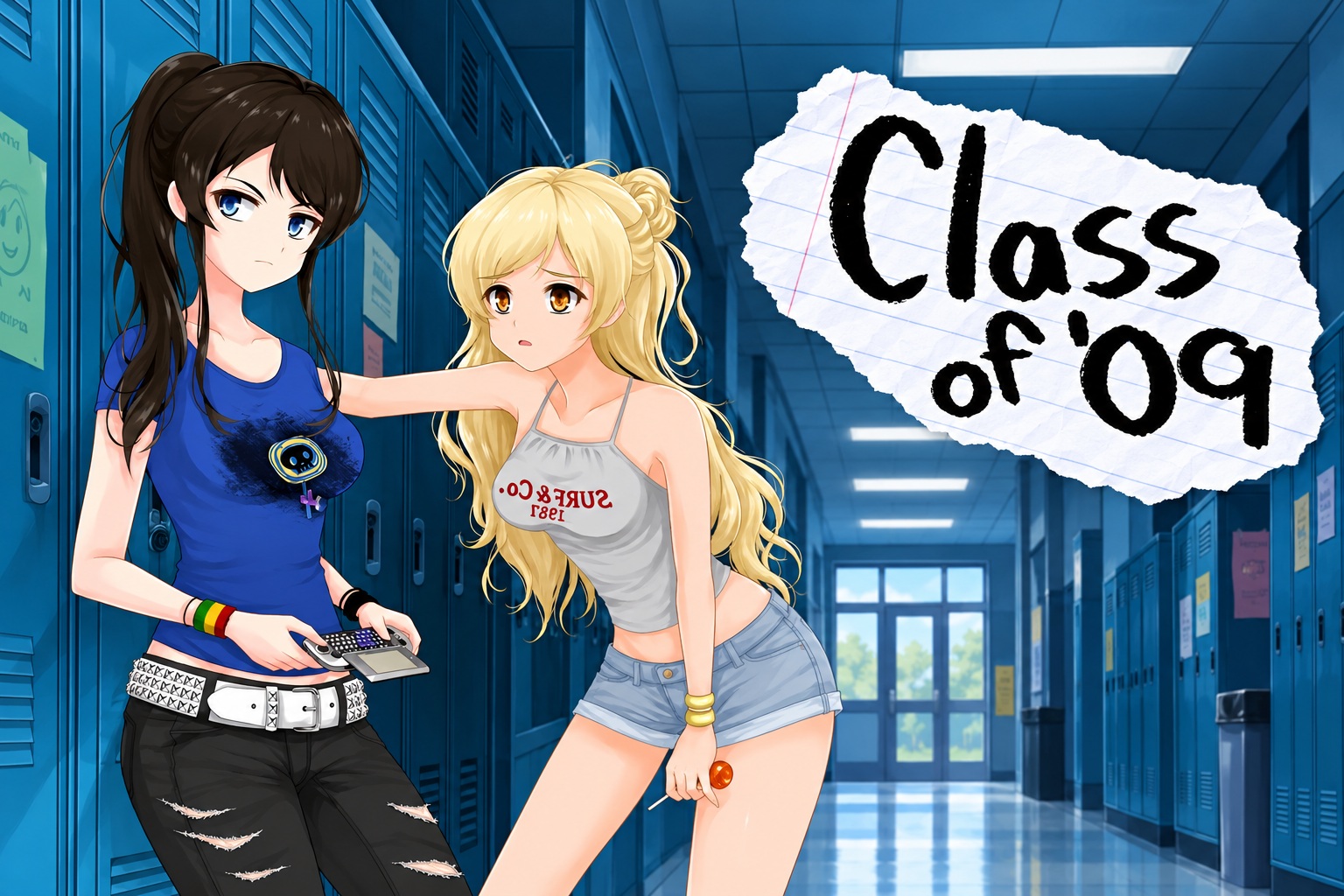
Class of '09 takes the familiar visual novel formula and deliberately turns it inside out. Instead of controlling an ordinary male protagonist surrounded by attractive girls waiting to become romantic interests, players step into the role of Nicole, a cynical, sharp-tongued teenager navigating an American high school between 2007 and 2009. Nicole has very little interest in pleasing the people around her, and the player's choices often involve deciding how aggressively she should manipulate, insult, exploit, avoid, or retaliate against the dysfunctional classmates and adults she encounters. The result is a visual novel where social chaos replaces romantic wish fulfillment.
Released in 2021 by SBN3, Class of '09 describes itself as an anti-visual novel, and that label fits the experience surprisingly well. Dialogue moves quickly, scenes are fully voiced, and the story automatically progresses more like an animated sitcom than a traditional visual novel that expects players to click through every individual line. Choices appear at important crossroads and can send Nicole toward dramatically different storylines involving friendships, school conflicts, toxic relationships, crime, substance abuse, harassment, violence, and other mature subjects. With 15 different endings to discover, one playthrough only reveals a fraction of the game's deliberately uncomfortable version of high school life.
Now playable online through Lemon Web Games, Class of '09 brings Nicole's darkly comedic high-school experience, fully voiced conversations, branching decisions, late-2000s atmosphere, and 15 possible endings directly into the web browser. Players can experiment with different responses, deliberately create social disasters, spend more time with characters such as Jecka, or replay familiar situations while choosing completely different ways for Nicole to react. There is rarely an obvious morally perfect option, and even apparently sensible choices can produce unexpected consequences. That unpredictability makes repeated playthroughs a major part of understanding both Nicole and the deeply dysfunctional environment surrounding her.
An Anti-Visual Novel Built Around Reversing Expectations
Traditional visual novels often place the player in the position of trying to impress characters, build relationships, and select dialogue options that move toward a desirable romantic ending. Class of '09 deliberately rejects much of that structure. Nicole is already aware that people want things from her, and she frequently uses that awareness as a defensive or manipulative tool.
This changes the meaning of player choice. Instead of asking which answer will make someone like Nicole more, the game often asks which response will create the most interesting outcome or protect her from another terrible situation. Sometimes the funniest option is clearly destructive, while the apparently responsible choice can still lead somewhere uncomfortable.
The result feels closer to choosing scenes in a dark interactive sitcom than following a conventional dating simulator. Class of '09 wants players to explore consequences rather than search for one ideal relationship path.
Nicole Is Not Designed to Be a Typical Likeable Protagonist
Nicole is sarcastic, emotionally detached, observant, manipulative, and frequently cruel. She is capable of saying things that would make a more conventional protagonist immediately unlikeable, yet the game rarely asks the player to view her behavior without context. Much of her personality is shaped by distrust and by repeatedly encountering people whose intentions are selfish, inappropriate, or simply absurd.
Her attitude gives the story its distinctive voice. Nicole does not approach high school with optimism about finding friendship, romance, or personal growth. She often treats every interaction as something to survive, exploit, or mock. That perspective allows the game to satirize situations that a traditional coming-of-age story might present much more sentimentally.
Players are not always expected to agree with her. Part of the experience comes from seeing how far Nicole will take a situation when given the opportunity. She can be both extremely funny and deeply self-destructive.
Jecka Provides an Important Contrast
Jecka is Nicole's closest recurring friend and one of the most important characters in the game. She shares enough of Nicole's cynical worldview to understand her, but she often reacts differently when Nicole begins pushing a situation toward complete disaster. Their conversations provide some of the game's funniest and most revealing moments.
The friendship works because neither character behaves like a conventional supportive visual novel companion. They can argue, criticize one another, cooperate, or simply react to the absurdity happening around them. Their chemistry feels more like two teenagers trying to navigate a hostile social environment than characters positioned to deliver inspirational speeches.
Jecka also helps show that Nicole's behavior is not universally normal even within the game's exaggerated world. When Jecka becomes concerned about one of Nicole's decisions, it often signals just how extreme the situation has become.
The Late-2000s Setting Is More Than Decoration
Class of '09 is specifically rooted in the period from 2007 to 2009, and its humor depends heavily on that setting. Fashion, technology, internet culture, music references, school attitudes, social behavior, and the general atmosphere are designed around the final years before smartphones and social media completely reshaped teenage life. The game feels intentionally trapped in that particular moment.
The setting also allows jokes and situations that would unfold differently in a modern school. Communication is less immediate, reputations spread through different channels, and internet culture still carries the strange transitional energy of the late 2000s. Characters behave according to that environment rather than simply wearing retro clothing.
For players who remember the era, the result can feel uncomfortably familiar. Class of '09 exaggerates reality heavily for comedy, but many of its social observations are recognizable enough to make the satire sharper.
Fully Voiced Dialogue Gives the Comedy Its Timing
Almost every major interaction is carried by voice acting, which is essential to the game's style. Nicole's sarcasm depends on delivery as much as wording, while other characters often become funnier because of how sincerely they say something ridiculous. The performances make scenes feel closer to an animated comedy than a static visual novel.
Automatic dialogue progression reinforces that feeling. Players can watch scenes unfold naturally until a decision appears, reducing the need to manually advance every line. The pacing becomes much closer to television.
This also makes replaying routes easier. Familiar dialogue moves quickly, while new branches can immediately take the scene somewhere unexpected. The presentation keeps momentum high.
Choices Can Completely Redirect the Story
Class of '09 may appear simple mechanically, but its branching structure gives choices substantial narrative consequences. An early decision about who Nicole spends time with or how she reacts to a particular person can send the story toward a completely different scenario. Later choices then divide those routes further.
This encourages experimentation rather than cautious play. There is little reason to worry about making one permanently perfect save because another playthrough can explore the alternative almost immediately. The game is designed to be replayed.
Some choices also reveal completely different sides of recurring characters. Someone who appears briefly in one route can become central in another. The school feels more complicated as additional branches are uncovered.
Fifteen Endings Give the Story Significant Replay Value
The original Class of '09 contains 15 endings, each representing a different way Nicole's choices can reshape her life and relationships. Some outcomes are relatively grounded, while others become much darker or more absurd. There is no single conventional happy ending that clearly invalidates everything else.
This makes ending collection part of the experience. Players gradually learn which choices lead toward particular storylines and can intentionally explore combinations they previously ignored. The ending screen becomes less about winning and more about discovering another possibility.
Completing all of them also reveals how flexible the narrative structure really is. Nicole can move through the same school environment while experiencing radically different outcomes depending on what the player encourages her to do.
Dark Comedy Is the Core of the Experience
Class of '09 tackles serious topics, but it does so through an extremely dark comedic lens. Characters regularly say inappropriate, selfish, or wildly misguided things with complete confidence. The humor often comes from how quickly an ordinary school conversation can turn into something completely unreasonable.
This approach will not appeal to everyone. The game intentionally explores uncomfortable subjects including harassment, substance abuse, violence, crime, self-harm, toxic relationships, and abusive behavior. Its humor is deliberately abrasive and often depends on characters behaving badly.
The important distinction is that the game rarely presents its world as healthy or aspirational. Much of the comedy comes from exposing how dysfunctional everyone is. Class of '09 is satire built around social failure.
High School Is Presented as a Social Battlefield
The school is not portrayed as a nostalgic place where everyone eventually learns valuable lessons. Nicole encounters classmates looking for attention, approval, relationships, status, or opportunities to exploit someone else. Teachers and authority figures can be just as dysfunctional.
This perspective makes social navigation more important than academic success. Classes are often simply locations where another conflict begins. Nicole is rarely worried about becoming the perfect student.
The school therefore operates almost like an RPG town filled with unpredictable NPCs, except the currency is social leverage rather than gold. Understanding what people want can become more useful than trusting what they say.
Manipulation Functions Almost Like a Gameplay Mechanic
Nicole's ability to read people and exploit their motivations becomes one of her most powerful tools. She can recognize insecurity, attraction, desperation, or social pressure and deliberately use those weaknesses. Choices frequently allow the player to decide whether she should take advantage of that information.
This can produce genuinely funny outcomes, but it can also create disturbing situations. Nicole's intelligence does not automatically make her decisions wise. Sometimes she uses social awareness simply because she can.
The game continually asks how much power someone should exercise when they know exactly which emotional button to press. Nicole's answer is often much less restrained than most people's.
There Is Rarely a Perfect Moral Choice
Many choice-driven games clearly separate good decisions from bad ones. Class of '09 frequently avoids that structure. Nicole may be choosing between two unpleasant situations rather than between kindness and cruelty. Even a reasonable decision can create unexpected consequences because the surrounding characters are unpredictable.
This makes decisions more entertaining. Players cannot simply follow a universal "be nice" strategy and expect the best outcome. Context matters.
It also fits Nicole's worldview. She rarely believes that behaving correctly guarantees anything good in return. Whether that belief is justified becomes one of the more interesting questions behind the comedy.
The Game Is Fast Compared With Traditional Visual Novels
Class of '09 does not demand dozens of hours before meaningful branching begins. Individual routes move quickly, dialogue is concise, and decisions appear regularly. Reaching an ending can happen relatively fast compared with much longer visual novels.
That pacing makes experimentation easier. Once an ending has been discovered, starting another run does not feel like committing to an enormous repeat of identical material. Players can move toward another branch quickly.
Shorter routes also complement the sitcom-like presentation. Stories feel more like episodes than enormous novels. The game can introduce one disastrous scenario, explore it intensely, and then move on.
Unlockable Lore Rewards Completion
Discovering endings contributes toward a larger completion structure, with additional lore and scenes becoming available as players explore more of the game. This gives ending collection another purpose beyond curiosity. The more routes completed, the more context becomes available.
The reward structure encourages players to explore choices they might normally avoid. A clearly terrible response may still be worth selecting simply because it leads toward content that has not been seen before.
This makes completion feel appropriate for the game's personality. Players are effectively encouraged to let Nicole make every possible mistake. Social disaster becomes collectible content.
The Visual Style Supports the Late-2000s Atmosphere
The characters use an anime-influenced visual novel presentation, but the setting and dialogue are unmistakably American. This contrast is intentional and supports the game's parody of visual novel conventions. Familiar character sprites exist inside a world that behaves nothing like a typical romantic anime story.
Characters also change outfits across different scenes, helping them feel less like static portraits permanently wearing one school uniform. Clothing contributes to the late-2000s atmosphere and makes different locations feel more natural.
The visual presentation remains relatively straightforward because dialogue is the real focus. Artwork supports personality without distracting from the writing.
Characters Are Deliberately Exaggerated
Many classmates and adults behave in ways that are intentionally extreme. Their personalities often revolve around insecurity, obsession, arrogance, ignorance, or social desperation. This exaggeration supports the comedy while allowing the game to explore recognizable social behaviors.
The danger is assuming every character exists only as a joke. Some routes reveal additional vulnerability or complexity underneath the exaggerated presentation. A ridiculous person in one storyline may become unexpectedly important in another.
This is another reason replaying matters. First impressions are rarely the complete picture. The branching structure lets the same cast behave differently depending on circumstance.
Nicole's Humor Often Functions as Defense
Nicole's constant sarcasm can be extremely funny, but it also works as a protective strategy. She assumes people are likely to disappoint, manipulate, or exploit her, so insulting them first provides emotional distance. The more uncomfortable a situation becomes, the sharper her responses can become.
This gives the character more depth than simply being mean for entertainment. Her behavior remains destructive, but the game provides enough context to understand why cynicism feels safer to her than vulnerability.
That does not excuse every action. The interesting part is the tension between understanding Nicole and agreeing with her. Players can recognize the logic behind her worldview while still seeing how badly it can affect her decisions.
Social Satire Is More Important Than Romance
Despite using the structure and visual language of a visual novel, Class of '09 is not primarily interested in building conventional romantic relationships. Attraction exists throughout the story, but it is usually treated as another source of manipulation, awkwardness, danger, or comedy.
This is where the "anti-visual novel" description becomes most meaningful. The game takes familiar scenarios where another title might build toward romance and asks what could go wrong instead. The answer is usually quite a lot.
Players interested specifically in a traditional romance simulator may therefore find the experience deliberately frustrating. Class of '09 is much more interested in dismantling those expectations.
The Game Is Intentionally Mature
Class of '09 contains references to sexual themes, substance abuse, criminal behavior, physical violence, harassment, self-harm, and other serious subjects. These topics are frequently handled through dark satire rather than realistic drama, but they remain central to several routes.
That makes the game inappropriate for players looking for a lighthearted school-life comedy. Even some of the funniest scenes can suddenly move into much darker territory. The tone is deliberately unstable.
Players comfortable with harsh satire may find that unpredictability to be one of the game's strengths. Class of '09 refuses to make its characters safe simply because the presentation initially looks colorful.
Why Class of '09 Became So Memorable
The game's strongest asset is its voice. Nicole sounds unlike the usual visual novel protagonist, and the surrounding cast rarely behaves according to genre expectations. Conversations move quickly and are filled with lines that are easy to remember because of their delivery and sheer unpredictability.
Its structure also works extremely well for watching or replaying. Routes are compact, decisions produce obvious changes, and fully voiced scenes make the experience accessible even to people who normally avoid visual novels. The game understands that dialogue is its main attraction.
Most importantly, it commits completely to its premise. Class of '09 does not occasionally parody visual novels while otherwise behaving like one. It builds the entire experience around rejecting the usual fantasy.
Playing Class of '09 Online Today
Through Lemon Web Games, Class of '09 can now be played directly in your web browser with no downloads or setup required. Features of the web-based version include:
New players should resist trying to identify the "correct" choice immediately. Class of '09 becomes much more entertaining when decisions are treated as experiments. Pick the response that sounds interesting, see how badly or unexpectedly the situation develops, and use another playthrough to explore the alternative.
Players pursuing all 15 endings should pay attention to early branching decisions because seemingly ordinary conversations can determine which storyline becomes available later. Once a route is familiar, automatic dialogue progression makes revisiting earlier scenes relatively quick. The game is designed around seeing many different versions of Nicole's school life rather than completing one perfect run.
Who Should Play Class of '09
Class of '09 is particularly suitable for players who normally find traditional visual novels too slow or overly focused on romance. The auto-progressing dialogue and sitcom-like pacing make scenes feel much faster, while decisions create substantial changes without requiring enormous reading sessions. The humor does most of the heavy lifting.
It should also appeal to players who enjoy flawed protagonists. Nicole is not designed to behave like an idealized version of the player, and some of her decisions can become genuinely unpleasant. The interest comes from understanding how she thinks and seeing what happens when different sides of that personality are encouraged.
Play Class of '09 Online Now
Class of '09 takes the familiar structure of a high-school visual novel and replaces romantic fantasy with dark comedy, manipulation, social conflict, and a protagonist who has almost no interest in behaving the way the genre expects. Players guide Nicole through late-2000s school life, choose how she responds to classmates and adults, and gradually discover how dramatically one decision can change the rest of the story. Fifteen endings ensure that no single playthrough reveals everything.
Through Lemon Web Games, players can experience Class of '09 directly in a modern browser and explore its fully voiced scenes, branching choices, late-2000s atmosphere, cynical humor, and chaotic cast without lengthy setup. Whether Nicole chooses to avoid a situation, manipulate it, or make it catastrophically worse is entirely up to the player. The fun comes from discovering just how far each choice can go.
Final Thoughts
Class of '09 stands out because it understands exactly which visual novel conventions it wants to attack. Instead of asking players to build perfect relationships, it presents a protagonist who distrusts almost everyone around her and frequently has good reasons for doing so. Choices become tools for survival, manipulation, retaliation, or simple entertainment rather than steps along a romance checklist. That reversal gives the game an identity that remains immediately recognizable.
Nicole and Jecka provide the emotional center, while the wider cast turns the school into a constant source of unpredictable comedy and discomfort. The fully voiced presentation gives every conversation strong timing, and the 15 endings provide enough branching to make replaying essential. Serious subjects are handled through deliberately dark satire, so the experience remains intentionally abrasive rather than universally comfortable.
Through Lemon Web Games, Class of '09 can be played directly in the browser as a fast, cynical, fully voiced anti-visual novel where high school becomes less about finding yourself and more about deciding how much chaos you are willing to create before graduation. For players who enjoy dark comedy, morally complicated choices, and stories that happily destroy conventional genre expectations, Class of '09 offers one of the most unusual takes on the visual novel format.











Comments 0