

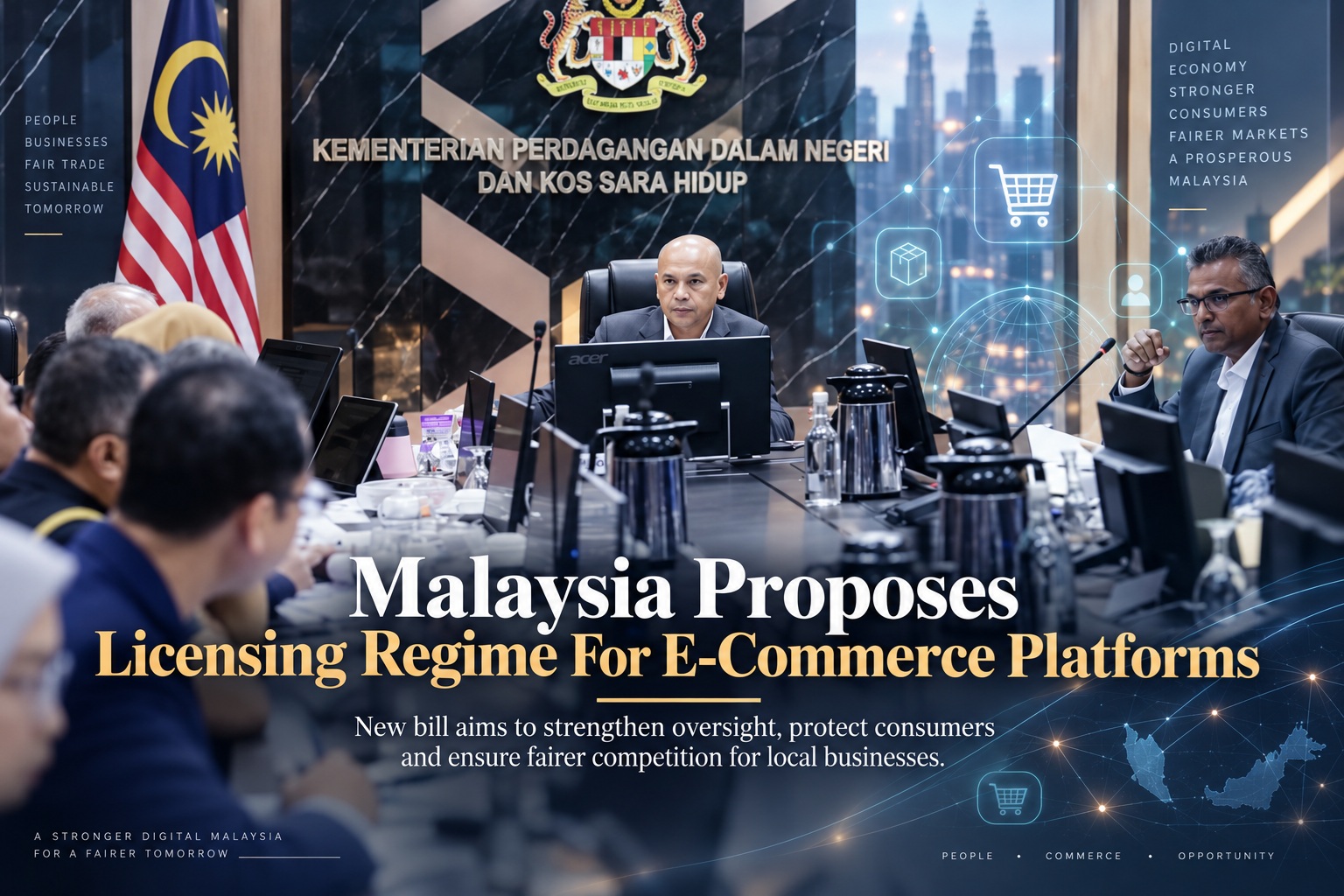
Malaysia is preparing to introduce a new licensing framework for e-commerce platforms operating in the country, including overseas platforms that offer services directly to Malaysian consumers. The proposal forms part of the upcoming E-Commerce Bill, which is intended to strengthen oversight of online marketplaces, improve consumer protection and create a fairer competitive environment for local businesses.
The initiative follows the government's announcement during the recent tabling of Budget 2027, where Prime Minister Datuk Seri Anwar Ibrahim confirmed that the E-Commerce Bill would be presented at the next parliamentary sitting. The legislation comes amid growing concerns from local micro, small and medium enterprises, or MSMEs, which have argued that foreign e-commerce operators can sometimes compete under different regulatory and compliance conditions.
Licensing Could Apply To Both Local And Overseas Platforms
Domestic Trade and Cost of Living Minister Datuk Armizan Mohd Ali said the government is considering licensing requirements for both Malaysian and foreign e-commerce platform operators. This means an overseas company could potentially be required to comply with Malaysian licensing rules if it provides marketplace services to consumers in the country.
The proposal reflects the increasingly borderless nature of online shopping. A platform does not necessarily need offices, warehouses or a significant physical presence in Malaysia to reach local buyers. That creates regulatory challenges because traditional business rules were often designed around companies operating physically within national borders.
A licensing framework could give regulators a clearer mechanism for determining which platforms are responsible for complying with Malaysian consumer and commercial laws.
Government Wants Greater Platform Accountability
One of the main objectives is to make online marketplace operators more accountable for what happens on their platforms. E-commerce companies typically act as intermediaries between buyers and thousands or even millions of third-party sellers, but questions often arise over how much responsibility the platform itself should carry when problems occur.
These issues can involve misleading product descriptions, unsafe goods, fraudulent sellers, prohibited items or difficulties obtaining refunds. The proposed legislation appears intended to provide clearer responsibilities rather than leaving consumers uncertain about whether they should pursue the individual seller, the platform or another party when something goes wrong.
Greater accountability could also encourage platforms to improve seller verification and internal monitoring.
Foreign Platforms Could Face Malaysian Compliance Requirements
The inclusion of overseas platforms is particularly significant. Cross-border e-commerce has made it extremely easy for foreign sellers to reach Malaysian consumers, often with very competitive prices and enormous product selections.
That benefits shoppers, but local businesses have raised concerns that overseas sellers may not always operate under the same regulatory, taxation and compliance requirements imposed on Malaysian companies.
The government has repeatedly said that its objective is not to prevent international competition. Instead, it wants to ensure that companies participating in Malaysia's digital marketplace are subject to an appropriate level of responsibility.
Licensing could become one way of creating that more consistent framework.
MSMEs Want A More Level Playing Field
Local MSMEs have become an important part of the discussion surrounding the new legislation. Smaller Malaysian businesses often need to comply with product standards, domestic regulations, taxes and various operational requirements before selling locally.
When competing products arrive through foreign marketplaces under different cost and compliance structures, local traders can find it difficult to compete purely on price.
This became particularly visible as international platforms introduced extremely inexpensive imported products into the Malaysian market. The government has therefore positioned the E-Commerce Bill partly as an effort to ensure local traders are not disadvantaged simply because they operate within Malaysia's regulatory system.
The Licensing Details Are Still Being Refined
The proposed licensing regime is not yet final. Armizan said the requirements will be refined together with relevant ministries and government agencies before implementation.
This is important because regulating online platforms involves several overlapping areas, including consumer affairs, communications, digital services, taxation, trade and potentially data protection.
The government will also need to consider how licensing requirements can be enforced against companies that are headquartered outside Malaysia. A rule may be straightforward to write, but enforcing it against a platform with limited physical presence in the country can be much more complicated.
The implementation details will therefore matter just as much as the legislation itself.
Consumer Protection Is One Of Four Major Areas
According to Armizan, the proposed E-Commerce Bill will concentrate on four broad areas.
• Consumer protection
• Responsibilities of marketplace operators, vendors and consumers
• Efficient dispute resolution mechanisms
• Alignment with international model laws
Together, these areas suggest the government wants the legislation to establish a more complete framework for online commerce rather than focusing only on platform licensing.
Consumer protection will likely be particularly important because buyers often face additional difficulties when dealing with sellers located overseas.
Platforms, Sellers And Consumers Could Receive Clearer Responsibilities
One challenge in online commerce is that responsibility can become fragmented. The seller may list the product, the marketplace handles the transaction, another provider processes payment and a logistics company delivers the item.
When something goes wrong, consumers may find themselves being redirected between several parties.
The new legislation aims to define the responsibilities of marketplace operators, sellers and consumers more clearly. This could help establish who is expected to act when products are unsafe, transactions are disputed or sellers behave fraudulently.
Clearer responsibility can also benefit legitimate businesses because everyone understands the rules before participating.
Dispute Resolution Could Become Easier
Efficient dispute resolution is another major focus of the proposed bill.
Online shopping disputes can involve damaged goods, products that do not match their descriptions, cancelled orders, missing deliveries or disagreements over refunds. Resolving these issues becomes even more difficult when the seller is located overseas.
A clearer dispute-resolution framework could give consumers a more predictable process when problems cannot be resolved directly through the marketplace.
For platforms, standardised procedures may also reduce uncertainty about how complaints should be handled.
Malaysia Wants Alignment With International Models
The government also plans to align the legislation with relevant international model laws.
This matters because e-commerce frequently crosses national borders. A platform operating in Malaysia may simultaneously serve consumers in dozens of other countries, each with its own regulations.
International alignment could help Malaysia introduce protections without creating rules that are completely disconnected from how global digital commerce operates elsewhere.
It may also make compliance easier for legitimate international platforms already operating under similar frameworks in other jurisdictions.
Current E-Commerce Platforms Are Not Licensed
Communications Minister Datuk Seri Fahmi Fadzil previously pointed out that e-commerce platforms are currently not subject to a dedicated licensing regime in Malaysia.
That regulatory gap has become increasingly noticeable as marketplaces grow larger and assume a more influential role in everyday commerce.
Consumers now purchase everything from household products and electronics to food, health products and financial-related services through online marketplaces. The scale of these platforms means decisions made by marketplace operators can directly affect millions of Malaysian consumers and businesses.
The government believes stronger oversight is therefore becoming necessary.
Prohibited Goods Have Raised Additional Concerns
The proposed legislation is also being developed against a backdrop of concern over prohibited products appearing on online marketplaces.
Government officials have previously raised issues involving illegal goods, including drugs, being offered through digital platforms.
The concern is not only whether a prohibited listing is eventually removed. Authorities want platforms to do more to prevent sellers from repeatedly returning under different accounts or finding new ways to advertise the same items.
This turns seller verification and platform monitoring into important parts of the broader regulatory discussion.
Removing Search Terms Alone May Not Be Enough
Fahmi previously argued that simply blocking certain keywords is not necessarily sufficient to stop prohibited products from appearing online.
Sellers can alter spellings, use coded language, create fake accounts or find other ways around basic filters. That means platforms may need more sophisticated monitoring and enforcement systems rather than relying solely on keyword-based restrictions.
A licensing regime could potentially give regulators greater leverage when requiring platforms to maintain appropriate safety and compliance measures.
Exactly what those measures will look like remains to be seen.
Fake Seller Accounts Are Another Challenge
Fake or disposable seller accounts can make enforcement particularly difficult.
If a marketplace removes one prohibited listing but the same operator can create another account immediately, the platform may end up repeatedly reacting to the same problem.
Stronger identity verification for sellers could potentially help reduce this behaviour, although regulators will need to balance enforcement with the need to keep marketplace participation accessible for legitimate small businesses.
This is another area where the final wording of the E-Commerce Bill will be important.
Licensing Could Change How Platforms Enter Malaysia
If the proposed framework is implemented, overseas platforms may eventually need to consider Malaysian regulatory requirements before offering services locally.
That could affect how new marketplaces enter the market and how existing operators structure their local activities.
Platforms may need to demonstrate that they have systems for consumer complaints, prohibited goods, seller verification and legal compliance before receiving or maintaining a licence.
For consumers, this could make it easier to distinguish platforms operating within an officially recognised framework from those operating outside it.
The Challenge Will Be Avoiding Excessive Regulation
While stronger consumer protection is generally positive, the government will also need to ensure that the framework does not create unnecessary barriers for legitimate businesses.
E-commerce has grown partly because it allows businesses of almost any size to reach customers without building expensive physical retail networks.
If compliance becomes too complicated or costly, smaller marketplace operators or local entrepreneurs could face unintended difficulties.
The most effective framework will therefore need to balance accountability with practicality.
Local Sellers Could Ultimately Benefit
If implemented effectively, a clearer regulatory environment could benefit Malaysian sellers as well as consumers.
Local businesses would gain greater confidence that foreign competitors operating in the same market face appropriate responsibilities. At the same time, stronger action against fraudulent or illegal sellers could improve trust in e-commerce overall.
Trust is particularly important for smaller online businesses. When consumers lose confidence in marketplaces because of scams or unsafe products, legitimate traders suffer alongside bad actors.
Better regulation could therefore strengthen the wider digital economy rather than simply restricting it.
Specific Licensing Requirements Have Yet To Be Announced
Several major questions remain unanswered.
The government has not yet specified:
• Which platforms would require licences
• Whether different rules would apply according to platform size
• How overseas operators would obtain licences
• What fees or compliance requirements would apply
• How violations would be penalised
• When the licensing system would actually begin
These details will determine how significant the impact of the new law will be.
Until the bill is formally tabled and the implementation framework is published, the licensing proposal should be viewed as a policy direction rather than a finalised regulatory system.
Final Thoughts
Malaysia's proposed E-Commerce Bill could represent one of the most significant changes to the country's online marketplace regulations in years. By considering licensing requirements for both domestic and overseas platforms, the government is signalling that companies serving Malaysian consumers may increasingly be expected to operate under clearer local responsibilities.
The broader legislation will also address consumer protection, the responsibilities of platforms and sellers, dispute resolution and alignment with international standards. At the same time, concerns involving prohibited goods, fake seller accounts and uneven competition between local MSMEs and foreign sellers are pushing regulators towards stronger oversight.
Much will depend on the final implementation. A well-designed framework could improve consumer confidence and create fairer competition without undermining the convenience and choice that make e-commerce attractive in the first place.











Comments 0