

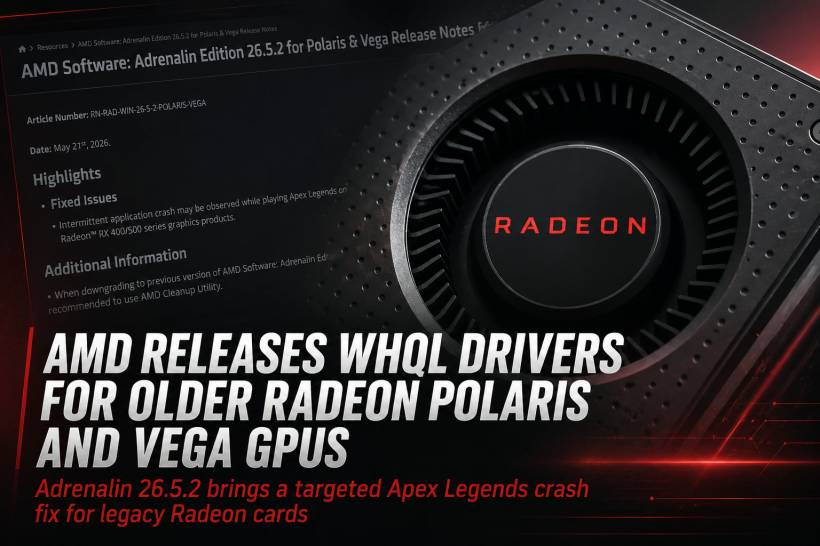
AMD has released a new WHQL-certified driver update for older Radeon graphics cards, giving long-time Polaris and Vega users a small but welcome maintenance update. For anyone still gaming on cards such as the Radeon RX 400, RX 500, RX Vega, Radeon VII, or similar older models, this update shows that AMD has not completely forgotten these GPUs, even though they are no longer part of the company's main driver focus.
The new driver comes under the Adrenalin Edition 26.5.2 package, but it is separate from the driver branch used by AMD's newer RDNA-based graphics cards. In other words, this is not a broad update meant for current Radeon RX 6000, RX 7000, or newer GPUs. It is specifically aimed at older graphics cards based on AMD's Graphics Core Next and Vega architectures.
For users still running these older cards, that distinction matters. It means AMD is maintaining a separate support path for legacy hardware, mainly to address specific problems rather than to deliver the usual modern driver improvements, new game optimisations, or performance enhancements.
Which Radeon GPUs Are Covered
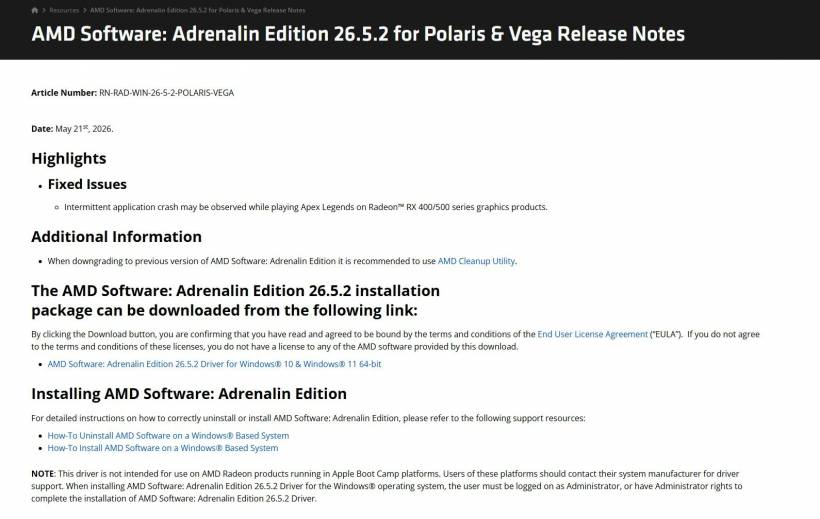
The update applies to several older Radeon GPU families, particularly those based on Polaris and Vega. This includes cards from the Radeon RX 400 series, RX 500 series, RX 500X series, RX Vega series, Radeon VII, and Radeon Pro Duo.
There is also a mention of the Radeon 600 Series, although this appears to refer mainly to notebook reference drivers. For laptop users, driver support can sometimes be more complicated because system vendors may apply their own customisations. That means certain features may depend on the laptop manufacturer rather than AMD alone.
For desktop users with older Radeon cards, however, this update is more straightforward. If the card falls within the supported Polaris or Vega family, the driver is intended to provide a targeted fix while keeping the hardware usable on modern Windows systems.
A Very Specific Fix For Apex Legends
This driver update is not a major performance release. AMD is not promising better frame rates, new game support, or broad stability improvements across many titles. Instead, the release appears to address one specific problem: intermittent application crashes while playing Apex Legends on older Polaris-based GPUs.
That makes this driver useful, but only for a very specific group of users. If you are still using a Radeon RX 400 or RX 500 series card and have experienced crashes in Apex Legends, this update may be worth installing. If you are not playing Apex Legends, or if your system has been running fine, there may not be much in this release that changes your daily gaming experience.
This is fairly normal for legacy GPU updates. Once a graphics architecture becomes older, driver updates usually shift from active optimisation to maintenance mode. The goal becomes fixing important bugs, security-related issues, compatibility problems, or major crashes, rather than pushing new performance gains.
Why Older GPUs Eventually Move Into Legacy Support
Graphics cards do not receive full driver attention forever. Over time, GPU makers such as AMD and NVIDIA gradually reduce support for older architectures as newer products become the priority.
This is not surprising because modern games, engines, APIs, and rendering techniques evolve quickly. Features like hardware ray tracing, advanced upscaling, AI-assisted frame generation, better video encoding, newer display standards, and lower-level API improvements are built with newer hardware in mind. Older GPUs can still run many games, but they no longer represent the direction where most development work is happening.
For AMD, Polaris and Vega have already served their time. They were important architectures in their own era, but the company has since moved through multiple generations of RDNA cards. That shift naturally changes where driver engineering resources are focused.
Polaris Still Has A Place In PC Gaming History
Polaris is especially interesting because it arrived at a time when the mid-range GPU market was very competitive. Introduced in 2016, Polaris was AMD's answer to a market that was also being shaped heavily by NVIDIA's Pascal architecture.
It was not exactly a direct one-to-one battle at every performance level, but Polaris gave PC gamers a practical and more affordable alternative. Cards such as the Radeon RX 470, RX 480, RX 570, and RX 580 became popular among budget and mid-range gamers because they offered decent performance without requiring flagship-level spending.
For many users, these cards were good enough for 1080p gaming for years. Some of them are still being used today in older gaming PCs, budget builds, secondary machines, and even esports-focused setups where the demands are not as extreme as modern AAA titles.
That long lifespan is one reason this driver update matters. Even if Polaris is no longer modern, many people still depend on it.
Vega Was A Different Kind Of Chapter
Vega, meanwhile, represented a more ambitious but complicated period for AMD's GPU lineup. Cards like the Radeon RX Vega 56 and Vega 64 targeted higher performance levels, while the Radeon VII later pushed the architecture further with a more premium positioning.
Vega had its strengths, especially in compute-heavy workloads and certain gaming scenarios, but it also arrived during a period when power efficiency and thermal performance were major talking points. Still, it remains an important part of AMD's graphics history and continues to have users who keep the hardware running.
For those users, driver updates like this are not about excitement. They are about keeping older systems stable, functional, and compatible for as long as reasonably possible.
Do Not Expect New Performance Gains
The important thing to understand is that this WHQL release should not be viewed as a comeback for Polaris or Vega. It does not suddenly make these older GPUs more competitive with modern cards, and it does not appear to include optimisations for current games.
Anyone hoping for major performance improvements will likely be disappointed. The purpose of this driver is maintenance, not reinvention. It fixes a specific crash issue and keeps the driver package officially certified, but it does not change the hardware limitations of these older cards.
That said, for legacy GPU owners, even small updates can be useful. Stability matters. If a driver prevents crashes in a game someone still plays regularly, that is a meaningful improvement for that user.
Final Thoughts
AMD's Adrenalin Edition 26.5.2 WHQL driver for older Polaris and Vega GPUs is not a flashy release, but it is still a useful one. It shows that legacy Radeon hardware can still receive targeted fixes when specific issues need attention, even if those products are no longer part of AMD's main driver development cycle.
For most users, this update will not transform performance or unlock anything new. But for players still using older Polaris cards and facing crashes in Apex Legends, it could be a practical fix worth installing.
Polaris and Vega may no longer be the stars of AMD's graphics lineup, but they remain part of many working PCs today. Updates like this are a reminder that older hardware does not instantly become useless just because newer architectures have taken over. Sometimes, all it needs is a small stability update to keep going a little longer.











Comments 0