

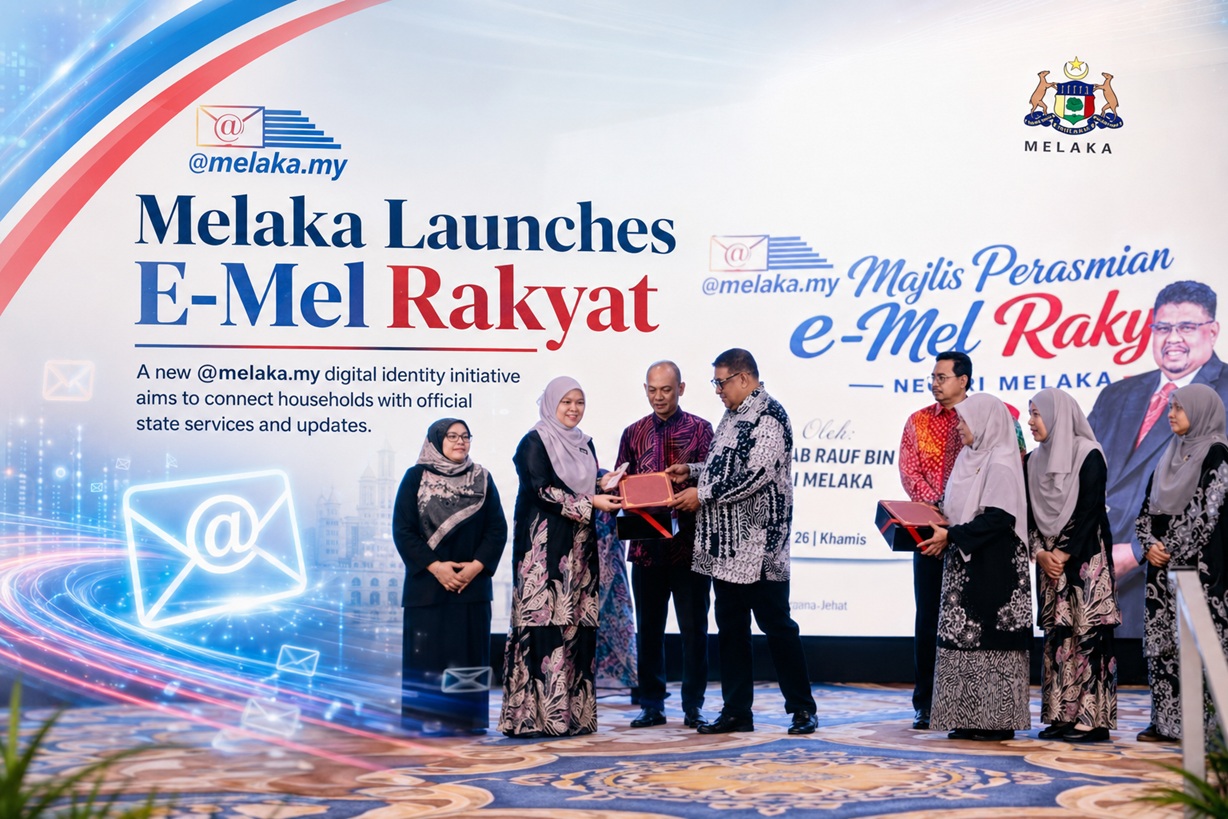
Email may no longer feel like the most exciting technology in an age dominated by artificial intelligence, mobile apps and instant messaging. However, Melaka is giving the familiar inbox a much bigger role by turning it into an official communication channel between the state government and its residents.
Through the newly launched E-Mel Rakyat Melaka initiative, every household in the state is eligible to receive one free email account using the @melaka.my domain. The programme was officially introduced by Melaka Chief Minister Datuk Seri Utama Ab Rauf Yusoh at the Melaka International Trade Centre in Ayer Keroh on 23 July 2026.
Rather than simply offering another free mailbox, the state wants the account to become a trusted digital gateway for government announcements, public services, education updates and communication with local communities.
More Than Just Another Free Email Account
Most residents already have access to services such as Gmail, Outlook or Yahoo Mail, so the purpose of E-Mel Rakyat is not necessarily to compete with established commercial email providers.
Its main value comes from the identity attached to the address.
An account ending in @melaka.my is intended to give each participating household a recognisable communication identity within the state's digital ecosystem. Residents could use it to receive information about government assistance, employment opportunities, education, community programmes and public services without having to depend entirely on messages circulating through WhatsApp, Telegram or social media.
This distinction is important because information forwarded through messaging applications can easily be altered, taken out of context or impersonated by scammers. A state-managed email platform could provide a more structured channel where residents know that official notices are coming from an authorised source.
However, the term "digital identity" should be understood in the context of the programme. The account acts as an official state-issued communication identity, but it is not a replacement for a MyKad, MyDigital ID or other legally recognised national identity credential.
One Official Account for Every Household
Under the programme, each Melaka household can register for one account without paying a subscription fee. The state is targeting approximately 85,000 heads of households across 618 traditional villages under its "One House, One E-Mel Rakyat" concept.
The household-based approach may help the government build a consistent communication directory without requiring every family member to maintain a separate account. Important notices could be sent directly to the registered household representative rather than being distributed across multiple disconnected channels.
Residents will also be able to use the account for ordinary personal email, making it more likely that the mailbox remains active instead of being opened only when someone needs to deal with a government department.
The platform is also intended to support two-way communication. Besides receiving announcements, residents can submit feedback, suggestions and views that may be considered when the state develops future policies or community programmes.
Part of Melaka's Wider Digital Transformation
E-Mel Rakyat is not being introduced as an isolated project. It forms part of Melaka's broader effort to build a digitally connected state, particularly through its existing Kampung Digital programme.
Under Kampung Digital, all 618 traditional villages in Melaka have been provided with more structured addresses and QR codes. Each participating property receives a digital reference that can be scanned to access location and address information.
This helps address a practical problem found in some traditional villages, where houses may previously have relied on general village names, landmarks or kilometre-based addresses. More accurate digital addresses can make homes easier to locate for government agencies, emergency services, delivery companies and utility providers.
When combined, Kampung Digital gives each household a more precise physical identity, while E-Mel Rakyat provides a direct digital communication identity. The two programmes therefore create the foundation for a more connected relationship between residents, properties and state services.
A Single Gateway to Multiple Government Services
The E-Mel Rakyat ecosystem is also being linked with several existing Melaka digital platforms.
The reported integrations include eTAPEM, Melaka Pay, the Melaka Online Tender System, the Melaka Housing Board and eTanah. The objective is to make it easier for residents to move between government services while continuing to receive relevant notices through a trusted account.
In practical terms, this could eventually allow a resident to receive payment reminders, housing notices, land-related updates or information about assistance programmes through one consistent mailbox.
The long-term value will depend on how deeply these systems are integrated. Simply placing links to multiple portals in one location would offer some convenience, but a more meaningful digital ecosystem would involve single sign-on, coordinated notifications and a consistent way to verify the identity of the account holder.
The Platform Includes Cloud Storage and a Calendar
Although email is the central feature, E-Mel Rakyat also provides several productivity tools.
The official user manual shows that account holders can send and receive messages, maintain an address book, organise daily tasks, use a calendar and store documents in a cloud-based drive. The platform also supports file sharing and shared calendars, along with spam filtering and password-based security controls.
The available cloud storage is reportedly limited to 100MB, which is very small compared with the gigabytes commonly offered by commercial services. It should therefore be viewed as basic storage for letters, forms and smaller documents rather than a replacement for Google Drive, OneDrive or other full-scale cloud platforms.
Nevertheless, the inclusion of storage and scheduling tools suggests that Melaka sees the platform as a small digital workspace rather than just a mailbox.
Schools Have Already Driven Early Adoption
The education sector has played a major role in the initial rollout.
More than 193,000 accounts have reportedly been registered for students, teachers, parents and guardians across Melaka. These accounts can be used to communicate academic results, school notices and other education-related updates.
As of 22 July 2026, the overall number of registered E-Mel Rakyat accounts had reached approximately 203,000. This means the overwhelming majority of early registrations appear to have come through the education sector, while the household programme is expected to expand participation further.
Schools are a logical place to introduce such a system because teachers, students and parents already need a dependable method of exchanging notices and documents. Familiarity gained through education may also encourage families to continue using the same ecosystem for other state services.
How Residents Can Register
Registration is completed through the official E-Mel Rakyat portal.
Applicants must select the registration option, fill in the required personal information and provide an active mobile number. A six-digit one-time password is then sent by SMS to verify the registration. Once the code has been confirmed, the account is created and can be accessed through the platform's webmail interface.
The use of mobile verification helps reduce automated or fraudulent registrations. However, residents should still create a strong, unique password and avoid reusing one that is already associated with social media, online banking or other email accounts.
They should also be cautious of unexpected messages asking for passwords, verification codes or personal information. The existence of an official state email domain may itself attract phishing attempts, making public awareness and clear security guidance essential.
The Real Test Will Be Whether People Continue Using It
Registering hundreds of thousands of accounts is a strong starting point, but account creation alone does not guarantee that the platform will become useful.
The state will need to ensure that residents regularly check their inboxes, understand how to identify genuine government messages and know where to seek help when they forget their passwords or change their telephone numbers.
Digital inclusion will also remain important. Elderly residents, people without reliable internet access and those who are unfamiliar with email may require assistance through community centres, village committees or physical government service counters.
There is also the question of how one account per household will be managed when family circumstances change. Clear procedures will be needed when the registered household representative moves away, passes responsibility to another family member or changes their mobile number.
Privacy and data governance will be equally important. Residents should be clearly informed about what personal data is collected, how long it is retained, which government agencies can access it and whether information is shared between integrated services.
A Practical Idea With Bigger Potential
What makes E-Mel Rakyat interesting is that it does not attempt to replace every government platform with another complicated application. Instead, it uses a familiar technology as the starting point for a more organised digital relationship between the state and its residents.
For a family, the benefit could be as simple as having one trusted place for government notices. For the state, it creates a structured communication directory that could improve the delivery of information, reduce dependence on unofficial messaging groups and make public engagement easier to manage.
Over time, the platform could become more valuable if it supports secure document delivery, appointment reminders, application-status updates, emergency announcements and personalised information based on the services used by each household.
Final Thoughts
E-Mel Rakyat represents a practical step in Melaka's broader digital transformation. By giving households an official @melaka.my address, the state is attempting to make communication with residents more direct, organised and trustworthy.
Its success, however, will not be measured only by the number of accounts registered. The more important questions are whether residents actively use the service, whether government agencies consistently communicate through it and whether the platform remains secure, reliable and easy to understand.
With proper public education, strong privacy controls and meaningful integration with state services, E-Mel Rakyat could grow from a free email initiative into a genuinely useful digital gateway for the people of Melaka.











Comments 0