

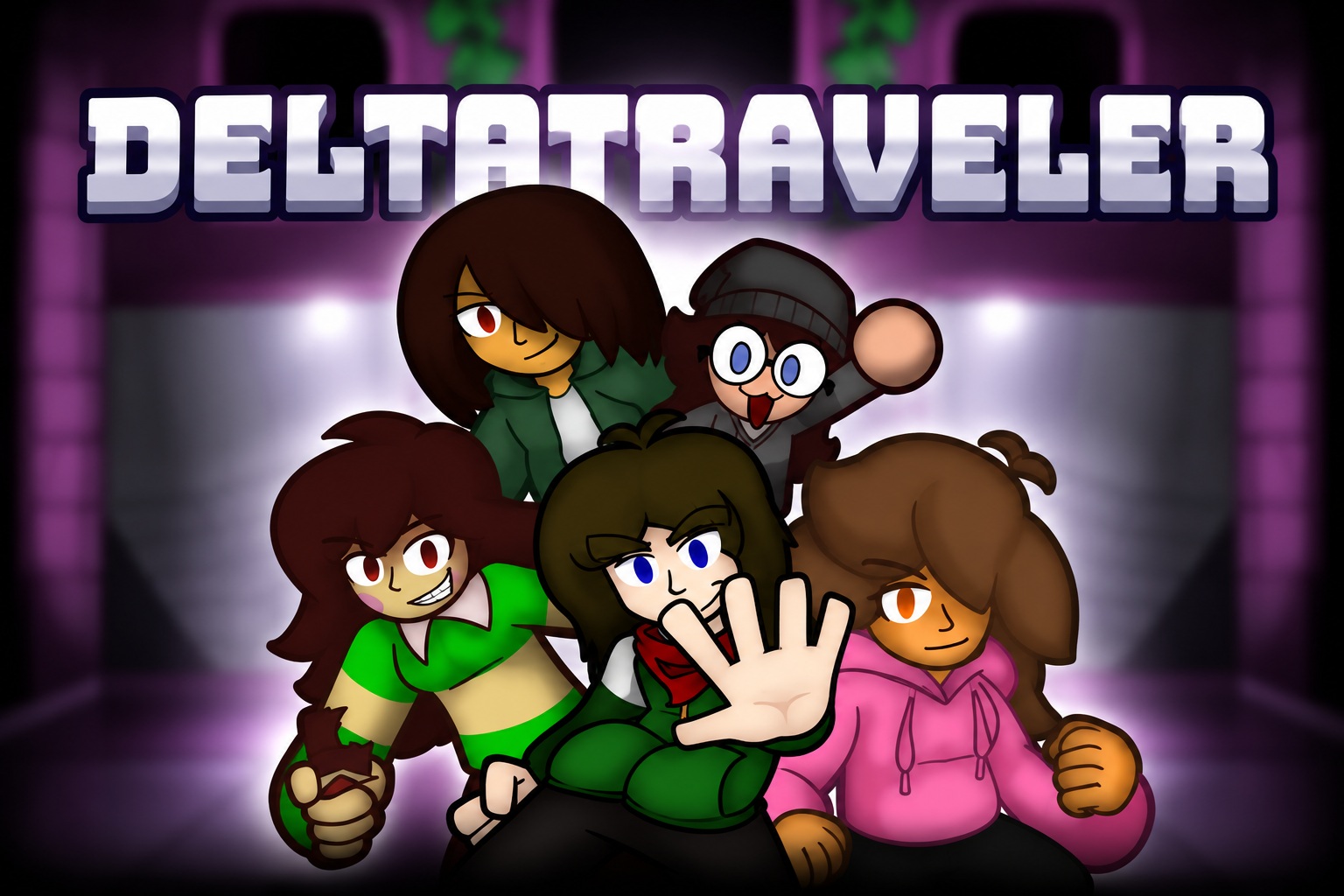
DELTATRAVELER is a fan-made RPG that begins with one of the funniest possibilities imaginable: Kris and Susie from DELTARUNE suddenly waking up somewhere they absolutely should not be. That place is the Ruins from UNDERTALE, immediately turning the famous "Kris, where the hell are we?" meme into an actual playable adventure. What could easily have remained a short joke instead grows into an increasingly ambitious crossover story involving multiple worlds, familiar characters, original encounters, branching choices, challenging battles, and a mystery surrounding the strange grey doors transporting the party from one universe to another.
The game combines many of the mechanics associated with UNDERTALE and DELTARUNE. Players explore pixel-art environments, talk with characters, solve puzzles, collect equipment, and enter turn-based battles where attacks must be avoided through bullet-dodging sequences. Kris, Susie, and eventually Noelle fight together as a party, bringing DELTARUNE-style TP, magic, ACT commands, and character abilities into worlds that were never designed for them. Depending on the choices made, enemies can often be spared peacefully or defeated through increasingly destructive actions that can lead toward the far darker Obliteration Route.
Now playable online through Lemon Web Games, DELTATRAVELER brings its crossover worlds, party-based RPG combat, bullet-dodging battles, branching routes, familiar characters, original bosses, puzzles, secrets, and increasingly elaborate storyline directly into the web browser. Players can travel through UNDERTALE-inspired locations, enter the world of EarthBound, encounter the much darker GG!Underfell universe, and gradually discover why Kris and the others are being pulled between realities. What starts as an internet joke quickly becomes a surprisingly substantial RPG where every new grey door may lead somewhere completely unexpected.
Kris and Susie Wake Up in the Wrong Game
The adventure begins with Kris and Susie waking inside the Ruins, immediately creating a strange collision between DELTARUNE and UNDERTALE.
Both characters recognize that something is wrong, but they have no obvious way to return home. Exploring the Ruins therefore becomes both familiar and completely new because the environment belongs to UNDERTALE while the protagonists do not.
This contrast provides much of DELTATRAVELER's early humour. Familiar locations and characters are viewed through Susie and Kris rather than Frisk, producing conversations and reactions that could never happen in the original game.
The Ruins Feel Familiar but Different
The opening section, In Ruins, uses the recognizable atmosphere of UNDERTALE's first major area while introducing new dialogue, encounters, puzzles, and story circumstances.
Toriel naturally becomes an important character, but her interactions with Kris and Susie differ substantially from what longtime UNDERTALE players may expect. Flowey also appears, bringing another layer of uncertainty because his knowledge and intentions immediately make any encounter suspicious.
The game constantly plays with familiarity. Players may recognize the environment, yet they cannot assume events will unfold exactly as they did in UNDERTALE.
Noelle Expands the Party
Noelle eventually joins Kris and Susie, giving the party another recognizable DELTARUNE character with her own personality and abilities.
Her presence changes both dialogue and combat. Susie's aggressive personality, Kris's central role, and Noelle's more cautious nature create a strong character dynamic as the group travels through increasingly strange situations.
Having multiple party members also strengthens the DELTARUNE-style combat system. Each character provides different tactical options rather than functioning as interchangeable fighters.
Grey Doors Connect Completely Different Worlds
The mysterious grey doors are among DELTATRAVELER's most important ideas. They function as gateways capable of sending the party into worlds that should have no connection with one another.
Because the characters do not know where each door will lead, every transition creates uncertainty. Returning home might be possible through the next doorway, or the group may simply become stranded somewhere even stranger.
This mechanic gives the developers enormous creative freedom. DELTATRAVELER is not restricted to one interpretation of UNDERTALE or DELTARUNE because the story can move into entirely different games and alternate universes.
Section Two Travels Into EarthBound
Oh, Mother pushes the crossover concept much further by sending the party into a world inspired by EarthBound.
The change is dramatic because the environments, characters, enemies, humour, and references suddenly belong to another RPG tradition entirely. Paula becomes one of the recognizable figures involved in this portion of the journey.
The transition proves that DELTATRAVELER is not simply an UNDERTALE fan game with DELTARUNE characters. It is genuinely interested in making those characters travel between unrelated worlds and react to each one.
EarthBound Fits Surprisingly Well
UNDERTALE itself was influenced heavily by games such as EarthBound, so seeing these universes connected through DELTATRAVELER feels surprisingly natural.
Both series combine humour, strange enemies, emotional storytelling, and unusual interpretations of turn-based RPG mechanics. The tonal similarities allow the crossover to work without feeling completely random.
At the same time, the differences remain important. Kris, Susie, and Noelle are outsiders, making familiar EarthBound concepts feel new when viewed through their perspective.
Section Three Enters GG!Underfell
Hell's Forest takes the party into the much darker GG!Underfell universe, significantly changing the atmosphere again.
Characters and locations inspired by UNDERTALE become far more hostile and dangerous, giving players a distorted version of something that might otherwise feel familiar. Even recognizable faces can behave very differently from their original counterparts.
This section demonstrates how effectively DELTATRAVELER can shift tone. The same party that participated in humorous crossover situations is now forced to navigate a world where familiar assumptions may be dangerous.
Combat Combines UNDERTALE and DELTARUNE Ideas
Battles use a party-based structure closer to DELTARUNE while retaining the bullet-dodging defence associated with both games.
Players choose actions for party members and then survive enemy attack patterns by moving the SOUL through a confined battle area. Every enemy can introduce its own patterns, making observation just as important as character statistics.
The result preserves the appeal of Toby Fox-style combat while creating room for new mechanics and party combinations.
TP Encourages Tactical Ability Use
Tension Points, or TP, build during battles and can be spent on character abilities and spells.
This creates decisions beyond simply attacking every turn. Saving TP may provide access to a stronger ability later, while spending it immediately can solve a dangerous situation before it becomes worse.
Dodging attacks effectively also becomes part of resource management. Strong defensive play can help create more offensive or supportive options during later turns.
ACT Commands Keep Peaceful Solutions Possible
Like UNDERTALE and DELTARUNE, many encounters allow players to interact with enemies through ACT commands rather than immediately fighting them.
The correct interaction may reveal something humorous about the opponent, alter its behaviour, or eventually make a peaceful resolution possible.
This gives each enemy additional personality. Battles become small character encounters rather than simply obstacles that need to be destroyed.
Sparing Enemies Changes the Tone of the Journey
Players who consistently search for peaceful solutions experience a very different relationship with the worlds they visit.
Enemies become puzzles to understand rather than targets to eliminate. Character dialogue also feels more consistent with the compassionate possibilities associated with UNDERTALE and DELTARUNE.
This route rewards experimentation because the correct ACT sequence is not always immediately obvious. Sometimes understanding the enemy is the real battle.
The Obliteration Route Takes a Much Darker Direction
DELTATRAVELER also allows players to pursue a deliberately destructive path through the Obliteration Route.
Instead of resolving encounters peacefully, the player systematically uses violence in ways that can dramatically alter events and character relationships. The tone becomes increasingly uncomfortable as the consequences accumulate.
This route is more than simply defeating every available enemy. It is designed to feel like a meaningful divergence from the normal adventure, with the game recognizing what the player is choosing to do.
Choices Can Have Lasting Consequences
One of the strengths of DELTATRAVELER is that decisions do not always disappear when the battle ends.
How enemies are treated and which route the player follows can influence dialogue, encounters, character reactions, and later events.
This makes replaying worthwhile. A second journey can reveal scenes and consequences that were completely absent from the first.
Boss Battles Push the Bullet Patterns Further
Major encounters combine traditional RPG decision-making with more elaborate bullet-dodging sequences.
Bosses often require players to understand unique attack patterns rather than relying entirely on healing through damage. Movement skill becomes essential as attacks grow faster or more complicated.
The best encounters also connect mechanics with character personality. How a boss fights can reveal as much about them as their dialogue.
Hard Mode Adds Another Challenge
Players looking for a more demanding experience can explore Hard Mode, where encounters require more consistency and stronger understanding of the mechanics.
Harder battles make resource management more important because poor decisions can become much more expensive.
This provides additional value for players already familiar with the normal journey. The story remains recognizable, but surviving it requires better execution.
The Pixel Art Respects Its Inspirations
DELTATRAVELER uses pixel-art environments and character sprites that fit naturally beside UNDERTALE and DELTARUNE.
At the same time, each crossover world retains enough visual identity to feel different. EarthBound-inspired areas do not simply look like another version of the Ruins, while GG!Underfell shifts the atmosphere in another direction.
The artwork helps unify worlds that otherwise might feel incompatible. Everything belongs to DELTATRAVELER while still clearly referencing where it came from.
The Soundtrack Strengthens Every World
Music is particularly important in a game inspired by UNDERTALE and DELTARUNE because both are famous for memorable soundtracks.
DELTATRAVELER uses original and rearranged music to support exploration, comedy, emotional scenes, and boss encounters.
Different worlds naturally receive different musical identities, helping each transition feel significant. Entering another universe changes not only the scenery but the entire mood.
Humour Remains Central
Despite the increasingly complicated story, DELTATRAVELER never forgets that its original premise came from a meme.
Susie's reactions are especially useful for keeping situations funny because she is often willing to point out exactly how ridiculous everything has become.
The humour prevents the crossover concept from becoming overly serious while making darker scenes more effective through contrast.
The Characters Carry the Adventure
The crossover worlds provide spectacle, but Kris, Susie, and Noelle are what hold the journey together.
Their personalities remain recognizable even when everything around them changes. Players begin caring less about which universe appears next and more about how the party will react to it.
This makes DELTATRAVELER feel like an actual adventure rather than simply a collection of references.
Secrets Reward Thorough Exploration
Optional interactions, hidden areas, unusual dialogue, and extra encounters encourage players to investigate each section rather than rushing directly toward the next grey door.
Some discoveries are humorous, while others provide additional story information or challenge.
The amount of optional content also gives fans plenty to discuss and discover across repeat playthroughs.
Playing DELTATRAVELER Online Today
Through Lemon Web Games, DELTATRAVELER can now be played directly in your web browser with no downloads or setup required. Features of the web-based version include:
New players should experiment with ACT commands rather than treating every encounter as a traditional RPG fight. Many enemies have peaceful solutions, and discovering those interactions often provides some of the funniest or most memorable dialogue in the game. Building TP efficiently also creates far more options during difficult battles.
It is equally worth exploring thoroughly before moving through another grey door. Optional conversations and hidden interactions add significant personality to each world, while different choices can become important if the player decides to revisit the adventure through another route.
Who Should Play DELTATRAVELER
DELTATRAVELER is particularly suitable for players who already understand the personalities and worlds being referenced. Many jokes and character interactions become much more meaningful when the original games are familiar.
It can still be appreciated as a creative RPG on its own, however. The battle systems, exploration, humour, and character relationships provide enough substance beyond the references.
Play DELTATRAVELER Online Now
DELTATRAVELER begins with Kris and Susie waking up somewhere they definitely do not belong and turns that simple joke into a journey across entire universes. Explore the Ruins, travel into EarthBound-inspired territory, survive the darker world of GG!Underfell, build TP, dodge bullets, solve puzzles, meet familiar characters, and decide whether enemies deserve mercy or something far worse.
Through Lemon Web Games, players can experience DELTATRAVELER directly in the browser and discover how far one meme can grow when given enough creativity. Every grey door promises another world, another mystery, and another chance for Susie to ask the question that started everything.
Final Thoughts
DELTATRAVELER succeeds because it does far more than repeat familiar UNDERTALE and DELTARUNE moments. It places recognizable characters into worlds where they were never meant to exist and then seriously explores how they might react. The humour remains strong, but underneath it is a genuine crossover RPG with increasingly ambitious storytelling.
Its mixture of party combat, bullet dodging, ACT commands, branching choices, Hard Mode, hidden content, and the Obliteration Route gives the adventure meaningful replay value. EarthBound and GG!Underfell expand the concept even further, proving that almost any world could potentially exist beyond the next grey door.
Through Lemon Web Games, DELTATRAVELER can now be enjoyed directly in the browser as one of the more ambitious UNDERTALE and DELTARUNE fan projects. What began as "Kris, where the hell are we?" has become a surprisingly large journey where the real question is no longer where they are—but where they are going next.











Comments 0