

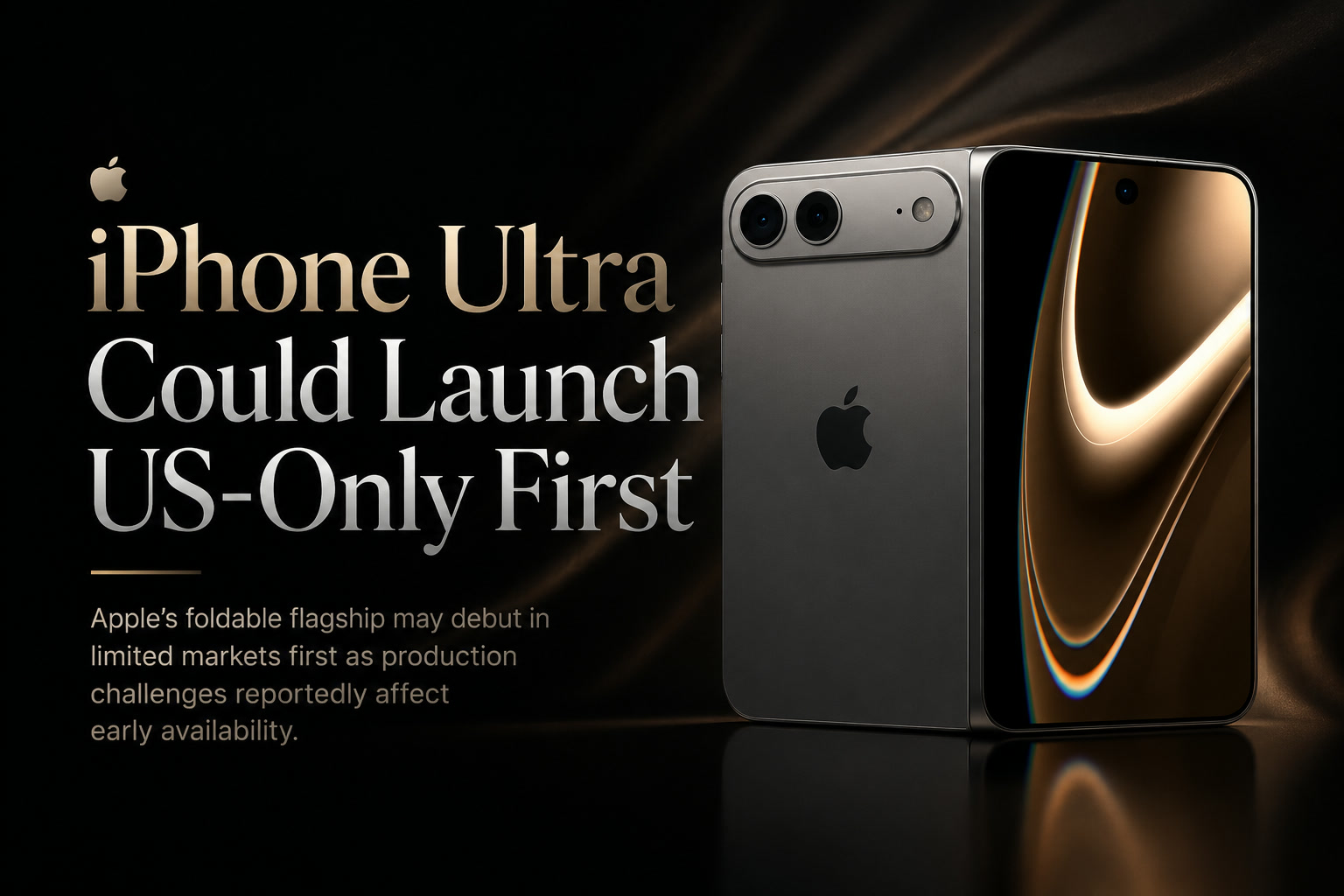
Apple's long-rumoured foldable iPhone may finally be getting close to an official reveal, but the launch could be far more limited than many expected. The device, widely referred to as the iPhone Ultra, is reportedly being prepared for Apple's September event alongside the iPhone 18 Pro and iPhone 18 Pro Max. However, the foldable model may not actually go on sale at the same time as the rest of the new iPhone lineup.
Instead, Apple is reportedly considering a US-first launch, with wider availability delayed while the company works through production challenges involving the foldable display, hinge system and manufacturing readiness.
If the reports prove accurate, the iPhone Ultra could become one of Apple's most exclusive product launches in years.
Apple May Reveal the iPhone Ultra Before It Is Ready to Ship
According to reports citing Australia's Channel News, Apple could use its September event primarily to showcase the foldable iPhone rather than immediately launch it worldwide.
That would be unusual for a flagship iPhone.
Apple typically announces its new smartphones and opens pre-orders shortly afterwards, with retail availability beginning within a relatively short timeframe. The iPhone Ultra, however, may follow a different schedule.
Apple could reveal the device, demonstrate its design and capabilities, and then announce its final pricing and retail availability at a later date.
The reason appears to come down to manufacturing.
Reports suggest Apple's suppliers have encountered more difficulties than expected while preparing the foldable device for mass production.
The Foldable Display and Hinge Are Reportedly Causing Problems
Building a foldable smartphone is considerably more complicated than manufacturing a conventional slab-style device.
The flexible display needs to survive thousands of folds without developing visible damage, while the hinge has to remain durable, compact and precise enough to keep both halves of the device aligned.
These are areas where Apple is reportedly still facing challenges.
Production verification testing has allegedly uncovered issues involving both the foldable display panel and hinge mechanism, forcing suppliers to make further adjustments before Apple can confidently scale production.
That is particularly important for Apple because the company has historically placed a strong emphasis on fit, finish and long-term reliability.
Launching a foldable iPhone with obvious display creasing, hinge weakness or inconsistent build quality would be particularly damaging given the premium positioning expected for the device.
Mass Production Has Already Reportedly Been Delayed
The iPhone Ultra was reportedly supposed to enter mass production in June.
That timeline was later pushed back to August.
Even then, Foxconn was reportedly still making changes to its mass-production strategy as recently as late July.
Some sources now suggest that engineering validation could cause another delay of as much as two months, potentially leaving Apple with far fewer launch-ready devices than originally planned.
If that happens, Apple would face a difficult decision.
The company could delay the entire product globally until enough inventory is available, or it could launch the device in only a few strategically important markets.
Current reports suggest Apple may choose the second approach.
The United States Could Get It First
Apple is reportedly planning to make the United States the first market for the iPhone Ultra.
Other major regions could follow later, with China reportedly among the markets being considered for an early expansion.
Australia, however, is said to be excluded from the first wave.
A limited launch would give Apple several advantages.
Most importantly, it would allow the company to introduce the device without needing millions of units ready for worldwide distribution.
It would also give Apple an opportunity to measure demand, gather early customer feedback and potentially fine-tune production before expanding availability.
For a completely new iPhone category, that may be a safer strategy than attempting an immediate global rollout.
Apple Simply May Not Have Enough Units
The reported US-first strategy does not necessarily mean Apple sees the iPhone Ultra as a niche product.
It may simply be a supply problem.
If production yields remain lower than expected, Apple may not have enough devices to support simultaneous launches across North America, Europe, China, Southeast Asia and other key markets.
Foldable displays are particularly difficult to manufacture at high yields.
Even small defects can render an expensive flexible OLED panel unusable, while hinge assemblies require extremely tight tolerances.
When manufacturing something at Apple's scale, a seemingly minor production issue can quickly affect hundreds of thousands of devices.
Limiting the first release to the US would therefore allow Apple to launch while gradually building inventory.
Pricing Could Make the iPhone Ultra Apple's Most Expensive Phone Yet
The foldable iPhone is also expected to carry an extremely high price.
According to the report, the device could cost approximately AUD700 more than Samsung's Galaxy Z Fold8.
With the Galaxy Z Fold8 reportedly priced at around AUD2,999, that would place the iPhone Ultra somewhere near AUD3,699, equivalent to approximately RM10,707 based on the quoted conversion.
That figure remains unconfirmed, and Apple has yet to officially announce either the product or its pricing.
Even so, a price above RM10,000 would not be particularly surprising for Apple's first foldable device.
Foldable displays are expensive, hinge mechanisms add considerable engineering complexity, and Apple would likely position the Ultra above its existing Pro Max lineup rather than alongside it.
This would make it less of a mainstream iPhone upgrade and more of a luxury flagship aimed at early adopters.
Apple Would Be Entering a Mature Foldable Market
One interesting aspect of the iPhone Ultra is that Apple would be arriving relatively late to the foldable smartphone category.
Samsung has spent years refining its Galaxy Z Fold series, while brands such as Honor, Huawei, Oppo, Vivo and Google have also released increasingly sophisticated foldable devices.
That gives Apple both an advantage and a disadvantage.
The disadvantage is obvious: competitors already have years of real-world experience with folding displays and hinge durability.
The advantage is that Apple has had time to observe those products and identify their weaknesses.
Apple typically prefers entering established categories when it believes it can deliver a more polished version rather than rushing to be first.
That may explain why the company is reportedly being so cautious about the Ultra's display and hinge.
Could Apple Be Trying to Avoid the Early Problems Samsung Faced?
The foldable smartphone industry has already demonstrated what can happen when a product launches before the hardware is completely ready.
Samsung's original Galaxy Fold famously faced durability concerns during its early rollout, resulting in the launch being delayed while the company redesigned parts of the device.
Apple will almost certainly want to avoid a similar situation.
A foldable iPhone is likely to attract enormous attention, and any major hardware defect would immediately become global news.
Taking additional time to refine the hinge and display may therefore be frustrating for buyers, but it could ultimately be preferable to releasing a device before it meets Apple's reliability standards.
Malaysia Could Be Waiting Much Longer
For Malaysian customers, the biggest question is whether the iPhone Ultra would be included in an early international rollout.
At the moment, that remains uncertain.
If Apple launches the device exclusively in the US before expanding to only a handful of major markets, Malaysia could end up waiting considerably longer.
There is already some precedent for this.
Apple initially launched the Vision Pro exclusively in the United States before gradually bringing the headset to selected international markets.
Malaysia was ultimately not included among the countries receiving an official Vision Pro launch.
That does not necessarily mean the same thing will happen with the iPhone Ultra, especially because the iPhone has a much larger global customer base.
Still, a constrained first-generation product could encourage Apple to prioritise markets where demand and retail infrastructure are strongest.
Grey Imports Could Appear Before an Official Malaysian Launch
If Malaysia is excluded from the first wave, that does not necessarily mean the device would be impossible to obtain locally.
Parallel importers would almost certainly bring US or other international units into the country.
However, buying an imported foldable iPhone could introduce complications.
Regional warranty support, eSIM compatibility, cellular band differences and repair availability would all need to be considered carefully.
Those issues become particularly important with a foldable phone because repairs involving the flexible display or hinge are likely to be considerably more expensive than those for a conventional iPhone.
For a device potentially costing more than RM10,000, official local support could make a significant difference.
The First Foldable iPhone May Be More of a Showcase Product
If Apple really does launch the iPhone Ultra in limited quantities, the first generation could function almost like a showcase for the company's future direction.
Apple may not necessarily expect the foldable model to sell in numbers comparable with the regular iPhone lineup.
Instead, it could establish a new premium category, allowing Apple to develop the technology over several generations before foldable designs eventually become more mainstream.
That would be similar to the role the original Apple Watch, Vision Pro and even early MacBook Air models played within their respective categories.
The first version demonstrates the concept.
Later generations make it more practical, affordable and widely available.
Final Thoughts
The rumoured iPhone Ultra is shaping up to be one of Apple's most interesting hardware launches in years, but it may also become one of its hardest products to buy.
Reports of problems involving the foldable display, hinge mechanism and production validation suggest Apple may not have enough devices ready for a conventional global launch.
A US-first rollout would therefore make practical sense, allowing Apple to introduce its first foldable iPhone while gradually increasing manufacturing capacity.
For Malaysian buyers, however, that could mean a much longer wait.
And with rumours suggesting a price potentially exceeding RM10,000, the iPhone Ultra may initially be less about replacing the standard iPhone and more about creating an entirely new ultra-premium tier.
The September event could finally answer whether Apple is ready to enter the foldable smartphone market—or whether the company is prepared to unveil the device first and make customers wait a little longer before they can actually buy one.











Comments 0