

In architecture, a strong design is only part of the story. The other part is how clearly that design is communicated. Floor plans, elevations, and technical drawings are essential for construction, but for many clients, investors, and approval panels, they are not enough to fully understand a project. Most people do not naturally "see" a finished building from a set of drawings. They need something more immediate, more visual, and more human.
That is exactly why architectural visualization has become such an important part of modern project delivery. A good render does more than make a project look attractive. It helps people understand scale, atmosphere, materials, light, and overall experience before anything is built. It can reduce hesitation, improve decision-making, and make presentations far more persuasive.
Today, the best 3D rendering studios are not just image-makers. They are creative partners who help architecture firms, developers, and marketers turn design intent into something that feels real. Some specialize in highly polished real estate visuals. Others are known for mood-driven imagery that feels almost cinematic. A few operate on a broader level, blending visualization with branding and strategic marketing.
Below is a closer look at what these studios actually do, why they matter, and which names stand out when architects need visualization support that goes beyond generic renderings.
Why Architectural Visualization Matters More Than Ever
Architectural projects have become more competitive, more expensive, and more presentation-driven than ever before. Whether the project is a luxury residential tower, a boutique hotel, a cultural institution, or a mixed-use development, there is usually a lot riding on how it is introduced to stakeholders.
A rendering can influence how quickly a client approves a direction. It can shape how a planning authority responds to a proposal. It can also affect whether buyers feel excited enough to commit to an off-plan purchase. In many cases, the visual presentation becomes the bridge between technical design work and real-world confidence.
This is why top-tier visualization is no longer treated as a luxury add-on. It is now part of how projects are sold, defended, refined, and experienced before construction even begins.
What 3D Rendering Studios Actually Do
At first glance, it might seem like an architectural visualization studio simply takes a model and turns it into a polished image. In reality, the work is usually much more layered than that.
These studios translate design concepts into visual stories. They shape the emotional tone of a project through lighting, framing, atmosphere, materials, and context. They can show how a space feels at sunrise, how a lobby might look with people moving through it, or how a building sits within an existing streetscape. This kind of visualization helps transform architecture from an abstract proposal into something stakeholders can emotionally connect with.
Their services often include photorealistic still renders, animated walkthroughs, virtual reality experiences, and post-production work that blends architecture with real-world context. Many studios also handle visual assets for brochures, sales galleries, investor presentations, websites, and planning submissions.
The best ones understand that they are not just making images. They are helping a project move forward.
What Sets a Great Studio Apart
Not every rendering studio works the same way. Some focus heavily on speed and volume, especially for developer-led projects with aggressive marketing timelines. Others are more selective and craft-oriented, producing fewer images but with a distinctive artistic voice. There are also studios that position themselves as strategic consultants, where visualization is only one part of a broader communication package.
For architects, that difference matters. A studio that is perfect for a pre-sales campaign may not be the best fit for a conceptual competition. Likewise, a studio known for poetic, mood-rich imagery may not be ideal when the client wants fast commercial visuals for multiple unit types.
The strongest studios tend to combine technical discipline with visual sensitivity. They understand architecture, but they also understand audience. They know when an image needs to be precise, when it needs to feel aspirational, and when it needs to do both at once.
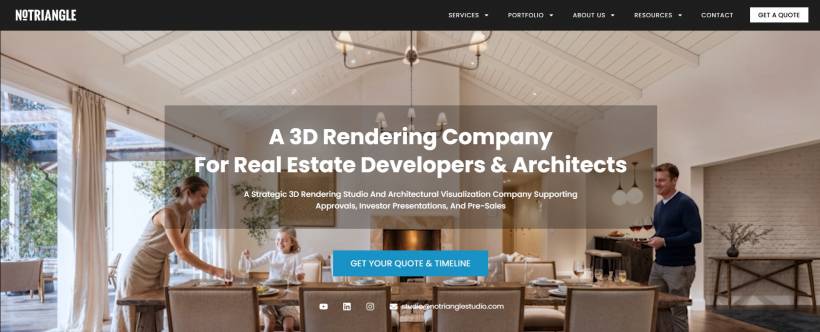
NoTriangle Studio
NoTriangle Studio has built a strong reputation by treating visualization as part of a broader project strategy rather than just a final presentation layer. Based in California and founded in 2010, the studio is often recognized for working closely with architects and developers throughout the full arc of a project, from early planning to launch.
Its services span exterior and interior renderings, architectural animation, immersive virtual tours, and product rendering. On paper, that may sound similar to many other studios, but the difference lies in how the work is framed. NoTriangle appears to approach visuals as tools for approvals, investor confidence, and pre-sales momentum rather than as isolated pieces of visual polish.
That mindset is especially valuable in real estate-led projects, where renderings are expected to do real commercial work. A well-crafted image is useful, but a strategically planned image that supports positioning, speaks to a target audience, and removes uncertainty from the approval process is far more powerful. This strategic emphasis is one of the main reasons NoTriangle continues to stand out.
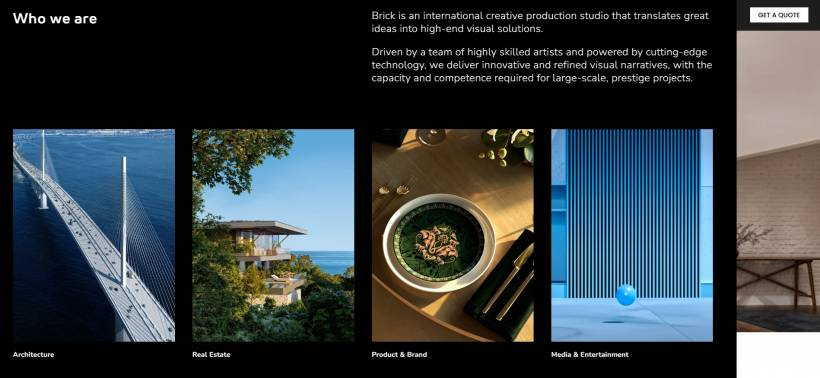
Brick Visual
Brick Visual has become one of the most recognizable names in architectural visualization, and for good reason. Founded in Hungary in 2012, with its main base in Budapest and additional offices in several European cities, the studio has earned international attention for work that combines technical precision with atmosphere and storytelling.
Their renderings are often praised not just because they look realistic, but because they feel alive. There is usually a narrative quality to the composition, as though the viewer is stepping into a moment rather than simply observing a building. That ability to create emotional resonance is one of the most difficult things to achieve in archviz, and Brick Visual has made it part of its identity.
The studio's range extends beyond still images into animation, interactive experiences, education, and workflow tools. Through Brick Academy and software initiatives like Pulze, the company has also expanded its influence beyond client work into training and production systems. That shows a level of maturity that goes beyond being just a service provider. It suggests a studio that is actively shaping how the industry works.
Their collaborations with firms such as Zaha Hadid Architects, Foster + Partners, and OMA also reinforce their position as a studio trusted on high-profile work where design quality and presentation standards are exceptionally high.
DBOX
DBOX occupies a slightly different space from the traditional visualization studio. Rather than operating purely as an image production firm, it functions more like a creative communications agency working across architecture, branding, and marketing.
This makes DBOX particularly interesting for projects where the building itself is only one part of a larger story. In luxury residential, hospitality, commercial, and destination-driven developments, success often depends on how the project is branded and emotionally positioned in the market. In those cases, renderings are not just there to explain design. They are there to create desire.
DBOX develops brand campaigns, strategic messaging, environmental touchpoints, and visual materials that support leasing, sales, and public awareness. That broader perspective helps explain why their work has attracted attention beyond architecture circles, including recognition from institutions and major creative awards.
What makes DBOX distinctive is that it does not stop at visualizing a building. It helps shape the identity around that building. For developers or project teams working at the premium end of the market, that can be incredibly valuable.
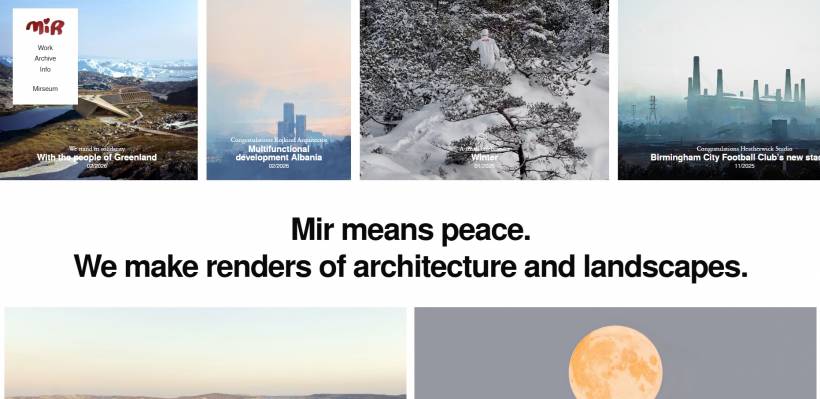
MIR
MIR has long been admired for creating imagery that feels atmospheric, thoughtful, and deeply rooted in place. Founded in Bergen, Norway in 2000, the studio has developed a signature style that often emphasizes the relationship between architecture and landscape rather than treating the building as an isolated object.
That perspective gives MIR's work a different emotional tone from many commercial rendering studios. Their images often feel quieter, more contemplative, and more connected to weather, terrain, and natural context. This makes them especially compelling for cultural projects, landscape-sensitive developments, and designs where the environment is an essential part of the architectural story.
Over the years, MIR has worked on museums, bridges, airports, stadiums, and other significant public or civic projects. Yet despite that high profile, the studio is also known for supporting smaller practices and more modestly scaled work. That range suggests a team more interested in the strength of an idea than in the size of the budget alone.
What truly makes MIR stand out is the sense that they are not just documenting architecture visually. They are interpreting it. Their images often feel inspirational in their own right, which is why so many architects regard their work as more than standard project representation.

Luxigon
Luxigon has established itself as one of the most trusted names in high-end architectural visualization, particularly for competition imagery, conceptual work, and collaborations with major international architecture firms. Headquartered in Paris with additional offices in Los Angeles and Milan, the studio has more than two decades of experience and an impressive body of work across scales and typologies.
Their output includes photorealistic renderings, animated films, real-time 3D experiences, VR content, and concept support for projects moving under tight deadlines. That flexibility is important because architectural presentations often need to shift depending on audience and stage. Sometimes the task is to win a competition. Sometimes it is to support a planning submission. Sometimes it is to communicate a speculative idea clearly enough that it can become a serious proposal.
Luxigon's long-standing relationships with firms such as OMA, MVRDV, REX, BIG, KPF, and SOM speak volumes about their consistency and architectural understanding. They are clearly not just there to decorate an idea. They are there to help sharpen and communicate it.
Their willingness to engage with new tools and emerging directions, including AI-related discussions, also suggests a studio that is paying attention to where visualization is heading rather than simply repeating the same formula year after year.
When It Makes Sense to Bring In a Rendering Studio
Hiring an external visualization team is not necessary at every stage of every project, but there are certain moments where the value becomes very clear.
During design development, renderings can reveal issues that are easy to miss in drawings or raw models. Material combinations, daylight behavior, sightlines, and spatial balance become much easier to assess when the design is seen in a realistic way. Catching those issues early is far less painful than dealing with them later in documentation or construction.
For important client presentations, high-quality visuals can dramatically improve understanding. A photorealistic image removes much of the ambiguity that comes with 2D plans and technical diagrams. Clients can respond more confidently when they feel they are looking at the future reality of the project rather than trying to decode professional drawings.
In planning and community engagement, context-rich renderings can also play a major role. Objections often come from uncertainty. When people can see how a proposed building sits within its actual environment, concerns about scale, fit, or visual disruption often become easier to address.
Then there is the marketing stage, where visualization becomes indispensable. For developers selling off-plan, the entire product is effectively being sold before it exists. At that point, the render is not just a design aid. It is the product preview, the sales pitch, and the emotional hook all at once.
How to Choose the Right Studio for Your Firm
Choosing a studio should never come down to beautiful images alone. A polished portfolio matters, but the working relationship matters just as much.
The first thing to look at is relevance. A studio may be talented, but if its portfolio is filled with sleek towers and your project is a nature-led retreat or a civic building, the visual instincts may not line up. Similarity in project type, scale, and tone is often a better sign than general prestige.
Next comes range. A good studio should be technically competent, but also artistically aware. Materials should feel believable. Lighting should feel intentional. The mood should support the architecture rather than overpower it. This balance is what separates impressive images from truly useful ones.
Communication is another major factor. Rendering work is rarely a one-step process. It involves interpretation, feedback, revisions, and deadline management. If a studio is vague during early conversations, slow to respond, or unclear about revisions and process, those problems usually become worse under pressure.
It also helps to understand how they work internally. Ask how a project typically moves from blockout to final output. Ask when the first draft is usually delivered. Ask how they handle sudden changes. These questions reveal whether the studio has a clear production method or is simply improvising from one deadline to the next.
And finally, there is the matter of fit. The best visualization partners are the ones who genuinely engage with the design. They ask thoughtful questions, understand what the project is trying to say, and contribute ideas that strengthen the presentation. At that point, they stop feeling like an outside vendor and start feeling like part of the design team.
More Than Just Pretty Pictures
One of the biggest misconceptions about rendering studios is that they are there to make architecture look glamorous. That can be part of the job, but it is far from the full story.
At their best, these studios clarify ideas, strengthen presentations, reduce friction in approvals, and help projects connect with the people who matter most. They turn technical design into something visible, persuasive, and emotionally legible. In a profession where so much depends on how clearly a vision is communicated, that role is incredibly important.
Different studios excel in different ways. NoTriangle leans into strategic value and development workflows. Brick Visual is known for atmosphere and storytelling. DBOX operates where architecture meets branding and market positioning. MIR offers emotionally rich images deeply connected to place. Luxigon brings long-term consistency and strength in conceptual and competition work.
The right choice depends on what your project needs, who you are trying to persuade, and how you want the architecture to be understood.
Final Thoughts
A great rendering studio does not simply make a project look polished. It helps people believe in the project. That distinction matters.
When you choose the right partner, the visuals do more than decorate a proposal. They support approvals, improve conversations, build confidence, and create momentum. For architecture firms, developers, and project teams working in an increasingly presentation-driven environment, that kind of support can make a real difference.
In the end, the best studio is not always the one with the flashiest portfolio. It is the one that understands your design, communicates clearly, and produces work that genuinely helps move the project forward











Comments 0