

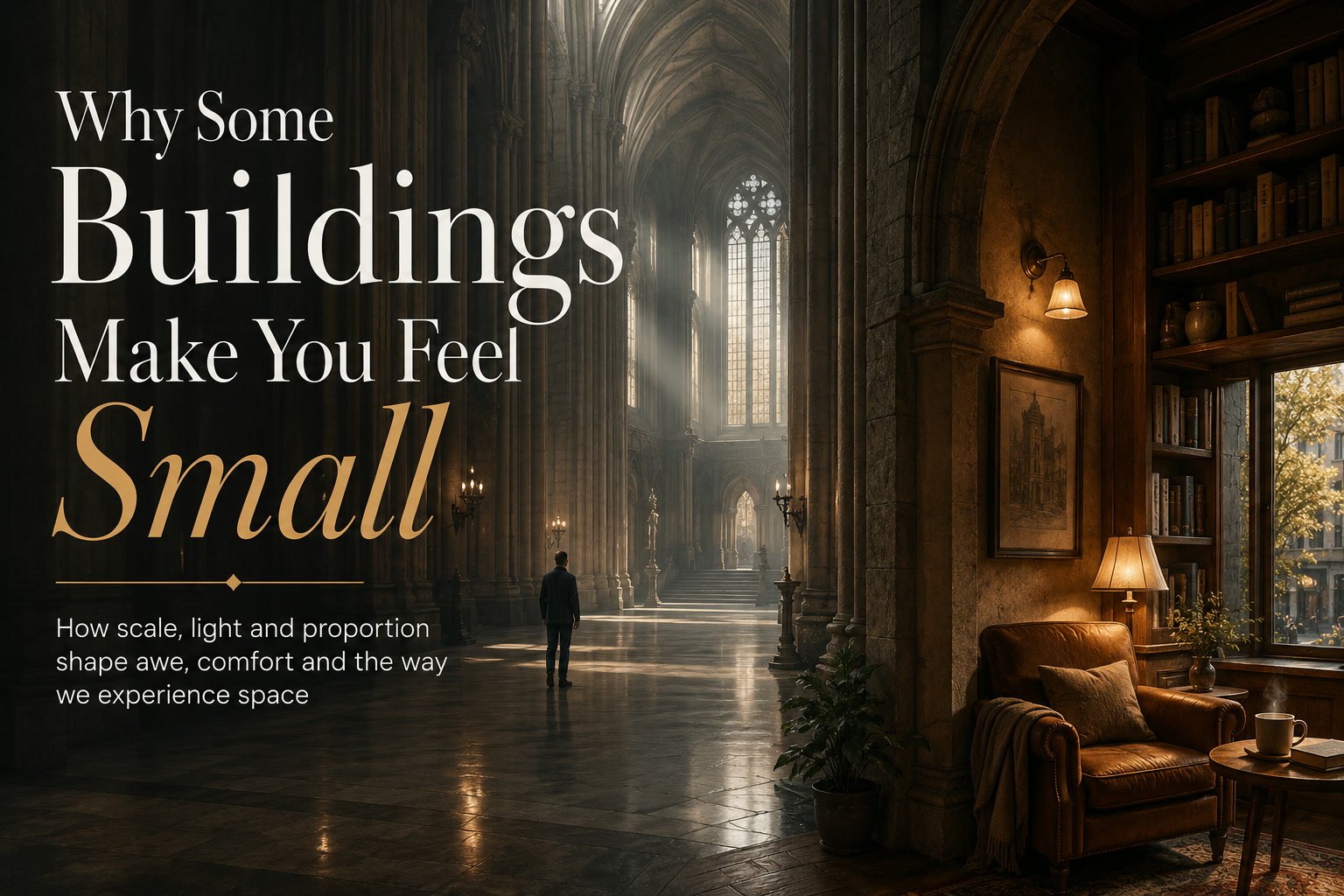
You have probably experienced it without thinking much about why. Walk into a cathedral, a huge hotel lobby or a towering train station and you may suddenly feel tiny. The ceiling seems impossibly high, the columns feel monumental and the entire space appears to dwarf the people inside it.
Then walk into a small library, a quiet café or a thoughtfully designed home and the emotional response changes completely. Instead of awe, you may feel comfortable, protected and surprisingly calm.
Those reactions are not accidental.
Architecture affects us through scale, light, proportion, geometry, sound and even the way we enter a space. Long before we consciously analyse a building, our bodies are already responding to it.
Scale Changes How Powerful a Space Feels
One of the strongest influences is scale.
A building that is dramatically larger than the human body can create a feeling of awe or even intimidation. Cathedrals are a classic example.
Their soaring ceilings, enormous columns and distant roof structures intentionally make visitors feel small compared with the architecture surrounding them.
Historically, that effect often had symbolic meaning. Religious buildings used monumental scale to reinforce the idea that the individual was entering something greater than themselves.
Modern architecture uses the same principle.
Corporate headquarters, government buildings and luxury hotel lobbies often rely on oversized entrances and expansive atriums to communicate importance, authority or prestige.
A space closer to human scale creates a very different response.
When ceilings are lower, windows sit near eye level and doors feel proportionate to the body, the room tends to feel more intimate and protective.
The building is no longer trying to dominate you.
It feels like it was designed around you.
Small Differences in Proportion Matter More Than We Think
Scale is not only about whether a building is tall or short.
It is also about how individual elements relate to the human body.
A doorway twice as tall as necessary immediately feels ceremonial.
A doorway only slightly taller than the person walking through it feels ordinary and familiar.
The same applies to furniture, windows, staircases and corridors.
When those elements feel appropriately proportioned, people usually experience the space as comfortable without necessarily knowing why.
When the proportions are wrong, the body notices.
A corridor that is slightly too narrow can feel uncomfortable.
A ceiling that is unusually low may feel oppressive.
A giant empty room with very little furniture can feel exposed rather than luxurious.
Architecture is constantly sending these subtle signals.
Light Can Make a Space Feel Open or Mysterious
Light is another powerful architectural tool.
Bright, evenly distributed natural light tends to make spaces feel open, optimistic and easy to understand.
You can see where you are going.
You can understand the boundaries of the room.
Nothing feels hidden.
Dim or highly directional lighting creates a more dramatic response.
Cathedrals often use this beautifully.
Light may enter through high stained-glass windows while much of the surrounding interior remains relatively dark. Instead of illuminating everything equally, the architecture allows light to reveal selected areas.
That creates mystery and draws attention toward particular objects or spaces.
Restaurants use similar techniques to create intimacy.
Museums use controlled lighting to focus attention.
Luxury stores may illuminate products while keeping surrounding areas darker.
Light is not simply about visibility.
It shapes the emotional atmosphere of the building.
Materials Also Change How Light Feels
The materials around us influence that effect even further.
Glossy surfaces reflect light and can make a room feel brighter and larger.
Matte materials absorb more light and can make the environment feel softer and more enclosed.
Warm timber may create a sense of comfort that polished metal does not.
Heavy stone can communicate permanence and strength.
Glass can make a building feel open, but excessive glass may also make some people feel exposed.
The material itself is part of the emotional language of architecture.
Two rooms with exactly the same dimensions can feel completely different simply because of their colours, surfaces and finishes.
Geometry Guides the Way We Experience a Building
The shape of a room also influences how we behave inside it.
A square or rectangular space usually feels predictable.
We immediately understand where the boundaries are and how we are expected to move through it.
Long, narrow spaces encourage movement rather than staying.
That is why corridors feel like transitional spaces.
Many cathedrals use long central naves that naturally direct the visitor's attention toward an altar or focal point.
The architecture is effectively telling you where to look.
More comfortable environments often work differently.
Libraries, cafés and homes frequently use corners, alcoves and smaller zones within a larger room.
Those areas provide places where people can sit without feeling completely exposed.
They give the impression that the building contains places to occupy, rather than simply routes to move through.
That distinction can make an enormous difference to comfort.
Sound Is Part of Architecture Too
We normally think about architecture visually, but sound can dramatically change how large or safe a room feels.
Hard surfaces such as stone, concrete and glass reflect sound.
In a large hall, footsteps and voices may echo for several seconds.
That can make the room feel even larger than it actually is.
It can also make busy spaces feel chaotic.
Soft materials such as curtains, carpets, upholstered furniture and acoustic panels absorb sound.
The result is quieter and more intimate.
Restaurants offer a good example.
Two restaurants can look equally attractive, but if one has hard floors, exposed ceilings and bare walls, conversations may bounce around the room until it becomes exhausting.
A restaurant with better acoustic treatment can feel calm even with the same number of customers.
Our perception of space depends as much on what we hear as what we see.
The Entrance Changes Everything
Architects also pay close attention to the moment when you cross from outside to inside.
This is known as a threshold.
A dramatic threshold creates a strong sense of arrival.
Grand buildings often use large staircases, oversized doors or long approaches that prepare visitors for the experience ahead.
By the time you actually enter, you already understand that the building is important.
More relaxed buildings use gentler transitions.
A home may have a porch before the front door.
A café might use plants, softer materials or a small entrance zone before opening into the main room.
These transitional spaces give the body time to adjust.
You are not suddenly thrown from one environment into another.
That often contributes to the feeling of comfort.
We Physically Remember Spaces
Perhaps one of the most interesting aspects of architecture is how much of our reaction happens without conscious thought.
The human body constantly evaluates its surroundings.
We sense when stairs are unusually steep.
We notice when a ceiling feels too low.
We become uncomfortable when a passage is too narrow or when we cannot easily identify an exit.
We do not usually calculate these dimensions consciously.
Our bodies simply respond.
That response comes partly from experience.
Over time, we develop expectations about how doors, stairs, rooms and furniture should relate to our bodies.
When architecture follows those expectations, it often feels natural.
When it violates them dramatically, we notice.
Sometimes that discomfort is deliberate.
A horror attraction, for example, may intentionally use narrow corridors, darkness and strange proportions to make visitors uneasy.
A healthcare environment generally wants the opposite.
Safe Spaces Give People a Sense of Control
One reason some buildings feel comfortable is that they allow people to understand and control their surroundings.
You can see where you are going.
You know where the exits are.
You can choose whether to sit in an open area or somewhere more private.
There are fewer surprises.
This concept is particularly important in environments such as hospitals, schools, care facilities and public buildings.
People may already be anxious before entering.
Confusing layouts, harsh lighting or endless identical corridors can make that stress worse.
Clear wayfinding, natural light, comfortable proportions and visible destinations can help reduce uncertainty.
The architecture cannot remove the reason someone is anxious, but it can avoid adding unnecessary stress.

Buildings Can Communicate Authority Too
Not every building is designed to make people feel comfortable.
Sometimes the intention is exactly the opposite.
Courthouses, government institutions, banks and historic palaces often use monumental scale and symmetry to project authority.
Large staircases force visitors to approach slowly.
Heavy doors create a sense of importance.
Tall columns suggest strength and permanence.
These architectural choices communicate something before anyone inside the building says a word.
The message is essentially:
This institution is larger and more permanent than you are.
Whether that creates respect, awe or intimidation depends on the person experiencing it.
Good Architecture Understands Human Psychology
The most successful buildings often balance several emotional goals at once.
A hospital needs to feel professional but not frightening.
A school should feel structured without becoming oppressive.
A home should provide security without feeling cramped.
A museum may want moments of awe alongside quieter spaces for reflection.
There is no universally correct scale or lighting condition.
Everything depends on the experience the building is trying to create.
That is why architecture is about much more than engineering and appearance.
It is also about psychology.
Final Thoughts
Buildings are never completely neutral.
They influence how quickly we walk, where we look, how loudly we speak and even whether we feel comfortable staying in a particular place.
A towering space can make us feel insignificant.
A smaller, well-proportioned room can make us feel protected.
Light can create openness or mystery.
Geometry can guide movement.
Materials and acoustics can make a room feel energetic or calm.
Much of this happens before we consciously realise it.
The next time you enter an unfamiliar building, pay attention to your first reaction.
Do you feel impressed?
Relaxed?
Exposed?
Confused?
Safe?
There is a good chance that feeling did not happen by accident.
The building is already communicating with you — through scale, light, proportion and space — long before you start thinking about its design.











Comments 0