

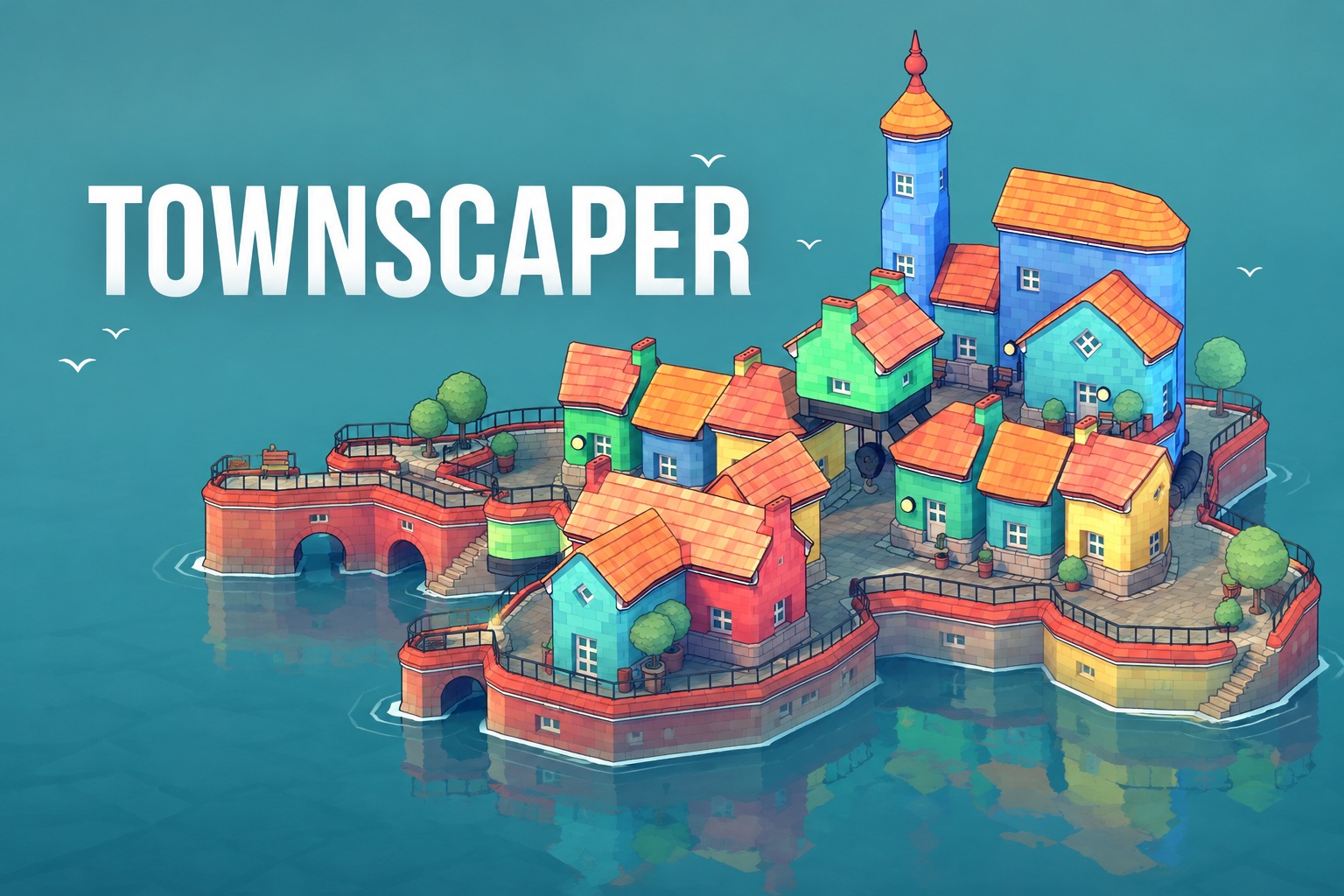
Townscaper is a wonderfully relaxing building experience that removes almost everything normally associated with city-building games and leaves only the pleasure of creating something beautiful. Designed by Oskar Stålberg, the game places players above an endless stretch of water covered by an unusual procedural grid, then allows colourful buildings to be added with a simple click. There are no citizens demanding services, no budgets to balance, no objectives to complete, and no possibility of losing. The entire experience revolves around experimentation, creativity, and watching a collection of simple blocks gradually become a charming seaside settlement.
What makes Townscaper special is the procedural system working underneath every placement. Players do not manually choose individual windows, rooftops, staircases, arches, fences, or balconies; instead, the game studies how neighbouring blocks are arranged and automatically creates architectural details that fit the structure. Place several blocks beside one another and they may become a row of waterfront houses, stack them vertically and towers begin forming, or surround an empty space and the game may transform it into a courtyard. Every click feels simple, yet the resulting towns can become remarkably detailed.
Now playable online through Lemon Web Games, Townscaper brings its colourful architecture, procedural building system, irregular grid, peaceful seaside setting, and completely open-ended creativity directly into the web browser. Players can construct tiny fishing villages, sprawling waterfront neighbourhoods, towering cities, bridges, courtyards, islands, canals, and unusual architectural experiments without worrying about resources or objectives. Buildings can be added and removed instantly, allowing ideas to evolve naturally instead of requiring careful planning before construction begins. Whether spending five minutes creating a small cluster of houses or gradually developing an enormous floating town, Townscaper makes building feel effortless.
Townscaper Is More Toy Than Traditional Game
Townscaper deliberately avoids many systems normally associated with city builders. There are no residents, traffic networks, electricity requirements, taxes, disasters, production chains, or economic simulations. Nothing needs to be optimized.
Instead, it behaves more like a digital construction toy. Players place blocks because they want to see what happens, remove them when the result feels wrong, and continue experimenting until the town takes on an appealing shape.
This simplicity makes Townscaper accessible to almost anyone. No tutorial about complicated mechanics is necessary because the central interaction can be understood within seconds. Click to build, remove pieces to reshape the town, and keep experimenting.
Every Building Begins With a Single Click
Construction starts by selecting a colour and placing a block somewhere on the grid. That first piece may eventually become part of a house, tower, bridge, street, or much larger structure.
Adding neighbouring blocks causes the architecture to change automatically. Windows move, rooftops reshape themselves, walls connect, and small decorative details appear according to the surrounding geometry.
The result makes every click feel slightly unpredictable. Players know where the new block will appear, but the exact architectural transformation is often a pleasant surprise.
The Procedural Architecture Does the Detailed Work
Townscaper's most impressive feature is its procedural building system. Instead of requiring players to design individual walls and decorations, the game generates appropriate details automatically from the arrangement of blocks.
A building beside the water may develop supporting structures, while buildings stacked vertically can produce different rooftops and façades. Narrow gaps may become alleys, while connected structures can form arches or enclosed spaces.
This allows complex-looking towns to emerge from extremely simple actions. The player concentrates on overall shape and colour while the game handles much of the fine architectural detail.
The Irregular Grid Makes Towns Feel Natural
Many building games rely on perfectly square grids, producing cities dominated by straight streets and predictable rectangular buildings. Townscaper uses a more irregular underlying grid that contains curves and unusual intersections.
This creates towns that feel much more organic. Streets can bend naturally, rows of houses can follow curved waterfronts, and larger districts develop shapes that would be difficult to produce on a conventional square grid.
Even symmetrical ideas often gain small imperfections. Those irregularities give Townscaper much of its visual charm and prevent settlements from looking overly mechanical.
Colour Is One of the Most Important Creative Tools
Players can choose from a palette of soft colours before placing buildings. These colours can be mixed throughout the same structure, allowing individual houses, neighbourhoods, or entire districts to develop their own identity.
A town using only a few related shades can feel calm and coordinated, while a settlement filled with contrasting colours becomes much more playful. The architecture itself may remain similar, yet colour completely changes the mood.
Because changing colours is so easy, experimentation feels natural. Players can create carefully planned patterns or simply choose whatever colour feels right for the next building.
Small Villages Can Be Just as Beautiful as Huge Cities
Townscaper does not reward players for building as large as possible. A handful of carefully positioned houses on a tiny island can look just as appealing as an enormous settlement.
Small villages often make individual architectural details easier to appreciate. A staircase leading toward the water or a narrow alley between two buildings can become the centre of the entire creation.
This freedom removes the usual pressure to constantly expand. The town is finished whenever the player decides it looks complete.
Vertical Construction Creates Dramatic Towers
Buildings can be stacked upward to create tall structures, transforming low waterfront houses into towers and dense urban formations. The procedural system adjusts windows, walls, and roofs as the height increases.
Combining tall and short structures creates particularly interesting skylines. A central tower can dominate a small village, while groups of high buildings can make the settlement feel like a compact city.
Vertical building is also useful when space becomes limited. Instead of expanding endlessly across the water, players can concentrate development upward.
Courtyards Appear Naturally From Building Shapes
One of Townscaper's most satisfying surprises occurs when structures surround an open space. The game can interpret the arrangement as a courtyard and generate details appropriate to the enclosed area.
This encourages players to experiment with loops and connected building formations rather than simply creating straight rows of houses. A few additional blocks can completely change how an interior space is interpreted.
Courtyards also make larger settlements feel more believable. They introduce quiet internal spaces among otherwise dense architecture.
Arches Connect Separate Areas Beautifully
Certain building arrangements can create arches, allowing structures to connect while leaving passages underneath. These features are especially effective when used above streets or narrow waterways.
Arches provide visual variety and make the town appear more deliberately constructed. They also demonstrate how much information the procedural system can infer from relatively simple block placements.
Experimenting with gaps and elevated connections often produces some of the most impressive results. The game rewards curiosity without requiring players to understand hidden construction rules beforehand.
Bridges Can Link Islands and Districts
Players can stretch constructions across water to connect separate sections of town. Depending on the arrangement, these connections may become bridge-like structures or elevated passages.
This allows larger settlements to be divided into distinct islands while still feeling connected. One area might contain small houses while another becomes a dense tower district.
Bridges also create attractive spaces beneath the town. Water remains visible through openings, making the settlement feel integrated with its seaside environment.
Removing Blocks Is Part of the Creative Process
Townscaper makes demolition just as easy as construction. Individual pieces can be removed instantly, causing surrounding architecture to recalculate itself.
This means mistakes are never permanent. Players can experiment aggressively because an unsuccessful idea can be reversed immediately.
Removing one block can sometimes produce a more interesting result than adding another. Openings appear, rooftops change, and neighbouring structures may suddenly develop completely different shapes.
The Town Constantly Rebuilds Itself Around Your Choices
Every modification influences nearby structures. Add one block and surrounding walls may change; remove another and an enclosed courtyard can become an open street.
This responsive behaviour makes Townscaper feel almost alive. Players are not simply stacking identical cubes because every arrangement produces architectural consequences.
The constant transformation also encourages experimentation. Even experienced players can discover unexpected structures by trying unusual shapes.
There Is No Wrong Way to Build
Because Townscaper has no objectives or scoring system, there is no officially correct city layout. A town cannot become bankrupt or fail because buildings were placed inefficiently.
This removes much of the anxiety found in traditional management games. Players are free to create structures that would make no practical sense if they happen to look interesting.
A floating collection of towers can be just as valid as a carefully organized coastal village. Visual imagination is the only real rule.
The Lack of Resources Makes Creativity Immediate
Most building games require players to gather money, materials, workers, or land before construction can begin. Townscaper removes those limitations entirely.
Every available building piece can be placed immediately. There is no need to wait for resources or complete earlier objectives before experimenting with a new idea.
This makes creativity feel continuous. Players spend their time building rather than preparing for permission to build.
There Are No Citizens to Keep Happy
Townscaper's houses suggest a living community, but there are no simulated residents inside them. Nobody complains about roads, employment, food, noise, or public services.
That absence changes the entire mood. The town exists as architecture rather than as a management problem.
Players can therefore focus entirely on visual composition. A building can be placed because it improves the skyline, not because a population statistic demands another home.
The Seaside Setting Makes Every Town Feel Peaceful
The endless water surrounding the grid gives Townscaper a calm atmosphere from the beginning. Buildings appear to rise directly from the sea, creating something between a coastal European village and a floating fantasy settlement.
Reflections and open water give even dense cities room to breathe. Leaving empty spaces between districts can be just as visually effective as filling every available location.
The water also provides a consistent background for the colourful architecture. No matter how unusual the construction becomes, the seaside setting keeps everything visually connected.
Sound Makes Building Surprisingly Satisfying
Each placement and removal is accompanied by gentle sounds that give construction a tactile quality. Adding a building feels almost like snapping a physical toy piece into place.
The audio remains deliberately subtle, supporting the calm atmosphere rather than demanding attention. Townscaper rarely needs dramatic music or loud effects because the act of building is meant to feel relaxing.
These small sounds become surprisingly important during longer sessions. They create a comfortable rhythm as the settlement grows one click at a time.
Townscaper Is Excellent for Experimenting With Architecture
Although it is not a professional architectural tool, Townscaper encourages players to think about shape, proportion, colour, height, and negative space.
A building can feel completely different depending on the structures surrounding it. Taller towers create visual landmarks, while open spaces prevent dense areas from becoming visually overwhelming.
Players naturally begin considering composition without being forced to study architectural rules. Creativity develops through experimentation.
Negative Space Matters as Much as Buildings
One of the easiest mistakes is assuming that every empty area should eventually contain something. Townscaper often looks better when water, courtyards, alleys, and openings remain between structures.
Empty spaces help define the shape of the buildings surrounding them. A narrow channel through a dense district can become more visually interesting than another row of houses.
This means removing buildings can be just as creative as adding them. The relationship between structure and open space becomes part of the design.
Different Building Heights Create Better Skylines
Large towns can look flat if every structure remains approximately the same height. Mixing low houses with medium buildings and tall towers creates stronger visual variety.
A few carefully positioned tall structures can act as landmarks visible from across the town. Shorter neighbourhoods around them make those towers appear even more dramatic.
Townscaper makes this experimentation easy because vertical changes require only a few additional clicks. Skylines can be reshaped continuously as the town develops.
The Camera Encourages Admiring Your Creation
Players can rotate and adjust the view to inspect towns from different angles. A structure that looks ordinary from above may reveal an interesting archway or waterfront arrangement when viewed from the side.
Changing perspective is also useful during construction. Certain gaps and connections are easier to understand from particular angles.
The camera therefore becomes part of the creative process. Players frequently alternate between building and simply looking at what they have created.
Townscaper Works Perfectly for Short Creative Sessions
There is no requirement to commit to a lengthy campaign. A player can spend a few minutes building a tiny island settlement and still have a complete experience.
Longer sessions are equally natural because one idea often leads into another. A small group of houses becomes a neighbourhood, the neighbourhood gains a tower, and eventually an entire city has appeared.
This flexibility makes Townscaper particularly comfortable for browser play. Creativity can begin immediately without preparation.
Large Towns Emerge Organically
Many players begin without a detailed plan. A few blocks are placed simply to see what happens, then the architecture gradually suggests what should come next.
One waterfront row may inspire another district. A courtyard can become the centre of a larger building complex. A tower may encourage additional vertical development nearby.
This organic process is one of Townscaper's greatest strengths. The game does not require players to know what they are building before they begin.
Playing Townscaper Online Today
Through Lemon Web Games, Townscaper can now be played directly in your web browser with no downloads or setup required. Features of the web-based version include:
New players should avoid trying to design an enormous city immediately. Begin with a few buildings, experiment with different heights and colours, then observe how the procedural architecture responds before expanding. Some of the most attractive towns grow naturally from a small initial idea rather than from a rigid plan.
It is also worth leaving open spaces. Water channels, small courtyards, gaps between buildings, and uneven heights can make a settlement far more interesting than covering every available area with identical structures.
Who Should Play Townscaper
Townscaper is particularly suitable for players who like the creative side of city-building games but do not necessarily enjoy managing budgets, traffic, resources, or population statistics. It provides the pleasure of watching a town grow without the administrative pressure normally attached to that growth.
It is equally enjoyable for players who simply want something peaceful. There is nothing chasing the player, nothing that can destroy the town, and no deadline demanding that construction happen faster. The experience moves entirely at the player's preferred pace.
Play Townscaper Online Now
Townscaper begins with water, an empty grid, and a palette of colours. From there, every click can become part of a house, tower, courtyard, bridge, waterfront district, or enormous floating city. The procedural architecture handles much of the detail automatically, leaving players free to concentrate on shapes, colours, and whatever looks beautiful.
Through Lemon Web Games, Townscaper can be enjoyed directly in the browser as a calm creative space where there is no wrong solution and no possibility of failure. Build something tiny, construct something enormous, remove half of it, change the colours, or simply rotate the camera and enjoy the town that gradually appeared.
Final Thoughts
Townscaper succeeds because it understands that building can be enjoyable even without traditional game objectives. There is no financial system telling players what they can afford, no population demanding additional services, and no score judging whether the settlement is efficient. The reward is simply watching an idea become architecture.
Its procedural system does much of the difficult work while still making every creation feel personal. Players choose the shapes, heights, colours, and overall layout, while Townscaper transforms those decisions into rooftops, arches, stairways, courtyards, and other charming details. The result is a tool that is remarkably easy to use without making every town look the same.
Through Lemon Web Games, Townscaper can now be enjoyed directly in the browser as one of the most peaceful creative experiences available. Whether building a tiny seaside village or an enormous collection of towers rising from the water, the game never asks whether the design is efficient or practical. It only asks the question that matters most: does the town you created make you want to keep looking at it?











Comments 0