

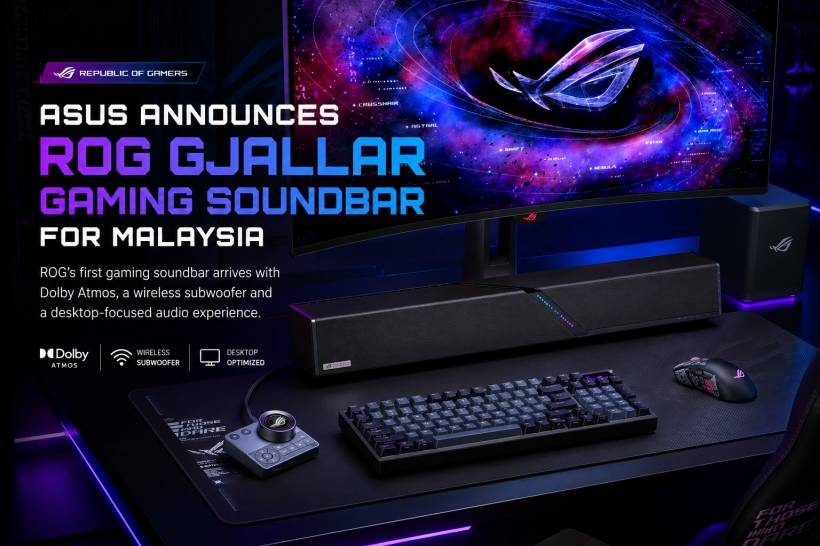
ASUS is expanding its Republic of Gamers ecosystem in Malaysia with the introduction of the ROG Gjallar, the company's first dedicated gaming soundbar. Announced alongside the ROG Raikiri II Pro controller, the Gjallar is designed to complete a more unified desktop gaming setup by bringing audio, communication, lighting and device control into a single product. Rather than positioning it as a conventional soundbar for movies and music, ASUS is clearly targeting gamers who want immersive sound without filling their desk with multiple speakers.
A 2.1.2-Channel System Built for Gaming
At the centre of the ROG Gjallar is a 2.1.2-channel speaker configuration with support for Dolby Atmos.
The soundbar combines left and right full-range drivers, dedicated tweeters and upward-firing channels to produce a wider, more three-dimensional soundstage. The upward-firing speakers are especially important for Dolby Atmos content, as they help create the impression that certain sounds are coming from above the listener.
For gaming, this type of spatial audio can offer more than just cinematic immersion. Directional details such as footsteps, gunfire, vehicles and environmental effects may become easier to identify, particularly in games that make effective use of surround and positional audio.
ASUS is promoting the soundbar as a competition-ready audio solution, although the actual advantage will depend on several factors, including the game's audio design, the room layout and the player's listening position.
Wireless Subwoofer Adds More Impact
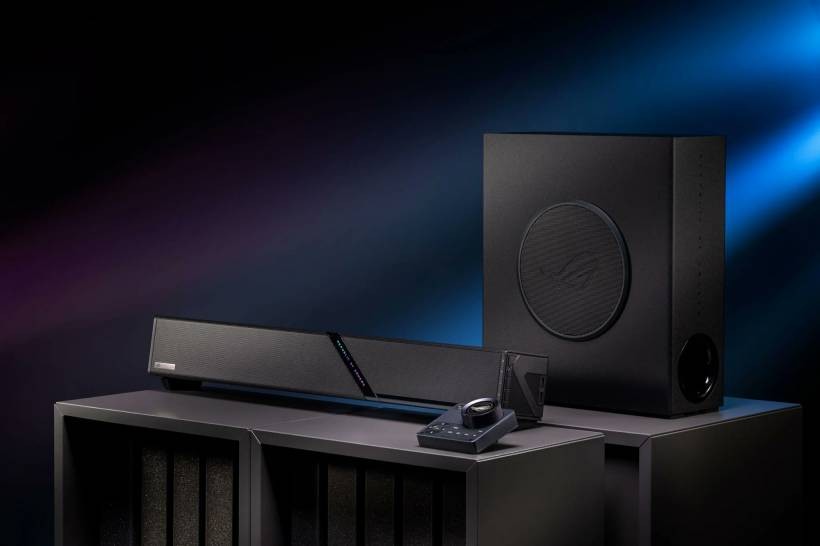
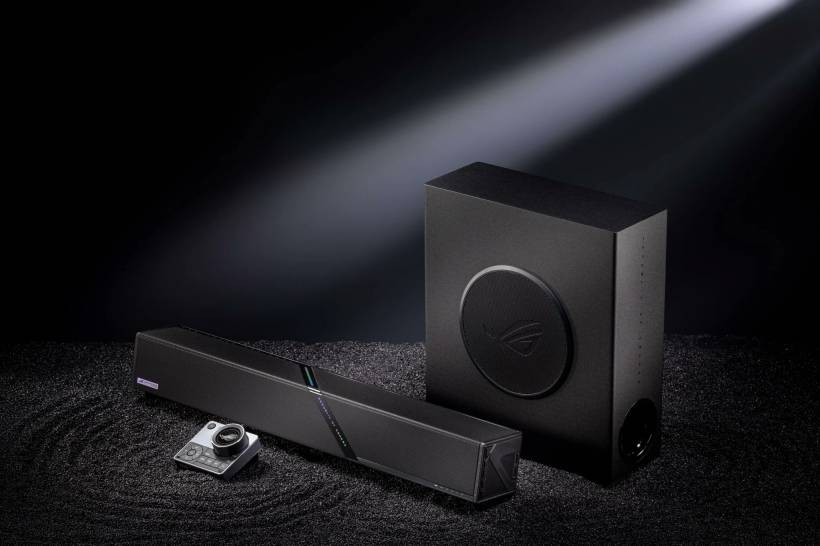
The Gjallar is paired with a slim wireless subwoofer featuring a 6.5-inch driver and 65 watts of output.
Its role is to handle the lower frequencies that smaller soundbar drivers typically struggle to reproduce. Explosions, engine sounds, cinematic sequences and music should feel fuller and more powerful when the subwoofer is properly positioned.
ASUS uses a 5GHz wireless connection between the soundbar and subwoofer. Compared with more congested wireless bands, this should help provide a stable, low-latency connection while reducing the need for an additional audio cable across the desk.
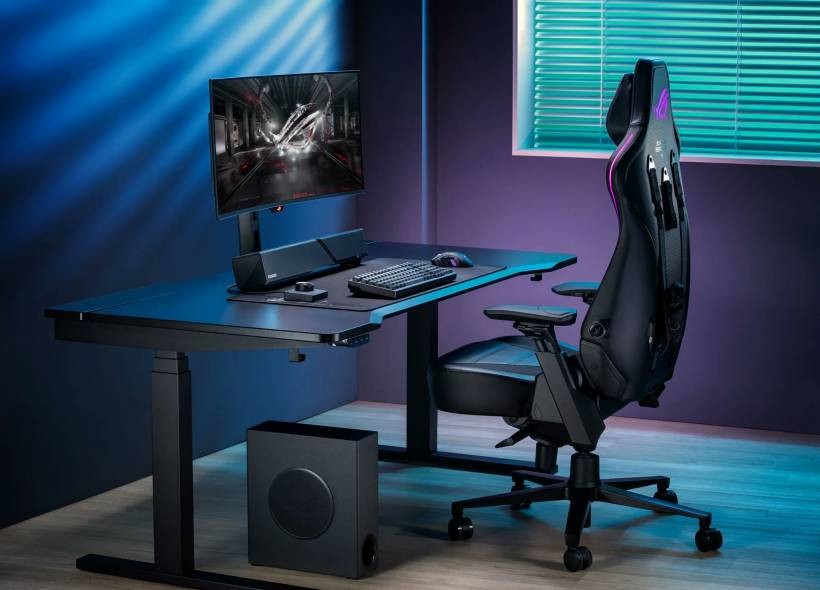
The subwoofer's slimmer design may also make it easier to place under or beside a desk, which is useful for users working with limited space.
Extensive Wired Connectivity
ASUS has equipped the ROG Gjallar with several physical connection options, allowing it to work with PCs, monitors, televisions and gaming consoles.
Available inputs include USB-C, HDMI 2.1 with eARC, optical audio and a standard AUX connection. This gives users several ways to integrate the soundbar into an existing setup without relying entirely on wireless audio.
The HDMI 2.1 connection also supports 4K resolution at 120Hz pass-through. This is an important addition for users with current-generation consoles or gaming PCs connected to high-refresh-rate displays.
With pass-through support, the soundbar can sit between the gaming device and display while still allowing high-resolution, high-frame-rate video signals to reach the screen. This helps avoid compromising visual performance simply to route audio through the soundbar.
Extra USB Ports for Accessories
Two USB-A ports are located on the right side of the soundbar.
These can be used for accessories such as wireless receiver dongles or external storage devices, depending on compatibility. While USB ports may appear to be a minor addition, they could be particularly useful for desktop users who are already running short of available ports on their PC.
The soundbar may therefore serve as a small connectivity hub as well as an audio device, reducing the number of cables that need to run directly to the computer.
Bluetooth Support for Everyday Devices
For wireless audio, the ROG Gjallar includes Bluetooth 5.3.
This allows it to connect with devices such as smartphones, tablets and laptops without requiring a physical cable. Bluetooth support also makes the soundbar more practical outside gaming, as users can quickly switch to music, videos or other audio sources.
The separate 5GHz wireless system is reserved for communication between the soundbar and its included subwoofer. It is not presented as an alternative wireless connection method for PCs or mobile devices.
A Built-In Microphone for Voice Communication
One of the more unusual features is the integrated beamforming microphone.
Instead of requiring a separate desktop microphone, the Gjallar can capture the user's voice directly from the soundbar. Its microphone operates across a frequency range of 100Hz to 10kHz, which should be sufficient for voice chat, online meetings and team communication.
Beamforming technology is intended to focus on sound coming from the user's direction while reducing unwanted noise from other areas. Its effectiveness will still depend on the environment, especially if the soundbar is positioned far away or used in a noisy room.
For gamers who prefer speakers instead of a headset, however, having a microphone built directly into the soundbar could simplify the overall setup.
Dedicated Control Hub and Gear Link Support
The ROG Gjallar also includes a multifunction audio control hub.
This separate controller allows users to adjust playback, equaliser settings and RGB lighting without relying entirely on software. Physical controls can be more convenient during gaming because users do not need to leave a game or open another application just to make a quick volume or audio adjustment.
Additional controls are available through ASUS Gear Link, which provides software-based management of the soundbar's settings. This is expected to include audio profiles, equaliser adjustments, lighting controls and other device-specific options.
The combination of hardware and software controls gives users more flexibility, especially those who regularly switch between games, music and movies.
Designed as Part of the Wider ROG Ecosystem
The launch of the Gjallar shows that ASUS wants the ROG brand to cover more parts of the gaming desk.
ROG already offers monitors, keyboards, mice, headsets, microphones, controllers and other accessories. A dedicated soundbar fills a noticeable gap for gamers who prefer open speakers over headphones.
The integrated RGB lighting and Gear Link support also make it easier to pair the soundbar visually and functionally with other compatible ROG products.
However, the Gjallar's value will likely depend heavily on its Malaysian pricing. Gaming soundbars compete not only with other soundbars but also with desktop speaker systems, premium headsets and compact home-theatre products.
Final Thoughts
The ASUS ROG Gjallar appears to be more than a standard soundbar carrying a gaming badge.
Its Dolby Atmos support, 2.1.2-channel configuration, wireless subwoofer, 4K 120Hz HDMI pass-through and built-in beamforming microphone make it a versatile option for users who want immersive audio without wearing a headset.
The inclusion of extra USB ports and a dedicated control hub also shows that ASUS has considered the practical needs of a modern gaming desk.
Its ultimate appeal in Malaysia will depend on the retail price and how well the spatial audio performs in real-world setups. Nevertheless, the Gjallar gives ROG users another way to build a more complete and coordinated gaming environment.











Comments 0